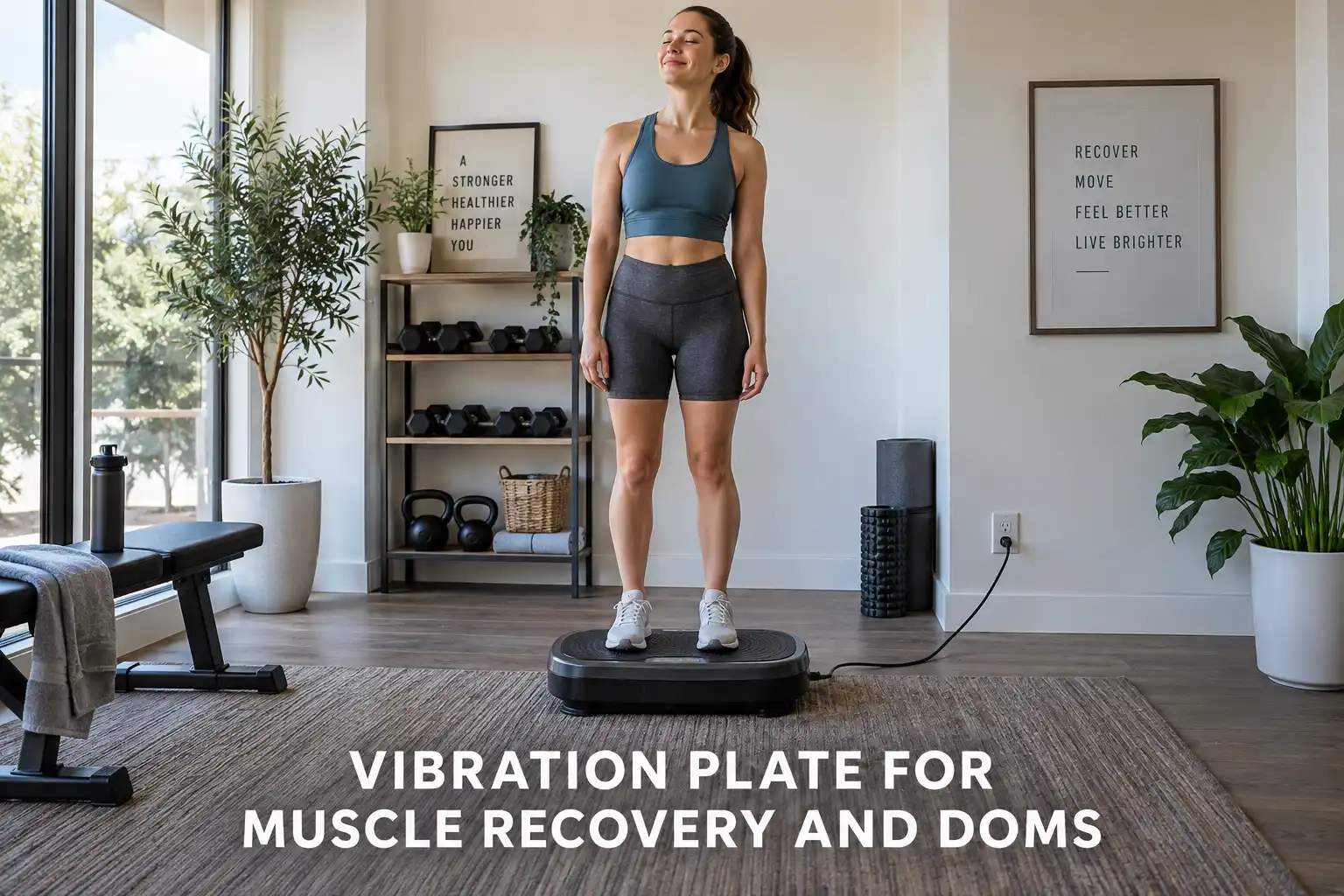
A vibration plate may help reduce delayed-onset muscle soreness after a demanding or unfamiliar workout. Research also suggests possible improvements in some indirect markers of exercise-induced muscle damage, including creatine kinase, particularly during the first 24 to 48 hours after exercise.

About the author: Hello! I’m Vladimir Stanar, professor of physical education, kinesiotherapist, marathon runner, cyclist, and cycling coach, and long-time advocate of health, fitness, and active living.
My journey with vibration plates runs parallel to my professional career in education, sports medicine, and athletic development. I’ve developed a unique process for testing vibration plates as they are some of the most versatile tools for enhancing health, recovery, and performance.
✅ Expert-Reviewed by: Vanja Vukas, MPhEd
📚 Expert Contributor: Milutin Tucakov, MPhEd
The important distinction is that feeling less sore does not necessarily mean your muscles have completely recovered. Some studies have found less soreness after whole-body vibration without faster restoration of muscle strength, so I would treat a vibration plate as one recovery tool rather than a shortcut around normal recovery.
Among the many claimed benefits of vibration plates, DOMS is actually one of the areas with a reasonably credible research base. The evidence is not perfect, but we have randomized trials and meta-analyses rather than relying entirely on theories about circulation or manufacturer claims.
Can a Vibration Plate Help With Muscle Recovery?
A vibration plate appears most useful for reducing some of the symptoms associated with exercise-induced muscle damage, particularly soreness and stiffness. Several studies have also reported lower levels of creatine kinase after vibration treatment.
That is slightly different from saying the plate "repairs muscles faster." Recovery includes the restoration of strength, normal movement, energy stores, tissue function, and readiness for another demanding training session.
I would therefore make a distinction between recovery symptoms and complete functional recovery. Vibration appears more convincing for the first category than the second.
What Is DOMS?
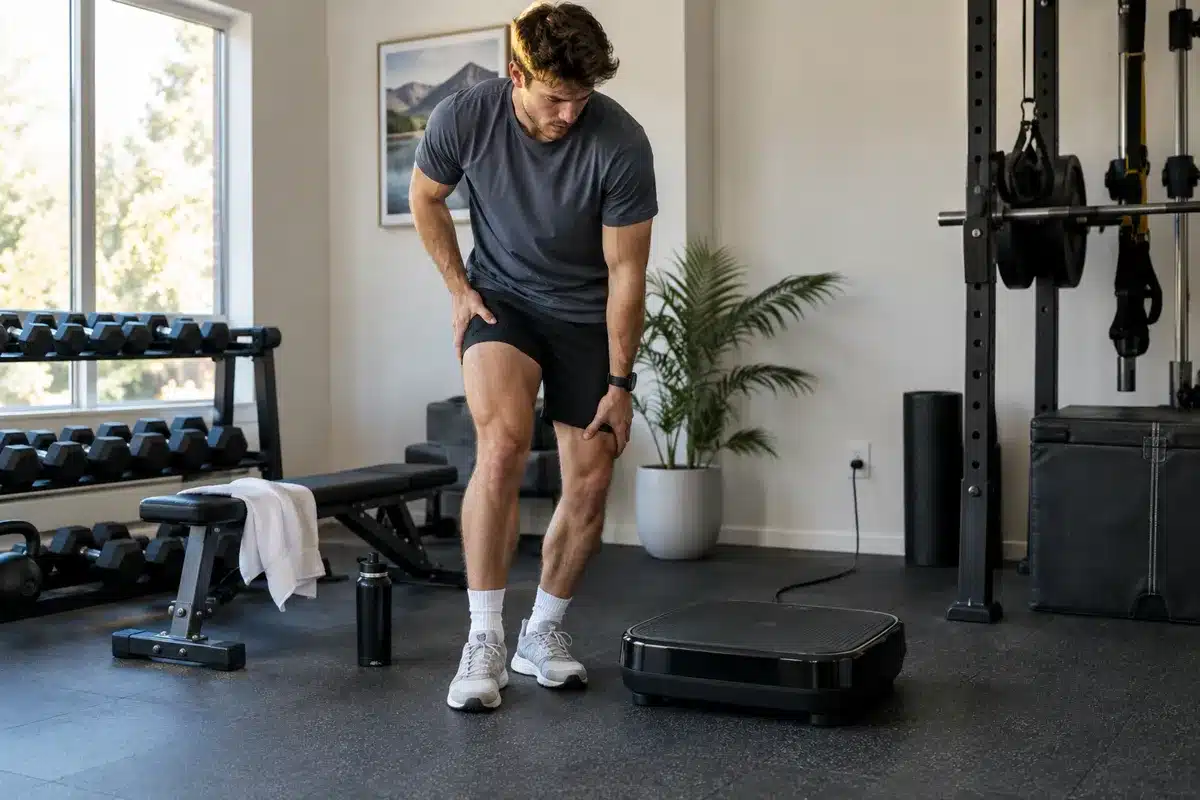
Delayed-onset muscle soreness, usually shortened to DOMS, is the soreness and stiffness that appears after unfamiliar or particularly demanding exercise.
It is especially common after eccentric exercise, where a muscle produces force while lengthening. Lowering a weight slowly, walking downhill, descending stairs, and controlling the downward portion of a squat all contain significant eccentric loading.
DOMS does not normally appear immediately after training. It commonly becomes noticeable later and may be most obvious around 24 to 72 hours after the workout.
Along with soreness, you may temporarily notice:
- Muscle stiffness
- Tenderness
- Reduced range of motion
- Lower force production
- A heavy or fatigued feeling
- Discomfort when stretching or contracting the muscle
These symptoms usually improve as the muscle adapts and recovers.
DOMS Is Not Simply Lactic Acid
The idea that soreness two days after exercise is caused by lactic acid trapped inside the muscles is outdated.
Lactate concentrations rise during demanding exercise but fall much sooner than DOMS normally reaches its peak. That timing alone makes accumulated lactate a poor explanation for soreness appearing one or two days later.
Current explanations involve a much more complicated response to unfamiliar or strenuous loading, including mechanical stress, changes involving muscle and connective tissue, and sensitization of pain receptors.
A vibration plate therefore does not need to "flush out lactic acid" in order to potentially make sore muscles feel better.
What Does Research Say About Vibration and DOMS?
This is where the evidence becomes more encouraging.
A systematic review and meta-analysis examining ten studies and 258 participants found that vibration significantly reduced reported muscle soreness at 24, 48, and 72 hours after exercise. Creatine kinase was also lower at 24 and 48 hours, although the difference was no longer significant at 72 hours.
A later meta-analysis reached a similar conclusion. Vibration training reduced subjective pain, increased pain tolerance, and improved some biochemical markers associated with exercise-induced muscle damage.
That does not make the evidence definitive. Vibration studies use different machines, frequencies, amplitudes, session lengths, positions, exercise protocols, and participant populations.
Some studies also involve localized vibration rather than whole-body vibration plates. Those interventions should not automatically be treated as identical.
Still, taken together, I think the research is strong enough to say that vibration is a credible option for reducing DOMS symptoms.
Can a Vibration Plate Help Before Exercise?
Interestingly, vibration may be useful before the muscle-damaging workout occurs.
A systematic review of six randomized trials involving 180 participants found that acute vibration performed before strenuous eccentric exercise reduced subsequent soreness at 24 and 48 hours. Some indirect markers of muscle damage also improved.
One frequently cited trial used a vibration platform for only 60 seconds before eccentric quadriceps exercise. Participants who received vibration subsequently experienced less soreness, lower creatine kinase, and smaller strength losses than the control group.
That suggests vibration may have a role as part of a warm-up.
I would not interpret this as evidence that everyone should copy the exact frequency, amplitude, and squat angle used in one study. A research protocol performed under controlled conditions is not automatically the ideal setting for every consumer vibration plate.
Can a Vibration Plate Help After Exercise?
There is direct evidence for post-workout vibration as well.
In one randomized study, participants completed demanding eccentric quadriceps exercise and then received three one-minute bouts of whole-body vibration. Muscle soreness and creatine kinase were lower afterward compared with the control group.
The key result was what didn't improve.
Peak isometric muscle strength did not recover faster in the vibration group.
That makes this study particularly useful because it shows why muscle soreness should not be used as the only measure of recovery. Someone can feel better while the muscle's force-producing capacity is still recovering.
Another trial involving elite hockey players found that stretching combined with whole-body vibration reduced soreness and quadriceps tightness more than stretching alone.
Overall, post-workout vibration looks reasonable as a recovery strategy, but I would use it gently rather than turning the recovery session into another demanding workout.
Does Less Soreness Mean Faster Muscle Recovery?
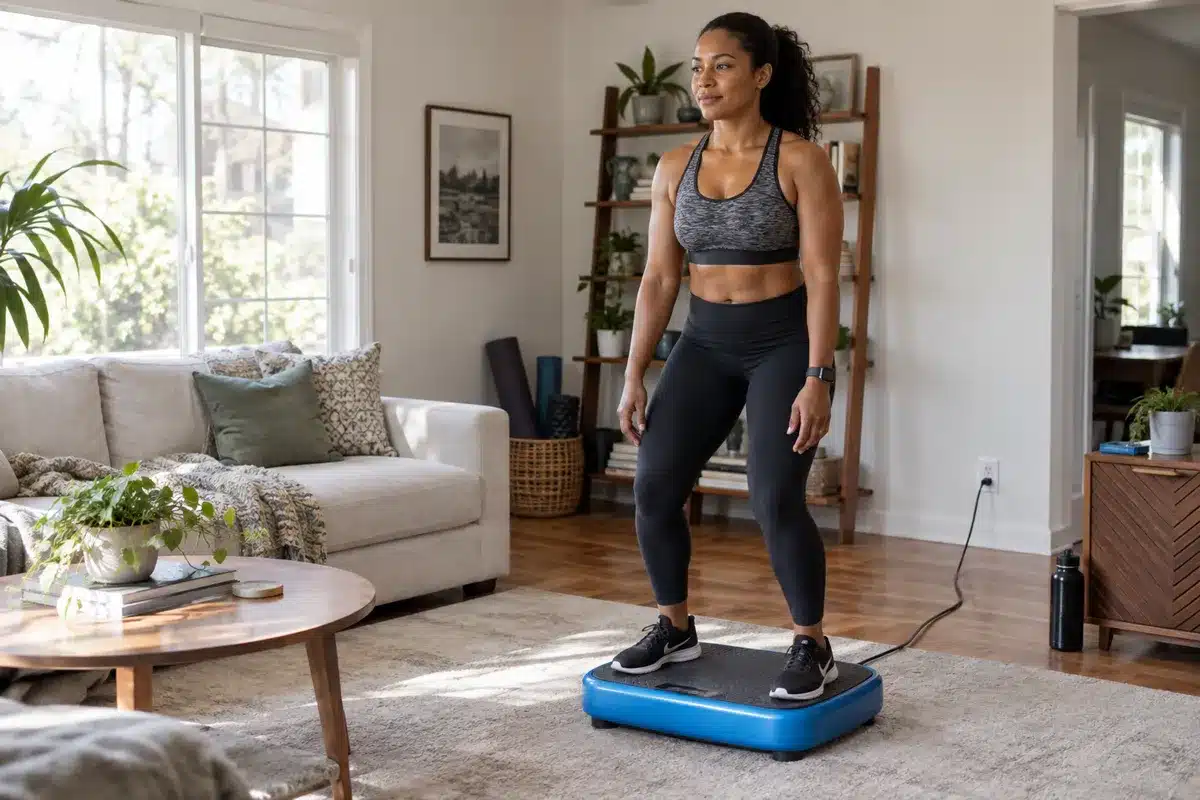
Not necessarily. This is probably the most important thing to understand when using a vibration plate for DOMS.
Soreness is subjective. Strength, power, coordination, muscle damage, fatigue, and readiness to train are related to soreness but do not necessarily recover at exactly the same rate.
The research provides a good example. Post-exercise whole-body vibration has reduced soreness and creatine kinase without significantly improving the restoration of muscle strength.
I would therefore not use reduced soreness as automatic permission to repeat a heavy workout.
If my legs feel much better after using a vibration plate but my squat feels weak, coordination is poor, or the muscles still feel deeply fatigued, I would give them more recovery time.
Does a Vibration Plate Reduce Creatine Kinase?
Several studies have reported lower creatine kinase after vibration.
Creatine kinase, or CK, is an enzyme commonly measured in exercise research as an indirect marker of muscle damage. CK can rise after strenuous or unfamiliar exercise, particularly exercise involving substantial eccentric loading.
Meta-analysis results suggest vibration may reduce CK during the first 24 to 48 hours after exercise.
I would not overinterpret that result, though. CK responses vary tremendously between people, and lower CK does not prove that every aspect of muscle recovery has accelerated.
For a normal home user, CK is mostly useful for understanding the research. It is not something you need to measure after every leg workout.
How Might Vibration Reduce Muscle Soreness?
There probably is not one single mechanism.
Increased Blood Flow
Whole-body vibration can increase peripheral blood flow under some conditions.
Improved circulation may contribute to changes in tissue temperature, oxygen delivery, and the local environment around exercised muscles. That is biologically plausible, although increased circulation by itself does not prove faster muscle repair.
If circulation improvement is a priority, my guide on the best vibration plate for circulation covers models with useful features for vascular health.
Changes in Pain Perception
Vibration provides strong sensory stimulation through muscles, joints, skin, and nerves.
That sensory input may influence how soreness is perceived. Reduced soreness therefore may partly reflect altered pain processing rather than a dramatic change in the underlying muscle tissue.
Neuromuscular Activation
The moving platform causes repeated muscle contractions and postural adjustments.
Used before exercise, this may act as a neuromuscular warm-up and prepare muscles for subsequent loading.
Gentle Movement Without Heavy Loading
Low-intensity vibration can make the muscles contract without requiring another heavy resistance session.
For me, this may be one of the most practical explanations for using a plate on a recovery day. It provides some movement and muscle activity without another hard workout.
If weight management is part of your broader fitness goal alongside recovery, my guide on the best vibration plate for weight loss covers models suited to both training and recovery sessions.
Does a Vibration Plate Flush Out Lactic Acid?
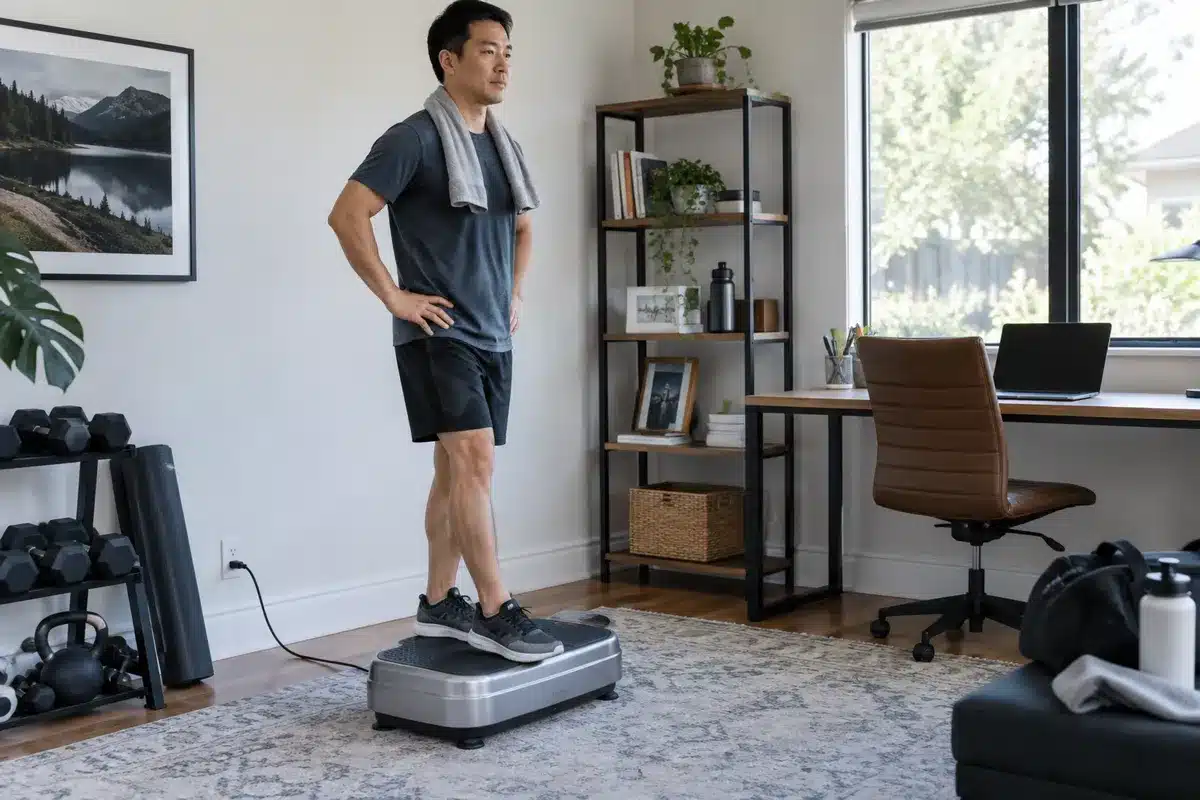
I would not use that explanation. Lactate produced during exercise does not simply remain trapped inside your muscles for two or three days causing DOMS. Blood and muscle lactate return toward normal much earlier than delayed soreness peaks.
A vibration plate may influence circulation and make muscles feel less stiff, but saying it "flushes lactic acid" and therefore removes DOMS oversimplifies both lactate metabolism and muscle soreness.
You may feel better after the session. That benefit does not require the lactic-acid explanation to be true.
Vibration Plate vs Massage, Stretching, and Active Recovery
Vibration is not clearly superior to every other recovery strategy.
Research comparing vibration with massage has found benefits from both approaches. Other studies have found vibration no better than stretching, massage, or light exercise for particular recovery outcomes.
This does not make vibration useless. It means we have several reasonable ways to manage post-workout soreness.
I see the main advantage of a vibration plate as convenience. If you already own one, you have a recovery tool sitting at home that can be used for a few minutes without booking a massage, preparing a cold bath, or leaving the house.
If you are still shopping, my picks for the best vibration plate for home use cover models across different footprint sizes and price points.
Walking, light cycling, mobility work, massage, and ordinary rest can still be useful. There is no need to turn muscle recovery into a competition between methods.
What Vibration Frequency Is Best for Muscle Recovery?
There is no scientifically established universal recovery frequency.
That may sound surprising because you'll often see very specific numbers online.
The problem is that studies reporting positive results have used very different protocols. Research has included low frequencies around 12 Hz as well as substantially higher frequencies around 30 to 35 Hz.
Amplitude varies as well. So do:
- Session duration
- Number of vibration bouts
- Knee position
- Vibration type
- Participant training level
- Timing relative to exercise
- Type of muscle-damaging workout
I would therefore ignore claims that one exact Hz setting is the scientifically proven "muscle recovery frequency."
If the objective is post-workout recovery, I would prioritize a comfortable setting that does not turn the session into additional strenuous exercise.
For a deeper look at what different Hz settings actually do, my guide on vibration plate frequencies breaks down the research on lower and higher frequency ranges.
Should You Use a Vibration Plate Before or After a Workout?
Research suggests both approaches may have value.
Before exercise, vibration can be incorporated into a warm-up. Some studies suggest this may reduce the severity of muscle soreness that develops afterward.
After exercise, vibration may reduce soreness and some muscle-damage markers during the following day or two.
There is not enough standardized research to say that one timing strategy is universally better.
Personally, I would use the plate differently depending on timing. Before exercise, I would use it to gradually activate the muscles before moving into a normal warm-up. After exercise, I would deliberately keep the session easier.
If you tend to train later in the day, my guide on using a vibration plate before bed covers how an evening session can fit into a recovery routine without disrupting sleep.
A Practical Vibration Plate Routine for Recovery
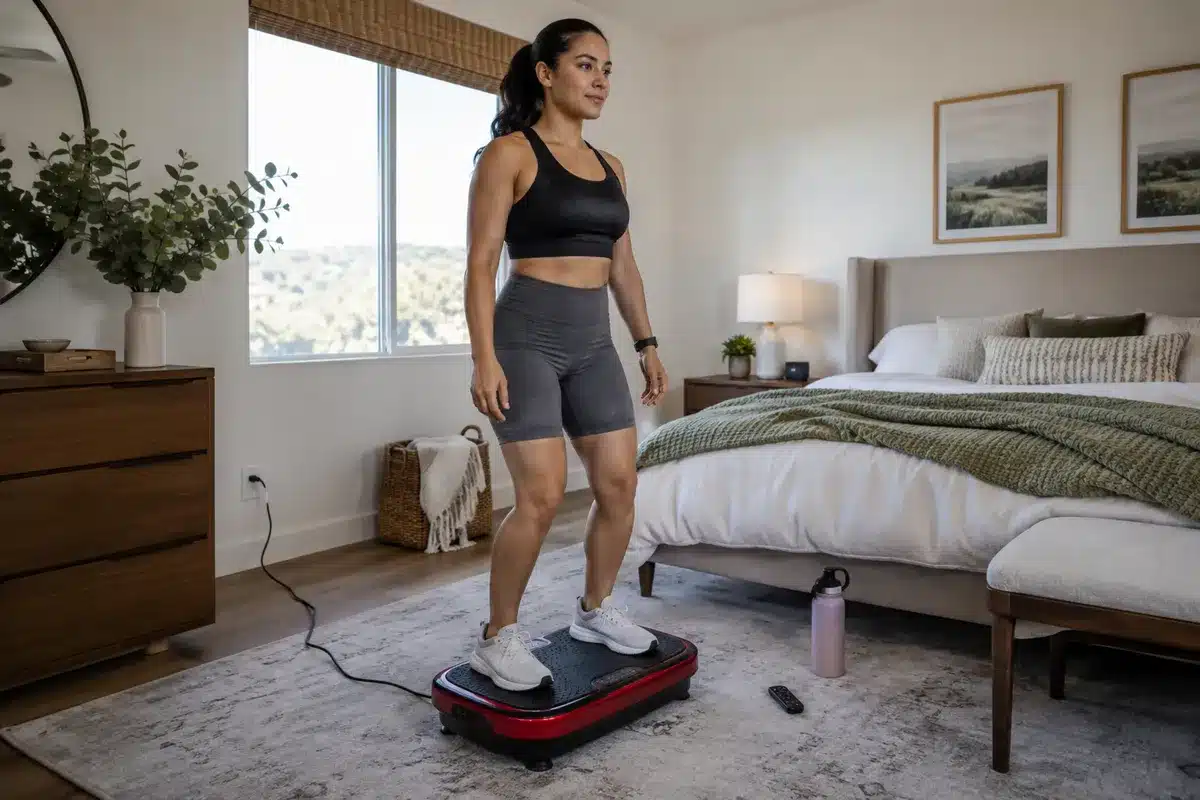
There is no universally validated consumer vibration-plate protocol for DOMS, so I would keep the routine simple.
Before Exercise
Start with a short low-to-moderate session.
You could include:
- Relaxed standing
- Gentle weight shifts
- Shallow squats
- Calf raises
Use the plate as the first part of the warm-up, not the entire warm-up. Continue with movement and exercise preparation specific to the workout you are about to perform.
Immediately After Exercise
This is not the time I would chase maximum intensity.
Use comfortable vibration with slightly bent knees and relaxed posture. Gentle weight shifting or easy standing is sufficient.
If your legs have already completed a difficult workout, another demanding set of deep vibration squats defeats the purpose of calling it recovery.
The Following Day
A short vibration session can provide light movement when the muscles are stiff.
Again, I would keep the goal clear: movement and comfort rather than creating another training stimulus.
If normal walking and mobility work feel good, they can be combined with or used instead of the plate.
For a structured list of positions and movements to include in a recovery session, I cover a range of vibration plate exercises suited to different intensity levels.
How Long Should You Use a Vibration Plate for Recovery?
Research protocols vary too much to identify one ideal duration.
Some positive studies used very short bouts of around one minute. That alone should make us skeptical of claims that a 20 or 30-minute recovery session is automatically better.
For normal home use, I would start with around 3 to 5 minutes at a comfortable setting.
If that feels good, the session can gradually increase toward roughly 5 to 10 minutes.
I would not extend a session merely because the muscles remain sore. More vibration is not necessarily more recovery.
For people managing bone density alongside muscle recovery, my guide on the best vibration plate for osteoporosis covers models that balance effective loading with safety.
Can You Use a Vibration Plate When Your Legs Are Already Sore?
With ordinary DOMS, gentle vibration may be reasonable if it feels comfortable.
I would use easy standing, small weight shifts, or other low-demand positions rather than aggressive squats and lunges.
Remember that vibration still creates muscular activity.
If soreness is severe enough that normal movement has changed substantially, I would be more conservative rather than trying to shake the soreness away.
For older adults managing DOMS alongside joint stiffness and mobility considerations, my picks for the best vibration plate for seniors focus on stability, low-intensity settings, and ease of use.
DOMS vs Muscle Injury
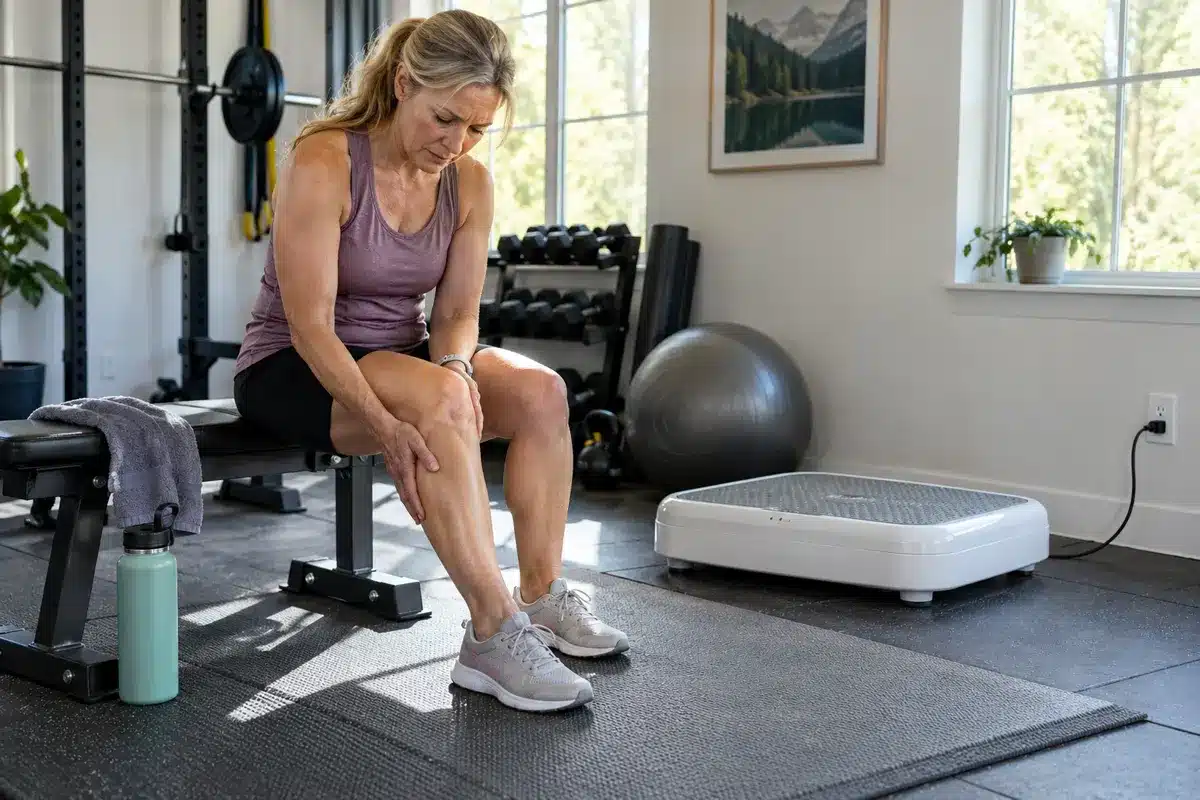
Not every pain that appears after exercise is ordinary DOMS. Typical DOMS tends to appear after demanding or unfamiliar exercise, affects the muscles that were trained, and gradually improves over several days.
I would be more cautious with:
- Sharp localized pain
- Sudden pain during the exercise
- Major swelling
- Significant bruising
- Inability to use the muscle normally
- Severe or worsening weakness
- Pain that continues getting worse instead of improving
Severe muscle pain combined with unusual weakness or dark tea- or cola-colored urine can be associated with rhabdomyolysis and warrants prompt medical attention.
A vibration plate is not the appropriate way to manage symptoms like those.
If you are managing joint pain or arthritis alongside post-exercise soreness, my picks for the best vibration plate for arthritis cover models suited to low-impact, joint-friendly recovery sessions.
Can a Vibration Plate Make Recovery Worse?
Potentially, if you use it like another workout.
Strong vibration combined with deep squats, long isometric holds, or extended sessions can increase muscular demand.
If the muscles are already fatigued, adding substantial loading can simply add more stress.
My rule would be simple:
A recovery session should feel easier than the workout you are recovering from.
If you step off the plate with your quadriceps burning and shaking from fatigue, you probably performed another training session rather than a recovery session.
For full guidance on session length, positions, and intensity levels for different goals, my guide on how to use a vibration plate covers the practical details for both training and recovery.
Common Muscle Recovery False Claims to Ignore
“Vibration Flushes Out Lactic Acid”
DOMS is not caused by lactic acid sitting in your muscles for several days.
“Ten Minutes Repairs Damaged Muscles”
There is no evidence that a fixed number of minutes on a vibration plate completely repairs exercise-induced muscle damage.
“Less Soreness Means Complete Recovery”
Reduced pain does not guarantee that strength, power, coordination, and muscle function are fully restored.
“Higher Frequency Means Faster Recovery”
No universal optimal recovery frequency has been established.
“Vibration Replaces Active Recovery”
Walking, light exercise, mobility work, sleep, nutrition, and sensible training management still matter.
“If the Soreness Is Gone, You Can Train Hard Again”
I would base the decision on overall recovery and performance, not soreness alone.
What I Would Realistically Expect
Reasonable Expectations
A vibration plate may:
- Reduce DOMS
- Make sore muscles feel less uncomfortable
- Reduce stiffness in some people
- Provide convenient light movement after exercise
- Reduce some indirect muscle-damage markers
- Work as part of a pre-workout warm-up
- Make a recovery day feel more active without requiring another full workout
Those are reasonable expectations based on the current research.
Claims I Would Not Make
I would not expect a vibration plate to:
- Instantly repair muscle fibers
- Completely prevent DOMS
- Guarantee faster strength recovery
- Remove all post-workout fatigue
- Flush out stored lactic acid
- Prevent exercise injuries
- Replace adequate sleep or nutrition
- Make heavily fatigued muscles ready for another maximum-effort workout
Those claims go beyond what the evidence shows.
My Take on Vibration Plates for Muscle Recovery and DOMS
I think muscle soreness and DOMS are among the more credible recovery-related reasons to use a vibration plate.
We have multiple controlled trials and meta-analyses showing reductions in post-exercise soreness, and some studies also report improvements in creatine kinase, stiffness, or pain tolerance. That is a much stronger foundation than many of the more speculative claims made about vibration plates.
The limitation is equally important.
Feeling less sore and being completely recovered are not the same thing.
I would use a vibration plate as a convenient addition to recovery, particularly for a short warm-up, gentle post-workout session, or light movement the following day. I would not use it to override fatigue or justify another difficult workout before strength and movement quality have recovered.
If you are deciding which model to get, I have a full breakdown of the best vibration plate options across different budgets and intended use cases.
FAQs
Does a vibration plate help sore muscles?
It may. Research suggests vibration can reduce muscle soreness after demanding exercise, particularly during the first 24 to 72 hours when DOMS is commonly most noticeable.
The effect does not necessarily mean muscle strength has fully recovered.
Can a vibration plate reduce DOMS?
Yes, there is reasonable evidence supporting this effect. Meta-analyses of randomized trials have reported lower DOMS pain after vibration interventions.
Study protocols vary considerably, so the size of the effect and ideal vibration protocol remain uncertain.
Should I use a vibration plate before or after exercise?
Both approaches have research support. Pre-exercise vibration may reduce subsequent DOMS, while post-exercise vibration may reduce soreness and some muscle-damage markers during recovery.
There is not enough evidence to declare one timing strategy universally better.
How long should I use a vibration plate for muscle recovery?
There is no established ideal duration. Some research protocols have used very short vibration bouts.
For home use, I would start around three to five minutes and work toward five to ten minutes if the session remains comfortable.
What vibration frequency is best for muscle recovery?
No single frequency has been established as best for muscle recovery or DOMS.
Positive studies have used substantially different frequencies, amplitudes, session lengths, and vibration protocols.
Does vibration remove lactic acid?
Vibration may influence circulation, but "removing lactic acid" is not a good explanation for DOMS relief. Lactate returns toward normal long before delayed muscle soreness typically peaks.
Can a vibration plate improve strength recovery?
The evidence is inconsistent. Some pre-exercise studies have reported smaller strength losses, while a post-exercise trial found less soreness without faster restoration of peak muscle strength.
I would not assume that reduced soreness means full strength has returned.
Can I use a vibration plate when my legs are sore?
Gentle vibration may be appropriate with ordinary DOMS if it feels comfortable. Use easy standing or light movement rather than turning the session into another difficult leg workout.
Is vibration better than massage for DOMS?
Current research does not establish vibration as universally superior to massage. Both can reduce soreness under some circumstances.
The vibration plate's practical advantage is that someone who already owns one can use it at home whenever needed.
How soon after a workout can I use a vibration plate?
Some research has applied vibration immediately after eccentric exercise, so there is no requirement to wait until the following day.
If you use the plate immediately afterward, keep the session comfortable and recovery-focused rather than performing another strenuous workout.
Notable Studies
- Lu X, et al. Does Vibration Benefit Delayed-Onset Muscle Soreness? A Meta-Analysis and Systematic Review. Ten studies involving 258 participants found reductions in soreness at 24, 48, and 72 hours and lower CK at 24 and 48 hours.
- Yin Y, et al. The Effect of Vibration Training on Delayed Muscle Soreness: A Meta-Analysis. Vibration reduced subjective pain and improved pain tolerance and selected biochemical markers of muscle damage.
- Tan J, et al. Effects of Pre-Exercise Acute Vibration Training on Symptoms of Exercise-Induced Muscle Damage: A Systematic Review and Meta-Analysis. Six randomized trials involving 180 participants supported possible benefits when vibration was used before eccentric exercise.
- Aminian-Far A, et al. Whole-Body Vibration and the Prevention and Treatment of Delayed-Onset Muscle Soreness. Pre-exercise WBV at 35 Hz and 5 mm was associated with less soreness, lower CK, and smaller strength losses after eccentric quadriceps exercise.
- Timon R, et al. Effects of Whole-Body Vibration After Eccentric Exercise on Muscle Soreness and Muscle Strength Recovery. Post-exercise WBV reduced soreness and CK but did not improve muscle-strength recovery.
- Whole-Body Vibration Decreases Delayed-Onset Muscle Soreness Following Eccentric Exercise in Elite Hockey Players: A Randomised Controlled Trial. Stretching combined with WBV produced greater reductions in pain and quadriceps tightness than stretching alone.
- Effect of Whole-Body Vibration on Delayed Onset Muscular Soreness, Flexibility, and Power. This trial found no significant advantage for WBV over the control condition for DOMS, flexibility, or explosive power, illustrating that findings are not universally positive.
Healthcare and Medical Disclaimer
The information provided on Vibration Plate Zone is for general informational purposes only and is not intended to replace professional medical advice, diagnosis, or treatment. Always seek the guidance of a qualified healthcare provider with any questions you may have regarding a medical condition, and never disregard or delay seeking professional advice.