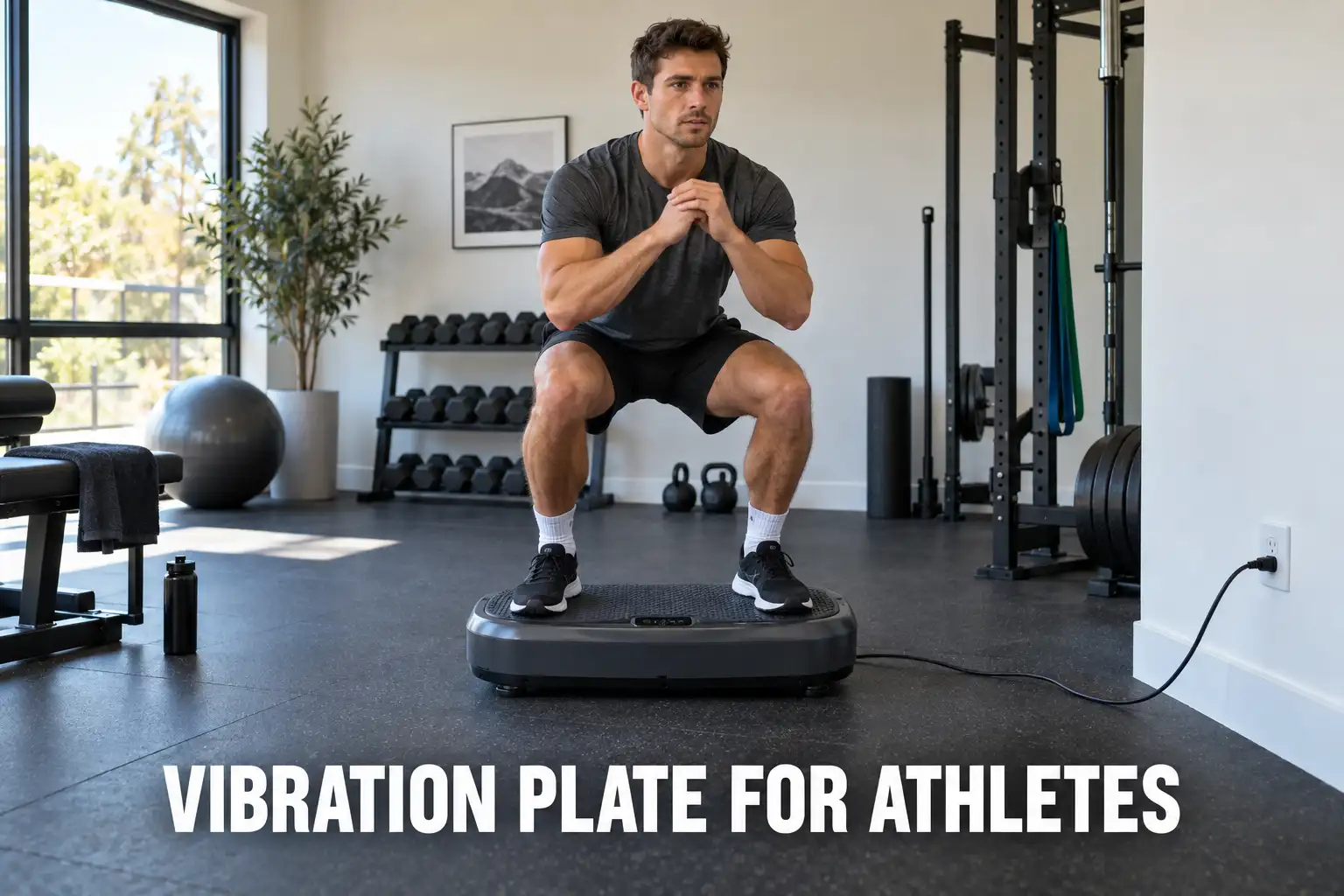
A vibration plate can be useful to athletes, but the evidence is much stronger for selected supporting qualities such as lower-body strength, muscle activation, flexibility, warm-up, and recovery than it is for actual sports performance. Current athlete-specific research does not show consistent improvements in jumping, sprinting, agility, or aerobic endurance.

About the author: Hello! I’m Vladimir Stanar, professor of physical education, kinesiotherapist, marathon runner, cyclist, and cycling coach, and long-time advocate of health, fitness, and active living.
My journey with vibration plates runs parallel to my professional career in education, sports medicine, and athletic development. I’ve developed a unique process for testing vibration plates as they are some of the most versatile tools for enhancing health, recovery, and performance.
✅ Expert-Reviewed by: Vanja Vukas, MPhEd
📚 Expert Contributor: Milutin Tucakov, MPhEd
That distinction matters because athletic performance is much more complicated than making a muscle contract harder in a laboratory test. An athlete needs strength, power, speed, coordination, conditioning, technical skill, decision making, and the ability to apply those qualities in the specific movements of a sport.
I would therefore treat whole-body vibration as an accessory to athletic training, not as a shortcut to becoming faster, more explosive, or better conditioned. Used intelligently, it can add another stimulus around conventional training. It should not replace the training that actually develops the sport.
Why “Athletic Performance” Needs to Be Broken Down
Athletic performance is often discussed as though it were one measurable quality. In reality, improving one physical attribute does not guarantee improvement in another.
A vibration protocol might increase lower-body muscle activation without improving sprint speed. Another program might increase knee-extension strength without changing vertical jump, while a short session might increase range of motion without making an athlete more powerful.
This is exactly what the research tends to show. Whole-body vibration can affect several physiological and performance-related measures, but those changes do not consistently transfer to the final outcomes that matter in competition.
For this reason, I think it is more useful to ask separate questions about strength, power, jumping, sprinting, agility, endurance, mobility, and recovery rather than simply asking whether vibration "improves performance."
What Does the Research Actually Show?
The newest athlete-specific systematic review and meta-analysis included 18 randomized controlled trials examining whole-body vibration and exercise performance in athletes.
The researchers looked at muscle power through countermovement and squat jumps, strength through knee flexor and extensor torque, and cardiovascular endurance through VO2max. Whole-body vibration significantly improved concentric knee-extension and knee-flexion torque, but it did not significantly improve the main jump-based power outcomes or cardiovascular endurance.
The quality of the evidence was also rated as low, so the authors did not consider the research strong enough to produce broad recommendations for athletes.
That result gives us a much more useful conclusion than saying vibration either "works" or "doesn't work." WBV appears capable of improving selected strength measures without reliably improving the broader athletic outcomes that strength is supposed to support.
What Earlier Elite-Athlete Research Found
An earlier systematic review focused specifically on competitive and elite athletes and reached a similar conclusion.
Whole-body vibration produced small and inconsistent acute and long-term changes in leg force, power, flexibility, and performance. The researchers argued that the neuromuscular adaptations created by vibration may simply be too nonspecific to improve athletic performance consistently.
That is particularly important for highly trained athletes. Someone already sprinting, lifting, jumping, cutting, and practicing sport-specific skills at a high level is receiving a very powerful and specific training stimulus.
Standing or exercising on a vibration platform may add something, but that additional stimulus has to compete with training that is already extremely targeted.
What Research on Sprinting, Jumping, and Agility Shows
A separate systematic review and meta-analysis specifically examined jump, sprint, and agility performance in athletes and physically active people.
It found no statistically significant immediate or longer-term improvement in jump performance. Sprint performance also failed to improve significantly, and the acute effect on agility was not significant.
These findings are particularly important because sprinting, jumping, and changing direction are exactly the outcomes that commercial vibration content frequently promises athletes.
The evidence does not support making those promises.
Does a Vibration Plate Increase Muscle Activation?
Yes, whole-body vibration can increase neuromuscular activation under many conditions.
A meta-analysis examining lower-body neuromuscular activation found a significant acute increase following WBV. The same analysis also reported improvements in measures categorized as lower-limb explosive power.
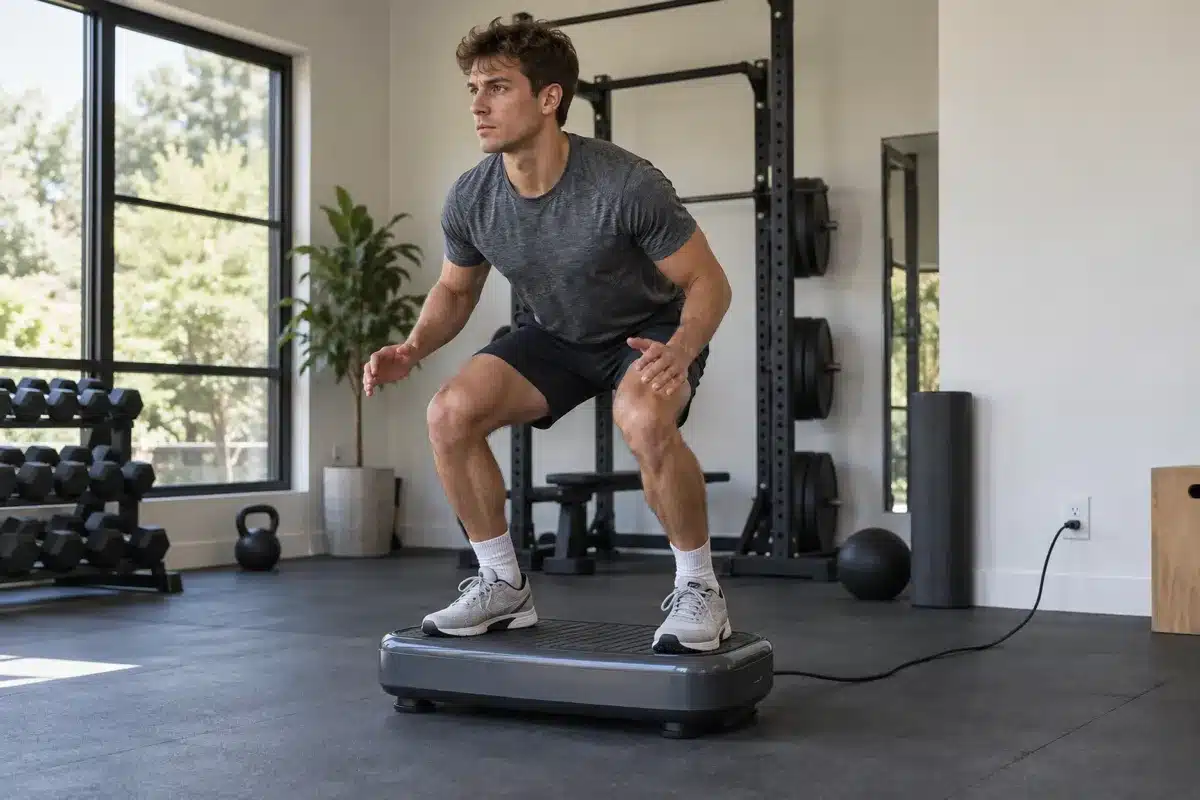
The platform moves underneath the athlete, and the muscles continually respond to maintain position. Adding squats, split stances, calf raises, or other exercises increases the muscular demand further.
This makes muscle activation one of the more believable athletic effects of vibration.
The mistake is assuming that more activation automatically produces better performance. An EMG change tells us that muscular activity changed. It does not tell us that an athlete will sprint faster, jump higher, make a quicker cut, or perform better during competition.
That transfer has to be demonstrated separately, and so far the evidence is much less convincing.
Can Whole-Body Vibration Increase Strength in Athletes?
Strength is probably the most defensible performance-related benefit.
The current athlete meta-analysis found significant improvements in concentric knee-extension and knee-flexion torque. Older research also includes positive results for selected lower-body strength outcomes.
I therefore think vibration can function as a supplementary strength stimulus, particularly when active exercises are performed on the platform.
I would not, however, replace conventional resistance training with vibration. Squats, deadlifts, Olympic lifts, unilateral exercises, loaded jumps, and other resistance movements provide much greater opportunities for progressive overload and sport-specific force development.
For an athlete, the plate makes more sense around those exercises than instead of them.
Does a Vibration Plate Improve Explosive Power?
The answer is less clear than many product pages suggest.
Some studies report improvements in explosive-power measures after whole-body vibration, and research confirms that vibration can alter neuromuscular activation. This creates a plausible pathway through which power could improve.
However, athlete-specific meta-analyses do not consistently find better jump performance. The current 18-trial review did not find significant improvements in its main muscle-power outcomes, while the previous sports-performance meta-analysis also found no significant jump benefit.
I would therefore describe explosive-power effects as possible but inconsistent.
An athlete should not buy a vibration plate expecting that the platform itself will reliably increase explosive performance.
If cost is a constraint, my picks for the best budget vibration plate identify machines that deliver the core activation and frequency range needed for supplementary training without the premium price.
Does a Vibration Plate Improve Vertical Jump?
Not consistently.
Vertical-jump tests are among the most common ways researchers estimate lower-body explosive power, and individual WBV studies have produced positive findings. When studies are pooled together, however, the overall picture is considerably less impressive.
Both immediate and repeated WBV interventions have failed to produce consistent significant improvements in jump performance across athlete-focused analyses.
That does not mean no athlete will ever jump higher after a vibration protocol. It means the effect is not reliable enough for me to recommend WBV as a primary vertical-jump training method.
If I wanted to improve vertical jump, I would still prioritize lower-body strength, plyometric training, jump practice, landing mechanics, and appropriate fatigue management.
Does Whole-Body Vibration Improve Sprint Speed?
Again, the pooled evidence says not reliably.
Some individual studies have reported favorable sprint outcomes, particularly under specific vibration or contraction protocols. But meta-analysis of athletic and physically active populations found no significant immediate or longer-term improvement in sprint performance.
This is a good example of the specificity problem.
Sprint speed depends on force application, acceleration mechanics, stride characteristics, stiffness, coordination, maximal velocity, and repeated technical exposure to sprinting. Standing or squatting on a vibration plate does not reproduce those demands.
If I wanted to sprint faster, I would sprint. I might use the plate around that training, but I would not replace sprinting with vibration.
Does a Vibration Plate Improve Agility?
The evidence is also weak for agility.
Agility requires acceleration, braking, direction changes, coordination, reaction, and often rapid decision making. Many team sports add another layer because the athlete has to respond to opponents, teammates, and an unpredictable environment.
A vibration plate can challenge the neuromuscular system, but it cannot reproduce those sport-specific demands. The available meta-analytic evidence has not shown a significant acute agility benefit.
I would therefore use WBV as a supplementary training tool for qualities such as strength or balance rather than as an agility-training substitute.
Does Whole-Body Vibration Improve Endurance or VO2max?
Current athlete-specific evidence does not show a meaningful improvement in VO2max.
A vibration plate creates muscle activity and can increase the physical demand of certain exercises, but it does not provide the sustained cardiovascular load that an endurance athlete gets from running, cycling, rowing, swimming, or another aerobic activity.
For endurance athletes, I see the plate as potentially useful for mobility, supplementary strength, warm-up, and recovery.
For endurance athletes managing body composition alongside aerobic training, my picks for the best vibration plate for weight loss identify the machines best suited to that combination.
I would not use it as a replacement for aerobic conditioning.
Is a Vibration Plate Useful as a Warm-Up?
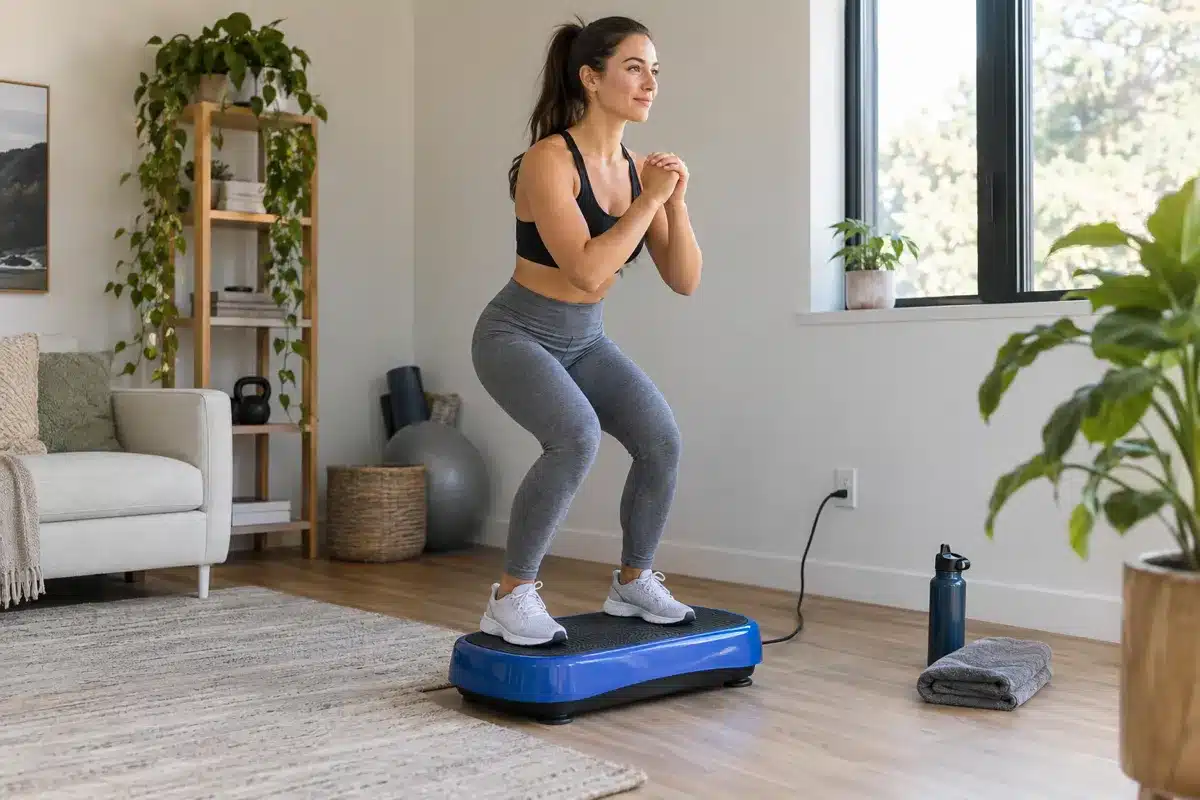
Yes, it can be.
A recent randomized trial involving 93 healthy, active adults compared a five-minute WBV warm-up with the same warm-up performed without vibration and with passive rest. Jump performance, flexibility, and reaction time improved from baseline in the vibration group.
The crucial detail is that the same exercises without vibration produced similar improvements. The vibration itself did not provide a significant additional advantage over the non-vibration warm-up.
That is one of the clearest examples of why research and marketing need to be separated carefully.
A vibration warm-up can work. That does not mean it works better than a good conventional warm-up.
For a full breakdown of how timing affects what vibration actually does, my guide on using a vibration plate before or after workout covers the evidence on warm-up, priming, and recovery windows.
I would use it as an optional first stage before moving into dynamic mobility, sport-specific movements, progressively harder drills, and warm-up sets relevant to the upcoming session.
Can WBV Produce Post-Activation Potentiation?
Whole-body vibration is sometimes promoted as a way to create short-term post-activation potentiation or post-activation performance enhancement.
The theory makes sense. A strong neuromuscular stimulus before explosive activity may temporarily increase subsequent force or power production under the right circumstances.
Some individual WBV studies have produced favorable short-term results. Others, including research involving highly trained sprinters and jumpers, have found no meaningful improvement beyond conventional warm-up.
That makes WBV a possible individual priming strategy, not a proven universal performance hack.
An athlete who already owns a vibration plate could test a short protocol during training and objectively measure whether sprint times, jump height, bar velocity, or another relevant outcome actually improves. I would not assume that a protocol works simply because it creates a noticeable sensation in the muscles.
Does Vibration Improve Flexibility for Athletes?
Flexibility is one of the more convincing reasons for athletes to use vibration.
Research shows that mechanical vibration can produce acute increases in range of motion, and repeated programs may improve flexibility over time. This could be particularly relevant to athletes in gymnastics, dance, martial arts, weightlifting, or other activities requiring large ranges of motion.
Vibration does not consistently outperform ordinary stretching, though.
For an athlete, I would use the plate when it makes mobility work more convenient or when a temporary increase in comfortable range helps with preparation. I would still combine that with active mobility and strength throughout the available range rather than focusing only on passive flexibility.
If flexibility is a primary training goal, my dedicated guide on using a vibration plate for stretching and flexibility covers the evidence, the practical protocols, and where vibration genuinely helps range of motion.
Can Athletes Use a Vibration Plate for Recovery?
Yes, and recovery may actually be one of the strongest practical athletic uses of the machine.
A randomized trial involving elite hockey players found that post-exercise stretching combined with whole-body vibration reduced pain and quadriceps tightness more than stretching alone. Broader DOMS research also supports reductions in soreness after vibration interventions.
This could be valuable during periods when an athlete trains or competes frequently and wants a convenient low-impact recovery tool.
Athletes who prioritize recovery tools should also look at my guide to the best vibration plate for circulation, which covers models designed to support blood flow and soft-tissue recovery between sessions.
The limitation is that feeling less sore and being fully recovered are not the same thing.
In another study, post-exercise vibration reduced soreness and creatine kinase after damaging eccentric exercise but did not improve recovery of peak isometric strength.
An athlete may therefore feel better before full force-producing capacity has returned.
I would judge readiness to train using overall fatigue, performance, movement quality, training load, sleep, and the specific demands of the next session rather than soreness alone.
Does WBV Improve Recovery for Runners?
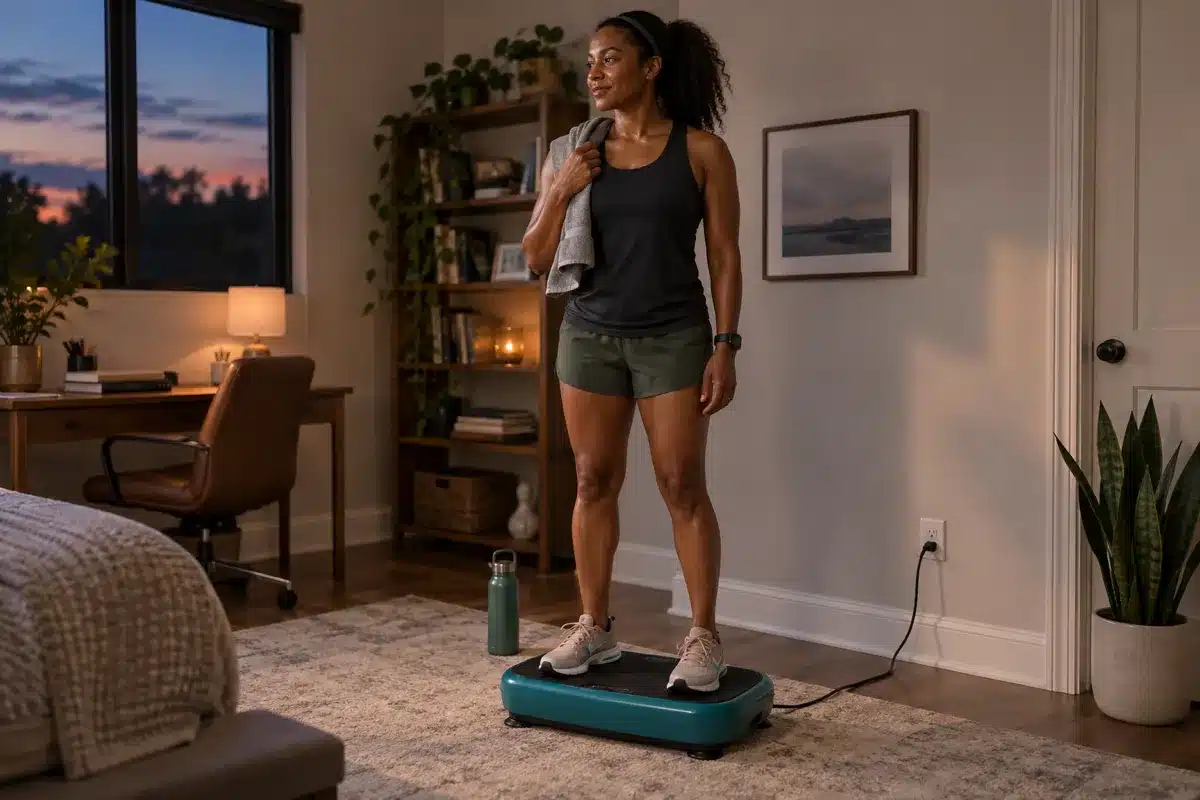
Not reliably.
A study involving well-trained runners tested 30 minutes of low-frequency vibration after a 3 km time trial and demanding interval training. The researchers then assessed running performance and muscle-damage markers the following day.
The vibration intervention did not improve next-day 3 km performance or creatine kinase compared with the control condition.
This is an important counterpoint to broad statements that vibration automatically accelerates athletic recovery.
WBV may reduce certain symptoms in some protocols without restoring the athlete's actual sports performance faster.
Can WBV Help With Balance and Ankle Stability?
This is another area where the evidence becomes more interesting, particularly for athletes with chronic ankle instability.
Systematic reviews have found improvements in dynamic balance, postural control, selected strength measures, joint-position sense, and muscle activity after whole-body vibration training in people with chronic ankle instability.
That makes vibration a plausible supplementary rehabilitation or sensorimotor-training tool for an athlete with this specific problem.
I would not extend that evidence into the claim that vibration plates prevent ankle sprains in healthy athletes. Improving balance or proprioception in an already unstable ankle and preventing future injuries across an entire athletic population are different research questions.
Can a Vibration Plate Prevent Sports Injuries?
There is not enough evidence to say that it can.
Strength, balance, ankle control, mobility, and neuromuscular function can all contribute to how an athlete tolerates sports demands. WBV may improve some of those qualities under certain conditions.
Actual sports injuries are influenced by much more, including previous injuries, workload, fatigue, exposure, contact, technique, tissue capacity, equipment, and the demands of the sport.
I would therefore not advertise a vibration plate as an injury-prevention device.
A plate can support parts of an athlete's physical preparation, but that is not the same as demonstrating fewer injuries.
What About Rehabilitation?
Rehabilitation is a legitimate but separate use case.
Research involving chronic ankle instability suggests that WBV can improve selected sensorimotor outcomes, while vibration has also been investigated as part of rehabilitation following procedures such as ACL reconstruction.
Those findings are useful because they show that the moving platform can be integrated into progressive rehabilitation when appropriate.
Athletes working through lower-limb overuse injuries should also look at my guide to the best vibration plate for plantar fasciitis, which covers machines suited to progressive sensorimotor rehabilitation.
An injured athlete should not take a general fitness routine from the internet and assume it is appropriate rehabilitation. Exercise selection, loading, progression, and return-to-sport criteria depend on the injury and stage of recovery.
Elite Athletes vs Recreational Athletes
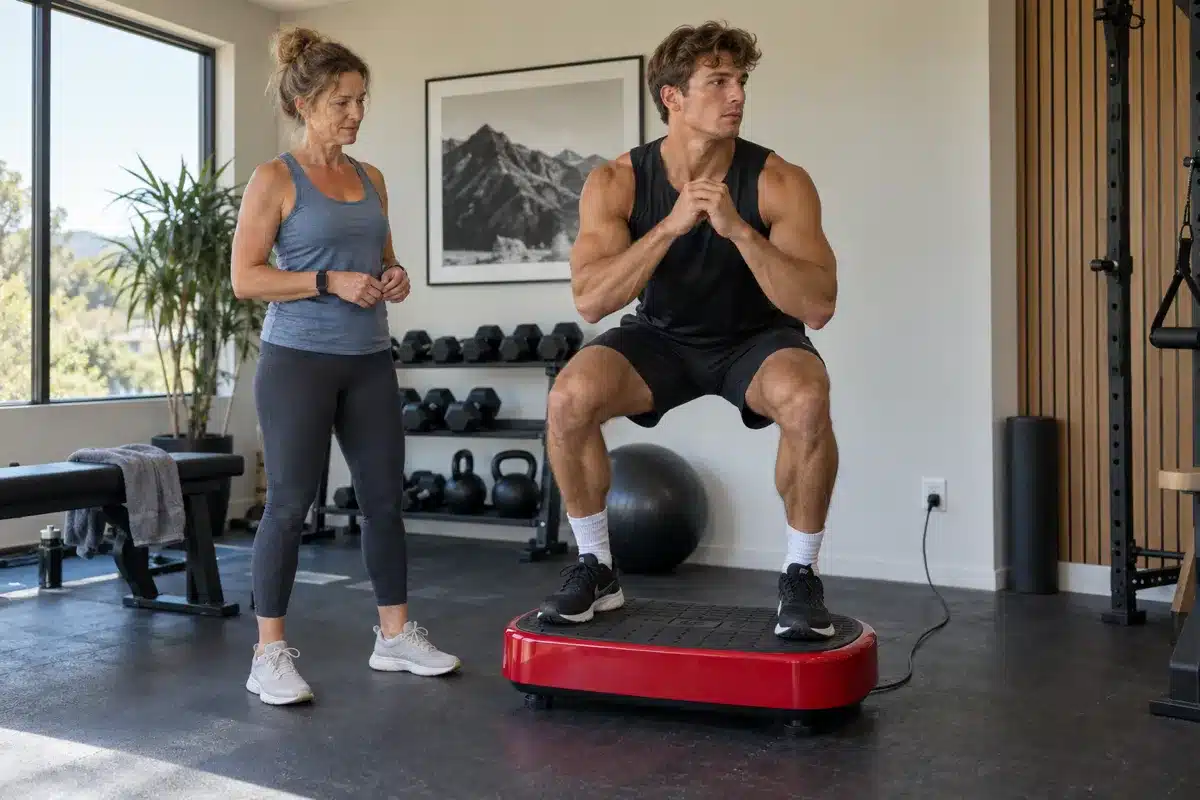
Training status may help explain why vibration research often looks more impressive in less-trained populations than in elite sport.
A recreational athlete may gain from almost any new structured strength or neuromuscular stimulus because there is significant room for adaptation. An elite athlete already performs highly specific training at loads and speeds designed around the requirements of the sport.
That makes the additional WBV stimulus relatively small and less specific.
The older competitive-athlete meta-analysis raised exactly this issue. Vibration can create physiological adaptations without those adaptations being specific enough to improve competitive performance.
For recreational athletes, I would therefore expect a greater chance of noticing general fitness improvements. For an elite athlete, I would demand much stronger evidence of transfer before replacing any established training component.
How Useful Is a Vibration Plate for Different Sports?
Strength and Power Sports
Strength and power athletes probably have one of the better cases for using WBV as a supplementary tool.
A plate can increase muscle activation, add difficulty to selected bodyweight positions, support mobility work, and possibly contribute to selected strength adaptations. It may also fit into a warm-up or recovery routine.
Athletes serious about equipment quality should look at my breakdown of the best VibePlate vibration plates, a brand engineered specifically for professional and performance training environments.
I would still build the training program around heavy resistance exercise, explosive lifting where appropriate, jumps, throws, and other highly specific power work.
Sprinting and Track
A vibration plate may be useful for warm-up, mobility, supplementary lower-body work, or recovery.
What it has not reliably done is improve actual sprint performance. That means I would never reduce sprint exposure because WBV supposedly creates the same neuromuscular effect.
The fastest way to become better at sprinting still involves sprinting within an intelligently designed training program.
Team Sports
Football, soccer, basketball, hockey, tennis, and similar sports require a large combination of speed, acceleration, deceleration, agility, repeat-effort capacity, strength, skill, and decision making.
WBV may fit into warm-up, mobility, recovery, strength support, or ankle-stability work. I would be much more skeptical of claims that it directly improves agility or overall game performance.
The complexity of team sports makes sport-specific training especially important.
Endurance Sports
Runners, cyclists, rowers, swimmers, and other endurance athletes may use vibration for supplementary strength, mobility, or recovery.
Current athlete research does not show a significant improvement in VO2max, and vibration cannot replicate the cardiovascular and metabolic adaptations created by actual endurance training.
I would keep aerobic conditioning firmly at the center of the program.
Gymnastics, Dance, and Flexibility-Heavy Sports
These athletes may have a particularly practical use for WBV because acute range-of-motion improvements are reasonably well supported.
The plate can be incorporated into mobility or flexibility sessions without assuming that vibration itself improves every element of performance.
Flexibility remains only one requirement. Strength, active control, balance, technique, and sport-specific practice still determine how effectively that range is used.
Vibration Plate vs Conventional Athletic Training
If the goal is actual sport performance, conventional training remains the priority.
An athlete improves by repeatedly exposing the body to the forces, speeds, energy systems, movements, and technical demands that matter in the sport. Resistance training develops force, plyometrics develop explosive qualities, sprint training develops sprinting, conditioning develops endurance, and sport practice develops technical and tactical skill.
Whole-body vibration is far less specific.
That does not make it useless. Plenty of athletic tools exist to support the main training rather than replace it.
That is where I would put the vibration plate.
What Vibration Frequency Is Best for Athletes?
There is no universally proven athletic-performance frequency.
Research protocols commonly use frequencies somewhere in the broad range from the mid-20s into 40 Hz and beyond, but the studies also vary in amplitude, acceleration, machine type, exercise position, external load, exposure time, and recovery between bouts.
Those differences make it difficult to compare one Hz number directly with another.
A major umbrella review of WBV research concluded that protocols remain too heterogeneous to establish a standardized training procedure. Athlete-specific evidence also fails to demonstrate one frequency that reliably improves sport performance.
For a deeper look at what the research actually says about vibration settings, my guide on frequencies in vibration plates covers the evidence without the marketing claims.
I would therefore ignore claims that 30, 35, or 40 Hz is the scientifically proven setting for athletes.
The better setting is the one appropriate to the goal and machine while allowing controlled movement without unnecessary fatigue or loss of technique.
How Long Should Athletes Use a Vibration Plate?
There is no universal athletic dose, so I would change the duration according to the purpose.
For a warm-up, around 3 to 5 minutes of controlled movement is a reasonable practical starting point before moving into the normal sport-specific warm-up. The goal is preparation, so the athlete should step off the machine feeling ready rather than tired.
For active training, I prefer short exercise bouts separated by rest rather than simply standing on the plate for a long continuous session. Squats, split stances, calf work, or upper-body positions can create considerable muscular demand once vibration is added.
For recovery, roughly 3 to 10 minutes of easier use is a reasonable practical range if it feels comfortable. These ranges are practical guidelines rather than scientifically established universal prescriptions.
A Practical Vibration Plate Routine for Athletes
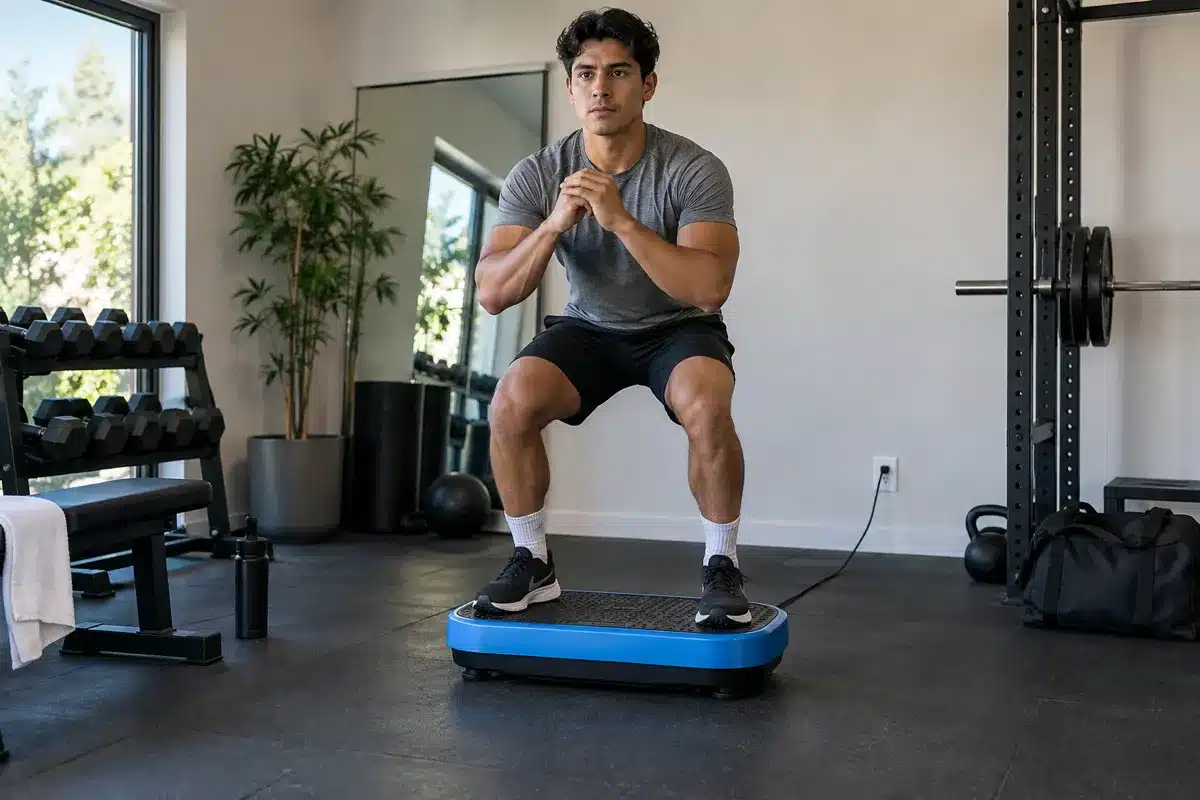
A pre-workout session can begin with comfortable standing, followed by gentle weight shifts, calf raises, and shallow squats. I would then step off the plate and continue with the normal dynamic, technical, and progressive warm-up required by the sport.
My guide to vibration plate exercises covers the specific movements that work best on the platform, organized by goal, so you can build each session phase around controlled, purposeful positions.
For a supplementary strength session, controlled squat variations, split-stance positions, calf exercises, and appropriate plank or push-up positions can make the platform more active. The objective should be adding a specific training stimulus rather than chasing the strongest vibration setting.
For athletes building a structured home setup around these principles, my guide to the best Lifepro vibration plate covers the models best suited to progressive training protocols.
Post-workout use should look different. Comfortable standing, gentle weight shifts, easy calf movement, and controlled stretching can provide a low-demand transition into recovery without adding another difficult training block.
In every case, I would decide what the vibration session is supposed to accomplish before turning the machine on.
For athletes setting up a training space at home, my picks for the best vibration plate for home use cover the machines that hold up to frequent, performance-oriented sessions.
Common Athletic Performance Claims to Ignore
The biggest mistake is assuming that more muscle activation means better sporting performance. WBV clearly affects the neuromuscular system, but athlete-specific research shows that this does not consistently translate into faster sprinting, higher jumping, or better agility.
Claims that vibration reliably increases VO2max, prevents sports injuries, or has one proven athletic frequency are also unsupported. Higher G-force is not automatically better, and professional-team adoption proves that the equipment is used rather than proving that it independently improves performance.
Recovery claims need similar caution. Less soreness can be useful, but it does not prove that strength or sport performance has completely recovered, and there is no need to explain legitimate recovery effects through outdated claims about flushing lactic acid or vague metabolic waste.
What I Would Realistically Expect
A realistic athlete can expect whole-body vibration to increase muscle activation during certain exercises and potentially improve selected lower-body strength measures over time. It can also provide short-term flexibility benefits, work as an optional warm-up tool, reduce post-exercise soreness in some situations, and contribute to balance or ankle-rehabilitation programs.
Athletes interested in the balance-specific benefits referenced here will find the full evidence base and practical protocols in my vibration plate fall prevention guide.
I would not expect the plate to guarantee faster sprinting, a higher vertical jump, better agility, improved VO2max, or automatic improvements in competitive performance. I also would not expect it to prevent injuries or replace resistance training, plyometrics, conditioning, technical practice, or sport-specific training.
The value of the machine depends largely on whether it fills a useful gap around those priorities.
My Take on Vibration Plates for Athletes
I think vibration plates can earn a legitimate place in an athlete's training environment, but not for the reason the marketing often suggests. The strongest case is not that standing on a moving platform directly makes an athlete faster, more explosive, or better conditioned.
The better-supported case is that WBV can provide an additional strength and neuromuscular stimulus, improve range of motion, fit into a warm-up, reduce soreness, and support selected balance or rehabilitation work. Those are useful benefits when they complement a well-designed athletic program.
If you are ready to invest in a machine, my picks for the best vibration plate cover the models that consistently perform well across activation, structural quality, and real-world use.
For actual sports performance, specificity still wins. If I wanted to sprint faster, I would prioritize sprinting. If I wanted to jump higher, I would train strength and explosive force production. If I wanted better endurance, I would train the cardiovascular system.
I would use the vibration plate around those priorities rather than instead of them.
FAQs
Are vibration plates good for athletes?
They can be useful as a supplementary training tool. Research supports effects on muscle activation, selected lower-body strength outcomes, flexibility, soreness, and some balance or rehabilitation measures.
The evidence is much weaker for direct improvements in sprinting, jumping, agility, aerobic endurance, or overall competitive performance.
Do vibration plates improve athletic performance?
Not consistently. Athlete-specific meta-analyses show some improvements in strength-related outcomes but little reliable improvement in sport-performance measures such as sprinting, jumping, and agility.
Can a vibration plate increase strength?
Yes, selected athlete research suggests WBV can improve concentric knee flexor and extensor strength. I would still treat it as a supplement to conventional progressive resistance training rather than a replacement.
Do vibration plates improve vertical jump?
Not reliably. Individual studies have reported positive effects, but pooled athlete-specific evidence does not show a consistent significant improvement in jump performance.
Can whole-body vibration improve sprint speed?
Current meta-analytic evidence does not show a reliable improvement in sprint performance. WBV may affect neuromuscular function, but those changes do not consistently transfer into faster sprinting.
Does a vibration plate improve agility?
There is currently insufficient evidence for a reliable agility benefit. Agility depends on sport-specific acceleration, braking, coordination, reaction, and change-of-direction skills that vibration training does not reproduce directly.
Can WBV improve endurance or VO2max?
Current athlete-specific research does not show a significant improvement in VO2max. Endurance athletes should continue to rely on sport-specific aerobic conditioning for cardiovascular development.
Do vibration plates increase muscle activation?
Yes. Research supports acute increases in lower-limb neuromuscular activation under many WBV protocols, but increased muscle activation should not be interpreted automatically as improved sports performance.
Should athletes use a vibration plate before competition?
It can be used as part of a brief warm-up, but research does not show that WBV consistently improves performance beyond an otherwise good warm-up. An athlete should test the protocol during training before introducing it before an important competition.
Can a vibration plate help with athletic recovery?
It may help reduce DOMS, tightness, and perceived soreness after hard exercise. However, reduced soreness does not necessarily mean strength or sport performance has recovered faster.
Can WBV prevent sports injuries?
There is not enough evidence to say that it does. WBV may improve some physical factors associated with injury resilience, but actual injury risk depends on many variables.
Can vibration improve ankle stability?
Research involving chronic ankle instability suggests WBV can improve selected measures of dynamic balance, strength, joint-position sense, and muscle activity. That evidence applies more directly to rehabilitation than to injury prevention in healthy ankles.
What vibration frequency is best for athletes?
No universal frequency has been established. Studies use widely different settings and protocols, and current evidence does not identify one scientifically proven athletic-performance frequency.
How long should an athlete use a vibration plate?
The duration depends on the goal. Around three to five minutes can work as a practical warm-up starting point, while recovery use may last approximately three to ten minutes if comfortable. Active training is usually better organized as shorter exercise bouts rather than prolonged passive standing.
Do professional athletes use vibration plates?
Yes, vibration platforms are used by some professional athletes, teams, performance facilities, and rehabilitation programs. Their use demonstrates that WBV can fit into elite training environments, but it does not by itself prove that vibration improves competitive performance.
Can vibration training replace strength or plyometric training?
No. Conventional resistance, power, plyometric, sprint, conditioning, and sport-specific training provide much more targeted stimuli for improving athletic performance.
Notable Studies
- Peng YC, et al. Effects of Whole-Body Vibration on Exercise Performance among Athletes: A Systematic Review and Meta-Analysis of Randomized Controlled Trials. Eighteen randomized trials were included. WBV improved concentric knee flexor and extensor torque but did not significantly improve muscle power or cardiovascular endurance.
- Hortobágyi T, et al. Small and Inconsistent Effects of Whole Body Vibration on Athletic Performance: A Systematic Review and Meta-Analysis. Competitive and elite athlete data showed small and inconsistent acute and long-term performance effects.
- Minhaj MA, et al. Effects of Whole-Body Vibration on Sports Performance: A Systematic Review and Meta-Analysis. The analysis found no statistically significant immediate or long-term improvement in jump or sprint performance and no significant acute agility effect.
- Wang Z, et al. Effect of Whole-Body Vibration on Neuromuscular Activation and Explosive Power of Lower Limb: A Systematic Review and Meta-Analysis. The review found significant acute increases in lower-limb neuromuscular activation and improvements in explosive-power measures.
- Amato A, et al. Whole-Body Vibration as an Effective Sports Competition Warm-Up: A Randomized Controlled Trial in a Young and Healthy Population. Ninety-three active adults completed WBV, sham warm-up, or control conditions. The WBV warm-up improved several outcomes from baseline but did not outperform the same warm-up performed without vibration.
- Timon R, et al. Effects of Whole-Body Vibration After Eccentric Exercise on Muscle Soreness and Muscle Strength Recovery. WBV reduced soreness and creatine kinase but did not improve recovery of peak isometric strength.
- Chen J, et al. Optimizing Athletes' Recovery and Performance: A Review of Vibration Therapy, Compression Garments, and Massage. The 2025 review identified 29 vibration-therapy studies and concluded that recovery evidence varies considerably while optimal duration and frequency remain insufficiently standardized.
- Petrigna L, et al. Intervention Hypothesis for Training With Whole-Body Vibration to Improve Physical Fitness Levels: An Umbrella Review. The review found substantial variation in frequency, amplitude, acceleration, exercise type, duration, and other protocol characteristics, preventing establishment of a standardized WBV procedure.
Healthcare and Medical Disclaimer
The information provided on Vibration Plate Zone is for general informational purposes only and is not intended to replace professional medical advice, diagnosis, or treatment. Always seek the guidance of a qualified healthcare provider with any questions you may have regarding a medical condition, and never disregard or delay seeking professional advice.