Affiliate Disclosure: Vibration Plate Zone is a proud participant in the Amazon Services LLC Associates Program.
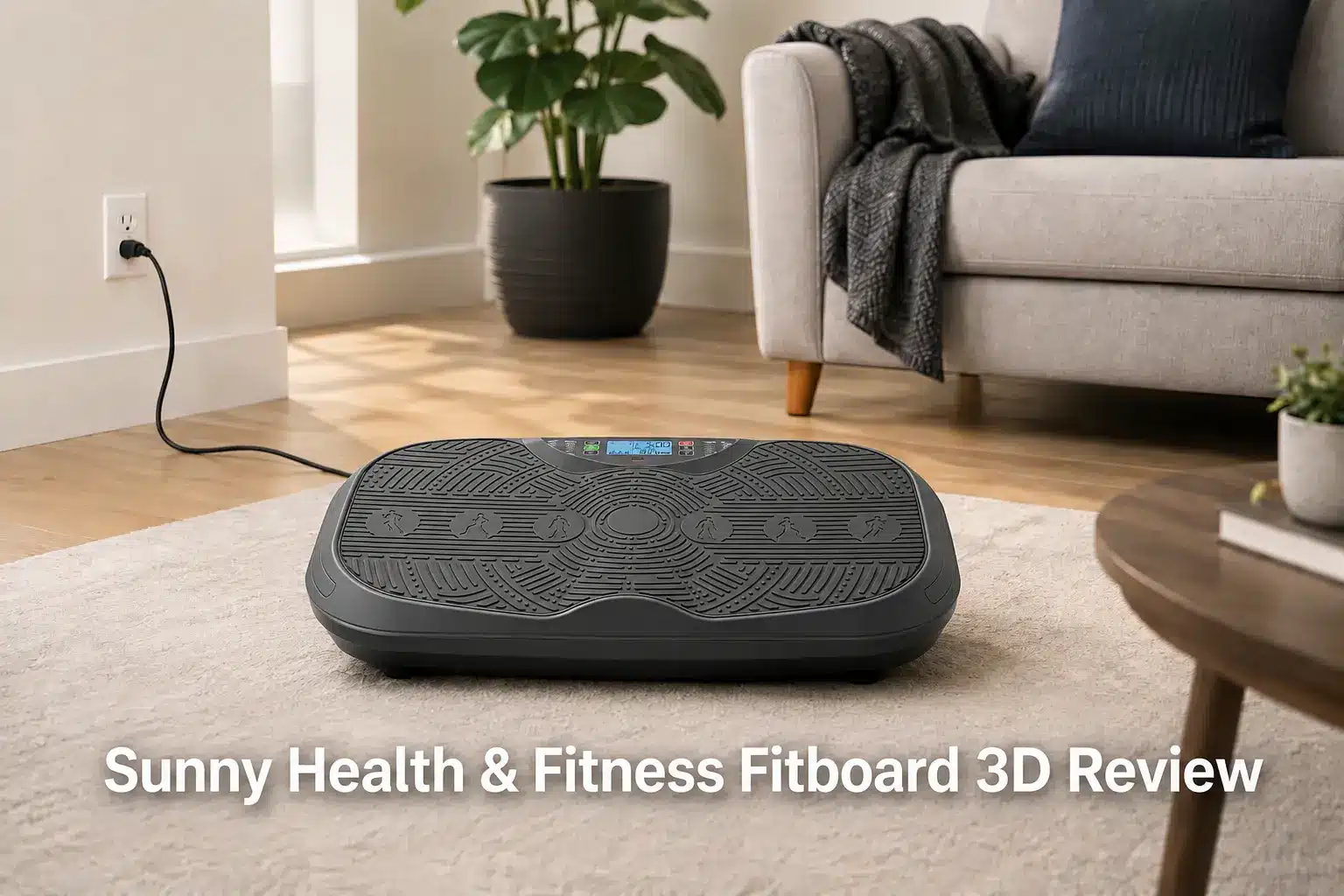
The Fitboard 3 is a substantial multidirectional vibration plate with three movement modes, with documented frequency and amplitude figures, and the backing of an established home-fitness brand, Sunny Health & Fitness.

About the author: Hello! I’m Vladimir Stanar, professor of physical education, kinesiotherapist, marathon runner, cyclist, and cycling coach, and long-time advocate of health, fitness, and active living.
My journey with vibration plates runs parallel to my professional career in education, sports medicine, and athletic development. I’ve developed a unique process for testing vibration plates as they are some of the most versatile tools for enhancing health, recovery, and performance.
✅ Expert-Reviewed by: Vanja Vukas, MPhEd
📚 Expert Contributor: Milutin Tucakov, MPhEd
There are plenty of vibration plates that look impressive until I start digging into the specifications. You get 99 speeds, 120 levels, or some other enormous number, but very little information about what the platform is actually doing underneath your feet.
The Sunny Health & Fitness Fitboard 3D SF-VP822057 is different. Sunny publishes the actual frequency range, amplitude, movement type, machine weight, dimensions, and other useful specifications. For someone like me who spends a lot of time comparing vibration plates, that technical transparency immediately gets my attention.
The other important distinction is the movement itself. This isn't a conventional side-alternating vibration plate with a fancy “3D” badge stuck on the front. The Fitboard 3D can operate vertically, horizontally, or use both vibration systems together.
That gives it substantially more versatility than a basic oscillating platform.
For those interested in skin-toning benefits, my picks for the best vibration plates for cellulite cover the machines with the movement patterns most relevant to that goal.
I also like that Sunny Health & Fitness is a recognizable fitness equipment manufacturer with manuals, customer support, replacement information, and model-specific maintenance documentation. That doesn't automatically make every Sunny machine great, but it matters to me when I'm comparing it with vibration plates from brands that seem to appear and disappear every few months.
After going through everything Sunny publishes about this model, I think the Fitboard 3D is one of the more interesting home vibration platforms for people who want multiple vibration patterns without moving all the way into a large commercial-style machine.
Sunny Health & Fitness Fitboard 3D Specifications
| Specification | Sunny Fitboard 3D SF-VP822057 |
|---|---|
| Vibration type | Vertical and horizontal |
| Vibration modes | 3 |
| Up-and-down frequency | 3.42 to 7.67 Hz |
| Translational frequency | 2.45 to 5.7 Hz |
| Vertical amplitude | 17 mm ±10% |
| Translational amplitude | 14 mm ±10% |
| Up-and-down movement rate | 205 to 460 RPM |
| Translational movement rate | 147 to 342 RPM |
| Intensity levels | 16 |
| Preset programs | 3 |
| Preset program duration | 10 minutes |
| Maximum user weight | 265 lb |
| Product dimensions | 30.7 × 18.3 × 6.7 in |
| Product weight | 43 lb |
| Shipping dimensions | 32.9 × 19.1 × 8.7 in |
| Shipping weight | 48 lb |
| Surface | Textured non-slip finish |
| Resistance bands | 2 detachable bands |
| Remote control | Yes |
| Transport wheels | Yes |
| Floor stabilization | Suction cups |
| Display metrics | Workout mode, program, speed, time |
| Frame warranty | 1 year |
| Other parts and components warranty | 180 days |
What Is the Sunny Health & Fitness Fitboard 3D?
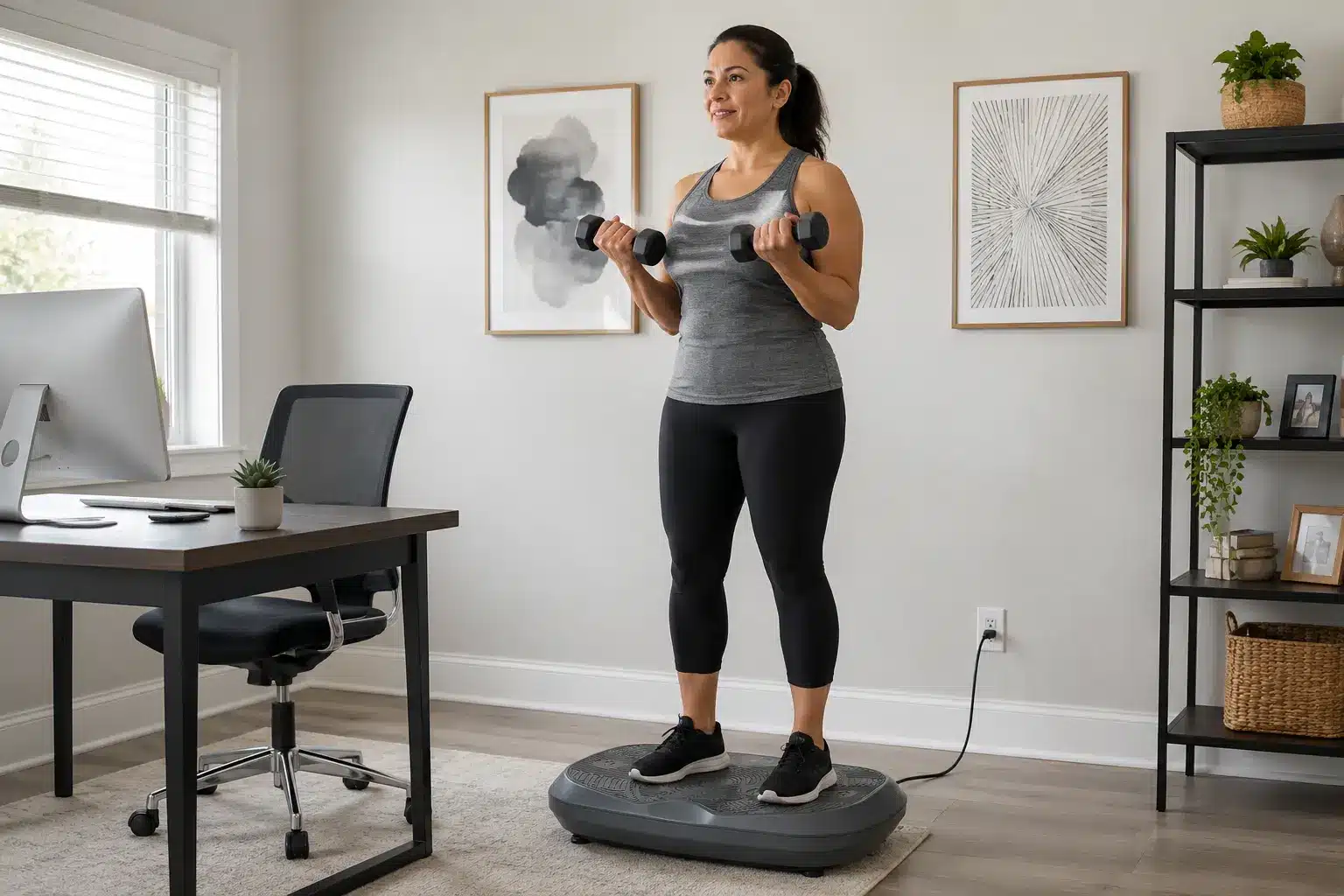
The Fitboard 3D is a motorized home vibration platform designed around two different movement systems.
One moves the platform vertically, while the other produces horizontal or translational vibration. You can run either type individually or combine them, which is where the “3D” terminology comes from.
That immediately separates it from the majority of affordable vibration plates I review. Most use one primary movement mechanism, usually side-alternating oscillation, and then give you a large number of speed levels within that single movement pattern.
Sunny takes a different approach.
Instead of giving me a hundred tiny speed increments, I get 16 intensity levels and three genuinely different operating modes.
Personally, I find that more useful.
The platform itself is also fairly substantial. At 43 pounds and just over 30 inches long, this isn't one of those featherweight vibration plates you casually pick up with one hand and slide underneath the sofa.
That extra mass has advantages when the motors start moving.
How the Fitboard 3D Vibration System Works
“3D” can be a confusing term in the vibration plate industry because there isn't one universal definition that every manufacturer follows.
With the Fitboard 3D, however, Sunny is quite specific about what the machine does.
You have three options:
- Up-and-down vibration
- Translational vibration
- Combined vibration
The important part is that these aren't simply three predetermined speeds. They are different movement configurations.
Up-and-Down Vibration
The vertical mode operates between 3.42 and 7.67 Hz, corresponding to approximately 205 to 460 movements per minute.
Sunny specifies a vertical amplitude of 17 mm ±10%.
That frequency range is relatively low compared with high-frequency vertical vibration platforms, but comparing frequency alone can be misleading. A vibration plate operating at 6 Hz with substantial displacement is doing something very different from a machine operating at 30 or 40 Hz with only a few millimeters of movement.
This is why I'm glad Sunny publishes both frequency and amplitude.
If I saw only “7.67 Hz,” I wouldn't have enough information to understand the character of the movement.
Translational Vibration
The second system operates at 2.45 to 5.7 Hz, or approximately 147 to 342 movements per minute.
Sunny lists the translational amplitude at 14 mm ±10%.
This horizontal movement gives the body a different stabilization challenge than straightforward vertical vibration.
I find this particularly interesting for standing work because the body isn't simply dealing with force traveling upward through the platform. It has to make small adjustments against movement in another plane.
Combined 3D Vibration
Then there is the mode that makes the Fitboard 3D more interesting to me: both systems operating together.
Instead of choosing between vertical and translational movement, the platform combines them.
This produces a more complex movement pattern than either mechanism alone.
For me, this is the main reason to consider the Fitboard 3D rather than Sunny's simpler vibration platforms. If I were going to use only one movement mode every session, much of the point of buying the 3D model would disappear.
The combined setting lets you make the most of what the machine was designed to do.
Is the “3D” Label Just Marketing?
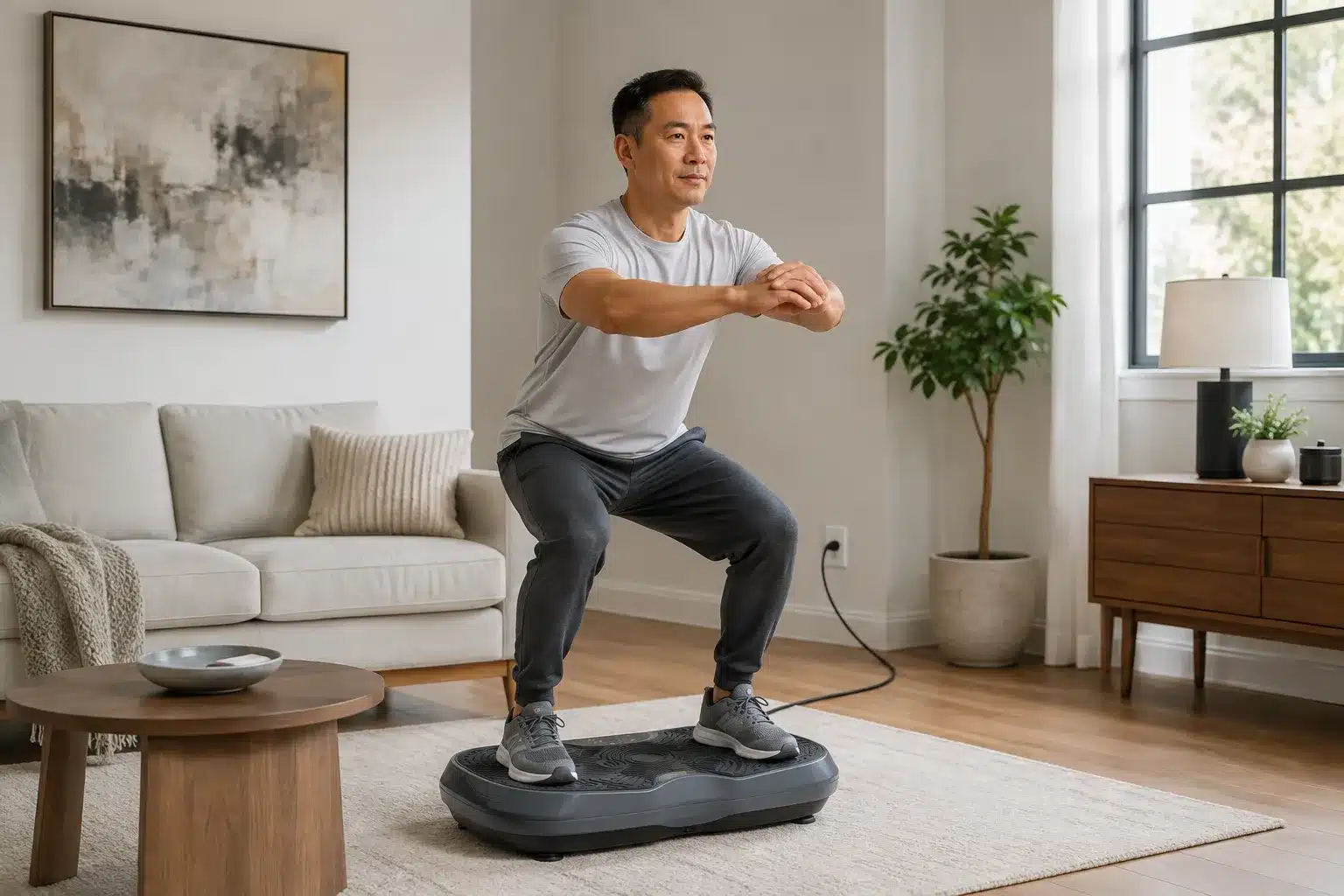
I always approach terms such as 3D, 4D, turbo, therapeutic, professional, and commercial with some skepticism because vibration plate manufacturers don't use them consistently.
There is no universal rule saying every “3D vibration plate” must use exactly the same mechanical arrangement.
But in this case, there is a real mechanical distinction behind Sunny's terminology. The Fitboard can provide vertical movement, horizontal movement, or the two together.
So while 3D is Sunny's product terminology rather than a standardized scientific vibration category, there is more happening here than marketing fluff.
That's an important distinction.
Frequency and Amplitude
This is one of my favorite parts of reviewing the Fitboard 3D because I don't have to guess.
Sunny gives us the numbers.
The vertical system works from 3.42 to 7.67 Hz with 17 mm ±10% amplitude, while the translational system operates from 2.45 to 5.7 Hz with 14 mm ±10% amplitude.
Those figures tell me much more than the number of speed settings ever could.
Frequency tells us how many vibration cycles occur each second. Amplitude describes the extent of the movement.
Neither specification should be considered in isolation.
One of the biggest mistakes I see when vibration plates are compared is assuming that a machine with the highest Hz figure must automatically produce the strongest or most effective vibration.
It doesn't work that way.
Movement direction, amplitude, frequency, body position, knee flexion, stance width, and the design of the platform all affect how vibration is transmitted through the body.
The Fitboard's relatively low frequencies paired with fairly substantial stated displacement make it a very different machine from a high-frequency vertical platform with minimal amplitude.
I would therefore classify it as a low-frequency, high-movement multidirectional home vibration plate rather than trying to compare the Hz number directly with every machine on the market.
For users focused on bone density support, my picks for the best vibration plates for osteoporosis cover the frequency and amplitude parameters most relevant to that goal.
Performance
The first thing I look at with a multidirectional plate is stability.
It is one thing to make a machine move in multiple directions. It is another thing to keep the chassis planted while those movements occur.
The Fitboard 3D weighs 43 pounds, which I consider a positive here. A vibration platform doesn't necessarily need to be extremely heavy, but once multiple movement mechanisms are involved, I'd rather have some mass underneath me than an ultra-light plastic shell bouncing around the room.
Sunny also uses suction cups underneath the machine.
Together with the wide chassis and non-slip upper surface, that should help keep the unit stable on an appropriate smooth floor.
Standing Sessions
For straightforward standing sessions, the Fitboard gives you plenty of room to alter your stance.
Changing foot position on a vibration plate can meaningfully change how the movement feels. I normally recommend starting closer to the center and gradually experimenting with stance width rather than immediately planting your feet as far apart as possible.
I also prefer maintaining some bend in the knees instead of locking them.
That's especially relevant when using vertical vibration because a relaxed, slightly flexed stance lets the lower body absorb and respond to the movement more naturally.
If improving blood flow is a priority, my picks for the best vibration plates for circulation cover the machines I'd recommend specifically for that use case.
Squats
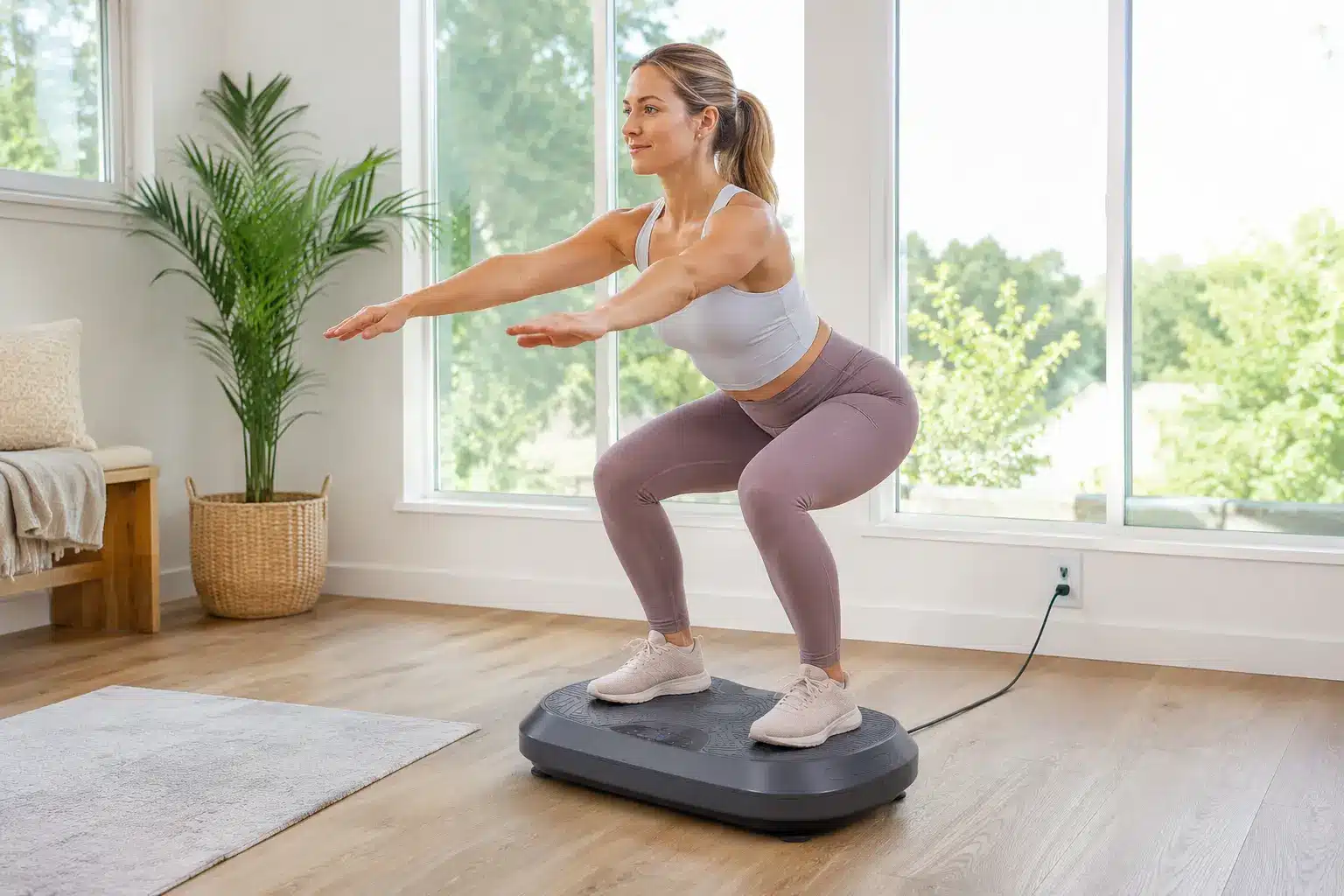
Squats make much better use of a vibration platform than simply standing still.
Once I bend at the hips and knees, the quadriceps, hamstrings, glutes, calves, and trunk have to work actively while the platform continues to move underneath me.
The Fitboard's broad deck gives enough room to experiment with different squat widths.
I would start conservatively, though. Adding vibration to an exercise changes how it feels, so there is little reason to combine the highest setting with a demanding squat variation on day one.
Lunges and Split Positions
The platform can also be incorporated into split-stance positions and variations where one foot remains on the plate.
This is where the large surface becomes useful.
I generally prefer vibration plates that give me enough usable deck space to do something beyond standing shoulder-width apart. The Fitboard's 30.7-inch overall length gives it a much more substantial footprint than many compact plates.
Tabletop and Upper-Body Positions
Sunny specifically demonstrates the machine being used in positions beyond standing, including tabletop-style exercises.
Placing the hands on a vibration platform changes where the vibration enters the body. Instead of primarily traveling through the legs, the stimulus begins through the hands and arms.
That creates more possibilities for upper-body and core work.
I wouldn't turn every push-up or plank into a vibration exercise just because the machine allows it, but the option makes the Fitboard more versatile than a plate intended primarily for passive standing.
Seated Use
The machine can also be used while seated.
One practical option is sitting on a chair with the feet on the platform rather than standing directly on it.
That makes the machine more approachable for lighter recovery sessions or for someone who doesn't want their full body weight on the plate.
For anyone managing lymphatic conditions, my guide on the best vibration plates for lymphedema covers the gentler options I'd recommend for that situation.
It also gives you another way to vary how vibration is transmitted.
16 Intensity Levels
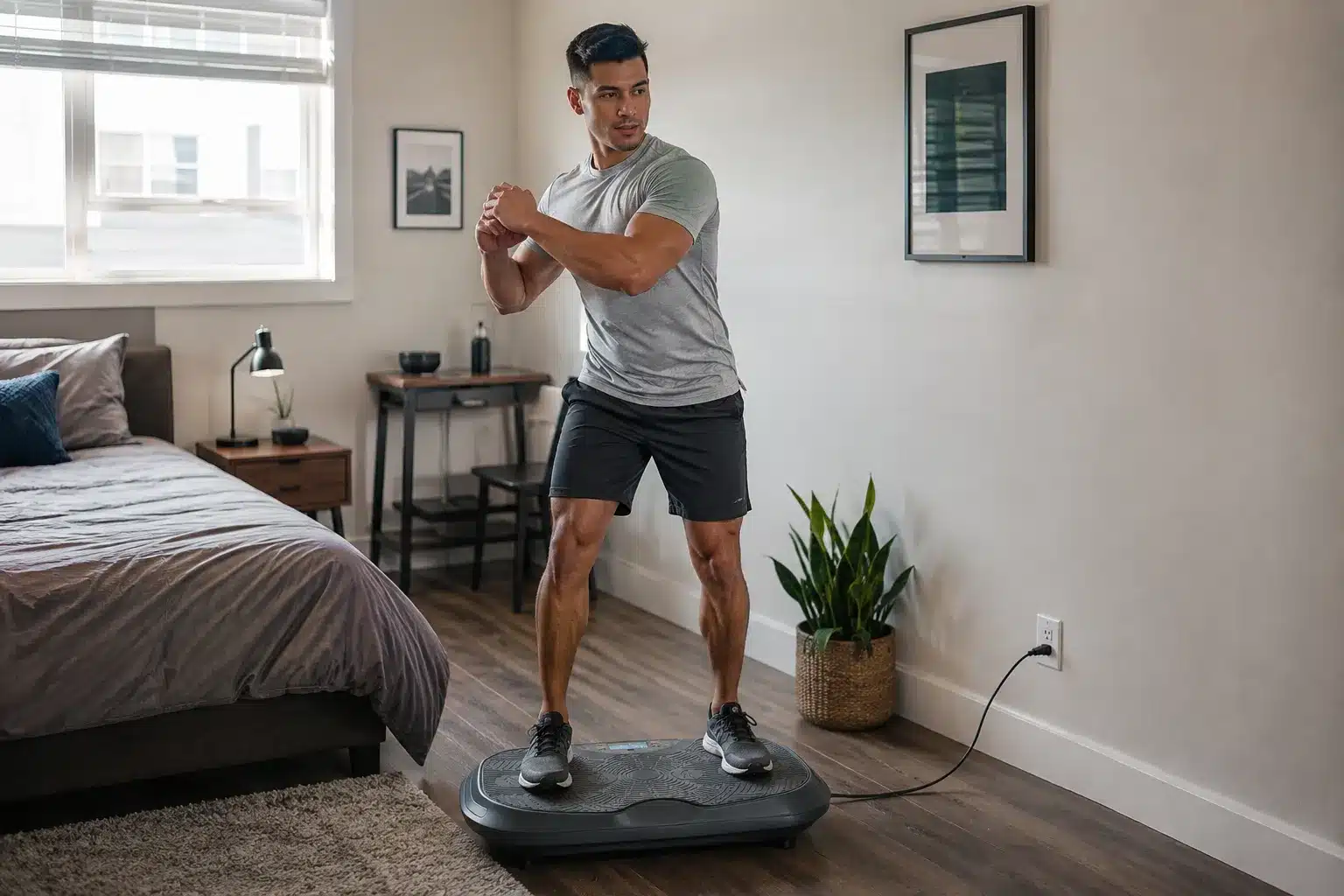
At first glance, 16 settings might sound unimpressive next to machines advertising 99, 120, or even 180 speeds.
I don't see that as a problem.
I'd rather have 16 usable levels across a documented operating range than 120 numbers that tell me almost nothing about the actual frequency.
There is also a practical usability advantage.
Going from Level 4 to Level 5 means something noticeable enough to make progression simple. I don't need to spend time wondering whether Speed 73 is meaningfully different from Speed 74.
For beginners, I would start low and get comfortable with each movement pattern independently.
That means trying the vertical and translational modes before immediately jumping into combined 3D vibration at a higher intensity.
Once the movement feels familiar, increasing the level gradually makes more sense.
Three 10-Minute Preset Programs
The Fitboard 3D includes three automatic programs, and each one lasts 10 minutes.
The programs automatically vary the speed during the session.
I see preset programs as useful mainly for convenience.
Sometimes I don't want to spend an entire vibration session reaching for the controls and deciding when to change levels. A preset lets the machine handle that.
For beginners, they also provide some structure.
For more deliberate exercise sessions, however, I generally prefer manual control. If I'm holding a squat, performing band curls, or doing a particular mobility exercise, I want to choose the movement mode and intensity that suit that exercise rather than letting a program dictate the changes.
So I like that the programs are there, but they aren't the main reason I would choose this plate.
Detachable Resistance Bands
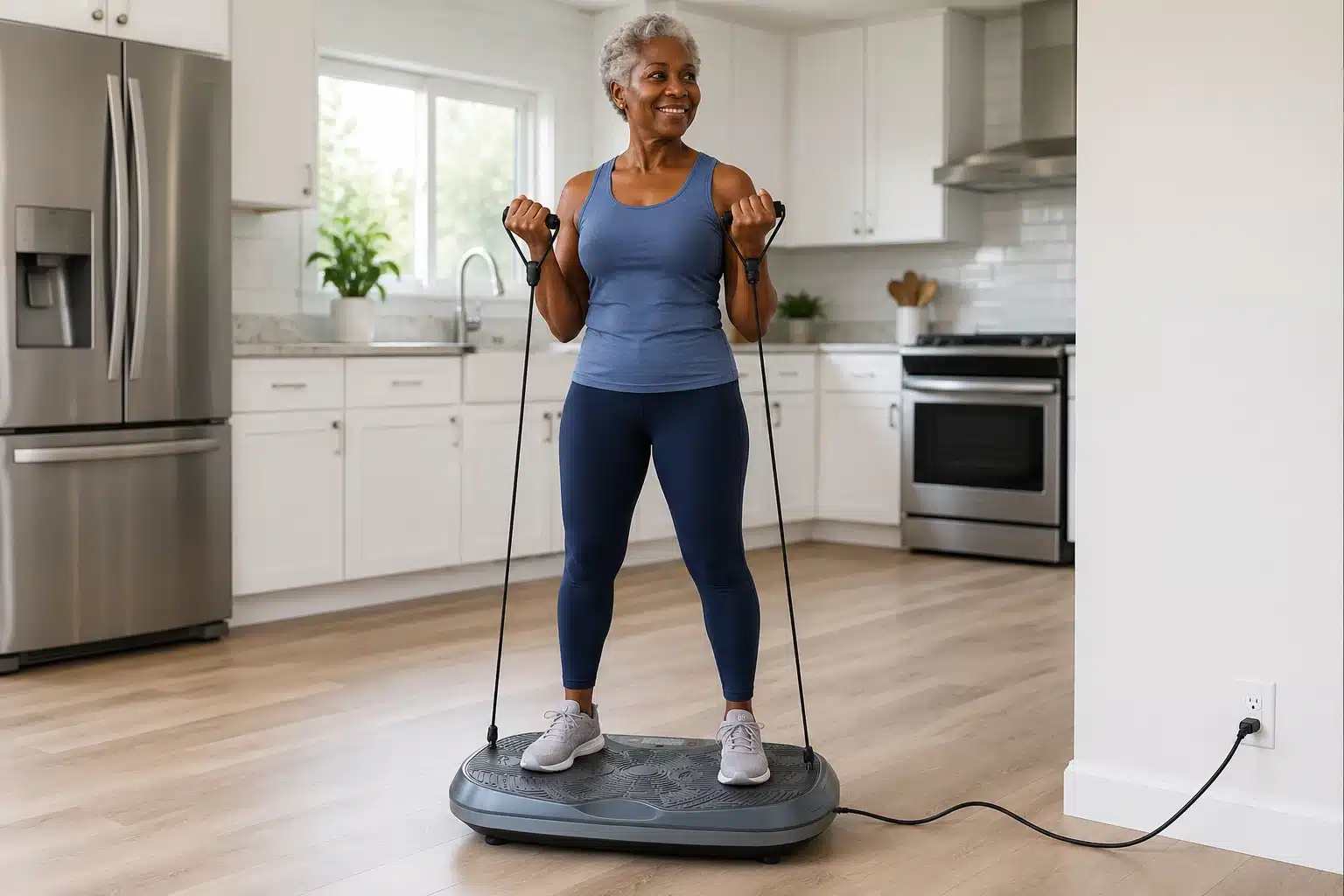
Sunny includes two resistance bands that attach to the platform.
This sounds like a small extra, but it does broaden what you can do with the machine.
You can perform exercises such as:
- Biceps curls
- Front raises
- Lateral raises
- Upright pulling movements
- Squat-and-curl combinations
- Other basic band exercises
I particularly like resistance bands on a vibration plate when they're used to make the session more active.
Instead of standing there waiting for ten minutes to pass, I can work the upper body while maintaining an active lower-body position.
That gives the session more purpose.
If using a vibration plate to support weight loss is part of your plan, my picks for the best vibration plates for weight loss cover the machines I'd prioritize for that goal.
At the same time, I wouldn't oversell the bands. They don't transform the Fitboard into a complete strength-training system, and they aren't a substitute for progressively loaded dumbbells, barbells, machines, or a good standalone resistance-band setup.
They're an accessory.
A useful one, but still an accessory.
Platform Size and Exercise Space
The Fitboard measures 30.7 inches long and 18.3 inches wide, with a height of 6.7 inches.
That is a reasonably generous footprint for a home vibration platform.
I like wider platforms because they allow more freedom with stance.
On a tiny plate, you're often forced into whatever foot position the deck allows. Here, there is substantially more room to adjust.
The top surface is textured and designed to provide grip.
That's particularly important when performing squats or other movements because the body is already adapting to the vibrating surface. Slipperiness is the last variable I want to add.
The 6.7-inch height is worth considering if you're doing exercises where one foot is on the machine and the other remains on the floor. That's enough elevation to alter body positioning noticeably.
Build Quality and Stability
The 43-pound machine weight is one of the Fitboard's strongest physical characteristics in my view.
There's always a balance with home fitness equipment.
Make a vibration plate too light and it becomes convenient to carry but potentially less planted during harder vibration. Make it enormous and heavy and nobody wants to move it.
The Fitboard falls somewhere in between.
Forty-three pounds is substantial enough that I wouldn't call it lightweight, but it's still manageable because Sunny built transport wheels into the chassis.
The underside also uses suction cup stabilizers.
On a clean, suitable hard surface, those should help resist movement while the machine is operating.
I would still pay attention to the floor underneath it. Vibration doesn't magically stop at the machine, and the amount transferred into the floor will depend partly on the flooring material and construction of the room.
Noise and Vibration Transfer
Sunny doesn't provide a model-specific sound-pressure measurement that I can verify, so I'm not going to invent a decibel number.
That's one area where vibration plate reviews often get too casual. Describing something as “whisper quiet” without an actual measurement doesn't tell us much.
What I can say is that the Fitboard has multiple mechanical movement modes and a fairly substantial chassis.
Where you place it will matter.
A vibration plate on a solid ground-floor surface is a very different situation from the same machine sitting on a lightweight upstairs floor.
If floor vibration is a concern, I'd experiment with an appropriate equipment mat and keep the machine away from objects that can rattle against walls or furniture.
I'd also make sure the platform is level before using it.
A machine that isn't seated properly can create more unwanted movement and noise regardless of how good the motors are.
Controls and Digital Display
The control system is straightforward. The central digital monitor displays:
- Workout mode
- Program
- Speed
- Time
That's enough information for the type of machine this is.
I don't need a giant touchscreen on a vibration plate. I want to know which mode I'm using, my intensity, whether I'm running a program, and how much time remains.
Sunny gives you onboard controls as well as a remote. The remote is more useful than it might sound.
Once you're standing in position, squatting, or using the resistance bands, repeatedly stepping off the plate just to change settings gets irritating quickly.
Being able to make adjustments without breaking position makes the whole experience smoother.
SunnyFit App
Sunny also promotes access to its SunnyFit app ecosystem.
The app includes trainer-led workouts, programs, fitness tracking tools, challenges, and other training content.
I view this as supplementary rather than central to the Fitboard 3D itself.
The important distinction is that I wouldn't buy this machine expecting it to behave like an advanced connected fitness device where every vibration parameter is automatically synchronized from the plate into the app.
For me, SunnyFit is more useful as a source of workout ideas.
That's particularly valuable with vibration plates because many people buy one, stand on it for a few minutes each day, and never explore the different exercises that can be performed on or around the machine.
A workout library can help solve that problem.
Moving and Storing the Fitboard 3D
At 43 pounds, this isn't what I would call truly portable. You can move it, but I wouldn't want to carry it from room to room every day. Fortunately, Sunny includes built-in transport wheels.
The sensible way to move it is to lift the opposite side and roll the machine rather than repeatedly picking up the entire 43-pound platform.
Its 6.7-inch height also makes storage easier than a larger vibration platform with handrails.
Whether it fits underneath your particular bed, sofa, or cabinet obviously depends on the available clearance, so I'd measure first rather than assuming.
Personally, I'd rather leave a vibration plate accessible if space allows.
Fitness equipment that requires a ten-minute furniture rearrangement before every workout has a habit of getting used less often.
Setup and Everyday Usability
One thing I appreciate about this type of platform is that there isn't a complicated frame to assemble.
You're dealing with a self-contained floor unit rather than a large machine with upright posts, consoles, handlebars, and multiple structural components.
The resistance bands attach to the platform, and the remote provides the secondary control method.
From there, the more important part of setup is choosing the right location.
I want:
a stable surface, enough clearance around the machine, access to power, and enough room to perform exercises safely without hitting furniture.
I also wouldn't wedge the Fitboard tightly between a wall and a cabinet simply because the chassis technically fits there. Once you start adding squats, band movements, or floor exercises, surrounding space matters.
The 265-Pound Weight Limit
The maximum supported user weight is 265 pounds.
That's adequate for many people, but it is not especially high for such a substantial 43-pound machine.
This is one specification I would check carefully before buying.
If you're close to the stated limit, I wouldn't treat it as an invitation to squeeze in under the number. The manufacturer sets a maximum for a reason.
There are vibration plates with higher capacities available, so heavier users may be better served by a different model.
For everyone comfortably below the limit, the Fitboard's physical construction otherwise looks reassuringly substantial.
What I Like About Sunny Health & Fitness as the Manufacturer
A vibration plate is only part of the equation. I also look at the company standing behind it.
Sunny Health & Fitness has been around the home exercise equipment market for a long time and sells far more than vibration platforms. Its catalog includes bikes, rowers, treadmills, steppers, strength equipment, and other home fitness machines.
More importantly for this particular review, Sunny provides model-specific support material for the SF-VP822057.
There are instructions covering internal servicing procedures such as fuse removal, access to the bottom frame, control-board removal, and power-switch replacement.
I find that reassuring.
I'm not suggesting the average owner should start dismantling a vibration plate. Electrical and mechanical repairs should be approached appropriately.
But the existence of model-specific service documentation tells me there is at least an actual support infrastructure behind the machine.
That's preferable to purchasing a generic platform where the entire troubleshooting process consists of emailing an unknown marketplace seller.
For anyone prioritizing home-friendly options from established manufacturers, my picks for the best vibration plates for home use cover the machines I'd recommend for that context.
Warranty
Sunny covers the Fitboard 3D structural frame for one year and other parts and components for 180 days.
The frame coverage is straightforward.
I'm less enthusiastic about only six months of coverage for the other components.
A vibration plate contains motors, electronics, controls, switches, and moving parts. Those are exactly the areas where longer coverage would give me more peace of mind.
So although Sunny's established support network is a positive, I would still call the parts warranty one of the Fitboard 3D's weaker points.
Who Is the Fitboard 3D Best For?
I think this plate makes the most sense for someone who has moved beyond the basic question of “Do I want a vibration plate?” and is now asking what type of vibration they want.
The three movement options give you more room to experiment than a conventional single-motion platform.
I particularly like it for people who want to combine vibration with exercise rather than just passive standing.
Squats, resistance-band movements, tabletop positions, seated sessions, warm-ups, and other body positions can all make use of the wider platform and multiple vibration patterns.
The translational mode is also relevant for anyone focused on circulation and lymphatic support, and I cover the plates best suited for that application in my guide to the best vibration plate for lymphatic drainage.
For people managing joint pain, my guide on the best vibration plates for arthritis covers the models I'd prioritize for low-impact joint work.
It's also appealing to anyone who values technical transparency.
Knowing the actual frequency and amplitude is surprisingly uncommon in this market, and I give Sunny credit for publishing those numbers.
For older adults who value documented vibration specs and multiple operating modes, my guide on the best vibration plates for seniors covers the machines I'd recommend for that group.
Who Should Skip It?
The Fitboard 3D won't suit everyone.
I'd look elsewhere if you:
- Weigh more than the 265-pound maximum
- Specifically want a high-frequency vertical vibration platform
- Need handlebars or a support rail
- Want an extremely light machine you can carry frequently
- Need an unusually compact plate
- Want longer component warranty coverage
- Only want basic side-alternating vibration and have no interest in multiple movement modes
The last point is important.
The strongest reason to choose the Fitboard 3D is its movement versatility.
If that feature doesn't matter to you, a simpler vibration platform may make more sense.
Pros and Cons
Pros
- Three genuinely different vibration configurations
- Vertical and horizontal movement can operate independently
- Combined 3D vibration mode
- Verified frequency specifications
- Verified amplitude specifications
- 16 straightforward intensity levels
- Three automatic 10-minute programs
- Large textured non-slip surface
- Solid 43-pound machine weight
- Detachable resistance bands
- Remote control
- Built-in transport wheels
- Suction cup stabilizers
- Seated and standing exercise options
- Model-specific support and maintenance documentation
- Established home-fitness manufacturer
Cons
- 265-pound capacity is lower than some competing vibration plates
What’s Included?
The Fitboard 3D setup includes the main vibration platform, two detachable resistance bands, and a remote control.
The bands connect directly to the machine so you can add upper-body movements without needing a separate anchor point.
The remote is particularly useful once you're already standing or exercising on the plate.
Fitboard 3D vs a Basic Oscillating Vibration Plate
This is where I think the purchase decision becomes much easier.
A typical entry-level oscillating plate uses a single see-saw style movement. The left and right sides rise and fall alternately around a central pivot.
That can be perfectly useful.
The Fitboard 3D simply gives you more options.
Instead of changing only the intensity of one mechanical pattern, you can choose vertical movement, horizontal movement, or combine them.
That gives you another variable to work with alongside speed, stance, exercise position, and session duration.
The Fitboard is also physically substantial at 43 pounds and comes with unusually detailed technical documentation.
If all you want is straightforward oscillation, none of that necessarily makes it the better choice.
If you specifically want multidirectional vibration, that's where the Fitboard becomes far more interesting.
Fitboard 3D vs Fitboard 4D
Sunny also offers a Fitboard 4D, which naturally raises the question of whether 3D is enough.
The key thing to remember is that these labels belong to Sunny's own product hierarchy.
The 3D already gives you separate vertical and horizontal movement plus their combined mode.
The 4D expands the available combinations and adjustment options further.
I wouldn't automatically assume more modes make the higher model better for everyone.
More adjustment is useful if you'll actually use it.
For many home users, three clearly different vibration configurations already provide plenty of variety without making operation unnecessarily complicated.
That's part of why I like the balance Sunny struck with the 3D.
My Verdict on the Sunny Health & Fitness Fitboard 3D
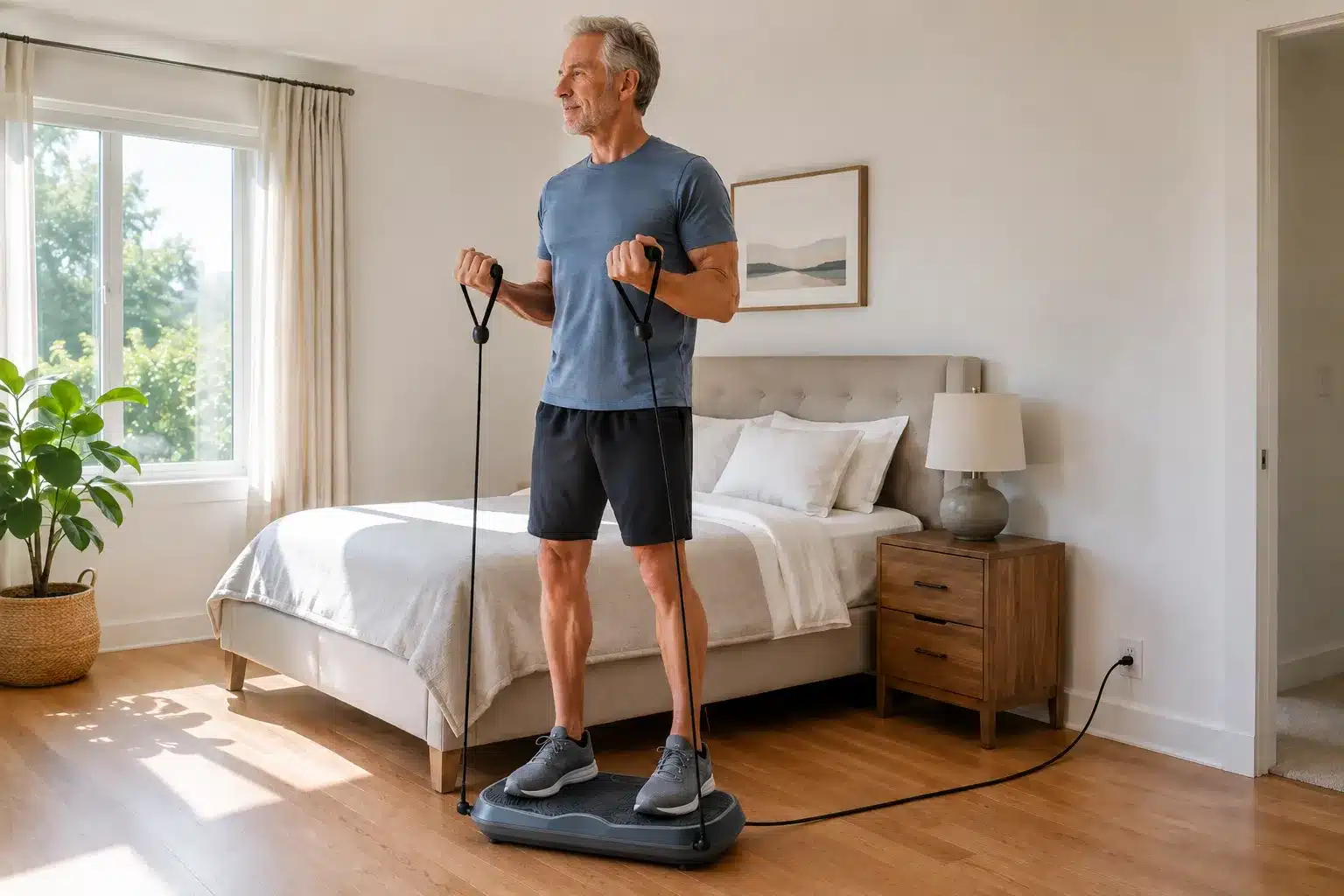
The Sunny Health & Fitness Fitboard 3D SF-VP822057 is one of the more technically interesting home vibration plates I've examined.
The biggest reason is simple: the 3D system actually changes the way the platform moves.
You aren't merely choosing between dozens of arbitrary speed numbers. You can use vertical vibration, translational vibration, or combine the two.
Sunny then backs that up with something I wish more vibration plate manufacturers provided: real frequency and amplitude data.
The 3.42 to 7.67 Hz vertical range, 2.45 to 5.7 Hz translational range, 17 mm vertical amplitude, and 14 mm translational amplitude make it possible to understand what sort of platform you're dealing with instead of relying on marketing terminology alone.
I also like the broad non-slip surface, 43-pound chassis, resistance bands, remote, transport wheels, suction stabilizers, and straightforward 16-level control system.
There are weaknesses.
The 265-pound user limit could be higher, and I'm not impressed by the 180-day warranty on parts and components outside the structural frame.
Still, the overall package makes sense.
If I wanted a multidirectional vibration plate for home use and specifically valued having more than one mechanical movement pattern, the Fitboard 3D would be firmly on my shortlist.
What gives it the edge over many lesser-known competitors isn't one flashy feature. It's the combination of useful multidirectional vibration, published technical data, solid construction, exercise versatility, and the support infrastructure of Sunny Health & Fitness.
That's a much more convincing foundation for a vibration plate than a huge speed number printed on an Amazon listing.
If you're still comparing options across the broader market, my breakdown of the best vibration plates covers the full range of machines I'd consider at different price points and goals.
FAQs
Is the Sunny Fitboard 3D a real 3D vibration plate?
Yes, the Fitboard 3D uses two distinct movement systems. It can produce vertical up-and-down vibration, horizontal translational vibration, or operate both systems simultaneously.
“3D” itself isn't a universal scientific classification for vibration plates, but in this case it describes genuine differences in the platform's movement rather than simply different speed settings.
What frequency does the Sunny Fitboard 3D use?
The vertical up-and-down mode operates between 3.42 and 7.67 Hz. The translational vibration system operates between 2.45 and 5.7 Hz.
In combined mode, both systems operate together within their respective ranges.
What is the amplitude of the Fitboard 3D?
Sunny specifies 17 mm ±10% vertical amplitude and 14 mm ±10% translational amplitude.
These are manufacturer-provided figures for the SF-VP822057 rather than estimates from a similarly named model.
How many speed settings does the Fitboard 3D have?
It has 16 intensity levels.
I don't consider the relatively small number a disadvantage because Sunny also provides the machine's actual frequency ranges. Sixteen practical increments are enough to create meaningful progression without padding the controls with dozens of tiny steps.
What movement does the Fitboard 3D produce?
It can operate in three configurations: vertical up-and-down movement, horizontal translational vibration, and combined vibration using both systems.
That multidirectional capability is the defining feature of the machine.
Can beginners use the Sunny Fitboard 3D?
Yes. Beginners can start at a low intensity and use a basic standing position with slightly bent knees before progressing to stronger vibration or more demanding exercises.
I would become comfortable with each vibration mode separately before using more intense combined sessions.
Can I sit while using the Fitboard 3D?
Yes. The platform can be incorporated into seated sessions as well as standing, squat, chair-pose, bridge, and tabletop positions.
One simple seated option is sitting in a chair and placing the feet on the vibrating platform.
Does the Fitboard 3D have resistance bands?
Yes. It includes two detachable resistance bands anchored to the platform.
They can be used for movements such as curls and raises while standing on the machine.
What is the Fitboard 3D weight limit?
The maximum user weight is 265 pounds.
Users above that limit should choose a vibration plate with a higher manufacturer-rated capacity.
How heavy is the Sunny Fitboard 3D?
The machine weighs 43 pounds.
Built-in transportation wheels help with moving it without having to carry the entire platform.
How large is the Fitboard 3D?
Its dimensions are 30.7 inches long, 18.3 inches wide, and 6.7 inches high.
That gives it a fairly substantial exercise surface compared with many compact vibration platforms.
Does the Fitboard 3D come with a remote?
Yes. The included remote allows you to adjust the machine without repeatedly stepping off the platform.
You can also operate it through the controls around the central digital display.
What does the Fitboard 3D display show?
The digital monitor shows workout mode, program, speed, and time.
The interface is deliberately straightforward rather than trying to function as a full smart fitness console.
How long are the automatic programs?
There are three preset programs, each lasting 10 minutes.
The programs automatically vary the speed during the session.
Does the Sunny Fitboard 3D connect directly to the SunnyFit app?
Sunny provides access to the SunnyFit fitness ecosystem and promotes its workout content alongside the Fitboard.
However, I haven't found sufficient model-specific documentation establishing that the SF-VP822057 itself transmits its vibration settings or workout metrics directly to the app, so I would treat SunnyFit primarily as an accompanying workout resource rather than a core connected feature of the plate.
What is the Fitboard 3D warranty?
Sunny specifies a one-year warranty on the structural frame and 180 days on other parts and components.
The relatively short component warranty is one of the weaker aspects of the machine in my opinion.
Is the Sunny Health & Fitness Fitboard 3D worth considering?
Yes, particularly if you specifically want multidirectional vibration rather than a conventional single-motion platform.
Its strongest qualities are the three vibration configurations, published frequency and amplitude specifications, substantial chassis, wide exercise surface, resistance bands, and support from an established fitness equipment manufacturer.
Healthcare and Medical Disclaimer
The information provided on Vibration Plate Zone is for general informational purposes only and is not intended to replace professional medical advice, diagnosis, or treatment. Always seek the guidance of a qualified healthcare provider with any questions you may have regarding a medical condition, and never disregard or delay seeking professional advice.