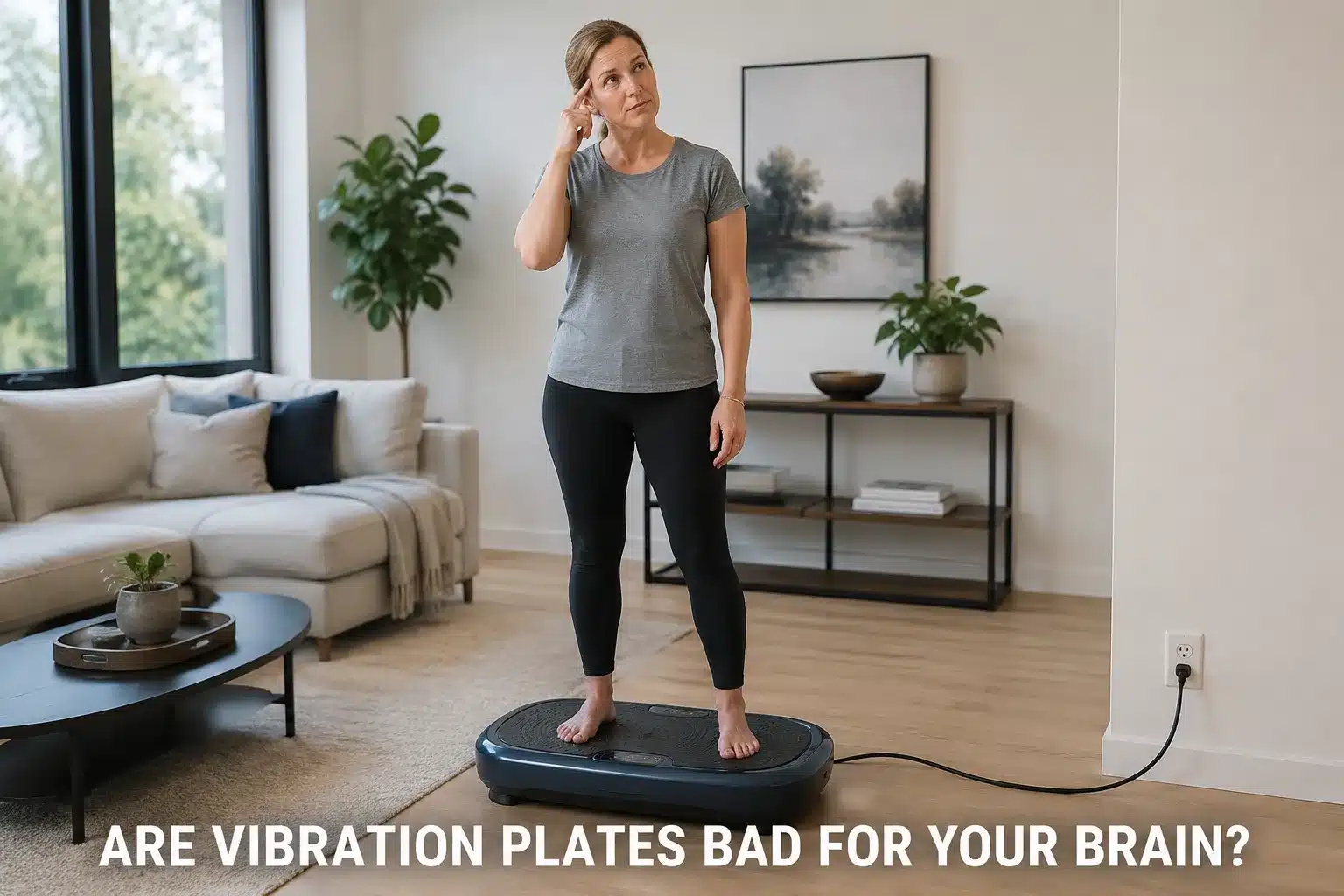
Are vibration plates bad for your brain? Current research does not show that properly used consumer vibration plates cause brain damage in healthy adults.

About the author: Hello! I’m Vladimir Stanar, professor of physical education, kinesiotherapist, marathon runner, cyclist, and cycling coach, and long-time advocate of health, fitness, and active living.
My journey with vibration plates runs parallel to my professional career in education, sports medicine, and athletic development. I’ve developed a unique process for testing vibration plates as they are some of the most versatile tools for enhancing health, recovery, and performance.
✅ Expert-Reviewed by: Vanja Vukas, MPhEd
📚 Expert Contributor: Milutin Tucakov, MPhEd
The vibration can sometimes reach the head, especially when someone stands with locked knees, selects an intensity that is too strong, or uses poor posture. This may cause temporary symptoms such as headache, dizziness, blurred vision, or an unpleasant shaking sensation, but those symptoms are not the same as brain injury.
Is a vibration plate bad for your brain? The answer depends on the exposure profile: the occupational vibration research that raises concerns involves very different conditions from a short home fitness session, and the symptoms users sometimes experience are uncomfortable but not equivalent to brain injury.
Research into whole body vibration has even examined possible benefits for cognition, balance, and neurological rehabilitation. The evidence is still developing, so vibration plates should be used sensibly rather than treated as completely risk free.
Vibration plates should be used sensibly rather than treated as completely risk free, since the mechanical forces they transmit through the body can produce uncomfortable symptoms at high settings and should be managed through appropriate stance, frequency, and duration choices.
Why People Worry About Vibration Plates and Brain Health
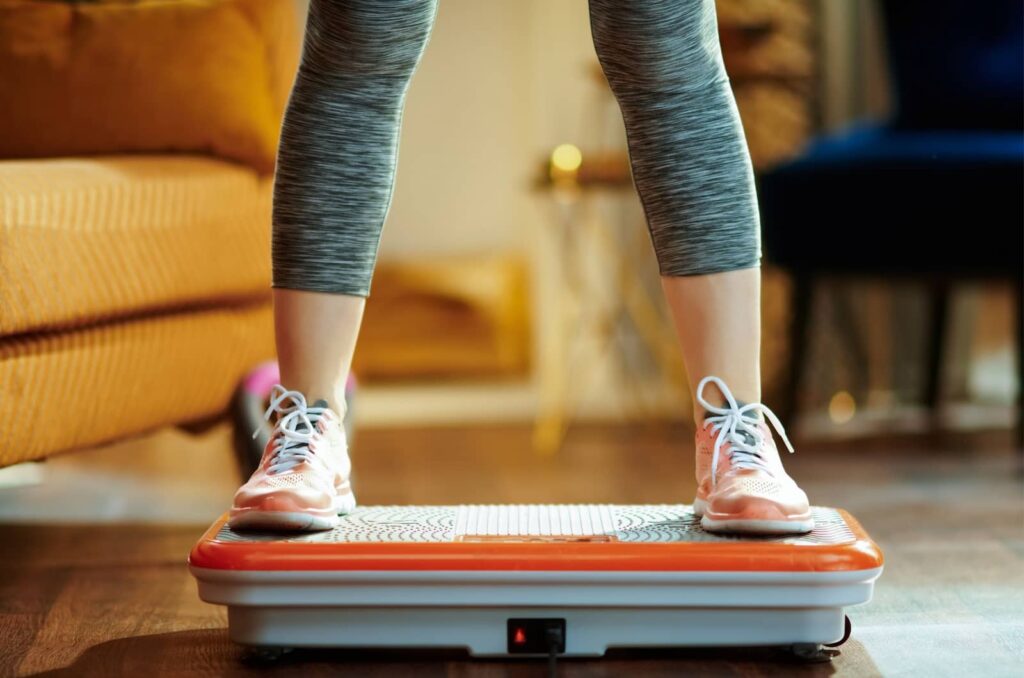
The concern usually begins with a simple observation. When you stand on a vibration plate, your legs, torso, and sometimes your head may visibly shake.
The visible head movement that some users experience on a vibration plate occurs because the oscillation travels up through the legs, spine, and neck, and minimizing that movement through posture and setting adjustments is more important than simply continuing regardless of how much shaking occurs.
That movement can look alarming. People often compare it with the violent head motion involved in a concussion, a car crash, or shaken baby syndrome, even though the forces and circumstances are very different.
Vibration plate brain damage is a concern that arises from comparisons with shaken baby syndrome or sports concussion, but these analogies do not hold because the forces, frequencies, and mechanical characteristics of consumer vibration plates are fundamentally different from traumatic impact events.
A concussion usually follows a blow to the head or a sudden acceleration and deceleration event that causes the brain to move rapidly within the skull. A vibration plate produces repeated mechanical oscillations through the feet over a controlled period.
Vibration plate nervous system effects include the sensory input generated by mechanical oscillations through the feet and legs, which the proprioceptive and vestibular systems process and which is responsible for both the beneficial muscle activation and the uncomfortable symptoms some users report.
Those two types of exposure should not be treated as equivalent. A short, controlled vibration session does not produce the same type of impact loading normally associated with traumatic brain injury.
Vibration plate brain damage risk from consumer plate use at recommended settings is not supported by the current literature, which distinguishes between the type of impact loading associated with traumatic brain injury and the controlled mechanical oscillation of a fitness platform.
Concern also comes from occupational health research. Heavy machinery operators, truck drivers, construction workers, and agricultural workers may experience whole body vibration for many hours per day over many years.
The workers in occupational vibration studies experience whole body vibration for many hours per day across years, and the neurological effects observed in that population cannot be applied to a home user performing a fifteen-minute session three or four times per week.
That type of exposure has been linked mainly with spinal, muscular, and lower back problems. It cannot be directly compared with a home session lasting ten or fifteen minutes.
A home session lasting ten or fifteen minutes at consumer settings cannot be directly compared with the cumulative exposure of occupational whole body vibration, since the dose, duration, and daily repetition are orders of magnitude different between the two contexts.
How Vibration Plates Affect the Body
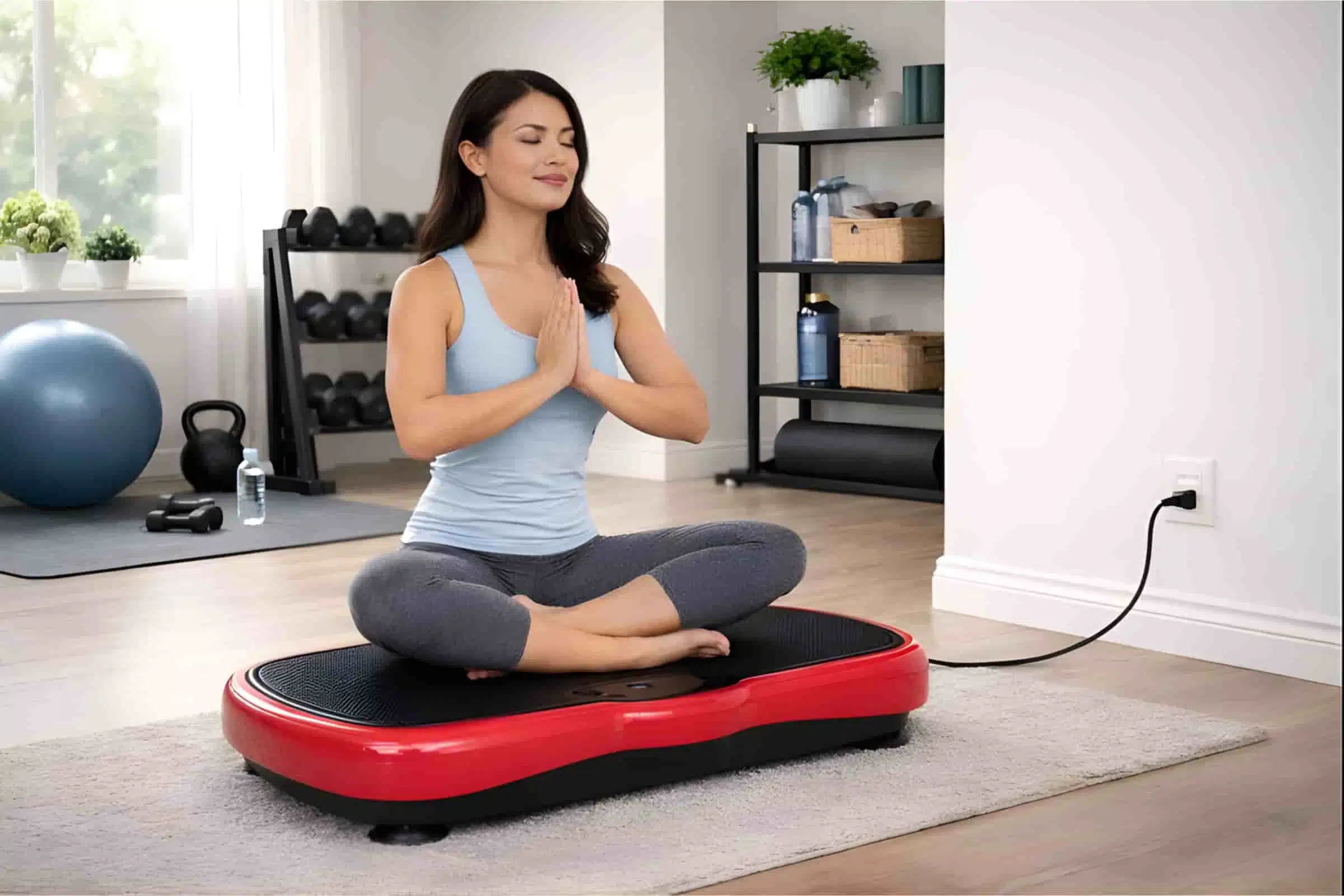
A vibration plate creates mechanical movement beneath the feet. The body responds with rapid muscle contractions that help maintain posture and balance.
Vibration plate nervous system activation through rapid muscle contractions helps maintain posture and balance during a session, and this postural reflex activity is one of the primary mechanisms through which the plate produces its training effect on the lower limbs.
The amount of vibration reaching the head depends on the machine, frequency, amplitude, vibration direction, stance, joint position, and body composition. A gentle oscillating plate used with bent knees will usually feel very different from a high frequency linear plate used with stiff legs.
How much vibration reaches the head depends on whether the plate uses oscillation or linear motion, at what frequency and amplitude, and whether the user stands with soft or locked knees, since these variables collectively determine how much of the mechanical stimulus is attenuated before it reaches the cervical spine.
The knees, hips, and ankles act as natural shock absorbers. Keeping these joints slightly flexed allows the muscles and soft tissues to absorb more of the vibration before it reaches the spine and head.
A soft-knee stance allows the lower limb muscles to absorb more of the vibration before it reaches the spine and head, and users who notice visible head movement during a session should adjust their stance toward a more flexed knee position before considering any other change.
Locked knees reduce that cushioning effect. This is why a person may notice more shaking around the jaw, eyes, or head when standing completely upright.
Frequency also changes the experience. Higher frequency means that the platform completes more vibration cycles each second, while amplitude describes how far it moves during each cycle.
Vibration plate amplitude describes how far the platform moves during each cycle, and while frequency determines the rate of oscillation, amplitude determines the displacement and directly influences how much mechanical force is transmitted through the skeleton to the upper body.
A high frequency and large amplitude combination can create a much stronger mechanical stimulus. Beginners should not assume that the highest setting provides the best results.
Users should not assume that the highest setting provides the best results: high frequency combined with high amplitude increases both the training stimulus and the transmission to the upper body, and for health-focused use there is no clinical justification for pushing into the extreme ranges.
Can Vibration Plates Damage the Brain?
There is currently no convincing evidence that normal vibration plate use causes structural brain damage in healthy adults. Published exercise studies have used whole body vibration in older adults, athletes, and people with neurological conditions without identifying traumatic brain injury as a typical outcome.
Studies on whole body vibration and neurological health have so far not identified traumatic brain injury as a typical outcome of consumer plate use, but this does not mean that head shaking during sessions should be disregarded as a sensory experience with no implications.
This does not prove that every machine and every training method is safe. Long term data are limited, and poorly controlled exposure could cause uncomfortable symptoms or aggravate an existing condition.
High-frequency settings on a vibration plate could cause uncomfortable vestibular symptoms or aggravate an existing condition such as benign paroxysmal positional vertigo, which is why users with a history of balance disorders, inner ear conditions, or motion sensitivity should proceed cautiously.
The type of movement linked with traumatic brain injury usually involves forceful head acceleration, rapid rotation, impact, or sudden deceleration. Consumer vibration plates create repetitive motion, but the vibration reaching the head is normally much lower when posture and settings are appropriate.
The transmission of vibration to the head is normally much lower when posture and settings are appropriate, and a user who manages stance, frequency, and session duration within sensible limits will experience significantly less cervical loading than one who uses maximum settings with rigid posture.
Using a powerful plate incorrectly may still feel unpleasant. If your vision shakes, your teeth chatter, or your head moves strongly, the setting is probably too intense for your current posture.
Can vibration plates cause vertigo? In users with vestibular sensitivity, the mechanical input from high-frequency plate use can temporarily disrupt balance processing, and sessions that produce persistent dizziness or spinning sensations indicate that the current setting is too intense for that individual.
Reducing the speed or frequency, switching to a lower amplitude, and bending the knees should reduce the amount of vibration reaching the head. A session should stop if symptoms continue after those changes.
What Research Says About Brain Function
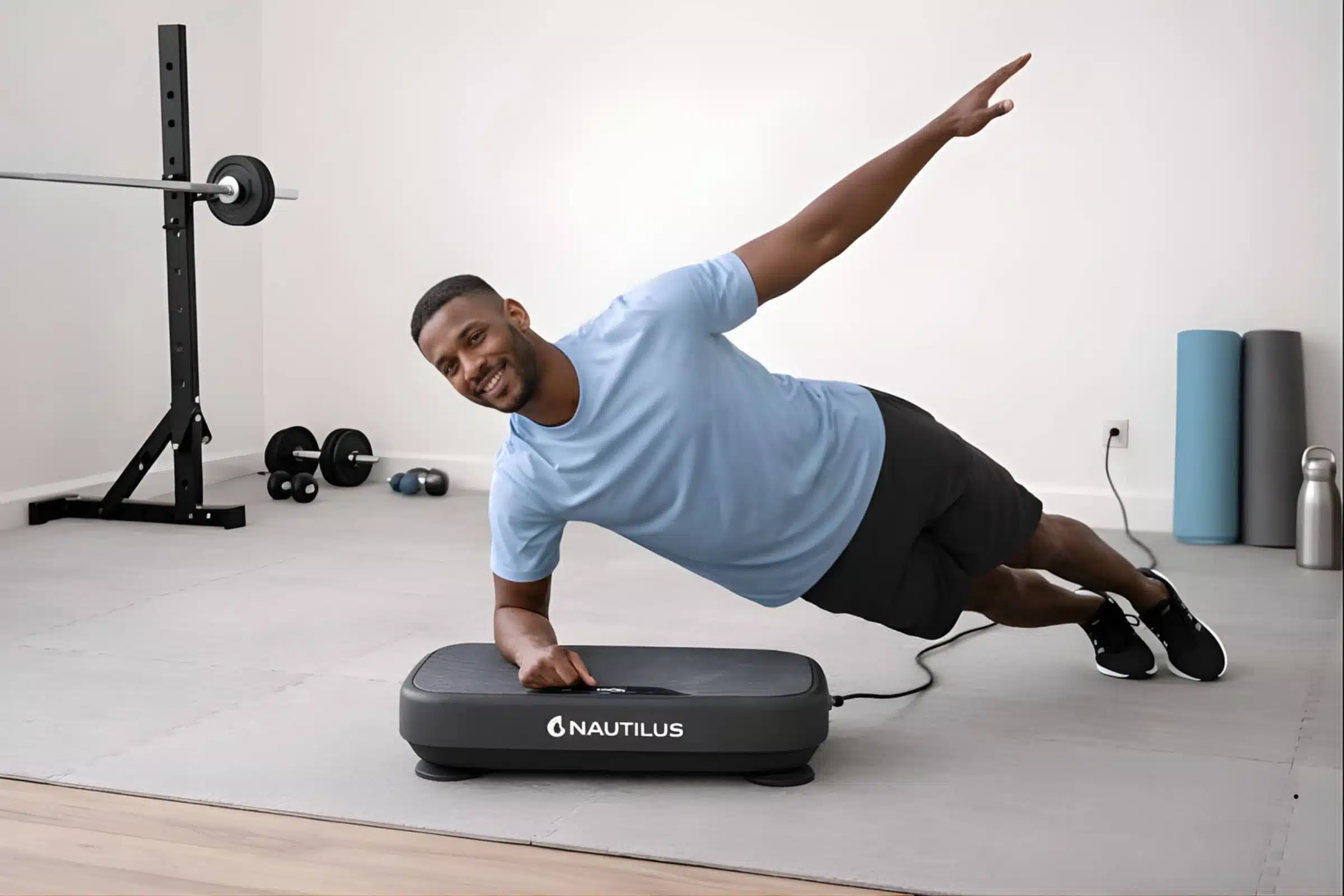
Research does not only examine possible harm. Several studies have investigated whether whole body vibration may affect attention, executive function, memory, and general cognitive performance.
Does power plate improve brain function? Some small studies have examined cognitive measures in older adults following whole body vibration training and found modest improvements in attention, executive function, and memory, though these are preliminary findings in specific populations rather than established benefits.
A systematic review published in 2023 examined whole body vibration and cognition. The authors found possible improvements in some cognitive outcomes, particularly among older adults and people with certain neurological conditions.
Vibration plate cognitive benefits have been studied primarily in older adults and people with certain neurological conditions, where the combination of physical activation and sensory input may support the systems that contribute to attention, balance, and coordination.
The results were not consistent across every study. Vibration frequencies, session lengths, body positions, participant health, and cognitive tests differed widely.
The cognitive improvement findings in vibration plate research are difficult to interpret definitively because study designs, body positions, participant health, session parameters, and cognitive assessments differed considerably across trials.
This makes it difficult to identify one ideal protocol. The findings are promising, but they do not support using a vibration plate as a treatment for dementia, brain injury, or another neurological disorder.
Using a vibration plate as a treatment for dementia, brain injury, or another neurological disorder is not supported by the current evidence: the small studies showing cognitive improvements addressed performance on specific tests in healthy older adults, not clinical treatment of established neurological conditions.
Possible cognitive effects may be related to increased circulation, sensory stimulation, balance demands, or changes in nervous system activity. These explanations remain under investigation.
The mechanisms proposed to explain vibration plate effects on the nervous system, including increased blood flow, sensory input, and autonomic nervous system activity, remain under investigation and should not be presented as established explanations for cognitive or neurological benefits.
For plates evaluated specifically for circulation support, my guide to the best vibration plate for circulation covers models that perform well for that kind of low-intensity routine.
A vibration plate should still be viewed as exercise equipment. Any possible brain related benefit is a developing research area rather than a guaranteed result.
Vibration plate brain health benefit is best understood as a developing research area rather than a guaranteed result, and the more conservative claim that gentle whole-body vibration contributes to physical activation and sensory stimulation in older adults is better supported than claims about specific cognitive improvements.
Can Too Much Vibration Reach the Head?
Yes, too much vibration can reach the head if the machine is used poorly. This is more likely with high intensity settings, straight legs, long sessions, or a vibration type that feels too aggressive for the user.
Users who find that high-frequency sessions trigger vestibular discomfort should try shorter sessions, lower frequency settings, or a vibration type that feels less aggressive, since sensitivity to mechanical oscillation varies considerably between individuals.
Linear plates move the whole platform vertically at the same time. This can send a direct vibration through both legs, especially when the knees are locked.
Standing with locked knees directs vibration through both legs without the attenuating effect of soft knee flexion, which increases transmission through the pelvis, spine, and upper body and is the primary postural mistake that leads to excessive head vibration during sessions.
Oscillating plates create an alternating side to side motion. Many people find this gentler, although the experience still depends on amplitude, speed, stance, and the design of the machine.
How much vibration reaches the head in any session depends on amplitude, speed, stance, and the design of the machine, and managing the first three variables is within the user's control during every session.
For a complete explanation of how oscillating and linear platforms compare in terms of mechanics and health effects, my guide to whole body vibration covers the full picture.
Head movement is not automatically dangerous. A small amount of transmitted vibration can occur during normal use, but strong head shaking should not be treated as something to tolerate.
Strong head shaking during a vibration plate session should not be treated as something to tolerate because the timer has not finished: it is a signal to reduce intensity, adjust posture, or stop the session entirely.
Headache, dizziness, nausea, visual disturbance, disorientation, unusual fatigue, or loss of balance are signs to stop. Continuing because the session timer has not finished is not sensible.
Continuing a vibration session because the timer has not finished, despite experiencing head shaking or vestibular discomfort, reflects a misunderstanding of how to use the machine safely and is not a sensible approach regardless of the frequency setting selected.
Readers dealing with neck pain alongside these concerns can also review my guide on vibration plate for neck pain relief, which covers how vibration affects the cervical spine and which posture adjustments reduce upper body transmission.
Adjusting the spine posture and identifying which stance adjustments reduce upper body vibration transmission is a more productive response to head movement than simply reducing the speed, since postural correction addresses the primary cause rather than reducing total stimulus.
Occupational Vibration Is Not the Same Exposure
Research on occupational vibration sometimes raises concerns about nervous system health. Workers may sit or stand on vibrating machinery for several hours at a time, often while also experiencing shocks, poor posture, noise, and physical strain.
The vibration dose in occupational exposure contexts, where workers experience mechanical oscillation for many hours per day over years, can be far greater than that of a short home fitness session, and this distinction is what makes the occupational research findings non-transferable to consumer plate use.
Exposure may continue five days per week for many years. The total vibration dose can be far greater than that of a short home fitness session.
Occupational safety standards therefore consider vibration magnitude, direction, daily duration, posture, and cumulative exposure. These limits are designed for workplace conditions rather than ten minute exercise sessions.
The comparison is still useful because it shows that vibration dose matters. A short session at an appropriate intensity is different from prolonged daily exposure, but more is not always better.
For users who need gentle, low-dose sessions for bone health alongside general fitness, my picks for the best vibration plate for osteoporosis cover models with controlled frequency ranges suited to that goal.
Who Should Be More Careful?
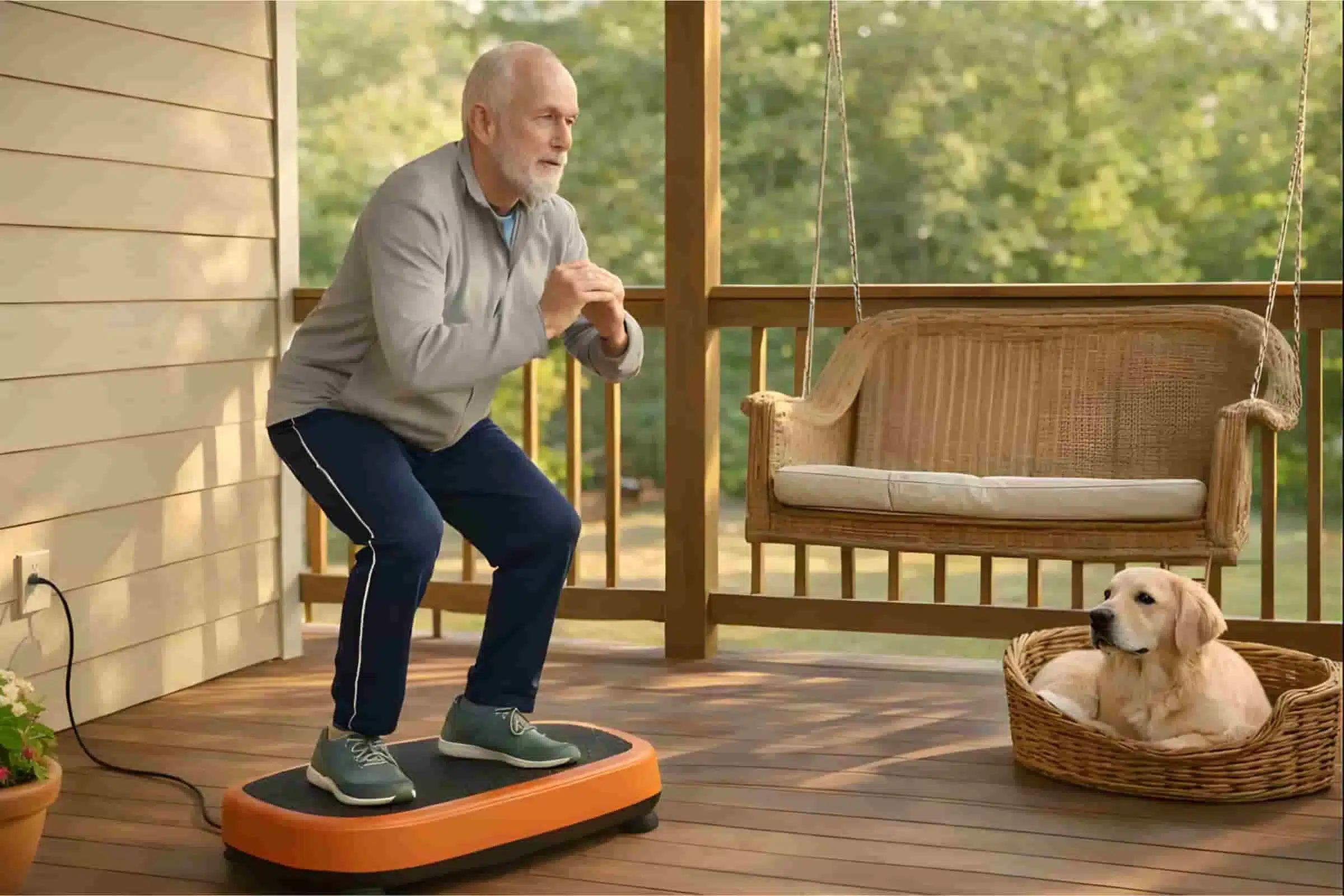
Anyone recovering from a concussion or traumatic brain injury should get medical clearance before using a vibration plate. Symptoms such as headache, light sensitivity, dizziness, nausea, balance problems, and difficulty concentrating may be aggravated by motion or sensory stimulation.
For a broader list of conditions that require caution or avoidance, my guide to the dangers of vibration machines covers the full range of contraindication groups.
People with epilepsy, severe vertigo, vestibular disorders, recent brain surgery, or unexplained neurological symptoms should also speak with a healthcare professional. The same applies to anyone whose symptoms become worse during or after vibration. People managing elevated blood pressure face a related cardiovascular consideration, and my guide on using a vibration plate with high blood pressure covers the circulatory load these devices place on the system and what clearance looks like in that context.
If you have a nervous system condition that makes you more sensitive to vibration, my guide to the best vibration plate for neuropathy covers models suited to low-intensity controlled use.
A person with migraines may find that strong vibration triggers discomfort, even though this does not mean the brain has been damaged. Individual tolerance matters, and a setting that feels comfortable to one user may feel excessive to another.
The same principle applies to joint conditions, and my picks for the best vibration plate for arthritis focus on models with gentle, adjustable settings suited to users with lower tolerance.
Older adults with poor balance should use stable support. Flexible resistance bands are not a reliable substitute for a fixed rail or another solid structure.
If you are choosing a plate for low-impact daily use with safety as the priority, my picks for the best vibration plate for seniors cover models with stable handles and gentle oscillating settings.
How to Reduce Vibration Reaching Your Head
Keep your knees slightly bent during standing exercises. This allows the legs to absorb more vibration and usually reduces shaking through the spine, neck, and head.
Start with the lowest practical setting. Increase the intensity gradually across several sessions instead of testing the maximum level on the first day.
For a full breakdown of how different frequency ranges affect the body and which settings suit different goals, my guide to frequencies in vibration plates explains how to choose the right range.
Use a balanced stance with both feet fully supported. Foot position can change the intensity, so moving farther toward the outside edges of an oscillating platform may make the vibration stronger.
Keep early sessions short. Five to ten minutes gives you time to judge how your body responds during the session and later that day.
Do not ignore head related symptoms. Stop if you develop a headache, dizziness, nausea, blurred vision, confusion, or unusual pressure in the head.
Check the floor and machine stability too. A plate that rocks, slides, or transfers excessive vibration through a flexible floor may create a less controlled experience.
For guidance on stance, session length, and frequency settings that minimize unwanted vibration transmission, my guide on how to use a vibration plate properly covers the setup variables in detail.
For a list of reliable home machines with stable builds and consistent output, my guide to the best vibration plate for home use covers models I have tested for everyday use.
My Take on Vibration Plates and Brain Safety
Properly used vibration plates do not appear to be bad for the brain in healthy adults. Current evidence does not show that normal home use causes concussion or structural brain damage.
If you are ready to choose a machine, my breakdown of the best vibration plate covers options across every budget and use case.
Technique still matters. Strong settings, locked knees, poor posture, and sessions that continue despite symptoms can turn a manageable stimulus into an unpleasant experience.
I would start gently, keep the knees relaxed, and treat strong head shaking as a sign to reduce the intensity. Anyone with a recent concussion, brain injury, neurological condition, or persistent dizziness should seek individual medical guidance before using a vibration plate.
For older adults navigating these concerns, my guide on vibration plate for elderly covers how to structure safe sessions with reduced intensity and appropriate support.
The question of brain safety mostly arises from confusion between two distinct exposures. Occupational whole-body vibration, experienced by truck drivers, forklift operators, and heavy equipment workers, involves prolonged daily exposure at specific resonance frequencies that can cause chronic neurological fatigue and vestibular disruption over years. Therapeutic vibration plates operate at different frequencies, for far shorter durations, and in controlled positions. The occupational research does not transfer directly to home use.
Session posture affects how much vibration reaches the head. Bent knees function as shock absorbers: soft, relaxed knees at 20 to 30 degrees of flexion reduce transmitted vibration to the torso and head. Locked knees transmit the full vibration impulse up through the skeleton. This is why every protocol recommends against standing rigid on the plate, and it is particularly relevant for people with vestibular sensitivity or a history of head injury.
The existing research on therapeutic vibration and cognitive function is actually encouraging rather than alarming. Several controlled studies have found that regular WBV training in older adults is associated with maintained or improved cognitive performance, including attention, executive function, and processing speed. The mechanism likely involves improved cerebral blood flow and BDNF expression, both of which support neurological health over time.
For a broader look at what the evidence shows across different vibration plate goals, my article on what vibration plates are actually effective for covers the key studies on muscle, circulatory, and cognitive outcomes.
FAQs
Can vibration plates cause brain damage?
There is no good evidence that properly used consumer vibration plates cause brain damage in healthy adults. The risk of uncomfortable head vibration rises when someone uses excessive intensity, locks the knees, or continues despite headache or dizziness.
Can a vibration plate cause a concussion?
A vibration plate is not known to cause concussion during normal use. Concussions usually involve a forceful impact or sudden head acceleration and deceleration, which is different from controlled whole body vibration.
Why does my head shake on a vibration plate?
Your head may shake on a vibration plate because some mechanical vibration travels upward through the legs and spine. Bending your knees, lowering the intensity, or switching to a gentler mode should reduce the amount reaching your head.
Should I use a vibration plate after a concussion?
You should use a vibration plate after a concussion only when a qualified healthcare professional has cleared you to do so. Motion, vibration, and balance demands may aggravate symptoms during recovery.
Can vibration plates improve brain function?
Vibration plates may improve some measures of cognitive function in certain groups, but the research is limited and inconsistent. They should not be considered a treatment for dementia, brain injury, or another neurological condition.
Should I stop if a vibration plate gives me a headache?
Yes, you should stop if a vibration plate gives you a headache. Rest, reassess your posture and settings, and seek medical advice if the headache is severe, persistent, or accompanied by neurological symptoms.
Notable Studies
3. Effects of whole-body vibration training on cognitive function: A systematic review