Affiliate Disclosure: Vibration Plate Zone is a proud participant in the Amazon Services LLC Associates Program.
If you are searching for a vibration plate for autoimmune disease, you are probably not expecting a miracle. Most people are looking for something more practical. They want to know whether a vibration plate may help them move a little more easily, feel less stiff, rebuild strength after inactivity, or deal better with fatigue and reduced mobility. That is the right way to approach this topic, because autoimmune diseases are not one single illness. They are a large group of conditions in which the immune system attacks healthy tissue, and there are more than 100 types affecting different organs and body systems.

About the author: Hello! I’m Vladimir Stanar, professor of physical education, kinesiotherapist, marathon runner, cyclist, and cycling coach, and long-time advocate of health, fitness, and active living.
My journey with vibration plates runs parallel to my professional career in education, sports medicine, and athletic development. I’ve developed a unique process for testing vibration plates as they are some of the most versatile tools for enhancing health, recovery, and performance.
✅ Expert-Reviewed by: Vanja Vukas, MPhEd
📚 Expert Contributor: Milutin Tucakov, MPhEd
As a licensed kinesiotherapist, I think that whole body vibration for autoimmune disease can make sense in some cases, but only if we frame it correctly. I do not see it as a treatment for autoimmune disease itself. I see it as a possible support tool for symptoms and function in certain situations, especially when someone is dealing with fatigue, deconditioning, weakness, balance problems, stiffness, or a very low exercise tolerance. That is also the safest angle supported by current niche coverage and the condition-specific evidence base, which is uneven and does not justify broad cure claims.
My honest view is this: a vibration plate may help some people with autoimmune symptoms, but it is not a universal solution, and it is definitely not something I would recommend the same way for every autoimmune disorder. The best use case is usually as a low-impact movement option during a stable phase or remission, or as a gentle re-entry into activity after a flare-up has reduced strength, balance, or confidence with movement.
What Is Autoimmune Disease, Really?
Autoimmune disease is not one diagnosis. It is a category. These conditions happen when the immune system attacks the body instead of protecting it, and they can affect joints, muscles, skin, blood vessels, the nervous system, the digestive system, and more. That is one reason the phrase “vibration plate for autoimmune disease” is tricky. The symptoms and limitations of rheumatoid arthritis are not the same as the symptoms and limitations of lupus, multiple sclerosis, Sjögren’s syndrome, or autoimmune connective tissue disease.
That matters a lot from an exercise point of view. If one person’s autoimmune symptoms are mostly joint stiffness and fatigue, and another person’s symptoms include dizziness, neurologic issues, or unstable balance, the same vibration routine may not make sense for both. This is why I always come back to function first. I want to know what the person is actually struggling with: fatigue from autoimmune disease, autoimmune pain, reduced mobility, muscle weakness, balance problems, low exercise tolerance, or all of the above.
Why “Autoimmune Disease” Is Too Broad for a One-Size-Fits-All Vibration Plan
This is the biggest point I would want a reader to understand. A lot of vibration-plate topics are fairly narrow, but autoimmune disease is different. It is broad enough that the phrase itself can become misleading if the article is not careful. There is no one-size-fits-all autoimmune exercise plan, because autoimmune diseases vary widely, symptoms vary widely, and exercise tolerance can vary widely too. That is why the strongest and safest framing is around function and symptom support, not direct treatment of autoimmune disease itself.
That is why I would never say, “A vibration plate is good for autoimmune disease,” as a blanket statement. The strongest and safest version of the topic is narrower: a vibration platform may support movement, balance, low-impact exercise, and physical function in some autoimmune-related situations. That is a much more honest claim, and it fits the evidence better.
The Symptoms People Usually Mean When They Search This Topic
When people search for this topic, I do not think they are usually asking whether a vibration machine changes the immune system directly. They are usually asking whether it can help with the day-to-day consequences of chronic illness. In practice, that usually means some combination of fatigue, joint stiffness, muscle weakness, reduced mobility, balance problems, low exercise tolerance, and deconditioning after flare-ups or long periods of inactivity.
That is exactly why this topic belongs more in the function and rehab space than in the disease treatment space. If someone has spent weeks or months moving less because of symptom flares, pain, or fatigue, even a very gentle tool can become meaningful if it helps them rebuild activity tolerance without overwhelming them.
Can a Vibration Plate Help Autoimmune Disease?
Yes, a vibration plate can help in some autoimmune-related situations, but I would define that help very carefully. If someone asks me, “Can a vibration plate help autoimmune disease?” my answer is usually that it may help with function and symptom management in some cases, but it does not treat autoimmune disease itself. I think it may be useful when someone needs low-impact movement, gentle muscle activation, support for balance and coordination, or a conservative way to counteract inactivity.
What I do not think is that vibration therapy for autoimmune disease is a cure, an anti-inflammatory treatment by itself, or a replacement for medical care. Autoimmune diseases are complex medical conditions that often require medication, monitoring, and individualized treatment planning.
If you are ready to explore options, my guide to the best vibration plate covers the top-rated machines tested across different budgets and health goals.
How a Vibration Plate May Help With Autoimmune-Related Symptoms
There are a few practical ways a vibration plate may help with autoimmune-related symptoms. It may provide a low-impact entry point into movement when normal exercise feels too demanding, support gentle muscle activation, help counteract deconditioning, and improve confidence with movement in people who feel weak, stiff, or less steady than usual. The most realistic benefit is support for function and activity tolerance, not direct treatment of the disease itself.
It may help during periods of fatigue and low exercise tolerance
This is one of the strongest real-world use cases. Many people with autoimmune disease are not looking for a hard workout. They are looking for a way to move at all without crashing afterward. A vibration plate may help by lowering the barrier to movement. If someone is too fatigued for a longer workout but can tolerate a short, low-intensity standing hold or a few gentle supported movements, that can still be useful.
For a broader look at how vibration plates address fatigue, deconditioning, and reduced exercise capacity, my guide on vibration plate benefits for elderly users covers many of the same challenges.
It may support balance, coordination, and confidence with movement
This is another area where I think WBV can make sense, especially in neurologic autoimmune conditions or in anyone who has become deconditioned.
From a practical standpoint, that matters because balance problems and coordination loss can make ordinary exercise more intimidating. Sometimes the value of a supported, low-impact platform is not that it transforms the body overnight, but that it helps the person move with less fear and more consistency.
For a deeper look at how vibration plates address alignment and movement confidence, my guide on posture correction with a vibration plate goes into the mechanisms and exercises in detail.
It may help counteract deconditioning after flare-ups
This is probably the most relatable section for many people.
Autoimmune conditions often come in waves. Symptoms flare. Activity drops. Strength drops. Stamina drops. Confidence drops. Then the person is left trying to rebuild after a period of inactivity.
I think this is where a vibration plate may fit best. Not as a treatment for the disease, but as a post-flare reconditioning tool. If someone is trying to get moving again after a rough period and needs a very gentle first step, that is where I am most open to using it.
For a machine suited to gentle reconditioning at home between flare-ups, my guide to the best vibration plates for home use covers compact models designed for daily low-intensity sessions.
It may support joint-friendly exercise
This is especially relevant in musculoskeletal autoimmune conditions.
If a person has inflammatory joint symptoms, weakness, or stiffness, traditional exercise may sometimes feel too demanding at first. A low-impact, short-session approach may be easier to tolerate.
For machines specifically tested for joint sensitivity and low-impact use, my roundup of the best vibration plates for arthritis covers the most relevant options.
What the Evidence Looks Like in Specific Autoimmune-Related Conditions
I think this section is important because it keeps the article honest.
Rheumatoid arthritis
This is one of the better examples for supportive WBV evidence. Some research has suggested possible benefits for functional ability and fatigue-related outcomes in people with established rheumatoid arthritis. That is very different from saying WBV treats rheumatoid arthritis, but it does support a practical conversation about symptom management and function.
For those whose autoimmune condition or its treatment has affected bone density, my guide to the best vibration plate for osteoporosis covers machines and frequencies suited to that goal.
Multiple sclerosis
MS is an autoimmune neurologic condition, and the WBV literature here tends to focus on mobility, muscle strength, balance, and postural control. Reviews and individual studies suggest there may be some positive short-term effects in these areas, though the evidence is not strong enough for sweeping claims.
For the sensory and nerve-related symptoms that sometimes accompany MS, my guide to the best vibration plates for neuropathy covers machines with the settings and stability features that matter most.
Lupus
This is where expectations need to stay more modest. Lupus is an autoimmune disease that can affect joints, blood, skin, kidneys, lungs, heart, and brain, and flare-ups can vary widely. Exercise can still be helpful, but the case for WBV here is not nearly as clear or as strong as it is in some other conditions.
That condition-specific pattern is exactly why I do not like broad claims around autoimmune disease as one category.
The same careful approach applies to hormonal claims, and my guide on vibration plate hormonal evidence covers what research actually shows for growth hormone, cortisol, insulin sensitivity, and other markers across study populations that include people with immune-related and metabolic conditions.
The same careful approach applies to hormonal claims, and my guide on vibration plate hormonal evidence covers what research actually shows for growth hormone, cortisol, insulin sensitivity, and other markers across study populations that include people with immune-related and metabolic conditions.
For those dealing with fluid retention or circulation issues alongside lupus, my guide to the best vibration plates for lymphatic drainage covers machines optimized for gentle fluid movement and circulation support.
What a Vibration Plate Cannot Do for Autoimmune Disease
A vibration plate does not cure autoimmune disease. It does not replace medical treatment, specialist care, or condition-specific management. It also does not work the same way for every autoimmune disorder. Even if it helps with fatigue, reduced mobility, or balance, that still does not mean it is addressing the disease process itself. It is a supportive tool, not a substitute.
If back or spinal pain is part of your autoimmune symptom picture, I cover the appropriate approach in my guide on using a vibration plate for back pain.
So even if a vibration plate helps with autoimmune fatigue, reduced mobility, or balance, that does not mean it is addressing the disease process itself. It is a supportive tool, not a substitute.
The Type of Person Who May Benefit Most
In my experience, the best candidate for a vibration plate in this context is usually someone who has autoimmune-related fatigue or low exercise tolerance, has become deconditioned from inactivity, feels weak or stiff rather than acutely inflamed, needs a low-impact starting point, and is in a relatively stable phase rather than an active flare. That is the kind of person I picture when I think of this tool as a practical support option.
Several autoimmune and chronic conditions, including hypothyroidism and certain neurological disorders, are directly associated with constipation; my guide on vibration plate and constipation covers the direct evidence and how the tool may or may not fit into a broader management plan.
I am much less enthusiastic when the person is in an acute flare, highly symptomatic, dizzy, medically unstable, or dealing with a condition where upright standing or vibration could be poorly tolerated. In those cases, I want much more caution and usually medical input first.
For older adults managing autoimmune conditions, platform stability and handrail support become especially important, which I address in my roundup of the best vibration plates for seniors.
A Very Practical Rule of a Licensed Kinesiotherapist
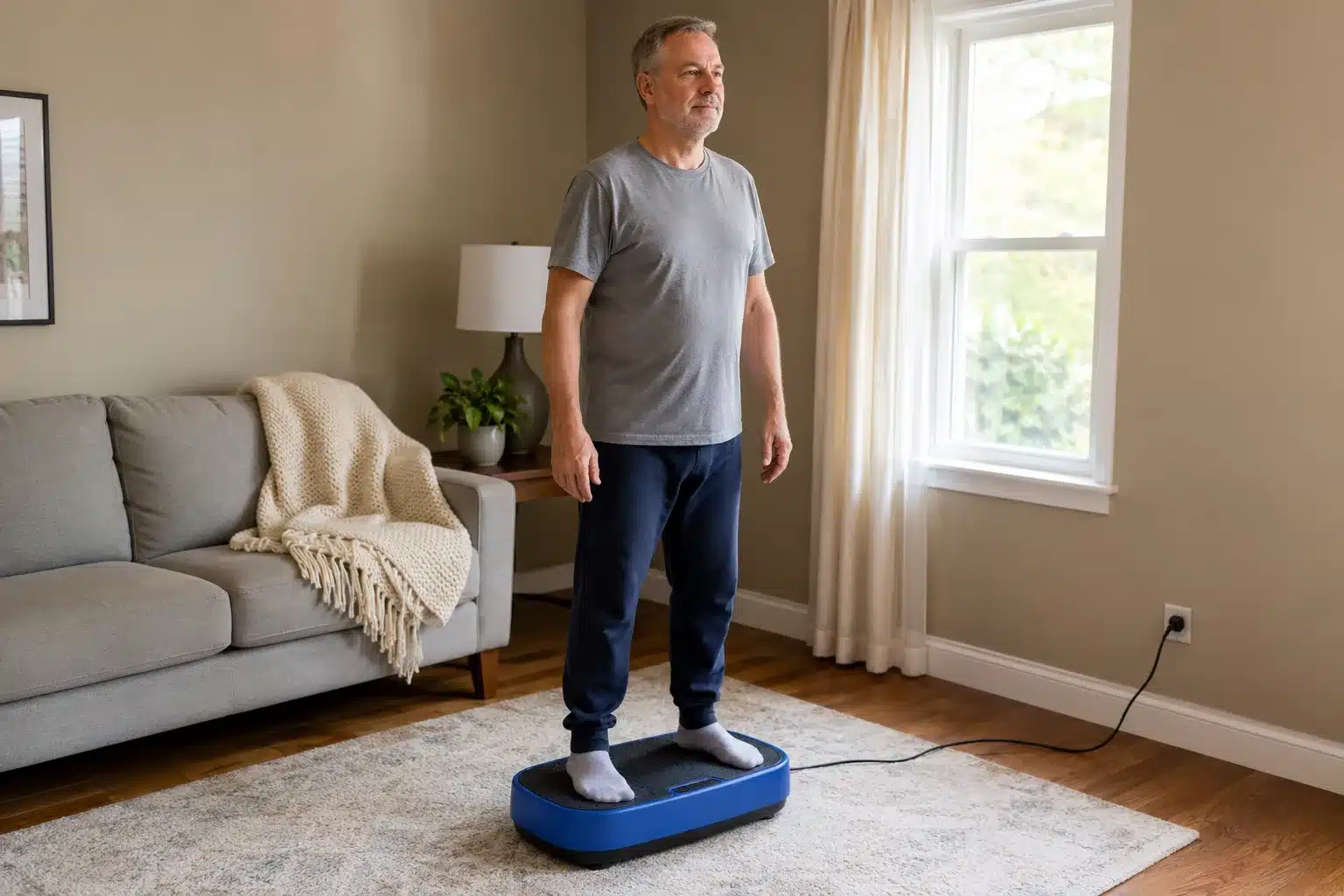
If the main problem looks like fatigue, stiffness, weakness, poor balance, low exercise tolerance, and post-flare deconditioning, I am more open to cautious vibration work.
If the person is in an active flare-up, highly symptomatic, dizzy, unstable, or medically complex, I become much more conservative.
A simple example: if someone tells me, “I feel weak and wiped out after a flare, and I need a gentle way to start moving again,” I think a conservative vibration routine may be worth considering. If someone tells me, “I am in the middle of a bad flare, everything feels inflamed, and even standing feels awful,” I am not thinking about more stimulation. I am thinking about symptom control, pacing, and medical guidance.
For those whose autoimmune condition affects fluid balance or immune circulation, my guide on using a vibration plate for lymphatic drainage explains how to approach this as a complementary tool.
How to Use a Vibration Plate Safely With Autoimmune Disease
If you want to try a vibration plate for autoimmune disease, I would keep the approach conservative. Start with low-intensity vibration, short sessions, and slow progression. Use it as a support tool, not as a hard workout. Track fatigue, pain, balance, and overall symptom response carefully, and avoid aggressive use during active flare-ups.
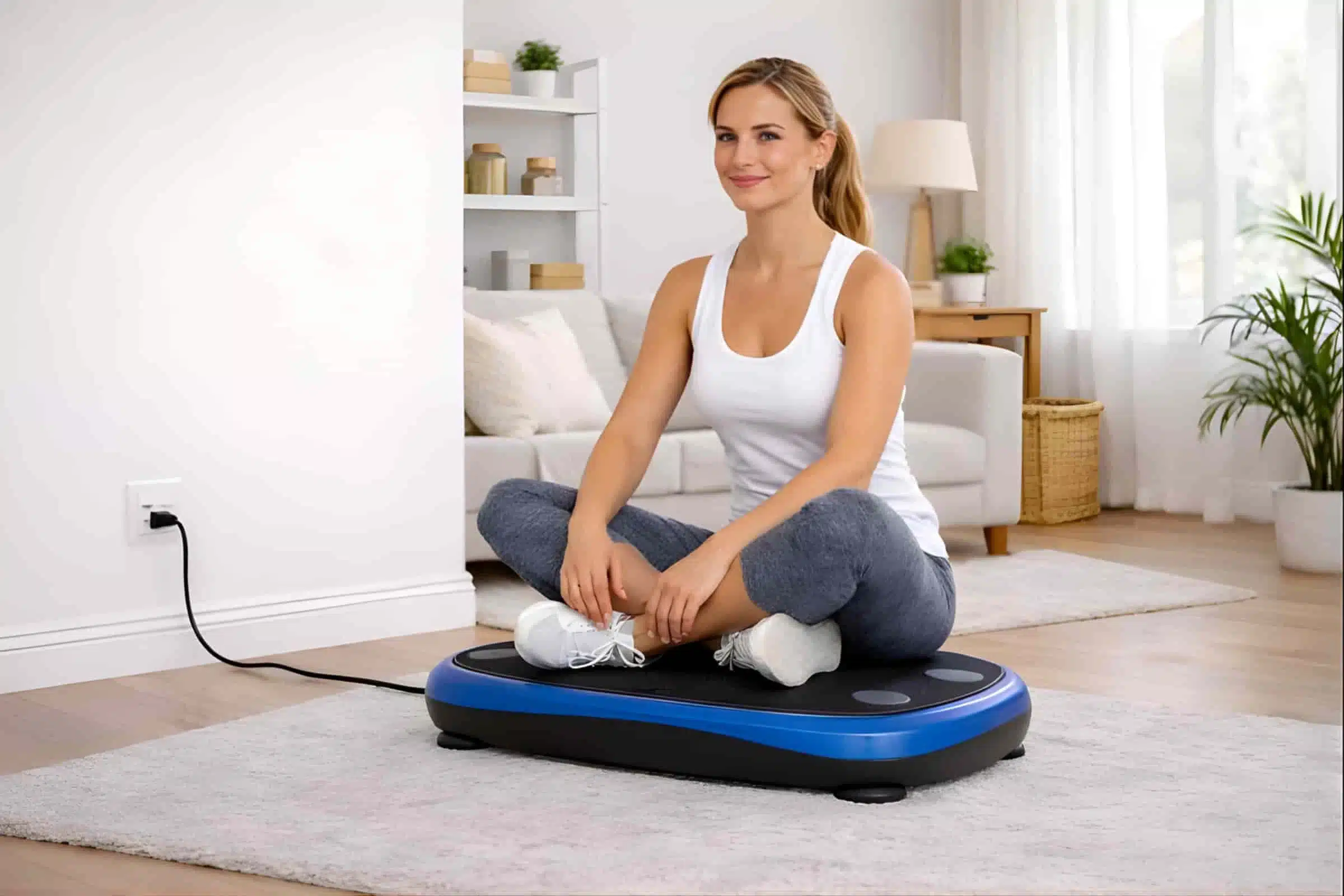
I also think seated vibration plate use can be a reasonable option for some people, especially if standing tolerance is poor. A gentle standing hold, a supported balance stance, or a few small movements may be enough at first. The point is not intensity. The point is to find out whether the body responds positively without triggering more fatigue or symptom worsening.
If symptoms worsen, stop. If dizziness increases, stop. If fatigue spikes far beyond normal afterward, stop. This is not a topic where pushing through makes sense.
For a detailed guide on settings, session length, and how to progress safely when starting out, my article on how to use a vibration plate safely walks through each variable in detail.
Best Vibration Plate Exercises for Autoimmune-Related Fatigue and Deconditioning
I would keep this exercise section simple.
Gentle standing hold
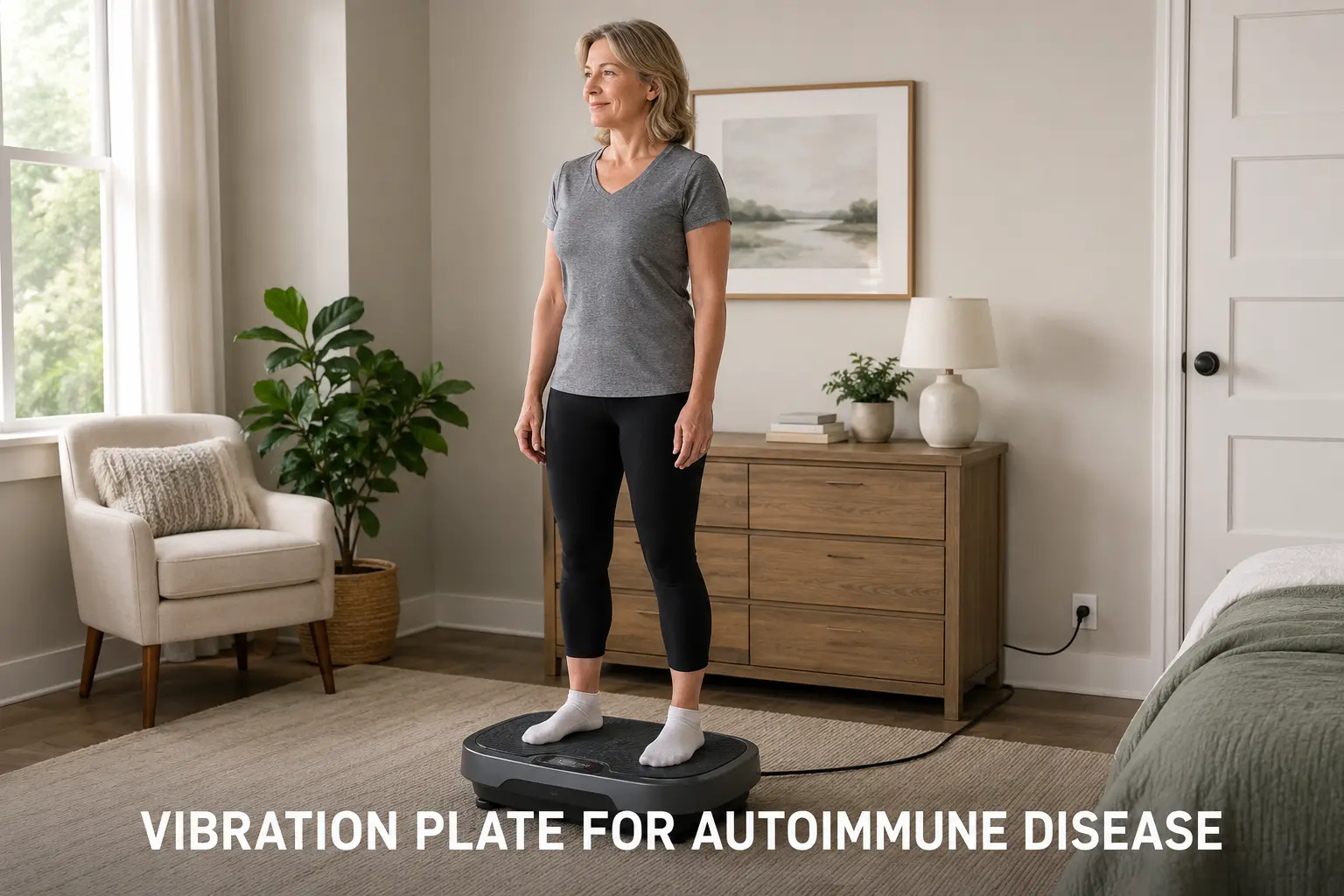
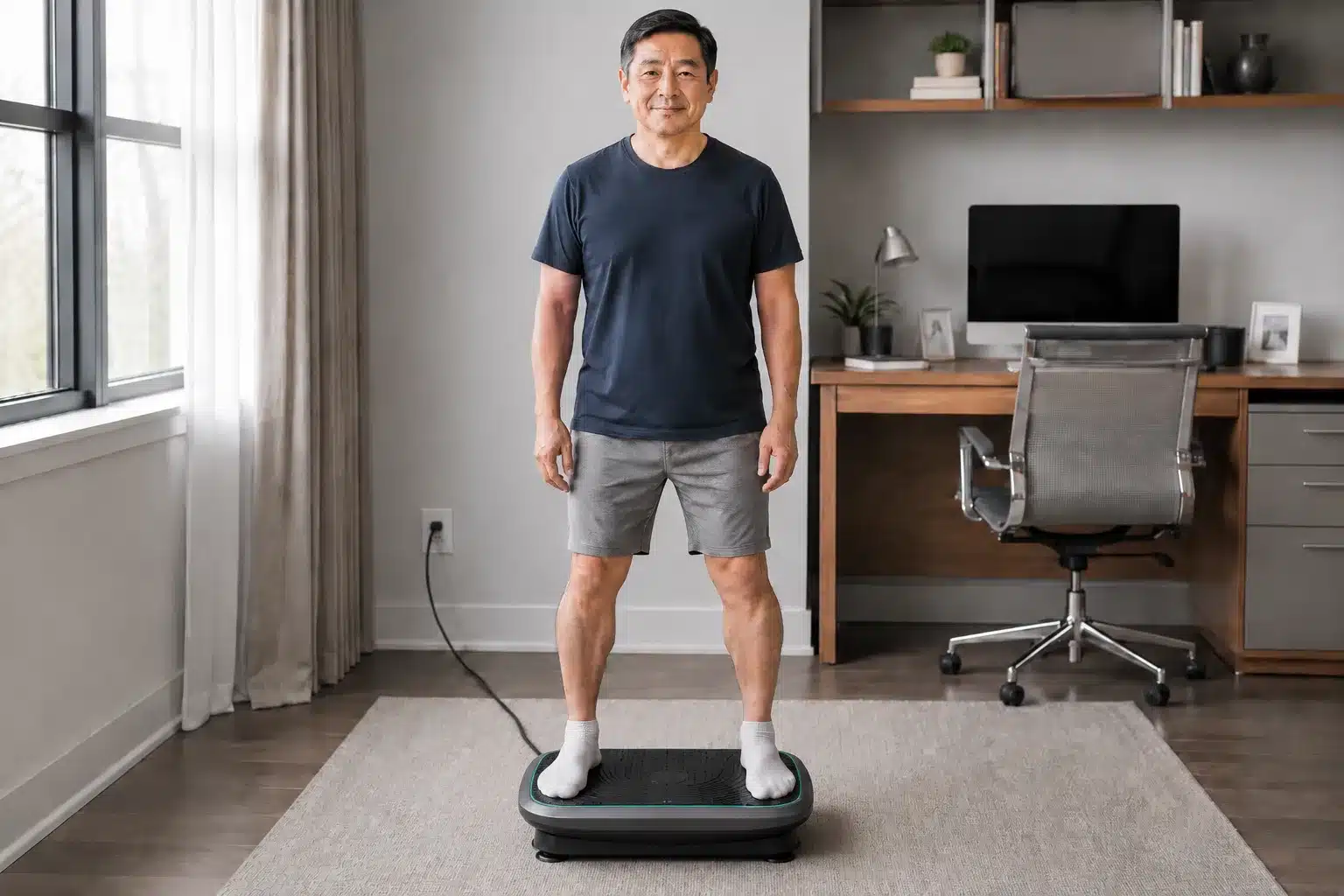
This is often the easiest starting point. Stand with soft knees, good posture, and very low settings. The goal is gentle muscle activation and tolerance, not challenge.
Seated support position
For someone with very low energy, limited balance, or poor standing tolerance, seated vibration plate use may be the better entry point. This reduces the demand while still giving the person some sensory input and light lower-body activation.
Calf raises
If tolerated well, calf raises can help with circulation and lower-leg activation without requiring large movements or complex coordination.
Supported squat or mini squat
A small supported squat can begin to rebuild leg strength and confidence, but I would only add this if the basic standing position already feels fine.
Balance stance
For people whose autoimmune condition or deconditioning has affected coordination and balance, a simple supported balance stance can be useful. This is especially relevant in neurologic autoimmune conditions where movement confidence has dropped.
When a Vibration Plate May Not Help or May Be the Wrong Tool
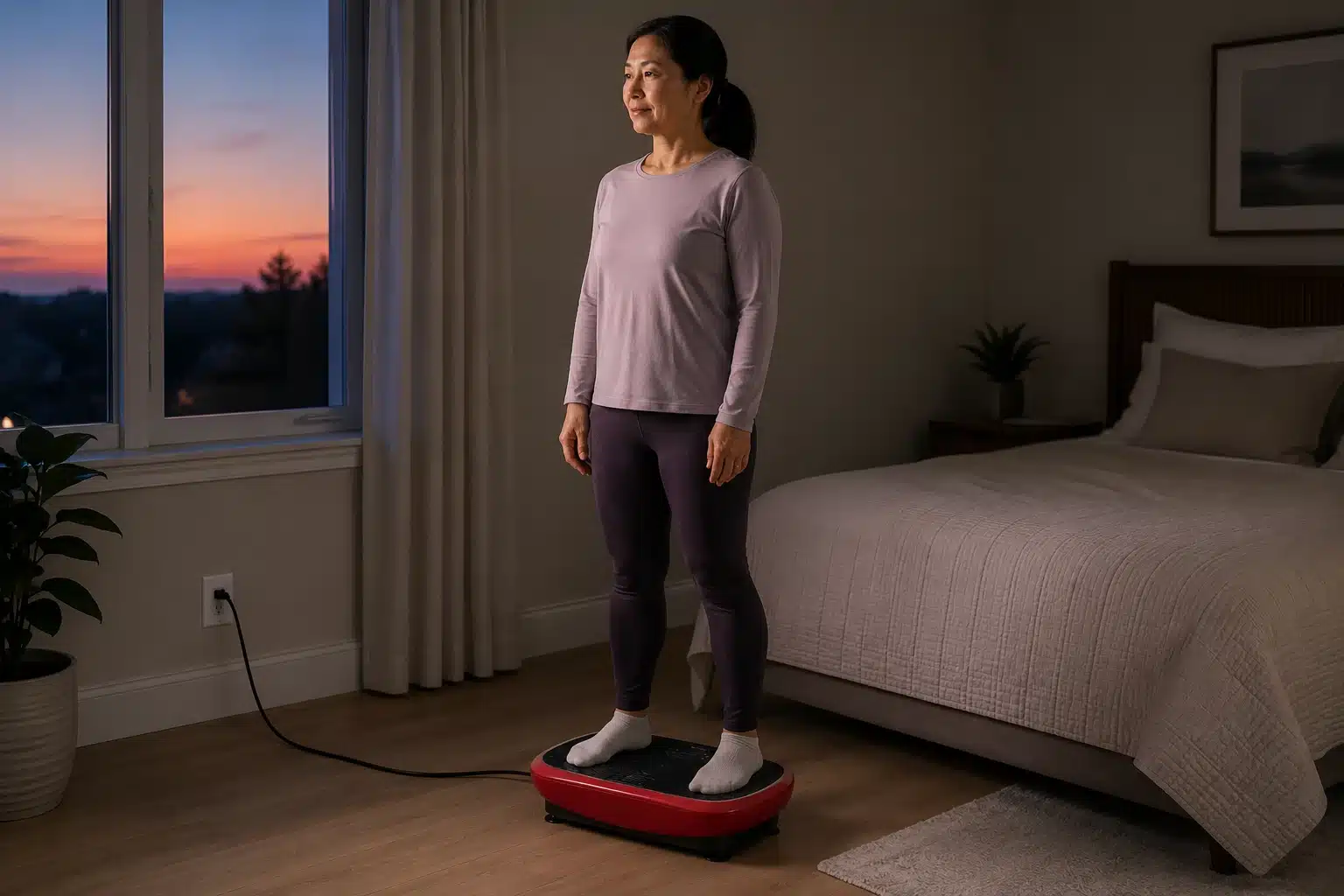
There are situations where I would not lean on a vibration plate much. I would be cautious during active flare-ups, when dizziness or balance instability is prominent, when fatigue is so strong that even small activity reliably causes a crash, or when the medical picture is complex and not well controlled. This topic depends heavily on symptom sensitivity and condition-specific limits, which is why broad recommendations do not work well here.
The same holds for autoimmune conditions that affect the cervical spine, and my guide on using a vibration plate with neck pain addresses the specific diagnoses that require the greatest caution.
This topic really depends on symptom sensitivity and condition-specific limits. That is why I think the safest message is not everyone with autoimmune disease should use a vibration plate, but some people with certain symptom patterns may find it helpful as part of a broader plan. For those comparing low-impact movement options, my vibration plate versus yoga guide covers what yoga can and cannot offer for people managing joint, fatigue, and stress-related symptoms.
When to Stop Using a Vibration Plate and Get Medical Help
I would stop using a vibration plate and get medical help if:
- symptoms clearly worsen
- a flare-up intensifies
- dizziness or instability becomes more noticeable
- pain increases sharply
- you feel significantly worse the next day
- the response feels unpredictable or concerning
This is especially important in autoimmune disease, because unusual symptom changes may mean more than just “I overdid my workout.” If something feels off, I would rather see caution than persistence.
My Honest Take: Is a Vibration Plate Worth Trying for Autoimmune Disease?
Yes, I think a vibration plate is worth trying for autoimmune disease in the right situation. I think it is most worth trying when the main goal is to support function: less deconditioning, better balance, more confidence with movement, gentle muscle activation, and a manageable entry point into activity after weakness, stiffness, or fatigue. I do not think it should be presented as treating autoimmune disease itself. The most honest position is that it may help some people with autoimmune-related function and symptom burden, but only as part of a broader, condition-specific plan.
I do not think it should be presented as treating autoimmune disease itself. That would be too broad and too strong. The conditions in this category are too different from each other.
So my honest middle-ground answer is this: a vibration plate may help some people with autoimmune-related fatigue, mobility loss, balance issues, and post-flare deconditioning, but it belongs inside a broader, condition-specific plan. It is a support tool, not a substitute for treatment.
Fatigue is the most commonly reported barrier to exercise in autoimmune disease, and it is where a vibration plate has a practical advantage over conventional training. A five-minute standing session on the plate at low frequency produces meaningful muscle stimulation with very low cardiovascular demand. For people in a post-flare deconditioning phase, this is often the only format of physical activity that feels manageable without triggering post-exertional malaise.
Flare timing requires consistent attention. Starting a new vibration protocol during a flare period is poor timing. The inflammatory burden is already elevated, and additional physical stimulus is unlikely to be tolerated well. The plate is most useful in the maintenance phase: between flares, when systemic inflammation is lower and physical capacity is available to train. Establishing a routine during stable periods allows the body to adapt before the next flare, preserving more function when it arrives.
Tracking response across multiple sessions provides the safety data that general guidance cannot. Some autoimmune conditions respond well to vibration consistently; others show variable responses depending on disease activity, medication cycles, and stress load. Keeping a simple log, noting session date, settings used, and how you felt 24 hours later, lets you identify patterns over months that a single session can never reveal.
For those starting out and wanting to calibrate their expectations, my guide on what vibration plates can realistically achieve covers the research across different health goals and explains where the evidence is strong and where it is limited.
FAQs
Can a vibration plate help autoimmune fatigue?
It may help indirectly, especially if it gives you a low-impact way to move when your exercise tolerance is poor. I would frame it as a support tool for activity and function, not as a direct treatment for fatigue itself.
Can a vibration plate reduce inflammation in autoimmune disease?
There is not enough evidence to make that a reliable article-level promise. Some research discusses immune and inflammatory pathways, but that is very different from showing that a vibration plate meaningfully treats autoimmune inflammation in day-to-day clinical use.
Is a vibration plate safe during an autoimmune flare-up?
Often that is when I am most cautious. Some people may tolerate very gentle use, but I would generally avoid aggressive exercise during an active flare and prioritize symptom response over rules.
Can I use a vibration plate with rheumatoid arthritis or multiple sclerosis?
Possibly, yes. These are actually two of the better-studied examples for WBV, especially in terms of function, fatigue, mobility, balance, and strength. But it still needs to be individualized.
What vibration plate exercises are best for autoimmune-related weakness?
The best starting options are usually the simplest ones: a gentle standing hold, seated support position, calf raises, a supported mini squat, and a balance stance if appropriate. The main goal is low-impact strength support, not intensity.
Can a vibration plate replace exercise or medical treatment for autoimmune disease?
No. It may support exercise, and it may help some people move more comfortably, but it does not replace exercise programming, specialist care, or medical treatment for autoimmune disease.