Affiliate Disclosure: Vibration Plate Zone is a proud participant in the Amazon Services LLC Associates Program.
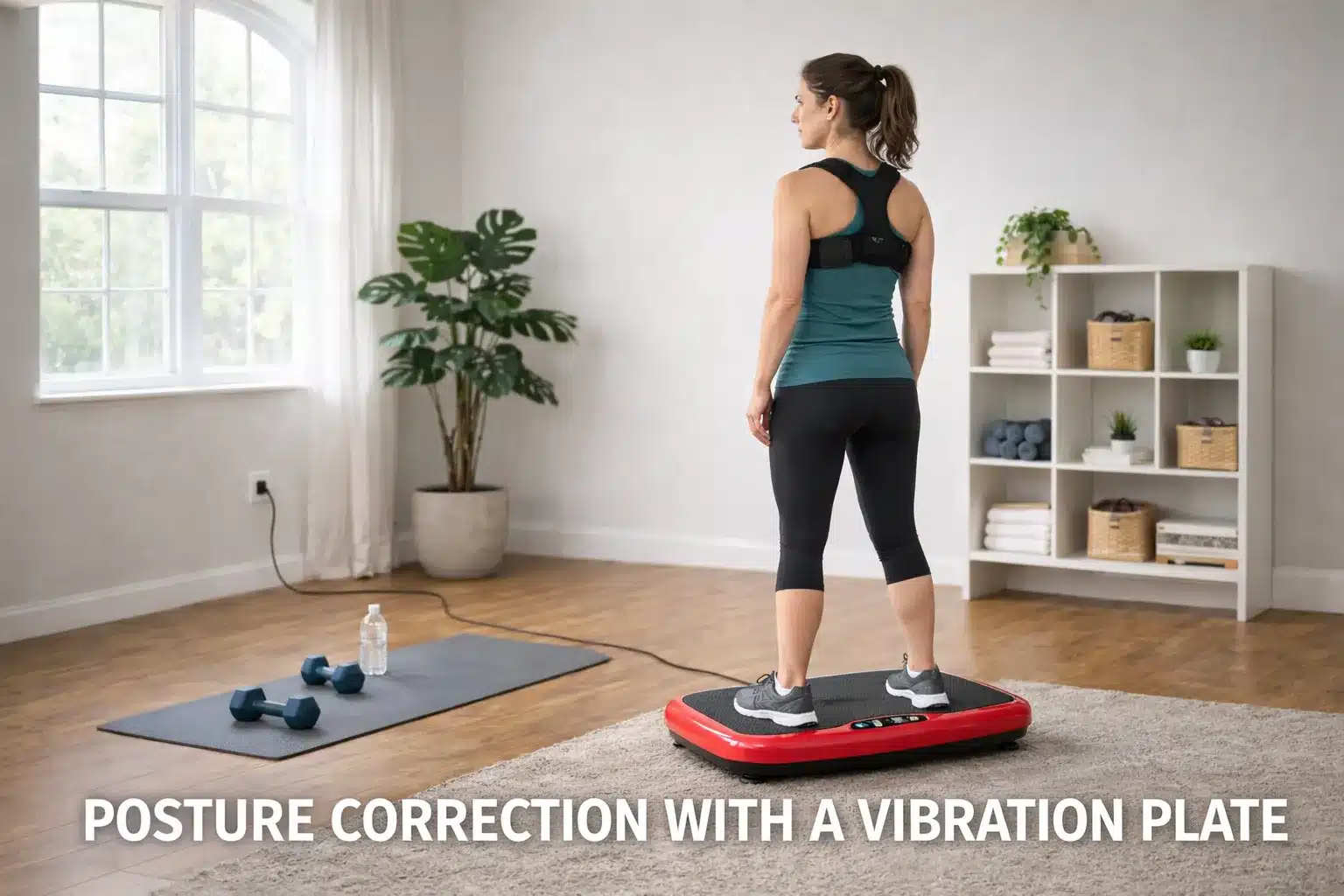
If you are looking into posture correction with a vibration plate, you are probably not really asking for perfect posture. Most people are trying to solve something more practical. They feel slouched at the desk, notice forward head posture in photos, catch their rounded shoulders in the mirror, or feel posture-related neck and upper back discomfort by the end of the day.

About the author: Hello! I’m Vladimir Stanar, professor of physical education, kinesiotherapist, marathon runner, cyclist, and cycling coach, and long-time advocate of health, fitness, and active living.
My journey with vibration plates runs parallel to my professional career in education, sports medicine, and athletic development. Over time, I’ve come to see vibration plates as one of the most versatile tools for enhancing health, recovery, and performance.
✅ Expert-Reviewed by: Vanja Vukas, MPhEd
📚 Expert Contributor: Milutin Tucakov, MPhEd
Proper posture is simply the way you hold your body while sitting, standing, or moving, and better alignment helps reduce unnecessary stress on the spine and surrounding joints.
As a licensed kinesiotherapist, I think a good vibration plate can be a useful support tool for posture improvement, but I do not think it magically fixes posture on its own. The more realistic benefit is that whole body vibration for posture may help with postural control, balance, proprioception, body awareness, and activation of the muscles that help you hold better alignment. That is the strongest evidence-backed angle, because whole-body vibration is more consistently linked to improvements in balance and proprioception than to dramatic structural posture correction claims.
My honest view is this: a vibration plate for posture correction makes the most sense when it is used as part of a larger posture-training plan. That plan still needs better exercise technique, better body awareness, stronger postural muscles, and better daily habits. If you use the plate that way, it can be useful. If you expect it to undo years of poor posture by itself, you will probably be disappointed.
What Is Poor Posture, Really?
Poor posture is not just slouching. It is really a pattern of body alignment that places more strain on certain joints, tissues, and muscles than necessary. Good posture is the way you hold your body during sitting, standing, and movement, and better posture helps reduce common aches and pains in the neck, shoulders, and back while supporting the spine more effectively.
In practical terms, when I think about poor posture, I think about whether the body is stacked efficiently. Is the head position too far forward? Are the shoulders rounded? Is the chest collapsed? Is the pelvis tilted? Is the person hanging on passive structures instead of using their postural muscles? Those are the issues that usually matter most.
A lot of people also confuse better posture with rigid posture. I do not want that. Good postural alignment should feel supported, not forced. The goal is a more neutral spine, better body alignment, better postural control, and less unnecessary strain, not an artificial pose that you cannot maintain for more than ten seconds.
Common Posture Problems a Vibration Plate May Help Support
When people ask me whether a vibration plate helps posture, they are usually talking about one or more common posture patterns.
The first is forward head posture. This is the classic head-jutting-forward pattern that often shows up with screen posture and desk posture problems. The second is rounded shoulders, where the upper body collapses inward and the chest appears closed. The third is slouched posture or a more kyphotic posture, where the upper back rounds more than it should. The fourth is anterior pelvic tilt or an arched lower back posture, where the pelvis sits in a position that affects the lumbar spine and overall standing posture.
These posture problems often overlap. A person with bad posture from sitting all day may have forward head posture, rounded shoulders, weak core posture, and glute weakness all at the same time. That is another reason I do not think one posture fix is enough. Usually, posture problems are really a collection of muscle imbalance and posture-control problems working together.
Why Poor Posture Happens in the First Place
Poor posture rarely happens for just one reason. In most people, it is a mix of weak postural muscles, poor core stability, deconditioned upper back muscles, glute weakness, tight hip flexors, tight chest muscles, poor body awareness, reduced proprioception, and long hours of prolonged sitting.
This fits what I see in real life. If someone sits for hours with a laptop that is too low, a chair that does not support the spine well, and a body position that keeps the head drifting forward, they are training poor sitting posture over and over again. That is not just a mobility issue. It becomes a motor-control issue, a postural-endurance issue, and often a balance-and-awareness issue too.
That is where proprioception comes in. Proprioception is your sense of body position. If your posture awareness is poor, you can spend hours in a bad position without noticing it. That is one reason whole-body vibration is interesting here, because it may help challenge proprioception and postural control in a way that makes alignment errors easier to notice and correct during exercise.
Can a Vibration Plate Improve Posture?
Yes, I think a vibration plate designed for home use can improve posture in some people, but I would define that improvement carefully. I do not think it straightens you by force. I think it may help support posture correction by improving balance, proprioception, postural control, and muscle activation, especially when you pair it with good posture exercises. That is a much more realistic claim, and it lines up better with both the research and the stronger niche guidance.
This matters because posture is really a control problem as much as it is a strength problem. If your stabilizing muscles are underactive, your balance is poor, and your body awareness is low, simply telling you to stand up straight will not solve much. A vibration platform for posture can help create a more demanding environment for posture training, which may improve how you sense and control your alignment.
That is one reason I see whole-body vibration for posture as a training tool, not a passive fix.
How a Vibration Plate May Help With Posture Correction

There are a few practical reasons a vibration plate may help with posture correction. It may improve balance and proprioception, increase awareness of body position, and help activate the muscles that support better alignment. The most realistic benefit is not that it fixes posture automatically, but that it can make posture training more effective when it is used with control and intention.
It may improve balance and proprioception
This is one of the strongest reasons I take the idea seriously.
Whole-body vibration introduces an unstable sensory environment that can challenge the body’s posture and balance systems. To stay controlled on the plate, your body has to respond.
From a posture perspective, that matters a lot. Better posture and balance are closely connected. If someone sways excessively, lacks awareness of where their pelvis or shoulders are, or cannot maintain a stable stance well, their standing posture will usually reflect that. A vibration plate may help reduce postural sway and improve the control needed for better standing alignment.
It may help activate the muscles that support better alignment
I also think a vibration plate can be useful for activating postural muscles. That includes the core, glutes, upper back, and other stability muscles that help you hold a more neutral spine and better shoulder and pelvic alignment.
In practice, I often see posture problems improve when people get better at using the right muscles at the right time. A person with rounded shoulders may not only need chest mobility. They may need better scapular control exercises, better upper back strength, better core bracing, and more awareness of how to hold their ribcage and pelvis.
It may improve posture awareness during exercise
This is another underrated benefit.
When someone stands on a vibration machine for posture, they usually become more aware of what their body is doing. If they are slouching, locking their knees, collapsing through their chest, or letting the head drift forward, the plate often makes those mistakes more obvious. That can be useful, because posture awareness is one of the hardest things to teach when people have spent years moving on autopilot.
That is why I like posture exercises on a vibration plate when they are done with intention. The plate can make a simple posture hold feel more alive, which may help the person learn what better movement quality actually feels like.
What a Vibration Plate Cannot Do for Your Posture
A vibration plate does not magically fix posture. It is not a replacement for exercise technique. It is not a cure for structural deformity. And it does not override your daily habits. If you spend most of the day in poor sitting or standing positions, those repeated habits will still matter far more than a few minutes on the machine.
I also do not think a vibration plate is the right lens for true structural conditions by itself. If someone has scoliosis concerns, significant spinal curvature issues, dizziness, pain during posture exercises, or medically complex problems, I do not want them assuming a home device is the whole answer.
The Type of Person Who May Benefit Most
In my experience, the type of person who may benefit most from posture correction with a vibration plate is someone with habit-driven posture problems. That usually means someone with bad posture from sitting, desk posture problems, forward head posture, rounded shoulders, weak postural support, and poor body awareness. It may also include someone with posture-related neck discomfort or posture-related back discomfort who tends to feel better when they move and activate their muscles more consistently.
I am much less enthusiastic when the expectation is unrealistic. If someone thinks a vibration machine will automatically pull them into perfect alignment without any effort, that is not the right mindset. I also become more conservative if the posture issue seems more structural, painful, or neurologic rather than habit-driven and exercise-responsive.
My Practical Rule as a Licensed Kinesiotherapist
My practical rule is simple. If the problem looks like slouching, weak postural muscles, rounded shoulders, forward head posture, poor core stability, and low posture awareness, I am more open to cautious vibration work. If the problem looks more structural, painful, medically complex, or connected to dizziness and balance issues, I become more conservative.
A simple example: if someone tells me, “I feel myself collapse when I sit at the computer, and I know my shoulders round and my head pushes forward,” I think a daily posture routine with a vibration plate may make sense. If someone tells me, “I have pain, numbness, dizziness, or a spinal diagnosis I do not understand well,” I am not starting with a DIY posture plan.
That distinction really matters here.
How to Use a Vibration Plate Safely for Posture Correction
If you want to use a vibration plate for posture correction, I would start with low-intensity vibration, short sessions, and a very controlled approach. Keep a tall posture, soft knees, and a light core brace instead of locking the joints or stiffening the whole body. The goal is to reinforce good movement patterns and alignment, not just to stand on a moving surface and hope posture improves on its own.
Second, use a light core brace, not a stiff body. I want support, not tension everywhere.
Third, focus on control, not just exposure. Simply standing on the plate is not enough if your alignment is poor the whole time. I want the exercise to reinforce good movement patterns, not poor form.
Fourth, stop if symptoms worsen. If you feel pain during posture exercises, dizziness, or worsening discomfort, that is a sign to back off and reassess. I'd also recommend reading my full guide to the dangers of vibration machines so you can avoid potential issues.
Best Vibration Plate Exercises for Better Posture

These are the vibration plate posture exercises I think make the most sense.
Gentle standing posture hold
This is the simplest place to start. Stand tall, feet grounded, knees soft, chest open, head stacked over the shoulders, and ribs controlled. This is basically a standing posture hold with awareness. I like it because it teaches basic body alignment before adding complexity.
Chin tuck and head-position awareness
For people with forward head posture, this is one of the most valuable drills. A chin tuck helps bring the head position back toward a better alignment over the torso. I keep it gentle. The goal is not to force the neck backward. The goal is to improve awareness and control.
Shoulder blade retraction and scapular control
Rounded shoulders often improve when people learn how to control the shoulder blades better. Simple scapular control exercises on or near the plate can help reinforce better upper back engagement and a more open shoulder position.
Supported squat with posture focus
A squat for posture is not really about the squat itself. It is about keeping the spine, pelvis, chest, and head aligned while moving. Done well, it can support neutral spine control, glute strength for posture, and better movement quality.
Plank or core-bracing stance
I do not use this with everyone, but for the right person, a plank for posture or a standing core-bracing posture drill can be useful. The point is to train the core to support alignment, not just to feel the burn.
Single-leg balance for postural control
Since posture and balance are closely linked, single-leg balance can be a very good progression. Balance challenges on vibration may be useful when applied well.
Posture Problems a Vibration Plate May and May Not Help
A vibration plate may be more helpful for posture problems driven by habits, muscle-control issues, balance deficits, and low awareness. That includes forward head posture, rounded shoulders, slouching, poor standing posture, poor sitting posture, and some pelvic-control problems. It is likely to be less helpful for fixed structural problems or situations where pain, dizziness, or a more complex medical issue is driving the posture pattern.
That is why I see a vibration plate as a support tool for posture improvement, not as a posture shortcut.
When a Vibration Plate May Not Help or May Be the Wrong Tool
There are situations where I would not lean on a vibration plate much.
If someone has scoliosis and posture precautions they do not understand yet, pain during posture exercises, dizziness or balance issues, or symptoms that worsen with use, I want more caution. The same goes for people who cannot maintain basic control on the plate. Poor form can reinforce bad posture rather than improve it.
I would also be careful with people who are chasing posture correction as if it were a purely cosmetic problem. Good posture is about function, comfort, and movement quality, not just looking straighter.
When to Stop Using a Vibration Plate and Get Medical Help
I would stop using a vibration plate and get medical help if posture exercises trigger pain, dizziness, worsening symptoms, or unexpected neurologic issues. I would also want evaluation if there is a known spinal condition, a major balance problem, or symptoms that do not match a simple posture issue.
In other words, posture training should make you feel more controlled and more supported, not less safe.
My Honest Take: Is a Vibration Plate Worth Trying for Posture Correction?
Yes, I think a vibration plate is worth trying for posture correction in the right situation. I think it is most worth trying when the goal is better posture awareness, better balance, better proprioception, better muscle activation, and stronger postural support. That is the strongest and most honest use case because it matches what the research supports best and fits the most realistic role of whole-body vibration in posture training.
But I do not think it should be oversold. A vibration plate does not correct posture automatically. It does not replace good posture habits, good ergonomics, or good exercise technique. The most trustworthy middle ground is this: a vibration plate can support posture improvement when it is used as part of a broader plan that includes awareness, strengthening, movement quality, and daily habit changes.
The realistic timeline for vibration-related posture changes is eight to twelve weeks of consistent use, not two to three. Postural adaptation requires the nervous system to build new motor patterns, the stabilizing muscles to develop endurance, and habitual movement patterns to shift. Vibration plates accelerate this process by increasing proprioceptive input, but they cannot compress it below the biological floor. Users who commit to eight weeks with realistic expectations consistently report improvement.
Two habits accelerate posture improvement when paired with vibration training. First, daily scapular retraction holds (pulling the shoulder blades back and down for 10 seconds, 10 repetitions), done away from the plate, reinforce the neuromuscular pattern the plate activates. Second, addressing seated screen position at a desk (monitor at eye level, feet flat on the floor, hips at 90 degrees) removes the input that creates the problem in the first place. The plate improves the baseline; removing the cause prevents regression.
For a broader look at what the research supports beyond posture, my overview of how effective vibration plates really are covers the clinical evidence on muscle activation, bone density, and circulation.
FAQs
Can a vibration plate improve posture?
Yes, it may help improve posture, especially by supporting balance, proprioception, postural control, and muscle activation. That is a more realistic claim than saying it directly fixes posture.
Can a vibration plate help forward head posture?
It may help as part of a larger plan, especially if you combine it with chin tucks, upper back work, and better posture awareness. But it will not correct forward head posture by itself.
Can a vibration plate help rounded shoulders?
It can support the exercises that help rounded shoulders, especially scapular control work, upper back activation, and posture awareness. It is a support tool, not a standalone fix.
What vibration plate exercises are best for posture?
The best starting exercises are usually a gentle standing posture hold, chin tuck work, shoulder blade retraction, supported squats with good alignment, core-bracing drills, and balance exercises.
Can a vibration plate replace posture exercises?
No. It can make posture exercises more engaging or more challenging, but it does not replace them. Good form, strength, mobility, and consistency still matter most.
How often should I use a vibration plate for posture correction?
There is no single perfect schedule for everyone, but a conservative approach with short, consistent sessions makes more sense than aggressive use. Consistency and exercise quality matter more than intensity here.