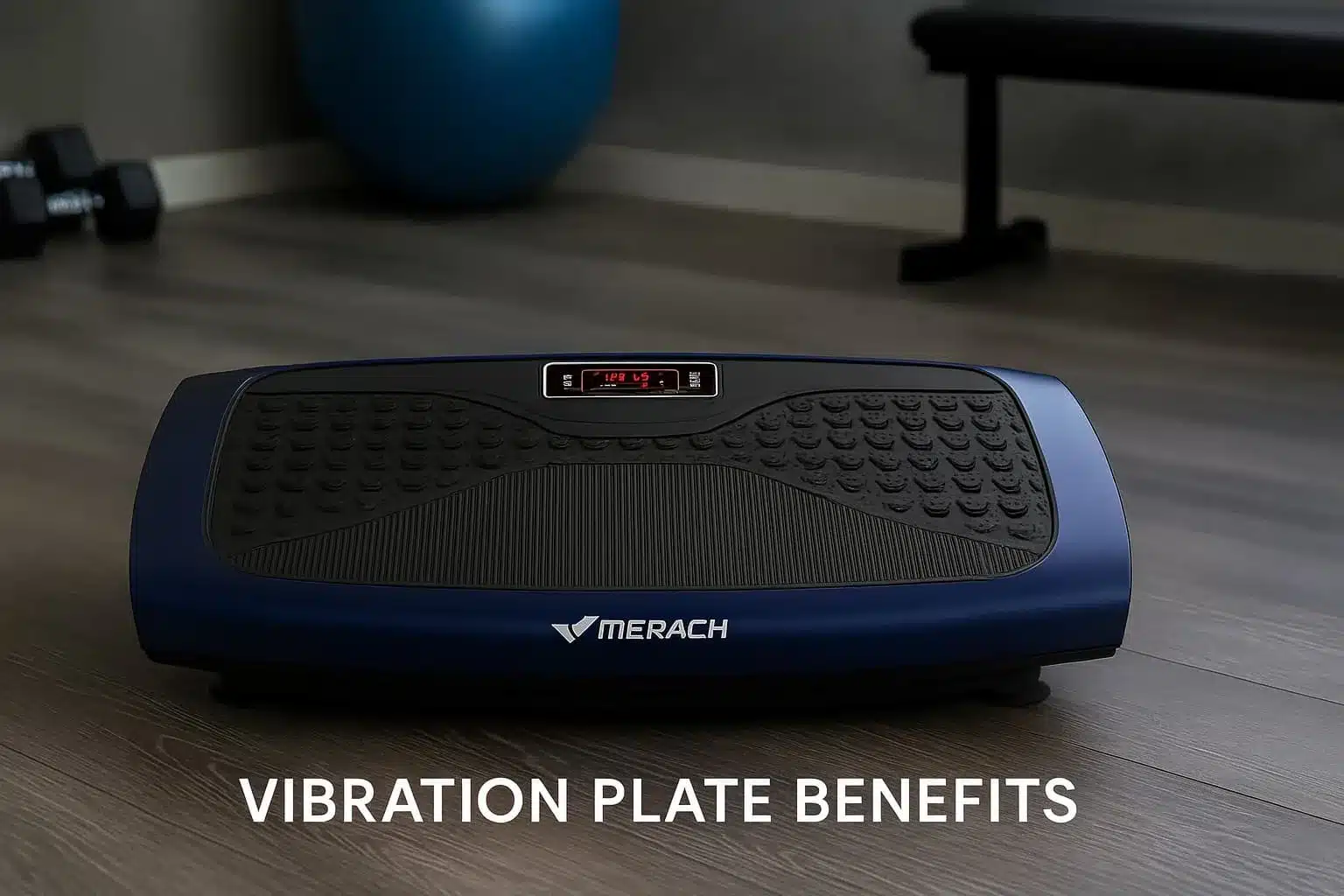
Vibration plate weight capacity varies considerably between models. Among the machines already reviewed on Vibration Plate Zone, published limits range from 220 pounds to 440 pounds, with 330 pounds being particularly common among home vibration plates.

About the author: Hello! I’m Vladimir Stanar, professor of physical education, kinesiotherapist, marathon runner, cyclist, and cycling coach, and long-time advocate of health, fitness, and active living.
My journey with vibration plates runs parallel to my professional career in education, sports medicine, and athletic development. I’ve developed a unique process for testing vibration plates as they are some of the most versatile tools for enhancing health, recovery, and performance.
✅ Expert-Reviewed by: Vanja Vukas, MPhEd
📚 Expert Contributor: Milutin Tucakov, MPhEd
The manufacturer's maximum user weight should be treated as an operating limit rather than a number to exceed because the machine probably has some hidden safety margin. At the same time, I have not found good evidence supporting the common online rules that everyone needs exactly 50 pounds, 100 pounds, or 30% of extra capacity above their body weight.
Weight capacity also tells only part of the story. Research shows that load can change the amplitude and acceleration actually produced by some vibration platforms, while two machines with the same 330-pound rating can have completely different platform sizes, weights, vibration systems, and support features.
What Does Vibration Plate Weight Capacity Mean?
Vibration plate weight capacity is the manufacturer's stated maximum user weight that the machine is designed to support during intended operation. You may also see this specification described as maximum user weight or maximum load.
I would treat that figure as a buying limit rather than the weight at which the machine is expected to physically break. If a plate is rated for 330 pounds, someone above that number should choose a higher-capacity machine rather than assume the manufacturer has left enough engineering margin to make exceeding the rating acceptable.
The specification normally refers to one user. A 440-pound capacity does not automatically mean that two 200-pound people should use the machine together.
Typical Vibration Plate Weight Capacities
There is no single standard weight capacity across vibration plates. Even within the machines we have individually reviewed on VPZ, the range is wide.
| VPZ-Reviewed Vibration Plate | Published Weight Capacity | What Makes It Different |
|---|---|---|
| LifePro VibraRed | 220 lb | Compact 20.9 × 12.6-inch oscillating plate that also adds red and near-infrared light |
| VT007 Therapeutic Vibration Plate | 250 lb | Focused linear vibration with direct 10-40 Hz control and dual amplitude settings |
| Nautilus Vibratone Pro | 265 lb | Very light and compact at about 14 lb with an approximately 20 × 14-inch platform |
| Sunny Health & Fitness Fitboard 3D | 265 lb | Much larger 30.7 × 18.3-inch deck, 43 lb construction, and multiple vibration modes |
| HURTLE Vibration Plate | Around 300 lb | Compact budget-oriented platform at roughly 27 × 14 inches |
| LifePro Waver | 330 lb | Common home-use capacity with an approximately 30 × 15-inch oscillating platform |
| LifePro Rumblex Pro 4D | 330 lb | Larger 30.9 × 18.2-inch deck, 41.7 lb chassis, triple motors, and multiple vibration modes |
| LifePro Rumblex 4D | 330 lb | Approximately 31 × 18-inch multidirectional platform with 4D vibration |
| LifePro Rhythm | 330 lb | Larger handled design at about 63 lb, focused more on stability and supported use |
| MERACH V44 With Handrail | 330 lb | Compact base with an adjustable rigid handrail for added support |
| MERACH MR-2489 | 330 lb | Lightweight 22 lb machine with an approximately 20 × 13-inch footprint |
| FLYBIRD Vibration Plate | 330 lb | Roughly 26.8 × 15.5-inch platform with multiple vibration modes |
| JOROTO 4D Vibration Plate | 440 lb | Highest-capacity example here despite a relatively compact approximately 20 × 12-inch platform |
This table demonstrates why I would never judge a vibration plate by capacity alone.
The Nautilus Vibratone Pro and Sunny Fitboard 3D both support 265 pounds, yet one weighs around 14 pounds with a compact deck while the other weighs 43 pounds and has a much larger exercise surface. Equal capacity clearly does not mean equal size, construction, portability, or vibration technology.
The 330-pound group makes the same point even more strongly. The LifePro Waver offers a conventional home-size oscillating platform, while the Rumblex Pro 4D has a substantially larger deck and triple-motor system. The LifePro Rhythm and MERACH V44 add fixed support, while the MR-2489 reaches the same published capacity in a much smaller and lighter package.
Is a 330 lb Weight Limit Normal?
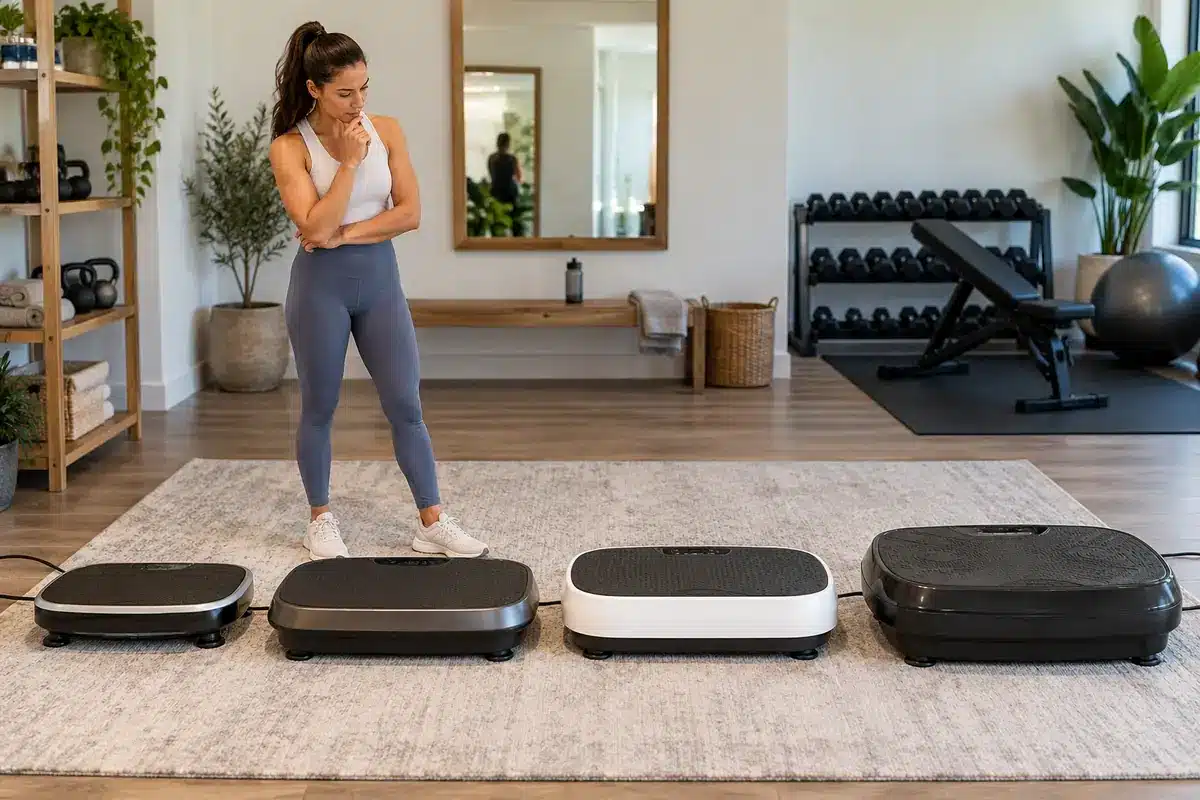
A 330-pound, or roughly 150-kilogram, capacity is very common among home vibration plates. Seven of the VPZ-reviewed machines in the table above are rated at 330 pounds.
That does not make 330 pounds an industry standard. There are lower-capacity machines such as the 220-pound VibraRed and 250-pound VT007, while the JOROTO 4D reaches 440 pounds.
What the clustering around 330 pounds does tell me is that many manufacturers consider it a practical capacity for general home-fitness equipment. Whether it is appropriate for you depends on your own weight and the rest of the machine's design.
Does Body Weight Affect How a Vibration Plate Works?
Yes. This is one of the most important points missing from most vibration plate weight-limit guides.
Researchers have measured commercial vibration platforms under different loads and found that the load can change the actual amplitude and peak acceleration produced by the machine. In one study of seven commercial platforms, researchers tested loads of 0, 45, 68, and 91 kilograms and found significant load-related changes in amplitude and acceleration across the machines.
Actual frequency did not always perfectly match the machine's intended setting either. The researchers concluded that people of different weights could receive different vibration stimuli from the same platform.
Another study comparing three commercial devices also found that body mass influenced platform acceleration. However, the effect varied considerably between machine designs.
That last detail matters because I would not simplify the evidence into saying that heavier users always receive weaker vibration.
Does a Heavier Person Get Less Vibration?
Not necessarily.
It is mechanically reasonable to expect the user's mass to interact with a moving platform, and laboratory research confirms that loading can alter the vibration generated by a machine. What does not happen consistently is a simple straight-line reduction where every additional pound produces proportionally less vibration.
Some machines maintain their mechanical output better under load than others. Movement direction can also change, and different components of acceleration may respond differently as weight increases.
For me, the practical lesson is not that heavier users need to compensate by turning the speed higher. It is that the quality and mechanical consistency of the actual platform matter, especially as the load becomes greater.
Should Your Vibration Plate Capacity Be Higher Than Your Body Weight?
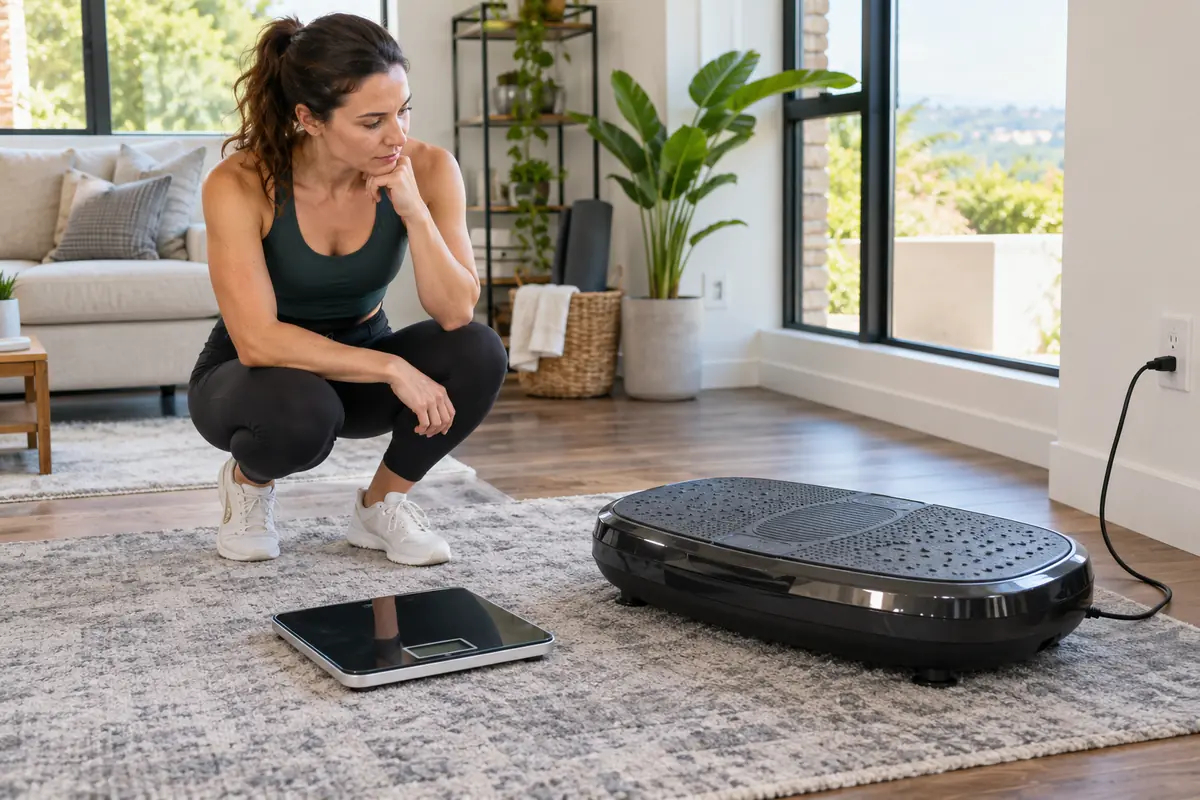
The plate's published capacity should at minimum meet your body weight. Beyond that, I would not invent a universal safety-margin formula.
You will find buying guides telling readers to select a machine 50 pounds above their weight, 100 pounds above their weight, or 30% above their weight. I have not found a vibration-plate engineering standard or clinical evidence establishing any of those figures as a universal requirement.
If I weighed 250 pounds and had a properly documented 265-pound machine that otherwise met my needs, I would not call it automatically unsafe because it lacked a 50-pound margin.
However, if an otherwise comparable 300- or 330-pound model also gave me a larger platform and more flexibility, I would personally choose the higher-capacity option. That is a practical preference, not a scientifically proven percentage rule.
How Close Is Too Close to the Maximum Weight?
There is no evidence-based percentage at which a properly rated machine suddenly becomes unsuitable before its stated limit.
If I weighed 295 pounds, for example, I would not automatically reject a 300-pound machine because an affiliate article says I need another 50 or 100 pounds of headroom. The manufacturer has already specified 300 pounds as its maximum user weight.
At the same time, being only five pounds below the limit gives me little flexibility if my weight changes or I want to use additional external resistance. If a suitable 330- or 440-pound alternative were available without sacrificing other features, I would probably take the additional capacity.
The key is not to transform that preference into a fake engineering standard.
What Happens If You Exceed the Weight Limit?
I would not intentionally do it.
Once you exceed the published maximum user weight, you are operating the equipment outside the manufacturer's specified range. That may affect platform operation, stability, long-term mechanical stress, or warranty coverage depending on the product.
There is no need to dramatize this by claiming the frame will immediately collapse or the motor will fail. The responsible advice is simpler: if your weight exceeds the manufacturer's maximum, choose another vibration plate. Anyone who wants a fuller picture of physical risks associated with vibration machines, from platform instability to vibration exposure limits, can find the evidence reviewed in my risks and dangers of vibration machines guide.
Weight Capacity and Platform Size Are Different Specifications
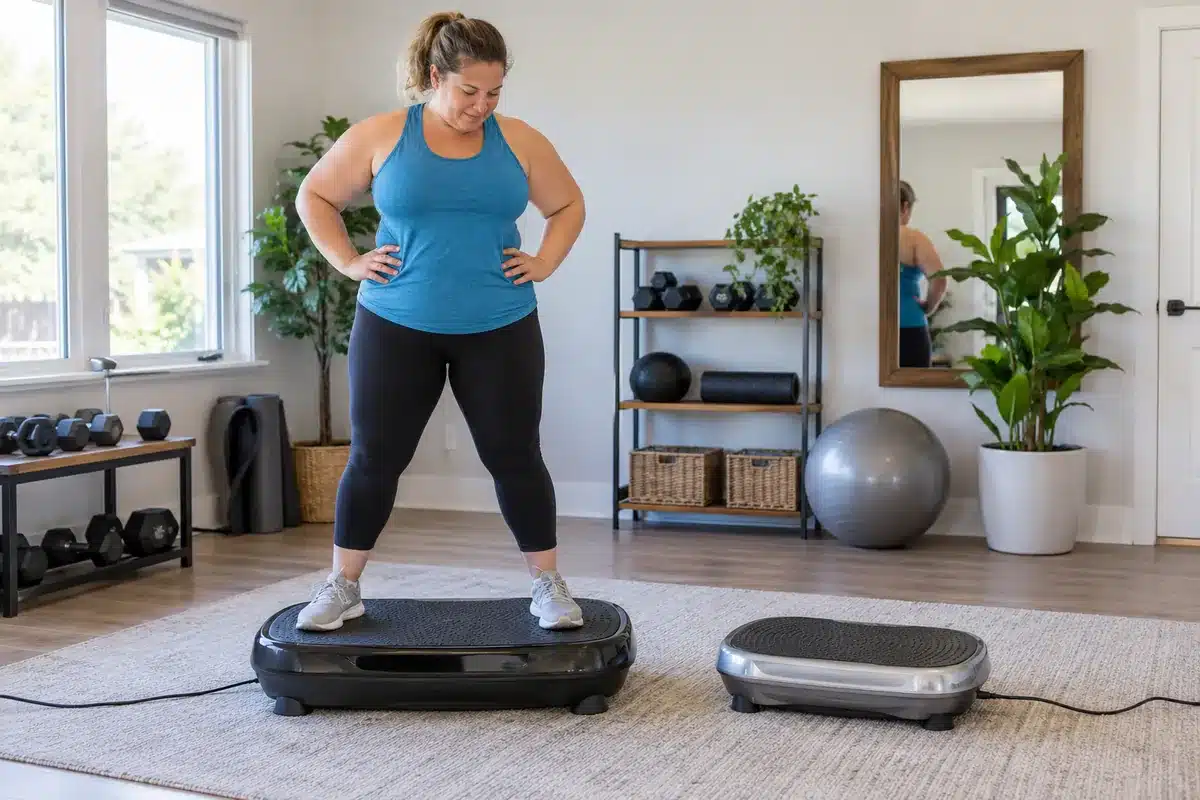
This distinction becomes especially important for larger users.
A 400-pound rating tells you how much user weight the machine is designed to support. It does not tell you whether the platform is physically large enough for your preferred stance or exercises.
The JOROTO 4D makes this especially obvious. It has the highest capacity among the models in our comparison at 440 pounds, yet its platform is approximately 20 × 12 inches.
Compare that with the 330-pound LifePro Rumblex Pro 4D, which provides approximately 30.9 × 18.2 inches of exercise space. The Rumblex Pro has the lower capacity but a substantially larger deck.
Platform size affects how comfortably you can:
- adjust stance width,
- perform squats,
- change foot position,
- maintain balance,
- position the hands for floor exercises.
For a larger user, I would check capacity and usable deck area separately.
Does Machine Weight Determine User Weight Capacity?
No.
The 330-pound examples make that especially clear. The MERACH MR-2489 weighs around 22 pounds, the LifePro Waver around 31 pounds, the Rumblex Pro approximately 41.7 pounds, and the LifePro Rhythm around 63 pounds, yet all carry the same published 330-pound user limit.
A heavier chassis may feel more planted during strong vibration and can be useful for stability. It can also make the equipment considerably harder to move around the house.
What it cannot do is tell you the approved maximum user load. Machine weight and user weight capacity need to be read as separate specifications.
Does Motor Power Determine Weight Capacity?
There is no reliable watts-to-pounds formula for vibration plates.
The maximum load a machine can support depends on the complete structure, including the deck, frame, bearings, mounts, motor arrangement, transmission system, housing, and overall engineering.
Multiple motors complicate the comparison further. A 4D machine may have additional motors because it produces several motion patterns, not simply because it is designed to support a heavier user.
I would therefore use the manufacturer's published user capacity rather than trying to calculate capacity from motor wattage.
What About 400 lb and Higher-Capacity Vibration Plates?
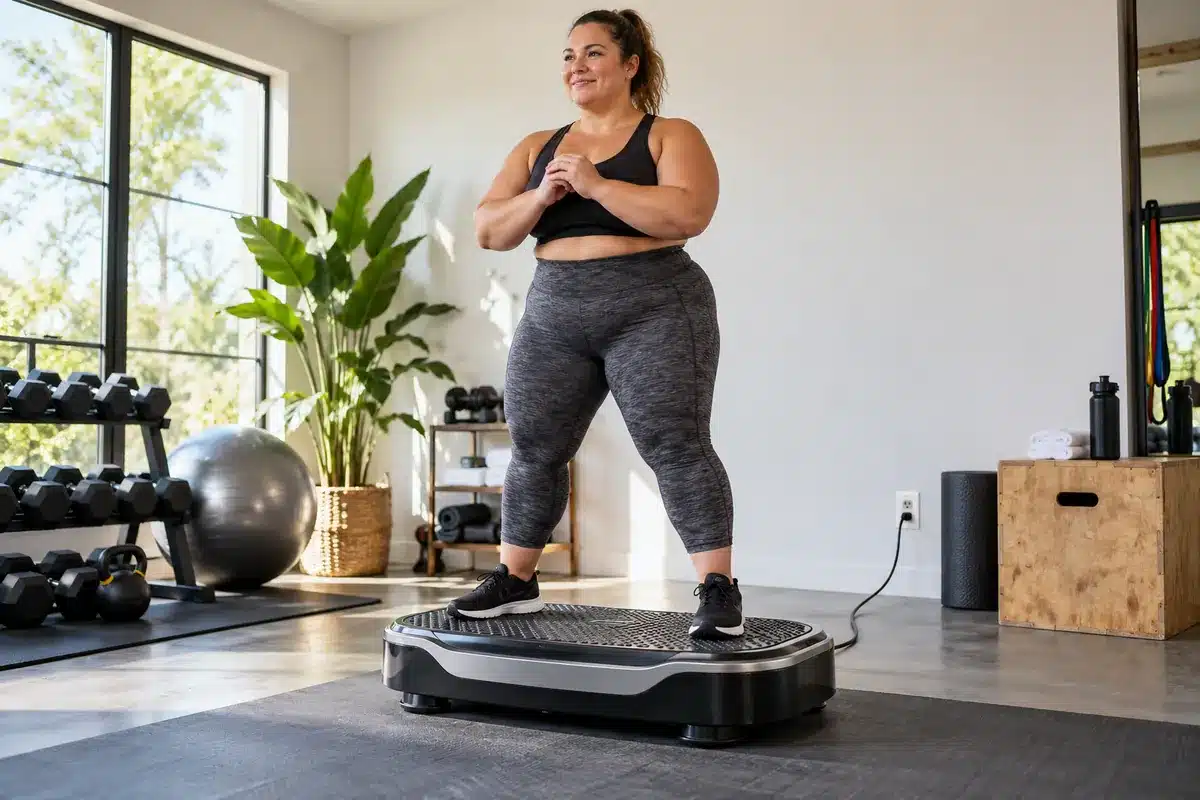
They exist, and a higher capacity can be valuable for users who genuinely need it.
The JOROTO 4D in our review library is rated at 440 pounds, which places it well above the common 330-pound group. The interesting part is that it achieves that rating while remaining relatively compact.
That is another reason I would not use capacity as a quality score. A high limit can be exactly what one buyer needs, but it does not automatically mean the machine has the largest platform, weighs the most, offers the best vibration specifications, or suits every type of exercise.
Capacity should eliminate unsuitable machines from consideration. It should not automatically choose the winner.
Can Two People Use One Vibration Plate?
I would not use a vibration plate this way unless the manufacturer explicitly designed and approved it for multiple users.
A capacity of 440 pounds does not mean two 200-pound people should stand side by side simply because their combined weight remains below the number. Vibration plate manuals commonly specify one user at a time, and the platform geometry itself is normally designed around a single person's stance.
Two people would also distribute weight very differently from one person, which could change stability and mechanical loading.
What If You Use Dumbbells or a Weighted Vest?
This is one area where I would avoid pretending the specification tells us more than it does.
Manufacturers generally publish a maximum user weight, but product documentation does not consistently explain how substantial external loading should be counted when someone performs weighted squats, holds dumbbells, or wears a weighted vest.
If I were comfortably below the capacity and using modest resistance, I would be less concerned. If I were already close to the stated maximum and wanted to add substantial external load, I would confirm that use with the manufacturer rather than assuming that only body weight counts.
I would not make up a rule such as subtracting every dumbbell pound directly from the user limit unless the manufacturer specifically tells users to calculate it that way. Readers who want a practical walkthrough of correct platform positions, session duration, and safe accessory use can find it in my vibration plate usage guide.
Can People With Obesity Use a Vibration Plate?
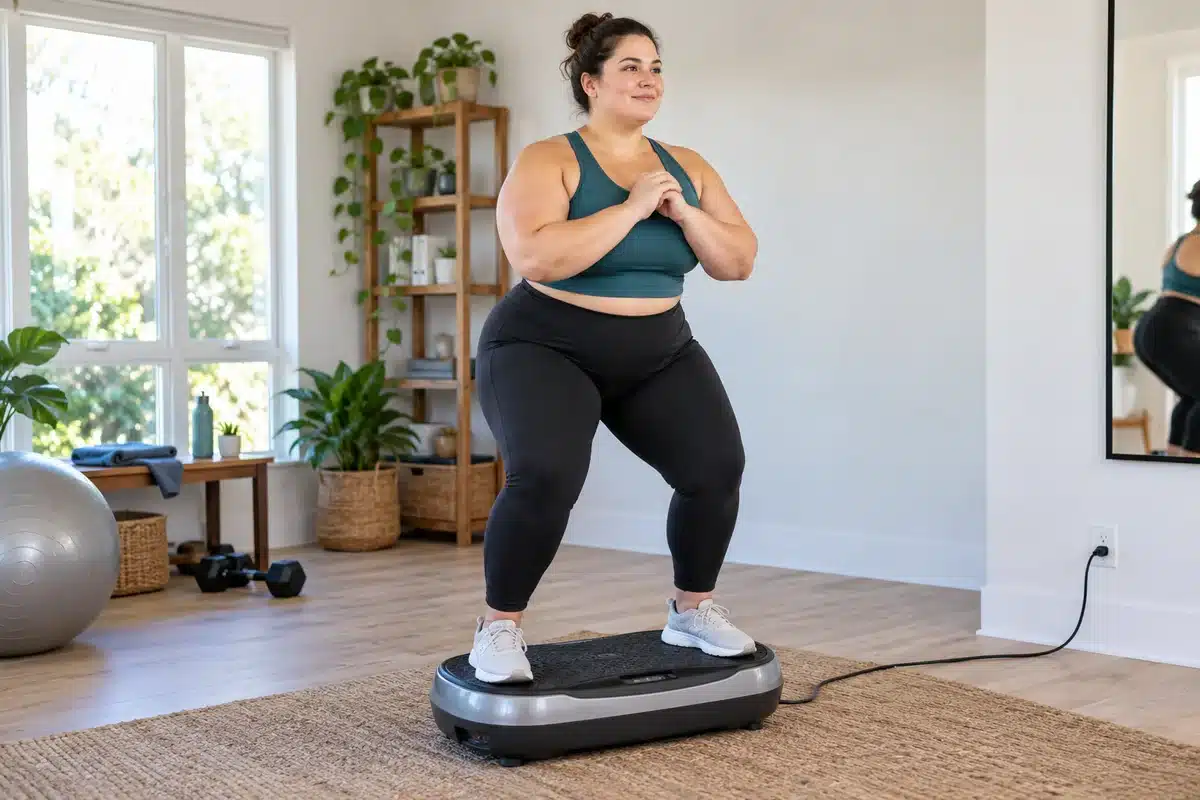
Higher body weight by itself does not make whole-body vibration inappropriate.
Research has included hundreds of participants with overweight and obesity. One meta-analysis included 23 studies and 884 participants and reported improvements in lower-extremity strength along with several cardiometabolic changes.
More recent research has continued to examine vibration combined with other forms of exercise in overweight and obese participants. The studies use different protocols, so the evidence does not support treating vibration as a stand-alone solution for weight management.
For this article, the practical issue is simpler: the machine must actually be rated for the user's weight and provide enough physical space and stability for comfortable use. I cover the published research on metabolic outcomes and machine selection factors that matter most for higher body weights in my full guide on vibration plates and obesity.
What Else Should a Heavier User Look For?
Capacity should be the first filter, not the final buying criterion. Once every machine below your body weight has been eliminated, I would compare platform size, stability, minimum intensity, vibration type, controls, construction, warranty, and support. Users managing circulation concerns alongside weight considerations can find machines evaluated specifically for vascular support in my best vibration plate for circulation guide.
A wider deck can matter if you need more stance room, while a fixed handrail may matter more than extra capacity if balance is limited. A non-slip surface and a base that remains planted on the intended floor are also more useful in daily use than a huge capacity number on an otherwise poorly documented machine.
I would pay particular attention to manufacturers that publish clear specifications instead of relying only on speed levels and marketing claims. My best vibration plate roundup applies exactly those specification standards to rank the top models currently available, including machines with sturdier frames and published weight ratings.
Common Weight Capacity Claims to Ignore
There is no established universal rule saying everyone must buy a vibration plate rated 50 to 100 pounds above body weight, nor is there a proven requirement to buy exactly 30% more capacity. Additional headroom can be convenient, but those precise formulas should not be presented as safety standards.
Higher capacity also does not automatically mean better quality, greater stability, a stronger motor, or a larger platform. The models already reviewed on VPZ make that obvious because several dramatically different machines share the same 330-pound rating.
I would also reject the idea that heavier users always receive weaker vibration. Research shows that load can change platform mechanics, but the way it changes them depends on the machine.
How I Would Choose the Right Weight Capacity
First, I would eliminate every vibration plate rated below my body weight. There is no reason to begin a product comparison with a machine the manufacturer says is not designed for me.
Next, I would compare the remaining options by platform size, stability, vibration specifications, usability, warranty, and overall construction. If I were very close to one model's maximum and a similarly suitable machine gave me more capacity and more room, I would normally choose the latter.
What I would not do is buy a mediocre machine simply because it advertises the highest capacity in the table. The objective is to find enough capacity inside the better overall vibration plate, not the largest number for its own sake. Older adults navigating the same balance of sufficient capacity, stability, and usability can find machines evaluated with those priorities in my vibration plate guide for older adults.
My Take on Vibration Plate Weight Capacity
I would treat maximum user weight as a hard buying filter, but not as the specification that decides everything else.
The research makes this more interesting than a basic safety number because load can alter the vibration actually delivered by a platform. At the same time, the machines we have reviewed show clearly that equal capacity can hide huge differences in deck size, machine weight, vibration type, support features, and overall design.
If I were choosing a vibration plate for a heavier user, I would want enough published capacity, a deck large enough for a comfortable stance, stable construction, and clear specifications from a manufacturer I trust. I would welcome extra capacity when it comes with the better machine, but I would not invent a 50-pound, 100-pound, or 30% safety rule that the manufacturer itself does not specify. Once the right machine is confirmed, my vibration plate exercises guide covers the specific positions and movements that suit different platform sizes and fitness levels.
FAQs
What is the average weight capacity of a vibration plate?
There is no universal average, but capacities around 300 to 330 pounds are common among home vibration plates. Among the VPZ-reviewed examples in this article, published limits range from 220 to 440 pounds.
Can a 300 lb person use a vibration plate?
Yes, provided the particular machine is rated for at least 300 pounds. I would not use a model with a published capacity below the user's body weight.
If similarly suitable higher-capacity options are available, I would also compare their platform size and stability rather than looking at the load rating alone.
Should a vibration plate’s capacity be higher than your body weight?
The manufacturer's rating must at least meet your body weight. There is no evidence-based universal rule saying you need an additional 50 pounds, 100 pounds, or 30% of capacity.
I personally prefer some additional room when I am very close to a machine's limit and an otherwise comparable higher-capacity option is available.
What happens if you exceed the vibration plate weight limit?
You are using the machine outside the manufacturer's specified operating range. That may affect operation, mechanical stress, stability, or warranty coverage depending on the model.
I would choose a higher-capacity vibration plate rather than intentionally exceed the rating.
Does body weight affect vibration intensity or performance?
It can. Laboratory testing has found that load can change the actual amplitude and acceleration produced by commercial vibration platforms.
The effect is machine-specific, so it is too simplistic to say that every heavier user automatically receives weaker vibration.
Does platform size matter for heavier users?
Yes. A plate can technically support your body weight while still having a platform that feels too narrow or short for a comfortable stance, squats, or other exercises.
Weight capacity and usable platform area should therefore be checked separately.
Do dumbbells or a weighted vest count toward the vibration plate weight limit?
Manufacturer documentation does not consistently explain how substantial external training loads should be calculated against maximum user weight. If you are close to the machine's stated limit and plan to use significant additional resistance, I would confirm the setup with the manufacturer rather than assume body weight is the only load that matters.
Notable Studies
- Merriman H, et al. Variability of Vibrations Produced by Commercial Whole-Body Vibration Platforms. Seven commercial platforms were tested under 0, 45, 68, and 91 kg loads. Amplitude and peak acceleration changed significantly with load, and actual frequency sometimes differed from the intended setting.
- Pel JJM, et al. Platform Accelerations of Three Different Whole-Body Vibration Devices and the Transmission of Vertical Vibrations to the Lower Limbs. Commercial platforms showed large differences in mechanical behavior, and user body weight affected platform acceleration differently depending on the device.
- Rubio-Arias JA, et al. Effects of Whole-Body Vibration Training on Body Composition, Cardiometabolic Risk, and Strength in the Population Who Are Overweight and Obese: A Systematic Review With Meta-Analysis. The analysis included 23 studies and 884 participants and found improvements in lower-extremity strength along with selected cardiometabolic changes.
- Batouli-Santos D, et al. The Physiological Effects of Whole-Body Vibration Combined With Other Exercise Modalities in Overweight and Obese Individuals: A Systematic Review. Seven studies were included, with substantial variation in vibration protocols and outcomes.
Healthcare and Medical Disclaimer
The information provided on Vibration Plate Zone is for general informational purposes only and is not intended to replace professional medical advice, diagnosis, or treatment. Always seek the guidance of a qualified healthcare provider with any questions you may have regarding a medical condition, and never disregard or delay seeking professional advice.