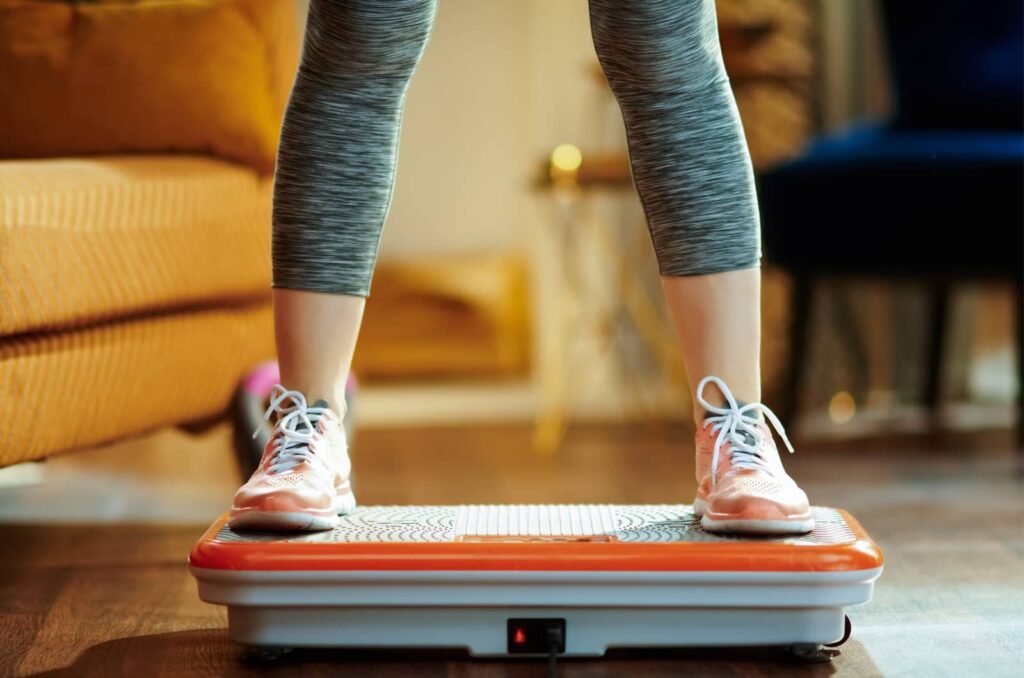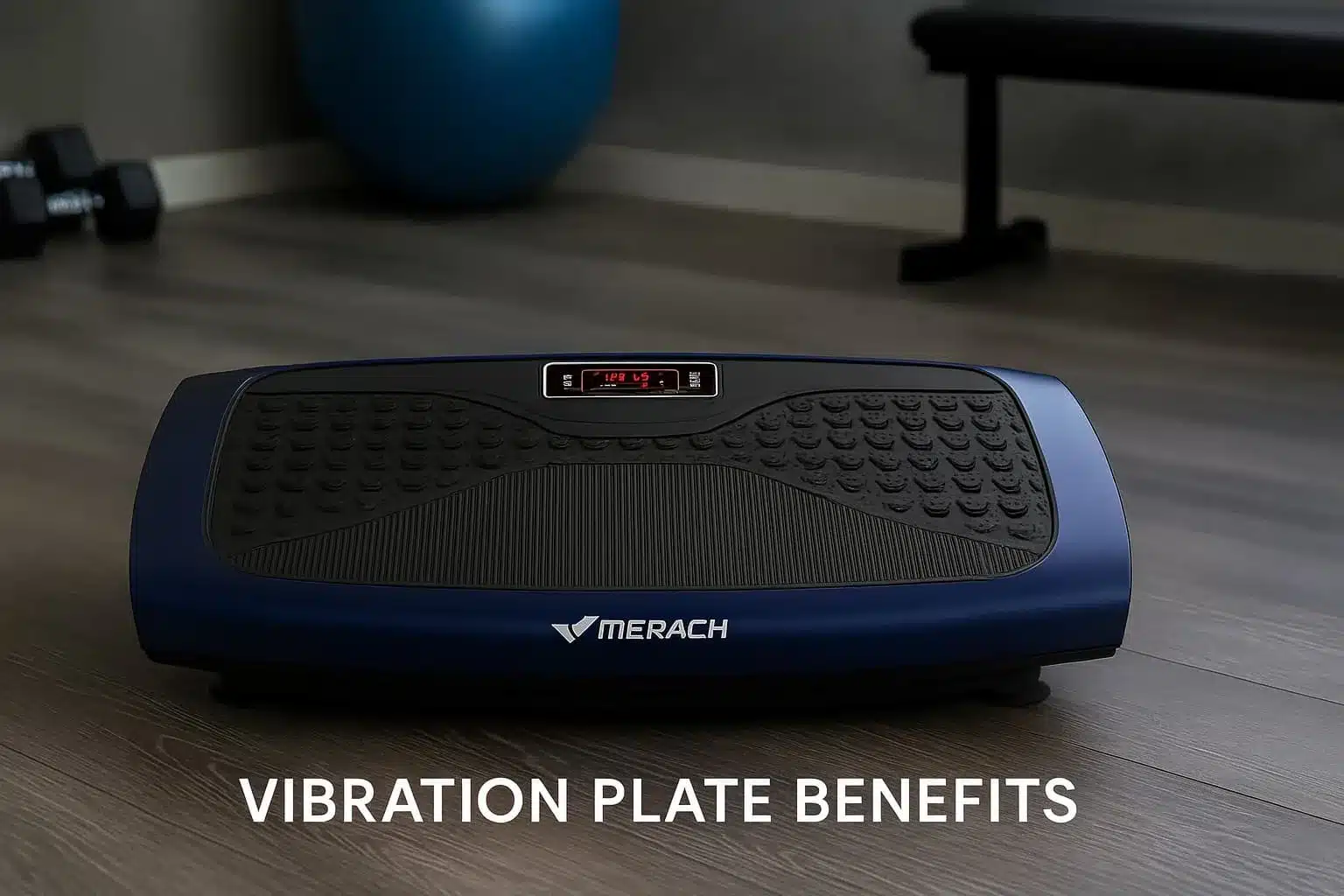
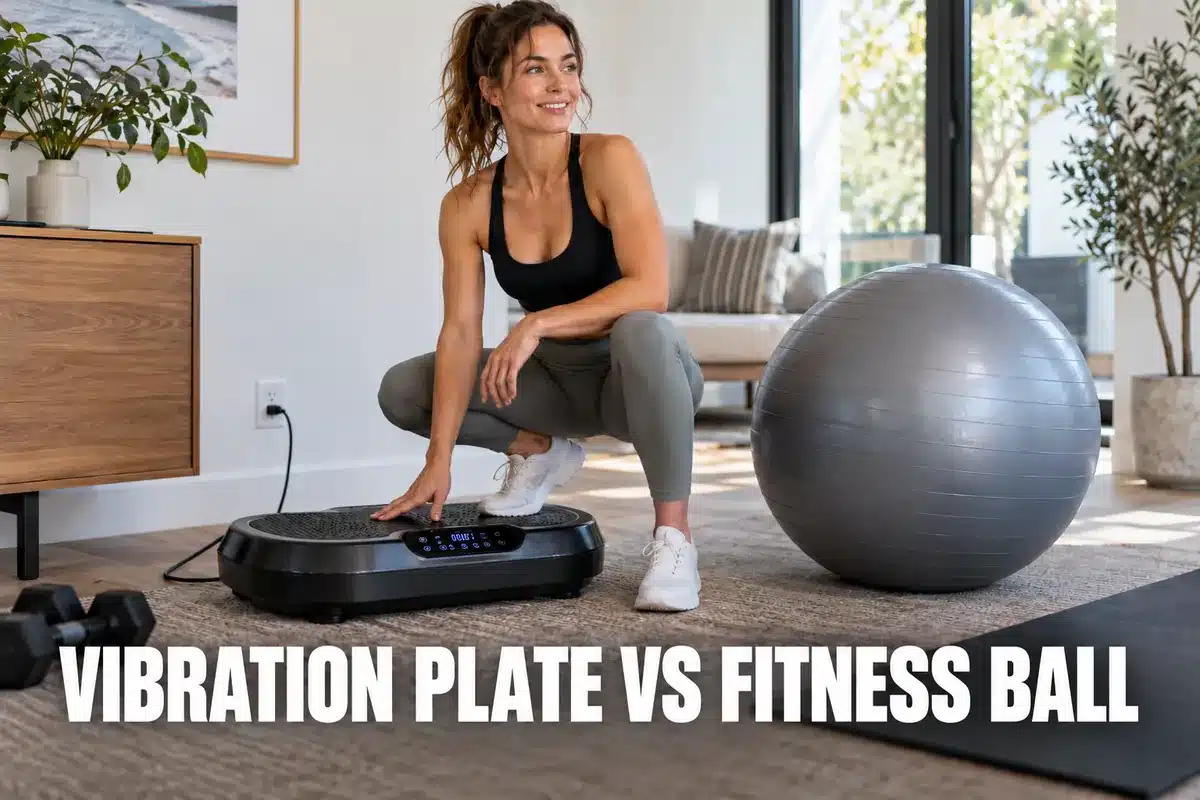
A vibration plate and a fitness ball can both make ordinary exercises more challenging, but they work in completely different ways. A vibration plate generates mechanical movement that stimulates muscular responses, while a fitness ball creates instability that you must control through voluntary muscle activity.

About the author: Hello! I’m Vladimir Stanar, professor of physical education, kinesiotherapist, marathon runner, cyclist, and cycling coach, and long-time advocate of health, fitness, and active living.
My journey with vibration plates runs parallel to my professional career in education, sports medicine, and athletic development. I’ve developed a unique process for testing vibration plates as they are some of the most versatile tools for enhancing health, recovery, and performance.
✅ Expert-Reviewed by: Vanja Vukas, MPhEd
📚 Expert Contributor: Milutin Tucakov, MPhEd
If my main goal were building core strength through exercises such as roll-outs, crunches, and hamstring curls, I would choose a fitness ball. If I wanted to add whole-body vibration to standing exercises, lower-body training, and short home workouts, I would consider a vibration plate.
Neither piece of equipment automatically produces better results just because it makes your muscles work harder during a particular exercise. The type of movement, training intensity, exercise progression, and consistency all influence what you can achieve.
In this vibration plate vs fitness ball comparison, I will examine the benefits, limitations, scientific evidence, and exercise options for both. I will also explain which is more suitable for different fitness goals and whether combining them makes sense.
Vibration Plate vs Fitness Ball: Key Differences
A vibration plate creates an external mechanical stimulus, while a fitness ball challenges your ability to maintain stability during exercise. This distinction affects the muscles involved, the types of movements available, and how training difficulty can be adjusted.
| Feature | Vibration Plate | Fitness Ball |
|---|---|---|
| Training mechanism | Mechanical vibration generated by a motor | Instability created by an inflatable ball |
| Main training emphasis | Lower-body activation, standing exercises, and balance | Core exercises, coordination, flexibility, and controlled movement |
| Core muscle involvement | Depends on vibration type, exercise position, and settings | Often substantial during appropriately selected core exercises |
| Lower-body training | Squats, calf raises, and other supported or standing exercises | Bridges, hamstring curls, wall squats, and related exercises |
| Balance training | Challenges posture on a vibrating platform | Challenges stability through controlled ball movement |
| External resistance | Limited unless combined with additional exercise equipment | Limited unless combined with additional exercise equipment |
| Adjustable intensity | Vibration settings, stance, exercise position, and duration | Exercise difficulty, leverage, ball size, and movement complexity |
| Cardiovascular benefits | Limited during passive standing | Limited during isolated ball exercises |
| Price | Generally more expensive | Generally inexpensive |
| Power requirements | Requires electricity | None |
| Portability | Depends on machine size and weight | Lightweight and deflatable |
| Storage | Usually relatively compact, but rigid | Bulky when inflated, compact when deflated |
| Main safety concerns | Excessive vibration, unstable stance, inappropriate settings | Rolling, slipping, inadequate inflation, and loss of balance |
| Best suited for | Supplementary vibration training and lower-body activity | Core conditioning, flexibility, and exercise variety |
The fitness ball is generally more practical for dedicated core and mobility exercises, while the vibration plate provides a mechanical stimulus that the ball cannot reproduce. Neither is a complete substitute for conventional resistance training.
What Is a Vibration Plate?
A vibration plate is a motorized exercise platform that produces rapid mechanical movement. Depending on the machine, this movement may be vertical, side-alternating, lateral, or a combination of several patterns.
The vibration is transmitted through the parts of your body contacting the platform. Muscles respond to the stimulus while you maintain a position or perform an exercise.
Frequency describes the number of vibration cycles per second, while amplitude describes the platform's movement distance. These technical characteristics, together with the user's weight and exercise position, influence the mechanical stimulus.
You can stand on a vibration plate with your knees slightly bent, perform shallow squats, or incorporate other exercises that the manufacturer permits. The muscular demands differ considerably between passive standing and active training.
What Is a Fitness Ball?
A fitness ball is a large inflatable exercise ball commonly made from PVC or another flexible synthetic material. You may also see it described as a stability ball, Swiss ball, exercise ball, or yoga ball.
Fitness balls typically come in several diameters, including 55, 65, and 75 centimeters. The appropriate size depends on your height, proportions, and the exercises you intend to perform.
Unlike a vibration plate, a fitness ball does not generate movement by itself. Its rounded shape creates instability when you sit, lean, or support part of your body against it.
Your muscles must control the ball and maintain the desired body position. This makes it useful for exercises that involve abdominal stability, coordinated movement, and controlled changes in body position.
Benefits of Vibration Plates
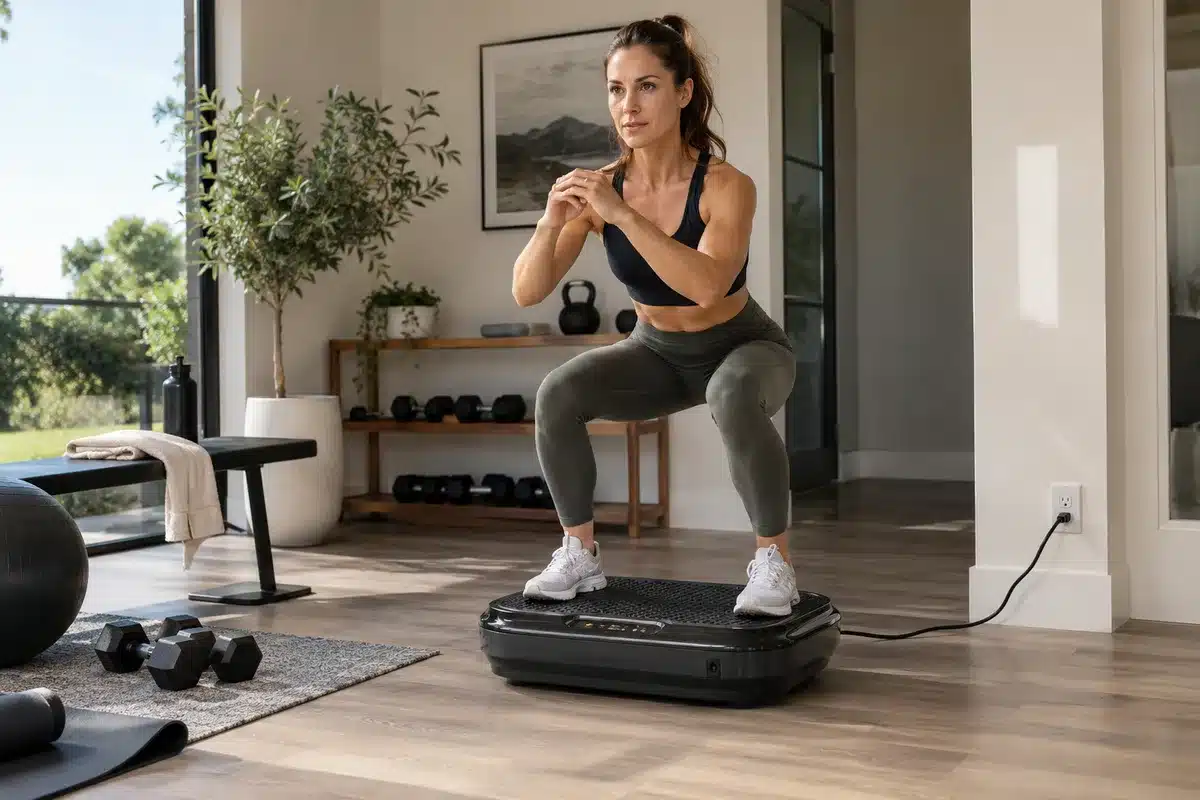
Vibration plates offer several practical advantages, particularly for people who want to incorporate additional muscular activity into a home exercise routine.
Their main appeal is not that vibration replaces regular exercise. It is that the moving platform creates a different mechanical stimulus that can be used during selected standing and bodyweight exercises.
Lower-Body Muscle Activation
Standing on a vibration plate requires the body to respond to rapid movement beneath the feet. The muscles of the lower limbs contribute to maintaining posture and controlling the position of the knees, hips, and ankles.
Research has demonstrated that whole-body vibration training can improve certain measures of lower-body strength and physical performance. These results depend on the participants, equipment, frequency, amplitude, and exercise protocols.
I would distinguish these adaptations from the effects of progressive resistance training. Increased muscular activity during vibration does not mean a short standing session can replace loaded squats or other demanding strength exercises.
Balance and Postural Control
A vibration platform can challenge your ability to maintain a stable standing position. The moving surface creates a stimulus that requires repeated postural adjustments.
Some research involving older adults has found improvements in balance and functional mobility following structured vibration training. However, the results are not uniform across studies or vibration protocols.
I see balance training as one of the more reasonable applications of whole-body vibration. Still, a person who struggles to stand securely should use appropriate support rather than assume a moving platform will automatically improve stability.
Exercise Variety
A vibration plate can be used for more than simply standing still. Depending on its dimensions and design, it may accommodate shallow squats, calf raises, supported standing exercises, and certain upper-body movements.
Changing the body position alters the muscles involved and the way mechanical vibration is transmitted.
For me, this versatility is one of the main reasons a vibration plate can complement an existing fitness routine. The platform does not need to replace traditional exercises to have a practical purpose.
Short Home Workouts
Vibration plates are convenient for people who want exercise equipment that remains accessible at home. Many compact models require little preparation beyond placing the machine on a suitable surface and selecting the desired settings.
Short sessions can incorporate several controlled movements without requiring a complete collection of gym equipment.
However, convenience should not be confused with exercise equivalence. Ten minutes of vibration training is not automatically comparable to ten minutes of walking, cycling, or resistance exercise.
Adjustable Mechanical Stimulus
Unlike a fitness ball, a vibration plate lets you change aspects of its mechanical output through the machine's settings.
Depending on the model, you may be able to adjust frequency, amplitude, vibration mode, or predefined programs. Exercise position and stance width can also influence the resulting stimulus.
I prefer machines with clearly documented technical specifications because the number of speed levels alone tells very little about the actual vibration produced. For a thorough review of the evidence behind each claimed benefit, my guide covering the research on vibration plate benefits examines what the studies actually support.
Drawbacks of Vibration Plates
Although vibration plates are versatile, they have limitations that become important when comparing them with fitness balls.
Higher Purchase Cost
A vibration plate contains motors, electronic controls, structural components, and a powered platform. This makes it substantially more complicated than an inflatable fitness ball.
Consequently, vibration plates generally cost more to purchase and may involve additional maintenance or warranty considerations.
If someone primarily wants to perform abdominal crunches, bridges, and roll-outs, I would find it difficult to justify purchasing a vibration plate solely for those activities.
Limited Progressive Resistance
Vibration intensity is not the same thing as conventional exercise resistance.
Increasing a vibration plate's speed or switching to a stronger vibration mode changes the mechanical stimulus, but it does not provide a direct equivalent to increasing the weight on a resistance machine.
A vibration plate can contribute to a strengthening routine, but I would not treat its settings as a complete progression system for building muscle.
Differences Between Machines
Vibration plates vary considerably in how they move and how their settings are controlled. Two machines with similar-looking displays may generate different frequencies, amplitudes, and acceleration.
Platform size, motor configuration, user weight capacity, and mechanical consistency can also vary.
These differences make it difficult to transfer results from one research device directly to every inexpensive consumer vibration plate.
Balance and Comfort Concerns
The moving platform may be uncomfortable or difficult to control for some users. Aggressive settings, narrow stance positions, or unsupported movements can increase the challenge.
People with substantial balance limitations or relevant medical conditions should obtain individualized guidance before introducing vibration training.
I would begin with modest settings, a comfortable stance, and exercises that can be performed with consistent control.
Recommended Vibration Plate Exercises
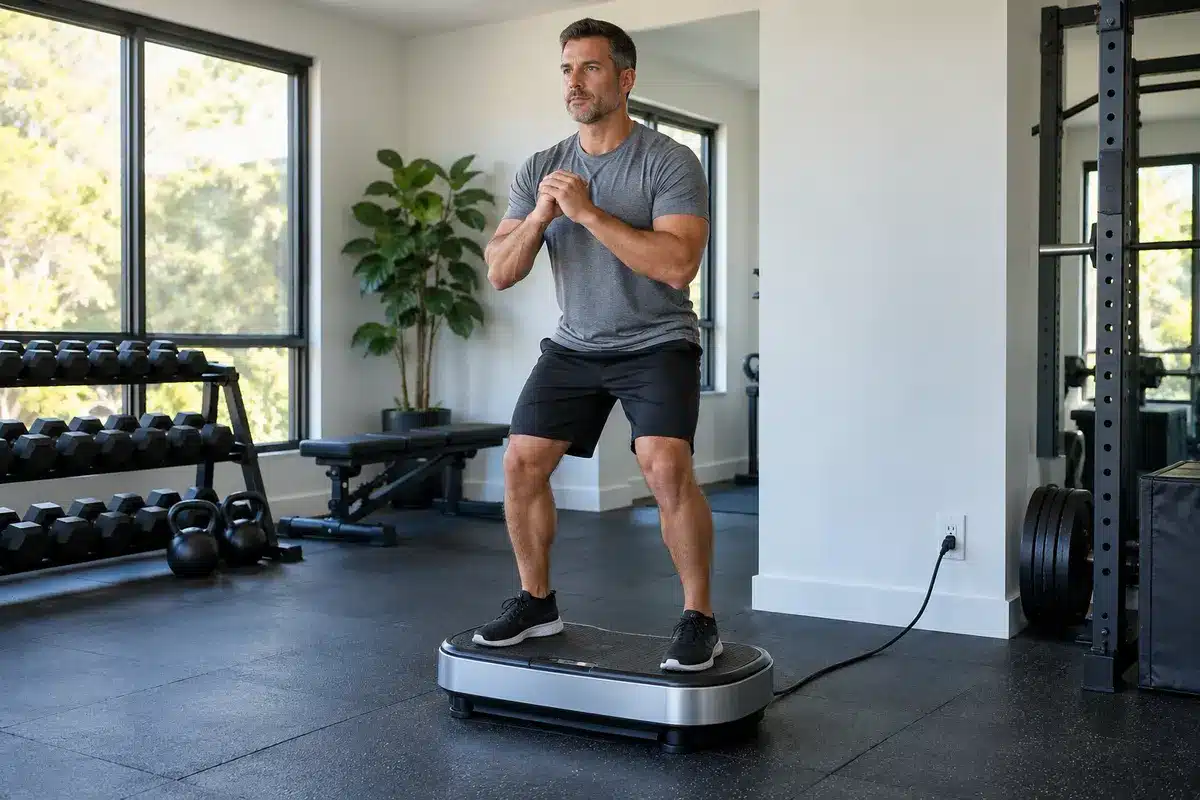
I prefer basic exercises that are easy to control and do not require complicated equipment arrangements. The objective is to incorporate movement while maintaining a stable body position.
Shallow Squat Holds
Stand on the platform with your feet comfortably separated and your knees slightly bent. Maintain the position while keeping your torso upright and your weight distributed evenly.
Start with a low setting and a short interval, then reassess your comfort and control. I would avoid deep or prolonged squat holds until the simpler position becomes manageable.
Controlled Bodyweight Squats
Begin from a stable standing position and slowly bend your hips and knees. Lower yourself through a comfortable range before returning to standing.
The exercise combines voluntary lower-body movement with the platform's mechanical stimulus. I would prioritize smooth repetitions rather than attempting to move quickly.
Standing Calf Raises
Position both feet securely on the platform and slowly lift your heels. Pause briefly before lowering them without bouncing.
This provides a relatively straightforward lower-leg exercise that can be modified according to balance and ability. A suitable handrail or fixed support can make the movement easier to control.
Supported Standing Weight Shifts
With appropriate support, gently transfer a small amount of weight from one leg toward the other while maintaining both feet on the platform.
This is a simple exercise for practicing controlled standing movements. I would keep the shifts small and avoid turning them into unsupported single-leg balancing drills. For a broader collection of movements covering different muscle groups and goals, my vibration plate workout guide includes options from beginner to more advanced progressions.
Benefits of Fitness Balls
A fitness ball has a different set of strengths. Its value comes primarily from the range of exercises that can be performed using the unstable, rounded surface.
Unlike a vibration plate, it does not require a motor or adjustable electronic settings. The training difficulty comes from the exercise itself.
Core Muscle Training
Core exercises are one of the clearest applications of a fitness ball.
Movements such as roll-outs, controlled crunches, and certain plank variations require the abdominal muscles to manage body position while the ball moves or attempts to move.
Research has found substantial abdominal muscle activation during specific Swiss ball exercises. The results vary between movements, which is why I consider exercise selection more important than merely placing a ball under the body.
For dedicated abdominal training, a fitness ball provides several practical options that do not require expensive equipment.
Balance and Coordination
The curved surface of a fitness ball introduces instability. When used appropriately, that instability requires coordinated muscular effort to maintain the desired position.
Exercises such as seated weight shifts or supported movements can develop greater familiarity with controlling the body's position.
I would be careful about describing the ball as universally superior for balance training. Other methods, including standing balance exercises and conventional core training, can also improve balance.
Flexibility and Mobility
A fitness ball can support the body during certain stretching and mobility exercises. This makes it useful for controlled trunk extension, gentle rocking movements, and selected hip or shoulder exercises.
The ball's shape allows movement through positions that might feel awkward on a flat floor.
However, the ball itself does not automatically increase flexibility. Any improvement depends on the movements performed, the available range of motion, and regular practice.
Lower-Body Exercise Variety
Although fitness balls are associated with abdominal workouts, they can also be used for lower-body exercises.
Hamstring curls, glute bridges, and wall-supported squats are common examples. These exercises challenge different muscles and movement patterns.
I find this especially useful because a single ball can support both core exercises and supplementary lower-body training.
Affordability and Simplicity
A fitness ball is generally much less expensive than a vibration plate. It does not require electricity, software, motors, or electronic controls.
This makes it accessible for people who want to experiment with home exercise without making a substantial financial commitment.
A good ball still requires appropriate sizing, inflation, and routine inspection. However, the overall equipment requirements remain simple.
Easy Transportation
A fitness ball is lightweight and can be deflated when necessary. This makes it easier to transport than a vibration plate.
The disadvantage is that an inflated ball can occupy a surprising amount of space and tends to roll unless stored securely.
For people with limited storage, I would consider both the inflated diameter and how frequently they are willing to deflate and reinflate it.
Drawbacks of Fitness Balls
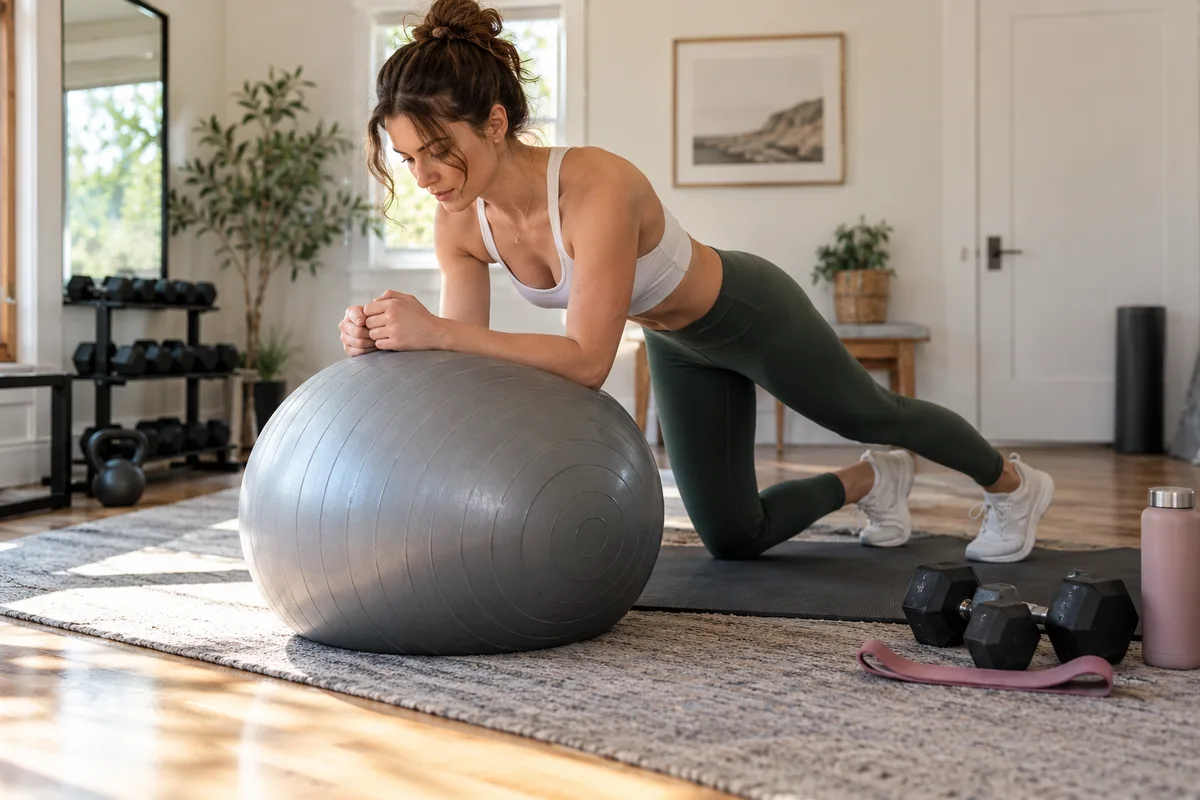
Fitness balls are useful exercise tools, but the instability that makes them interesting can also create limitations.
They Do Not Provide Progressive External Resistance
A fitness ball primarily changes body position and stability. It does not provide the kind of progressively adjustable resistance available through dumbbells, cables, or weight machines.
You can increase exercise difficulty by changing leverage, repetitions, movement range, or the amount of your body being supported.
For continued muscle growth, I would normally combine fitness ball exercises with conventional resistance training rather than rely on the ball alone.
Increased Instability Can Reduce Exercise Control
An unstable surface is not automatically an improvement.
For some exercises, instability may make maintaining position more demanding without necessarily increasing activity in the target muscles. It can also limit the amount of external resistance a person can use safely.
I would select unstable exercises when stability control is part of the objective. If the goal is simply to develop maximum force, I would often prefer a more stable setup.
Incorrect Ball Size Can Affect Technique
Using a ball that is too large or too small can make exercises awkward and affect body positioning.
Ball diameter, inflation pressure, and the user's proportions all influence how the equipment feels.
I would choose the size according to the manufacturer's guidance and then verify that it allows comfortable, controlled exercise positions.
Rolling and Slipping Risks
An inflatable ball can roll suddenly if body weight is distributed poorly. Slippery flooring or unsuitable clothing may make maintaining contact more difficult.
A ball may also lose pressure or become damaged over time. Anti-burst construction is a useful safety feature, but it should not be interpreted as a guarantee that the ball cannot fail.
I would inspect the ball regularly, follow its published load rating, and avoid using it near sharp objects or unstable furniture.
Passive Sitting Is Not a Complete Workout
Fitness balls are frequently promoted as alternatives to conventional office chairs.
However, research has not consistently demonstrated that prolonged sitting on a ball improves posture or meaningfully strengthens the core compared with ordinary seated work.
I would use a fitness ball for structured exercises rather than expect several hours of passive sitting to produce the benefits of a dedicated training session. Users focused specifically on spinal alignment and posture will find the evidence and recommended positions in my guide on using a vibration plate for posture correction.
Recommended Fitness Ball Exercises
A fitness ball offers numerous exercise possibilities, from simple beginner movements to demanding abdominal exercises.
I would build proficiency gradually, beginning with positions that are easy to control before introducing movements requiring substantial balance or trunk strength.
Seated Pelvic Tilts
Sit on the ball with both feet planted on the floor and your knees comfortably bent. Slowly tilt your pelvis forward and backward while keeping the movement small and controlled.
This is a relatively simple exercise for exploring pelvic movement and upright sitting posture.
I would not treat it as a substitute for dedicated resistance training, but it can be useful as part of a gentle mobility routine.
Fitness Ball Crunches
Sit on the ball and carefully walk your feet forward until the ball supports an appropriate portion of your lower back. With your feet firmly planted, perform a controlled abdominal crunch without pulling on your neck.
The exercise challenges the abdominal muscles through a different support arrangement from a conventional floor crunch.
Ball placement influences muscle activity, so I would focus on maintaining a repeatable position rather than extending backward as far as possible.
Fitness Ball Hamstring Curls
Lie on your back with your heels resting on the ball. Lift your hips into a controlled bridge position and slowly draw the ball toward your body by bending your knees.
Extend the legs again while maintaining control of your pelvis and trunk.
This is more demanding than it initially appears because the hamstrings and glutes must work while the ball moves. Beginners can start with ordinary bridges before attempting the full curl.
Fitness Ball Wall Squats
Position the ball between your back and a stable wall. Place your feet slightly in front of your body and perform shallow, controlled squats while allowing the ball to roll along the wall.
The ball acts as a moving support rather than a source of additional resistance.
I would use a comfortable movement range and make sure the ball remains securely positioned throughout the exercise.
Fitness Ball Roll-Outs
Begin in a kneeling position with your forearms resting on the ball. Slowly move the ball forward while keeping your trunk controlled, then return to the starting position.
This challenges the abdominal muscles as they resist unwanted trunk extension.
Roll-outs can become demanding quickly. I would begin with a very short movement and avoid allowing the lower back to collapse into an uncontrolled arch.
Fitness Ball Planks
Place your forearms on the ball and extend your legs behind you into a controlled plank position.
The unstable surface challenges your ability to maintain the position, particularly as the ball moves slightly under your arms.
I would master ordinary floor planks before progressing to this variation. Users with wrist, shoulder, or balance limitations may need a different exercise.
What Does Science Say About Vibration Plates vs Fitness Balls?
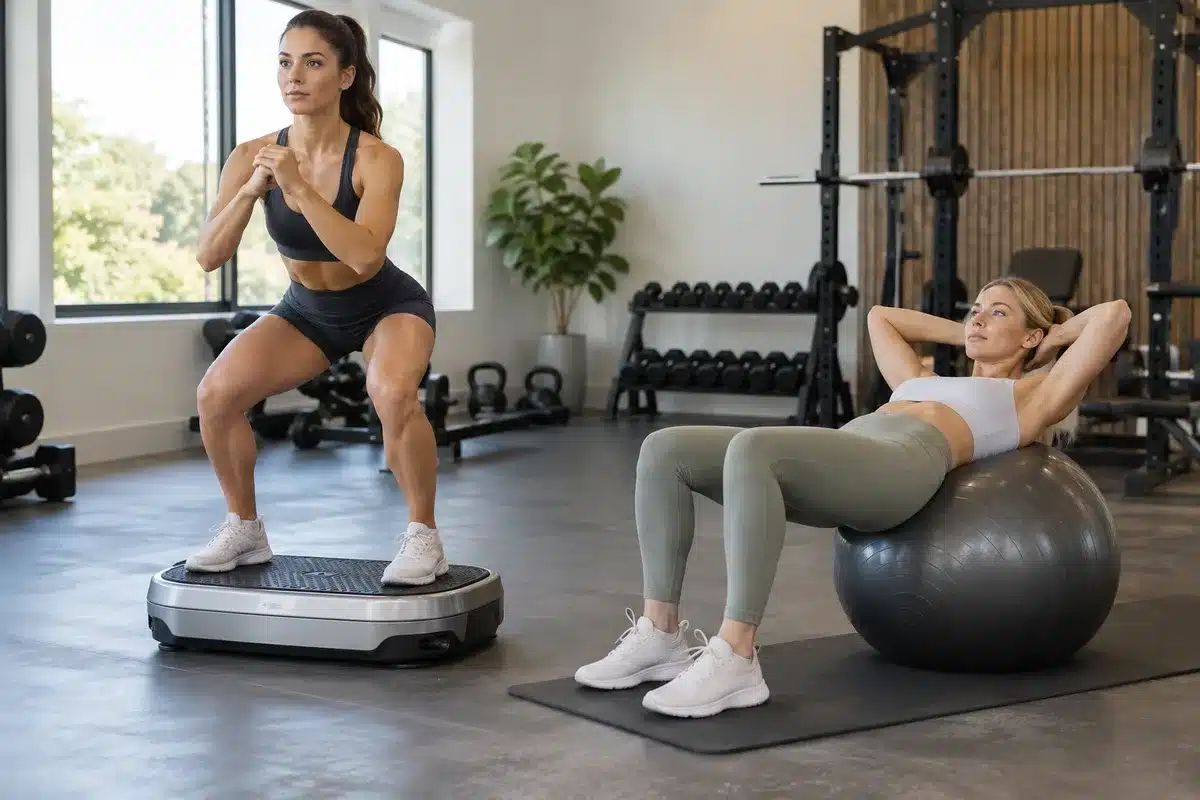
Research supports certain benefits from whole-body vibration and stability ball exercises, but the studies generally measure different outcomes. Vibration research focuses more on lower-body strength and balance, while fitness ball studies frequently examine core muscle activation and exercise control.
There is insufficient direct evidence to declare one device superior across all fitness goals.
Whole-Body Vibration Can Improve Strength and Balance
A 2026 network meta-analysis examined 27 randomized controlled trials involving 1,608 older adults.
The researchers investigated different whole-body vibration frequencies and their effects on strength, balance, and gait performance. Certain vibration protocols ranked favorably for static or dynamic balance, while traditional training ranked highest for muscle strength.
A separate systematic review of 18 randomized trials also found improvements in several lower-body strength and functional performance measures among older adults receiving whole-body vibration training.
These findings support vibration training as a potentially useful supplement for lower-body exercise. They do not prove that a typical consumer vibration plate outperforms a fitness ball, nor do they establish equivalence with conventional strength training.
Fitness Ball Exercises Can Produce Substantial Core Muscle Activation
A laboratory study involving 18 participants examined several Swiss ball exercises and conventional abdominal movements.
Ball roll-outs and pikes produced substantial activity in several abdominal muscles, including the rectus abdominis and obliques.
This supports the usefulness of appropriately selected fitness ball exercises for challenging the core. However, the measurements represented muscular activity during exercise, not long-term increases in muscle size or strength.
For dedicated abdominal conditioning, I would emphasize these active movements rather than passive ball sitting.
Ball Placement Changes the Results
Another study examined abdominal muscle activity in 41 healthy adults performing traditional crunches and stability ball crunches.
Muscle activity differed depending on where the ball supported the body. One ball position increased activation compared with a conventional crunch, while another produced less activation.
This demonstrates that adding instability does not guarantee greater muscular activity. The exercise position and technique determine whether the ball creates the intended challenge.
Core Training Can Improve Balance Without a Fitness Ball
A 2022 systematic review and meta-analysis examined how core training affected dynamic balance.
The findings supported improvements in balance following structured core training. However, the researchers did not establish that Swiss balls were consistently superior to other equipment or bodyweight-only exercises.
I would therefore treat the ball as one way to make core exercises more challenging, not as a necessary requirement for improving balance.
Not Every Unstable Exercise Produces More Muscle Activity
Some research has found that instability increases muscular activity in particular exercises. Other studies have found little difference between stable and unstable conditions.
The results depend on the muscles being measured, the exercise performed, and the training experience of the participants.
For example, a stability ball may create a substantial abdominal challenge during roll-outs while offering no meaningful advantage during another movement.
This makes exercise selection more important than the general claim that instability automatically activates more muscles.
Does Sitting on a Fitness Ball Strengthen the Core?
Research examining fitness balls as office chairs has not consistently demonstrated improved trunk muscle activation or lumbar posture during prolonged sitting. Some participants also reported greater discomfort.
Sitting on a ball for several hours should therefore not be presented as an effective replacement for structured core training.
I would reserve the ball for exercises that require deliberate muscular effort rather than expect passive sitting to produce significant adaptations.
What the Evidence Cannot Tell Us
Direct, high-quality comparisons between ordinary consumer vibration plates and fitness balls are lacking. The available studies involve different exercises, participants, equipment, and outcome measures.
The strongest conclusions are therefore equipment-specific: vibration training may support certain lower-body strength and balance outcomes, while appropriately selected ball exercises can challenge the trunk musculature. Neither finding establishes overall superiority. Readers who want a wider review of the evidence on vibration training across all use cases can find it in my guide on the effectiveness of vibration plates.
Which Is Better for Different Fitness Goals?
The answer depends on which aspect of fitness you want to develop. Rather than treating one device as an all-purpose winner, I would compare them according to their most relevant applications.
| Fitness Goal | My Preference | Reason |
|---|---|---|
| Core strength | Fitness ball | Supports roll-outs, crunches, planks, and other deliberate abdominal exercises |
| Lower-body muscle activation | Vibration plate | Adds mechanical vibration during standing and selected lower-body exercises |
| Balance and coordination | Depends | Vibration challenges standing posture; ball exercises challenge trunk and positional control |
| Flexibility and mobility | Fitness ball | Provides support for numerous stretching and controlled mobility movements |
| Muscle growth | Neither as the primary tool | Progressive resistance training is better suited to substantial hypertrophy |
| Weight management | Neither alone | Both can contribute to activity but do not replace cardiovascular exercise and appropriate nutrition |
| Older adults | Depends on abilities | Suitability depends on balance, mobility, available support, and exercise tolerance |
| Budget and portability | Fitness ball | Less expensive, lightweight, and deflatable |
| Short powered home workouts | Vibration plate | Provides an adjustable mechanical stimulus without a large gym setup |
Core Strength and Lower-Body Training
For focused core work, I would choose a fitness ball because it supports challenging exercises such as roll-outs, crunches, and hamstring curls. These movements require deliberate muscular control and can be made progressively more difficult.
For standing lower-body activation, a vibration plate offers a different stimulus. However, neither device would be my main choice for building substantial muscle size or maximal strength.
Balance and Mobility
Both tools can challenge stability, but through different mechanisms. Vibration plates introduce rapid movement beneath the feet, while fitness balls require users to control a rounded, unstable surface.
For mobility and stretching, I would generally prefer the fitness ball because it can support a wider range of controlled body positions. People with significant balance limitations should prioritize stable support rather than increasing instability unnecessarily.
Weight Management and General Fitness
Neither piece of equipment should be purchased primarily for promises of substantial calorie burning. Passive vibration and gentle ball exercises generally do not replace sustained cardiovascular activity.
Both can support a broader routine, especially when used for active exercises. I would choose according to which movements I intended to perform consistently.
Equipment for Older Adults
There is no automatic winner for older adults. Supported vibration exercises may suit some individuals, while carefully selected fitness ball movements may suit others. Older adults who specifically want to support peripheral circulation and blood flow can find dedicated machines reviewed for that purpose in my best vibration plate for circulation guide.
The important considerations are the ability to enter and maintain the exercise position, balance confidence, and the availability of suitable support. An inflatable ball's tendency to roll deserves particular attention when stability is limited. Buyers whose primary goal is weight management can find vibration plates evaluated specifically for that purpose in my best vibration plates for weight loss roundup.
Can You Use a Vibration Plate and Fitness Ball Together?
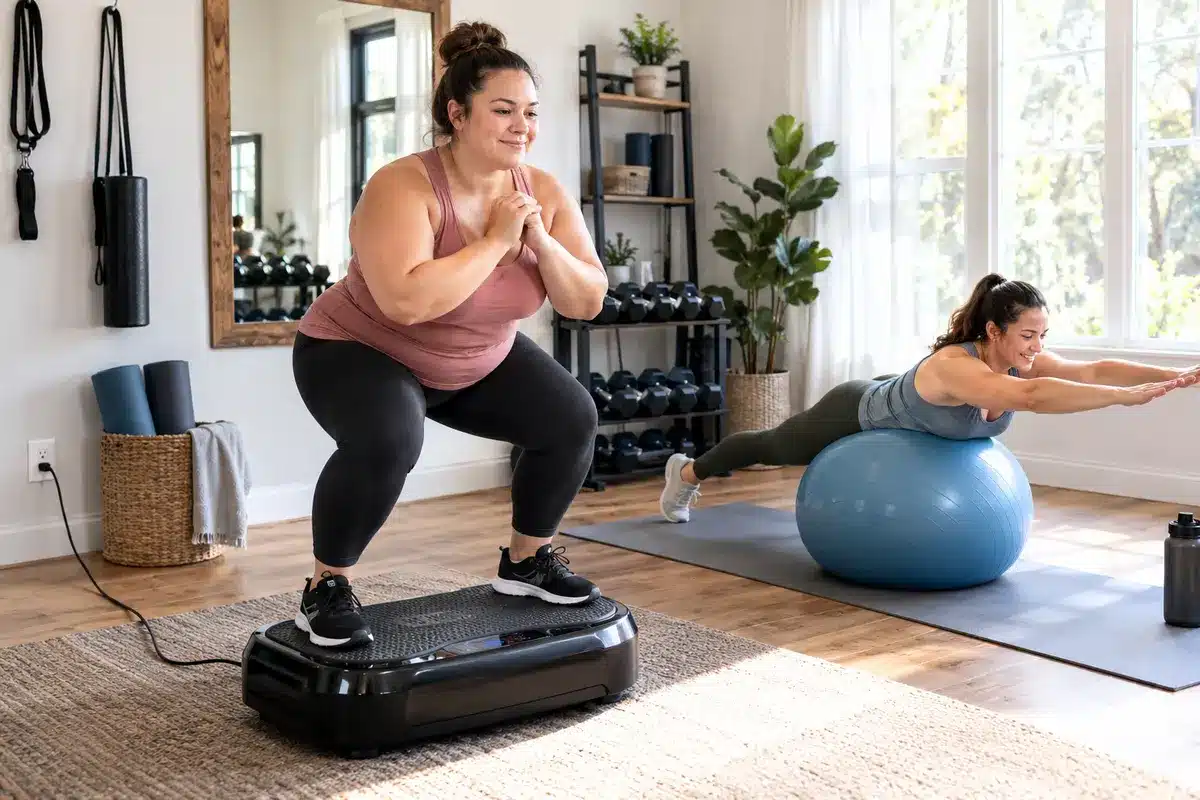
Yes. The two pieces of equipment can complement each other because they emphasize different aspects of exercise.
I would use the fitness ball for controlled core and mobility work, while reserving the vibration plate for standing exercises and selected lower-body movements.
The key is to use them separately rather than create unnecessary instability by placing one on the other.
Example Combined Home Workout
The following is an illustrative session for a generally healthy adult who is comfortable using both devices.
| Exercise | Equipment | Suggested starting approach |
|---|---|---|
| Seated pelvic tilts | Fitness ball | 1-2 sets of 8-10 controlled movements |
| Shallow squat holds | Vibration plate | 2 short intervals at a comfortable setting |
| Fitness ball crunches | Fitness ball | 1-2 sets of 8-12 controlled repetitions |
| Standing calf raises | Vibration plate | 1-2 sets of 8-12 repetitions |
| Fitness ball glute bridges | Fitness ball | 1-2 sets of 8-10 controlled repetitions |
| Gentle cooldown | Floor or suitable support | Comfortable movement without excessive instability |
I would complete each exercise with controlled technique and avoid increasing difficulty simply because the session feels manageable.
Beginners can omit the more demanding movements and use shorter sessions. The objective is not to accumulate as many exercises as possible, but to select movements that are appropriate for the user.
Should You Put a Fitness Ball on a Vibration Plate?
I would not recommend it.
An inflatable ball is designed to roll and deform under pressure, while a vibration plate creates rapid mechanical movement. Combining those two characteristics can produce unpredictable movement and increase the risk of losing control.
Unless an equipment manufacturer has explicitly designed and approved a particular combination, I would keep the ball and vibration plate exercises separate.
Should You Use a Fitness Ball Before or After Vibration Training?
Either sequence can work when the exercises are appropriate.
If core strength is the main focus, I would usually complete the more demanding fitness ball exercises while fresh and better able to maintain control.
If the vibration plate is the main activity, a few gentle ball movements may fit into the warm-up or cooldown. I would avoid exhausting the stabilizing muscles before exercises that require careful balance.
How to Choose Between a Vibration Plate and Fitness Ball
Once you know which exercises you want to perform, the remaining decision comes down to equipment fit, safety, space, and budget.
Check Equipment Size
For fitness balls, selecting the correct diameter is important.
A common starting guide is:
| User Height | Approximate Fitness Ball Size |
|---|---|
| 5'0" to 5'5" | 55 cm |
| 5'6" to 5'11" | 65 cm |
| 6'0" to 6'5" | 75 cm |
These are general manufacturer sizing recommendations rather than universal requirements. Body proportions, inflation, and the intended exercises may justify a different size.
For a vibration plate, I would examine platform dimensions, maximum user weight, machine stability, and available support features.
Evaluate Safety Features
For a fitness ball, look for a published load rating, suitable anti-burst construction, an appropriate surface texture, and clear inflation instructions.
For a vibration plate, check the manufacturer's user weight limit, platform stability, technical specifications, and available handles or support options.
Neither device should be selected exclusively on advertising claims about maximum weight capacity. The intended use and the user's physical capabilities matter just as much.
Consider Budget and Long-Term Use
A fitness ball is the more economical starting point for someone interested mainly in core exercises, stretching, and basic home workouts. Exercise difficulty can increase through changes in leverage, movement complexity, and repetitions.
A vibration plate is worth considering when the mechanical vibration itself is important to your routine and you expect to use it regularly. Its adjustable settings offer variety, but they should not be confused with conventional progressive resistance.
For long-term strength development, I would incorporate suitable resistance exercises regardless of which accessory I purchased.
Final Thoughts on Vibration Plates vs Fitness Balls
A vibration plate and a fitness ball are complementary exercise tools rather than interchangeable alternatives. The vibration plate introduces mechanical stimulation that may support lower-body strength, balance, and functional performance, while the fitness ball provides an inexpensive way to perform challenging core, stability, and mobility exercises.
I would choose a fitness ball for dedicated core training, stretching, and budget-friendly home exercise. I would choose a vibration plate when I specifically wanted to incorporate mechanical vibration into standing exercises and lower-body activity.
Neither replaces a complete fitness program, and owning both is not necessary. The better choice is the equipment that supports the exercises you can perform safely, consistently, and with appropriate progression. Readers ready to choose a vibration plate can find my full ranked comparison of top models across all price tiers in my top-rated vibration plates guide.
FAQs
Is a vibration plate better than a fitness ball for core strength?
Not necessarily. A fitness ball allows you to perform core-specific exercises such as roll-outs, controlled crunches, and planks that can produce substantial abdominal muscle activity.
A vibration plate can involve the trunk during certain exercises, but it has not been established as universally superior for core strength. I would choose the fitness ball for dedicated abdominal conditioning.
Can a fitness ball replace a vibration plate?
A fitness ball can replace some general exercise functions, such as selected bodyweight, balance, and mobility exercises. However, it cannot reproduce the mechanical vibration generated by a motorized platform.
If you primarily want conventional core exercises, the ball may be sufficient. If you specifically want whole-body vibration training, the devices are not interchangeable.
Which is safer for seniors, a vibration plate or fitness ball?
Neither is automatically safer for every older adult. Fitness balls can roll unexpectedly, while vibration platforms introduce mechanical movement that may challenge standing balance.
The more suitable choice depends on physical ability, available support, and the exercise being performed. People with significant balance or mobility limitations should obtain individualized guidance.
Can you build muscle using a fitness ball?
Fitness ball exercises can strengthen muscles, particularly when the movements are sufficiently challenging and performed consistently.
However, substantial muscle growth generally benefits from progressive resistance training. I would use fitness ball exercises to complement conventional strength workouts.
Is sitting on a fitness ball good for your core?
Passive sitting on a fitness ball has not consistently demonstrated meaningful improvements in core strength or posture compared with ordinary seated work.
For better training value, I would use the ball for structured exercises that require deliberate muscular effort.
Can you use a fitness ball and vibration plate on the same day?
Yes. You can use a fitness ball for core exercises and a vibration plate for appropriate standing or lower-body movements during the same workout.
I would perform each exercise separately, choose manageable intensity, and avoid combining the ball and platform into an unstable setup.
Notable Studies
- Xing K, et al. Does Frequency of the Mechanical Vibration Matter? Evaluating the Impact of Whole-Body Vibration Training on Older Adults Strength, Balance, and Gait Performance: A Systematic Review and Network Meta-Analysis. Analysis of 27 randomized controlled trials involving 1,608 participants compared low-, medium-, and high-frequency WBV with traditional training.
- Effects of Whole-Body Vibration Training on Lower Limb Muscle Strength and Physical Performance Among Older Adults: A Systematic Review and Meta-Analysis. Examined lower-body strength, balance, mobility, and physical performance outcomes across 18 randomized trials.
- Core Muscle Activation During Swiss Ball and Traditional Abdominal Exercises. Compared trunk muscle activation across eight Swiss ball exercises and two traditional abdominal exercises in 18 participants.
- Sternlicht E, et al. Electromyographic Comparison of a Stability Ball Crunch With a Traditional Crunch. Demonstrated that abdominal muscle activation varied according to ball placement in 41 healthy adults.
- Barrio ED, et al. Effects of Core Training on Dynamic Balance Stability: A Systematic Review and Meta-Analysis. Examined the effects of core training on dynamic balance and the influence of different training approaches.
- Changes in Muscle Activity and Perceived Exertion During Exercises Performed on a Swiss Ball. Investigated how unstable surfaces affect muscle activity during different exercises.
- Abdominal Muscle EMG Activity During Bridge Exercises on Stable and Unstable Surfaces. Compared abdominal muscle activation during bridge variations performed on different supporting surfaces.
Healthcare and Medical Disclaimer
The information provided on Vibration Plate Zone is for general informational purposes only and is not intended to replace professional medical advice, diagnosis, or treatment. Always seek the guidance of a qualified healthcare provider with any questions you may have regarding a medical condition, and never disregard or delay seeking professional advice.