If your main goal is to build stronger, bigger leg muscles, I would choose a leg press machine over a vibration plate. The leg press lets you increase resistance progressively, train through a controlled range of motion, and provide the mechanical loading that conventional strength training depends on.

About the author: Hello! I’m Vladimir Stanar, professor of physical education, kinesiotherapist, marathon runner, cyclist, and cycling coach, and long-time advocate of health, fitness, and active living.
My journey with vibration plates runs parallel to my professional career in education, sports medicine, and athletic development. I’ve developed a unique process for testing vibration plates as they are some of the most versatile tools for enhancing health, recovery, and performance.
✅ Expert-Reviewed by: Vanja Vukas, MPhEd
📚 Expert Contributor: Milutin Tucakov, MPhEd
That does not make vibration plates ineffective. Whole-body vibration can improve lower-body muscle activation and strength, particularly in people who are inactive or older, while also providing opportunities for balance training, controlled bodyweight exercises, and short home workouts.
The important distinction is that these machines challenge your muscles differently. In this vibration plate vs leg press comparison, I will explain where each performs best, what the scientific research actually demonstrates, and how I would incorporate either machine into a lower-body fitness routine.
Vibration Plate vs Leg Press: Key Differences
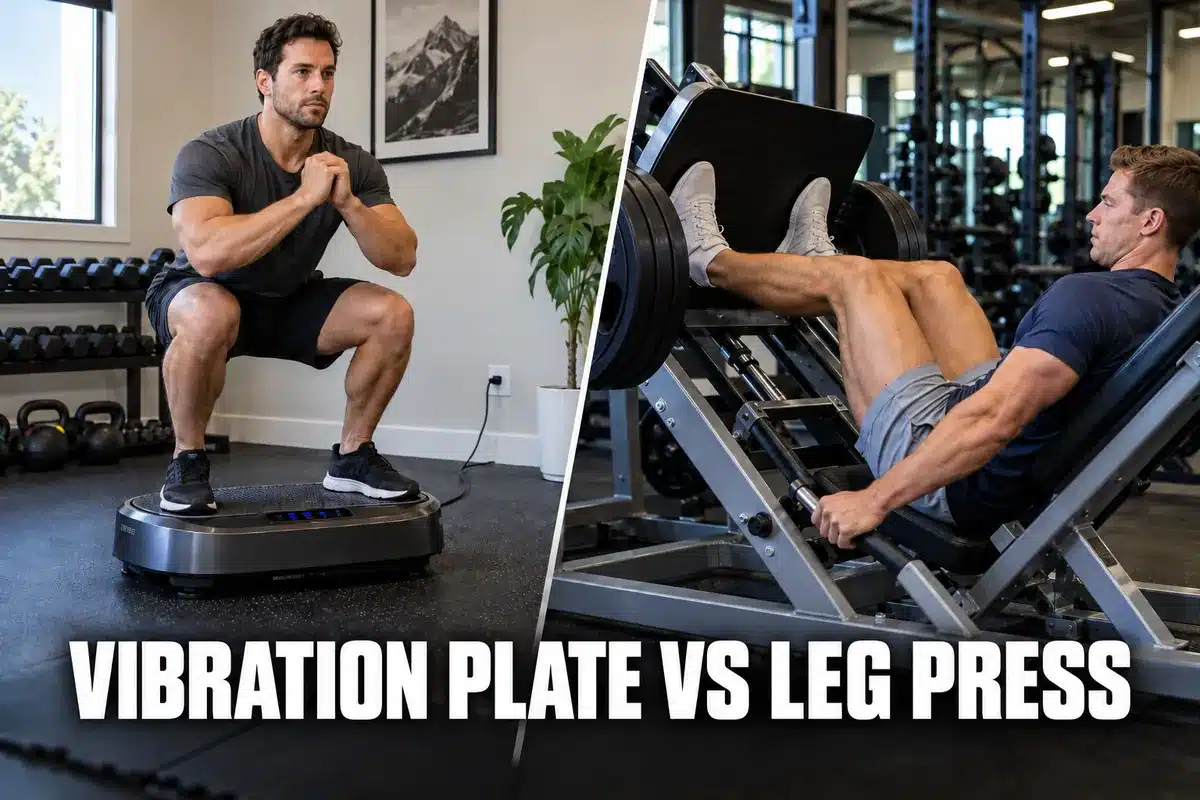
The biggest difference between a vibration plate and a leg press is how resistance reaches your muscles.
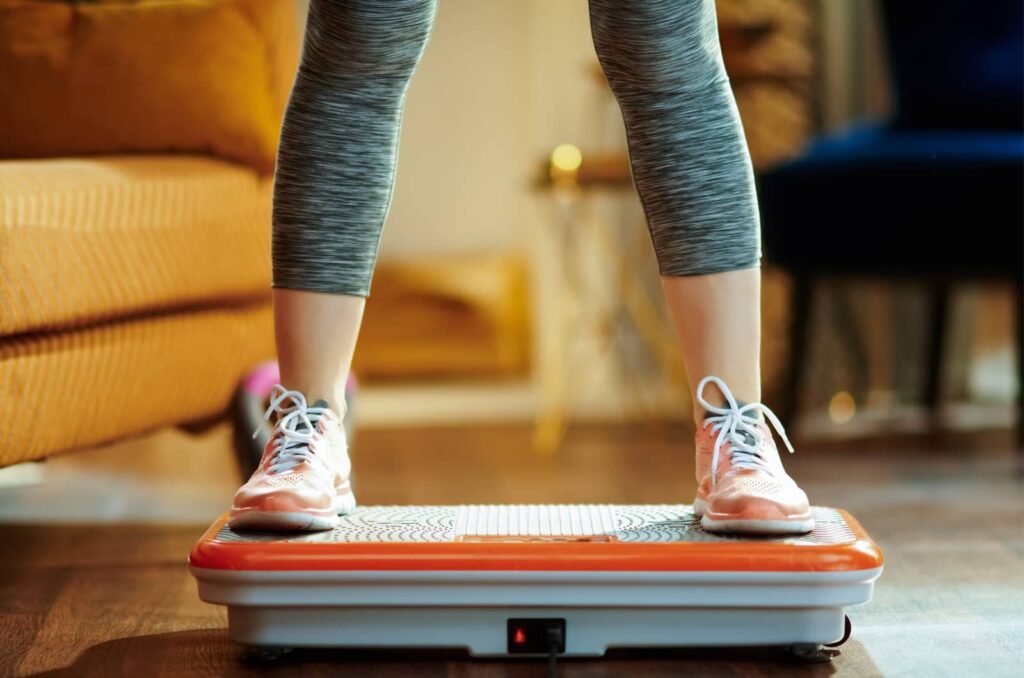
A vibration plate generates rapid mechanical movement beneath your body. Your muscles respond to this movement while maintaining posture or performing exercises such as squats, calf raises, and lunges.
A leg press uses external resistance that you move voluntarily by extending your hips and knees. You control the repetitions, movement range, exercise speed, and amount of weight being lifted.
Both can activate the quadriceps, glutes, and other lower-body muscles, but they do not create the same training stimulus.
| Feature | Vibration Plate | Leg Press Machine |
|---|---|---|
| Primary training method | Mechanical vibration and muscle stabilization | Progressive resistance training |
| Main muscles involved | Legs, hips, core, and stabilizing muscles depending on exercise | Quadriceps and glutes, with contributions from other lower-body muscles |
| Strength development | Possible improvements, depending on training protocol | Strong option for progressive lower-body strength training |
| Muscle growth | Limited and variable evidence | Established application for muscle hypertrophy |
| Balance demands | Can be significant during standing exercises | Generally lower because the body is supported |
| Adjustable resistance | Vibration frequency, amplitude, motion type, and exercise position | Weight, repetitions, sets, and movement range |
| Cardiovascular training | Limited with passive standing | Limited during conventional strength sets |
| Space requirements | Usually compact | Typically substantial, especially for home models |
| Joint loading | Depends on vibration settings, stance, and exercise | Depends on resistance, machine geometry, and technique |
| Best use | Supplementary training, muscle activation, balance, and movement variety | Building lower-body strength and muscle through progressive loading |
My preference depends on the outcome I want. For hypertrophy and measurable leg strength, the leg press has the clearer advantage. For compact home equipment that supports several different exercise positions, a vibration plate offers more variety.
What Is a Vibration Plate?
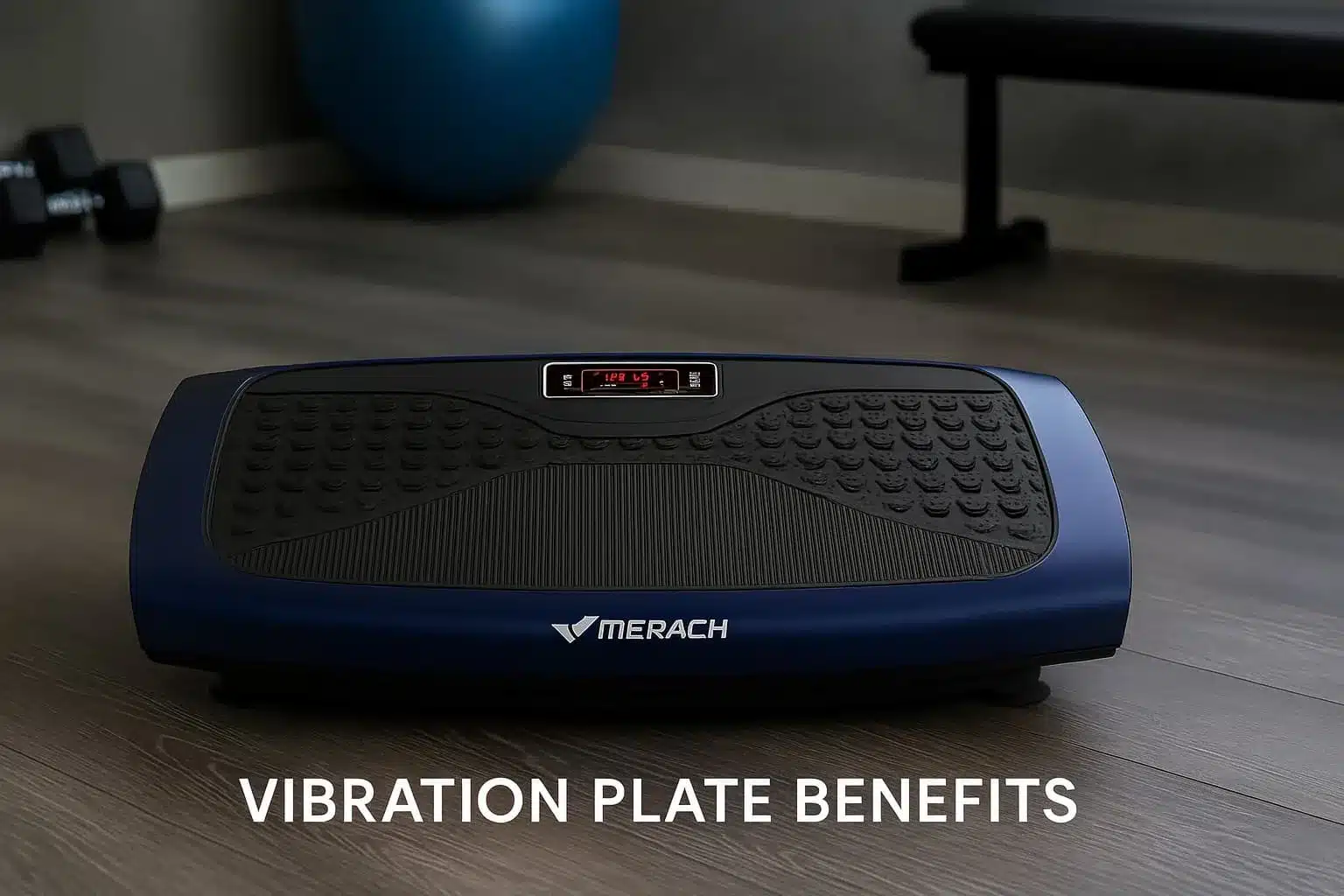
A vibration plate is an exercise platform that moves rapidly using a motorized mechanism. Depending on the model, it may produce side-alternating oscillation, vertical vibration, lateral movement, or combinations of different motion patterns.
Frequency describes how many vibration cycles occur per second, while amplitude describes the magnitude of platform displacement. These factors influence how the vibration is transmitted through your body, although the exercise position and your physical characteristics also matter.
Standing with slightly bent knees creates a different experience from performing a shallow squat or calf raise. The vibration adds a mechanical stimulus, but the amount of voluntary muscular effort depends on what you actually do on the platform.
I consider this distinction important because simply standing on a vibration plate and performing repeated squats on one should not be treated as equivalent workouts.
What Is a Leg Press Machine?
A leg press is a resistance-training machine designed primarily for lower-body exercise. You sit or lie in a supported position and push against a footplate or weighted carriage by extending your hips and knees.
Common designs include horizontal seated leg presses, 45-degree sled machines, and vertical leg presses. The amount and direction of resistance vary according to the machine's construction.
The quadriceps are major contributors during the pressing movement, while the glutes contribute to hip extension. The hamstrings and calf muscles participate to varying degrees, although the leg press does not train every lower-body muscle equally.
Unlike a vibration plate, the leg press provides an obvious method of progressing resistance. You can increase the load as your strength improves while maintaining a consistent exercise technique.
Benefits of Vibration Plates
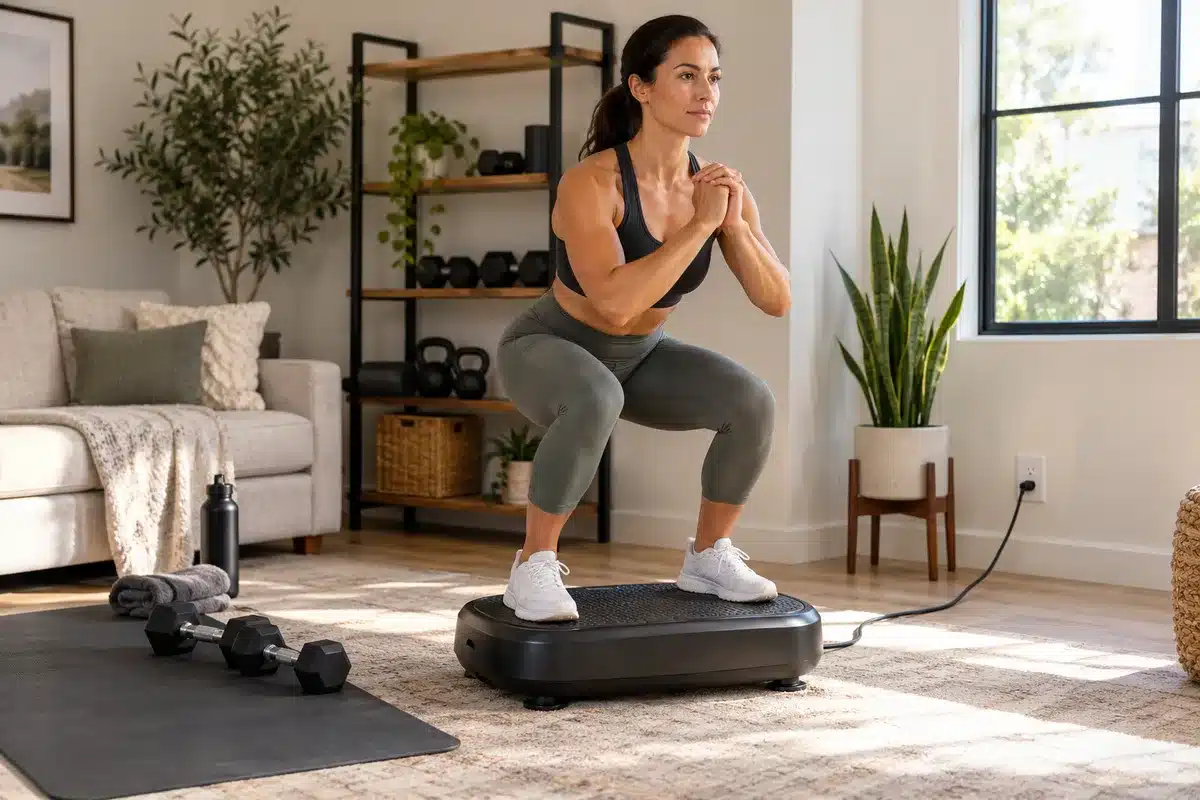
Vibration plates have several advantages for home fitness, particularly when the goal extends beyond lifting heavier weights.
I view their greatest value as a combination of muscle activation, movement variety, compactness, and their ability to add another stimulus to ordinary bodyweight exercises.
Muscle Activation and Lower-Body Strength
The mechanical movement of a vibration plate creates repeated changes in muscle activity as your body responds to the platform. Holding a squat or performing calf raises can therefore feel different from doing the same movement on a stationary floor.
Research indicates that whole-body vibration training can improve lower-body strength under certain conditions. These improvements are especially relevant when compared with doing no structured exercise.
I would not interpret increased muscle activity as automatic evidence of greater muscle growth. An exercise can produce substantial muscular activation without delivering the progressive mechanical loading needed for continued hypertrophy.
Balance and Stabilizing Muscles
Standing on a moving platform challenges your ability to maintain a stable body position. Small adjustments at the ankles, knees, hips, and trunk help control your posture throughout the session.
This gives vibration plates a practical use that seated leg presses do not directly reproduce. A leg press provides external support, whereas standing vibration exercises require the user to maintain balance.
The benefit depends on the exercise and the person performing it. Someone with significant balance difficulties may need fixed handles or external support rather than attempting unsupported movements.
Low-Load Exercise Options
One advantage of vibration training is that you can begin without loading heavy weight plates or lifting substantial external resistance. Simple standing positions, shallow squats, and controlled calf raises offer several ways to start.
This can appeal to people who are returning to exercise, have limited training experience, or want a shorter session on days when demanding resistance training is not appropriate.
However, low external loading does not automatically mean a vibration plate places less stress on every joint. The actual mechanical stimulus depends on the platform, settings, posture, and individual tolerance.
Compactness and Exercise Variety
Most home vibration plates require far less floor space than a dedicated leg press machine. Many can be placed in a corner or moved into storage after a session.
The exercise variety is also useful. Depending on platform dimensions and user ability, I can incorporate squats, calf raises, supported lunges, planks, and certain resistance-band exercises.
That versatility makes a vibration plate interesting for someone who already owns dumbbells or performs conventional strength training but wants another form of movement.
Supplementary Training and Recovery Sessions
Not every workout needs to be physically demanding. Some vibration plate users prefer short sessions involving gentle movement, relaxed standing positions, and controlled lower-body exercises.
A vibration plate can fit into this type of routine without requiring a complete resistance-training session. I would nevertheless distinguish perceived relaxation or reduced stiffness from scientifically established treatment effects.
For recovery, I would use comfortable settings and avoid assuming that stronger vibration automatically produces better results. For a thorough review of the research behind each claimed benefit, my vibration plate benefits guide covers the evidence from bone density to circulation in detail.
Drawbacks of Vibration Plates
The limitations become clearer when vibration plates are compared directly with equipment designed for strength training.
A vibration plate may provide muscular stimulation, but that does not make it a replacement for every training adaptation produced by progressive resistance.
Limited Progressive Resistance
This is the most important drawback for someone interested in building bigger and stronger legs.
A leg press allows you to add measurable external resistance as your strength increases. A vibration plate lets you change vibration settings and exercise difficulty, but those changes do not provide a directly comparable loading progression.
Increasing vibration speed from one setting to another should not be interpreted as adding a specific number of pounds to a strength exercise. The two adjustments describe fundamentally different mechanical demands.
Muscle Growth Is Less Predictable
Whole-body vibration studies have reported improvements in strength and certain muscle-related outcomes. However, the findings vary according to participant characteristics, vibration protocols, and comparison groups.
Conventional resistance training has a more extensive evidence base for increasing muscle size. That makes the leg press a more straightforward choice for someone specifically pursuing quadriceps and glute hypertrophy.
I would not purchase a vibration plate expecting it to reproduce the effects of progressively heavier leg presses simply because both exercises involve the lower-body muscles.
Balance and Posture Requirements
A vibration plate can introduce an additional balance challenge, which is not always desirable. Strong vibration, narrow foot placement, or poorly controlled movements may make maintaining posture difficult.
People who are new to vibration training should begin with simple positions and modest settings. I prefer controlled movements over attempting complicated exercises immediately.
Users with substantial balance problems should consider a platform with suitable support rather than relying on a nearby piece of movable furniture.
Equipment Quality and Technical Specifications
Not all vibration plates operate in the same way. Two machines advertising similar speed levels may produce different frequencies, amplitudes, acceleration, and movement patterns.
The lack of standardized consumer specifications makes comparing models more difficult than comparing two conventional resistance machines with clearly documented loading systems.
I would pay more attention to vibration type, available frequency information, deck dimensions, stability, and user capacity than to exaggerated advertising about the number of speed levels.
Recommended Vibration Plate Exercises for Leg Strength
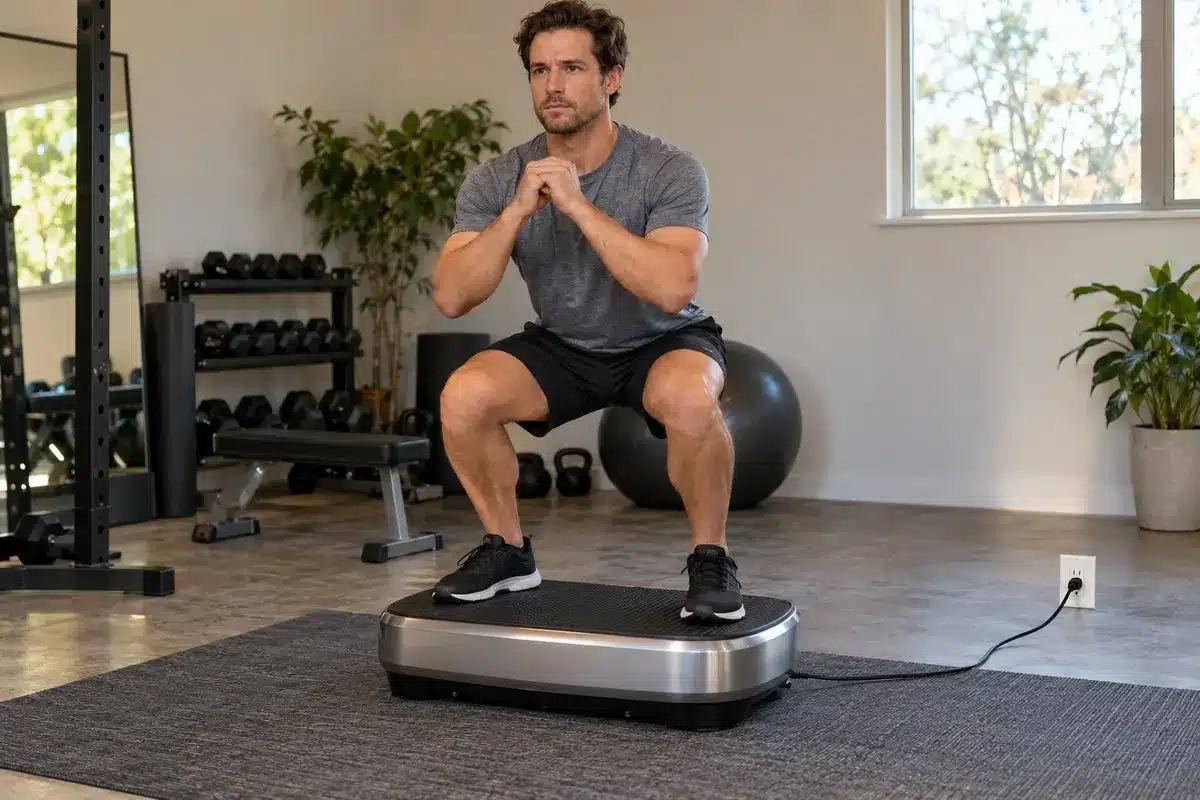
I prefer using a vibration plate actively rather than assuming passive standing will deliver every possible fitness benefit. Basic exercises provide a practical way to involve the quadriceps, calves, hips, and stabilizing muscles.
Shallow Squat Holds
Stand with your feet comfortably apart and bend your knees slightly into a shallow squat. Keep your torso controlled and hold the position for a short interval without allowing your knees to collapse inward.
Start at a low vibration setting and use support if needed. I would focus on maintaining an appropriate posture before increasing intensity or holding the position longer.
Controlled Bodyweight Squats
Stand in a stable position, bend your hips and knees, and lower yourself within a comfortable range. Return to standing without bouncing or rushing the movement.
The exercise adds voluntary muscular work to the vibration stimulus. I would prioritize slow, repeatable movements rather than trying to match the number of repetitions performed on a stationary surface.
Standing Calf Raises
Begin with both feet firmly positioned on the platform. Rise slowly onto the balls of your feet before lowering your heels in a controlled manner.
Calf raises are a simple way to train the lower legs without requiring a large exercise area. Support may be useful while learning to control the motion.
Supported Split-Stance Holds
With a suitable vibration plate and stable external support, some users may perform a carefully controlled split-stance position with one foot on the platform and the other on the floor.
This is more demanding than ordinary standing because it introduces an uneven support position. I would reserve it for people who already have good balance and experience with the machine. For a fuller list of exercises organized by difficulty and fitness goal, my full vibration plate exercises breakdown covers beginner positions through more advanced movement patterns.
Benefits of Leg Press Machines
The leg press has a much more focused purpose than a vibration plate. Its main advantage is the ability to train lower-body muscles against controlled external resistance.
That makes it a useful exercise for beginners, experienced lifters, and people who prefer machine-based strength training.
Progressive Lower-Body Strength
The leg press provides a measurable training challenge. As your capacity improves, you can increase the resistance while monitoring repetitions, sets, and movement quality.
This makes progression relatively straightforward. If a particular weight becomes easier to move with controlled technique, you have clear options for adjusting the workout.
For developing leg strength over time, I consider this one of the strongest reasons to choose a leg press over a vibration platform.
Quadriceps and Glute Development
Leg pressing involves repeated knee and hip extension, with the quadriceps and gluteal muscles contributing to the movement.
The precise muscular emphasis depends on machine geometry, movement range, individual anatomy, and technique. However, the ability to train these muscles against progressively challenging loads makes the exercise useful for hypertrophy.
The leg press is not a complete replacement for hamstring curls, hip hinges, calf raises, or other lower-body movements. I would use it as one component of a balanced leg-training program.
Stable and Supported Training
A seated leg press supports the torso and reduces the balance demands associated with standing exercises.
This allows many users to concentrate on producing force through the legs rather than controlling a moving platform or maintaining an unsupported squat position.
I would not confuse that support with automatic safety. The seat position, range of motion, chosen resistance, and proper use of the machine's safety features still matter.
Measurable Progress
I appreciate exercises that make long-term changes easy to observe. The leg press allows you to track the amount of resistance, repetitions completed, and improvements in controlled movement.
A gradual increase in exercise performance can help guide future training decisions. It also makes it easier to identify when the resistance is too heavy or progress has stalled.
A vibration plate can track settings and session duration, but those measurements do not provide the same direct indication of external force production.
Exercise Accessibility
Machine-based leg pressing can be useful for people who find certain free-weight movements difficult to coordinate.
The supported position may allow them to concentrate on knee and hip extension without needing to balance a barbell. Machines also differ in their entry positions, adjustments, and comfort.
Suitability remains individual. Someone with restricted hip mobility or painful knee flexion may find one leg press comfortable and another unsuitable.
Drawbacks of Leg Press Machines
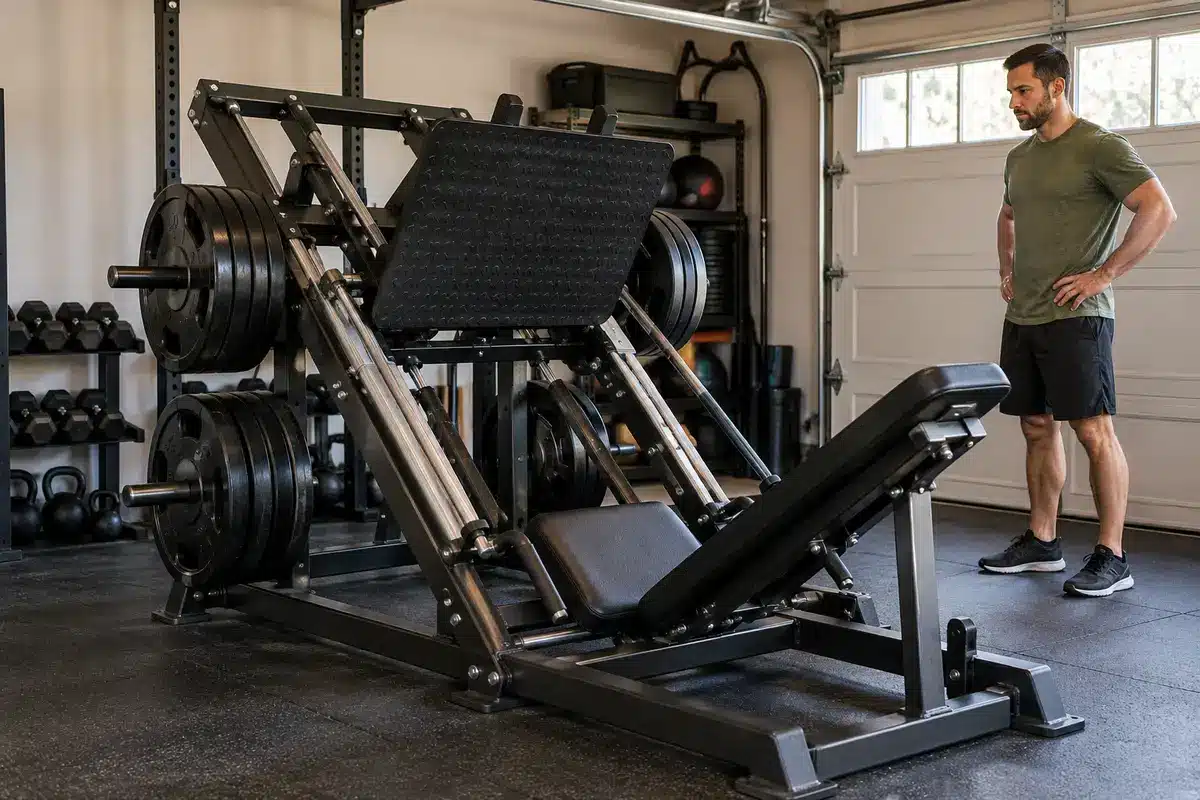
Although I favor the leg press for building lower-body strength, it has practical limitations that can make it less attractive for certain home users.
Large Space Requirements
A dedicated leg press machine can occupy a substantial part of a room. Full-size sled machines may require additional clearance for loading weight plates, entering the machine, and moving around it safely.
Even compact vertical designs are much larger and heavier than most vibration plates.
I would measure the available floor area before considering a home leg press. The machine's published dimensions do not always represent all the clearance needed during actual use.
Higher Equipment Costs
A dedicated leg press usually represents a larger home-gym investment than a basic vibration plate.
Plate-loaded machines may also require separate weight plates, while some seated machines use integrated weight stacks. Assembly, delivery, and floor protection can add to the practical cost.
For someone who already belongs to a gym, using its leg press may be more sensible than purchasing an entire machine for home use.
Technique and Joint Loading
Although the leg press is a guided exercise, incorrect technique can still create problems.
Using excessive resistance, allowing the lower back to round significantly, losing contact with the seat, or forcing a range of motion beyond comfortable control can increase unwanted stress.
I prefer a manageable load with smooth repetitions. A larger number on the weight stack is not useful if the exercise becomes poorly controlled.
Limited Movement Variety
A traditional leg press mainly trains repeated lower-body pushing. It does not provide the same standing balance challenges or exercise-position variety available on a vibration plate.
This is not necessarily a disadvantage when the objective is targeted strength training. It does mean that other exercises remain necessary for a more comprehensive fitness routine.
I would combine leg pressing with complementary lower-body movements rather than expect one machine to train every physical quality. Users who have experienced lower back strain from heavy resistance training may find the research on whole-body vibration for lumbar issues useful, which I cover in my guide on vibration plates for back pain.
Recommended Leg Press Workouts
For beginners, I would start by learning the machine's adjustments and the movement itself. Appropriate technique matters more than selecting an impressive amount of weight.
Beginner Leg Press Session
Start with a manageable resistance that allows controlled repetitions without significant discomfort.
- Perform 2 sets of approximately 8 to 12 repetitions.
- Keep your back and pelvis supported throughout each repetition.
- Lower the resistance within a comfortable range of motion.
- Avoid forcefully locking your knees at the top.
- Rest sufficiently between sets to maintain good technique.
This is an illustrative starting routine for a generally healthy beginner, not a mandatory prescription for every person.
I would increase the difficulty only after the movement becomes consistent and the current resistance is manageable.
Strength-Focused Leg Press Session
Once you have developed appropriate technique and training experience, the leg press can be used with progressively heavier resistance.
A strength-focused session may involve fewer repetitions per set with a greater external load. The appropriate number of sets and repetitions depends on your training program and ability to recover.
My main priority would remain controlled movement through a suitable range, rather than sacrificing form to lift more weight.
Muscle-Building Leg Press Session
For hypertrophy, the leg press can provide repeated challenging sets while progressively increasing the training stimulus over time.
Moderate loads are useful, although muscle growth is not restricted to one narrow repetition range. The overall training effort, volume, recovery, and progression all influence results.
I would combine leg presses with additional movements that train the hamstrings, calves, and other lower-body muscles through different actions.
Common Leg Press Mistakes
The first mistake I would avoid is loading the machine so heavily that the available range of motion becomes extremely short. Heavy partial repetitions can have a place in specialized training, but they should not automatically replace controlled full-range exercise.
The second is allowing the pelvis to lift or the lower back to round under the resistance. The third is losing control of the movement, particularly when approaching the bottom position.
Foot placement also deserves attention. Choose a position that allows comfortable knee and hip motion rather than assuming one foot angle works for everyone.
What Does Science Say About Vibration Training vs Leg Press?
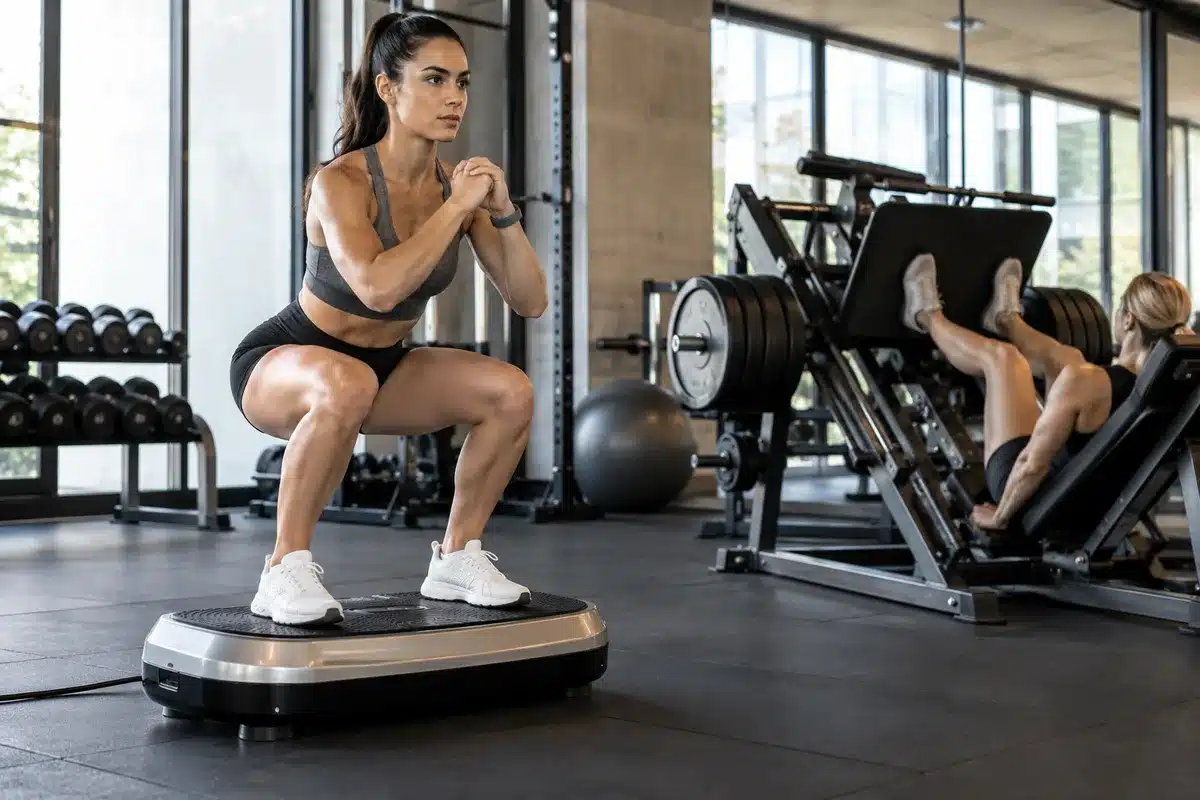
The scientific evidence is more nuanced than simply declaring that one machine builds muscle and the other does nothing.
Whole-body vibration training has produced measurable strength improvements in several research populations. However, improvements after vibration training do not necessarily establish that vibration is interchangeable with progressive resistance training.
Whole-Body Vibration Can Improve Leg Strength
A 2025 systematic review and meta-analysis included 21 randomized controlled trials involving 748 healthy women.
The researchers found improvements in knee-extension strength, leg-press strength, ankle plantar-flexion strength, and countermovement jump performance when vibration training was compared with non-exercise control groups.
For leg-press strength specifically, the analysis included four studies with 150 participants. The results favored vibration training over no exercise.
That is meaningful evidence that whole-body vibration can improve lower-body performance. It does not demonstrate that vibration is more effective than training directly on a leg press, because those leg-press outcomes were not compared with an active exercise control group.
Vibration and Conventional Exercise Can Produce Some Similar Strength Gains
Another study followed previously untrained women through 24 weeks of training.
One group performed whole-body vibration exercises, while another followed a conventional fitness program that included leg presses and leg extensions. Both groups improved knee-extensor strength.
The researchers reported some comparable strength adaptations between the training approaches. However, because the conventional program involved several exercises, it would be incorrect to describe the trial as an isolated comparison of a vibration plate against a leg press.
This reinforces an important point: strength improvements depend on the starting ability of participants, the exercise program, and the specific strength test being used.
Resistance Training Has a Stronger Evidence Base for Hypertrophy
Muscle strength and muscle hypertrophy are related, but they are not identical outcomes.
A person can improve a strength test through neural adaptations, better coordination, and greater familiarity with the movement without achieving a proportionate increase in muscle size.
Large reviews of resistance-training research support progressive loading and sufficient training volume for muscle development. For that reason, I would favor a properly programmed leg press when the objective is to increase quadriceps and glute muscle size.
Vibration training may complement these goals, but the evidence does not establish ordinary home vibration plate use as an equivalent substitute for progressive leg pressing.
What About Older Adults?
Research involving older adults suggests that whole-body vibration may improve certain lower-body strength and physical performance outcomes.
Some systematic reviews have found strength gains that were not significantly different from those produced by conventional exercise, while others have favored resistance training for particular outcomes.
I would not interpret those findings as proof that one approach is always superior. A person's ability to perform the exercise safely, the available equipment, and the training protocol all influence the practical decision.
For someone who can comfortably perform progressive resistance training, I would generally include it as part of the exercise program. A vibration plate may provide an additional option for supported movement and balance-related activity.
Does Adding Vibration to a Leg Press Improve Results?
Some research has investigated leg press equipment that incorporates a vibration stimulus, including rehabilitation applications.
This is different from using an ordinary home vibration plate before or after a conventional leg press session. The machines, training protocols, and populations are not necessarily comparable.
I would therefore avoid claiming that adding a few minutes of vibration to leg pressing produces a proven percentage improvement in strength or hypertrophy.
Both methods may fit within one routine, but the evidence does not justify promising an additional training benefit simply because they are combined. Readers who want a broader look at the quality of evidence across all claimed vibration training outcomes can find that covered in my guide on whether vibration plates work.
Comparing Vibration Plates and Leg Press Machines for Fitness Goals
Neither machine wins every category. The better choice depends on what you want to improve and which type of exercise you can perform consistently.
Strength and Muscle Development
My choice: Leg press.
If building larger quadriceps and stronger lower-body pushing muscles is the primary objective, I would choose a leg press machine.
Its measurable external resistance and progressive loading are directly aligned with conventional strength training. A vibration plate can contribute to lower-body activity, but it is not my preferred main exercise for substantial muscle growth.
Balance and Stability
My choice: Vibration plate, when used appropriately.
The moving surface can challenge standing posture and require adjustments through the lower limbs and trunk.
A seated leg press offers greater external support and generally places less demand on balance. That is useful for lifting resistance but less specific to maintaining stability while standing.
For someone with poor balance, I would use supported positions or another suitable exercise rather than assume unsupported vibration training is automatically beneficial.
Joint Comfort and Lower-Impact Exercise
My choice: Depends on the individual.
Both machines can be incorporated into relatively controlled exercise routines, but neither is automatically harmless to the joints.
A leg press can place substantial forces through the knees and hips when loaded heavily. A vibration plate transmits mechanical movement through the body, and the resulting sensation depends on its settings and exercise positions.
If existing knee pain or another medical condition affects exercise tolerance, I would make the choice according to the specific limitation rather than a general claim that vibration is always gentler.
Weight Loss and Metabolic Health
My choice: Neither as a complete solution.
The leg press can contribute to a resistance-training program that helps maintain or increase muscle mass. A vibration plate can support additional activity, particularly when active exercises are performed.
Neither is primarily designed for sustained aerobic conditioning, and neither should be presented as a stand-alone weight-loss solution.
For overall fitness and weight management, I would combine appropriate resistance training with regular cardiovascular activity and suitable nutrition. Users who prioritize blood flow and circulatory health as part of their routine can find machines reviewed for that purpose in my best vibration plate for circulation guide.
Home Use and Convenience
My choice: Vibration plate.
A vibration plate is usually much easier to accommodate in a living room, bedroom, or compact exercise area.
A dedicated leg press generally requires more room, substantial setup, and considerably more equipment.
If I already had access to a commercial gym, I would probably use its leg press for strength training and consider a compact vibration plate for additional home activity.
Training Variety
My choice: Vibration plate for exercise positions; leg press for resistance progression.
A vibration platform can be incorporated into different standing, seated, and floor-based exercises. The leg press offers fewer distinct movement patterns but greater control over resistance.
For someone who enjoys varied short workouts, the vibration plate may feel more versatile. For someone focused on recording and improving lower-body strength, the leg press provides clearer progression.
Can You Use a Vibration Plate and Leg Press Together?
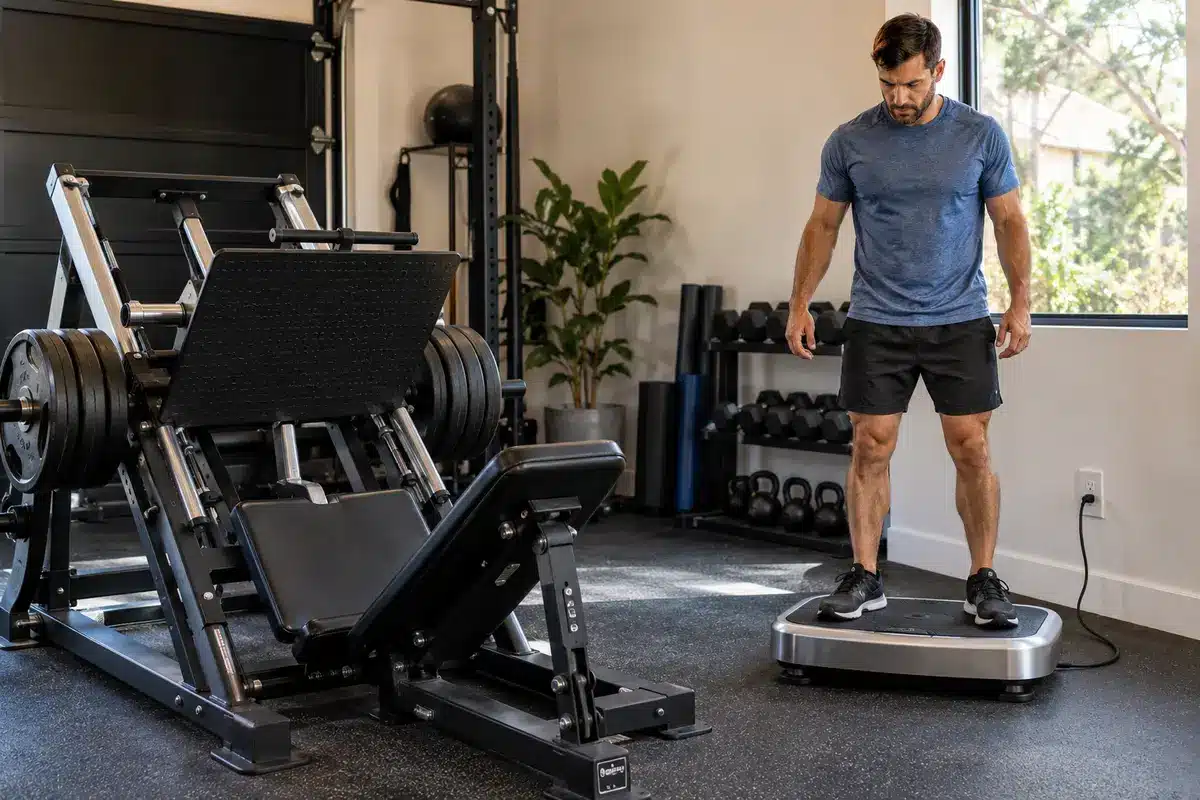
Yes. I consider them complementary tools rather than competing versions of the same exercise.
The leg press can provide the main strength-training stimulus, while a vibration plate can be used for controlled accessory movements or short sessions focused on balance and exercise variety.
Here is how I would organize a simple combined session for a generally healthy person who already tolerates both forms of exercise.
| Stage | Exercise | Practical approach |
|---|---|---|
| 1 | General warm-up | Several minutes of easy movement, followed by preparation for the pressing exercise |
| 2 | Leg press | 2-3 controlled working sets with appropriate resistance |
| 3 | Complementary leg exercises | Additional hamstring, hip, or calf work as needed |
| 4 | Vibration plate | A few minutes of gentle standing, shallow squat holds, or controlled calf raises |
| 5 | Cooldown | Comfortable movement and a gradual reduction in activity |
I would not deliberately exhaust the legs on a vibration plate before a demanding leg press workout. Pre-fatigue could make it harder to maintain controlled strength-training technique.
I would also treat the vibration portion as optional. If the resistance session has already provided enough training stimulus, there is no requirement to add vibration afterward.
Can a Vibration Plate Replace Leg Day?
Not if leg day is intended to build substantial lower-body strength and muscle through progressively challenging resistance exercises.
A vibration plate can be part of a leg workout, and active exercises on the platform may produce useful adaptations. However, it does not reproduce every feature of loaded leg presses, squats, lunges, and other resistance exercises.
If I wanted a smaller home workout setup, I would consider combining a vibration plate with conventional resistance equipment rather than expecting vibration alone to handle every lower-body training goal.
Selecting the Right Equipment for Your Needs
Before deciding which machine deserves a place in your routine, I would consider several practical factors.
Assess Your Primary Fitness Goal
Start with the outcome that matters most.
Choose a leg press if you want to develop measurable lower-body strength and muscle size. Choose a vibration plate if you want compact equipment for short sessions, muscle activation, balance exercises, and general movement variety.
If both sets of goals matter, there may be a role for each.
Consider Your Training Experience
Beginners can use either type of equipment, but their learning requirements differ.
The leg press requires correct machine adjustment, suitable resistance selection, and controlled technique. A vibration plate requires appropriate stance, intensity selection, balance, and an understanding of how different settings affect the body.
I would begin with straightforward exercises on either machine rather than attempting the most demanding options immediately.
Evaluate Physical Limitations
Equipment suitability becomes especially important when knee pain, balance problems, mobility restrictions, or other health conditions affect exercise.
A supported seated exercise may be easier for one person, while gentle standing activity may suit another. The presence of external support does not automatically make a particular exercise medically appropriate.
For an existing medical condition, recent surgery, or significant balance impairment, I would seek individualized professional guidance rather than choose equipment solely from its advertised benefits.
Measure Your Available Space
A compact vibration plate can often fit into a small area. A leg press machine usually requires considerably more floor space, along with adequate clearance around its moving components.
I would measure the entire training area rather than look only at the machine's footprint. Entry, exit, weight loading, and safe movement around the equipment all matter.
This is particularly important for 45-degree leg press and hack squat combination machines.
Think About Long-Term Progression
Ask how you expect the equipment to remain useful after six months or a year.
A leg press offers progressive external loading, which is valuable as strength improves. A vibration plate offers variation through different settings, exercises, stance positions, and resistance accessories.
Neither form of progression is inherently meaningless, but they serve different objectives.
If muscular strength and size are the main outcomes, I would prioritize equipment that allows consistent resistance training. Buyers whose primary goal is fat reduction alongside lower-body conditioning can find machines evaluated for that purpose in my vibration plates for fat loss comparison.
Final Thoughts on Vibration Plates and Leg Press Machines
The vibration plate vs leg press decision becomes much easier when I separate muscle activation from progressive strength training.
A vibration plate can provide a meaningful mechanical stimulus, and research suggests that whole-body vibration training can improve lower-body strength in certain populations. It also offers practical benefits for compact home workouts, balance exercises, and additional movement variety.
The leg press is more specialized. It lets you challenge the quadriceps and glutes with controlled external resistance, monitor progress, and gradually increase training demands. For building substantial lower-body strength and muscle, that is the approach I would favor.
If I could choose only one machine for a serious leg-strengthening program, I would choose the leg press. If I already performed resistance training and wanted a versatile addition to my home routine, I would consider a vibration plate.
The strongest approach is not to pretend that both machines produce identical adaptations. It is to understand what each does well and use that knowledge to build a routine that matches your actual goals. Readers ready to invest in a vibration plate can find my full ranked comparison of top models in my top vibration plate guide.
FAQs
Can a vibration plate build leg muscles like a leg press?
Vibration training can improve lower-body muscle strength, but the evidence does not establish it as an equivalent replacement for progressive leg pressing when muscle growth is the goal.
A leg press allows you to increase external resistance systematically, making it a more straightforward choice for quadriceps and glute development.
Is a vibration plate better than a leg press for seniors?
Not automatically. Both can be useful depending on a person's strength, mobility, balance, and ability to exercise safely.
Vibration training may support certain functional and strength outcomes, while appropriately supervised resistance training remains an important option for maintaining muscle strength with age.
Can I replace leg presses with vibration plate squats?
Vibration plate squats can provide an additional lower-body challenge, but they do not necessarily match the resistance or progression available during leg presses.
If your objective is substantial strength or muscle development, I would retain appropriate resistance exercises rather than replace them entirely with vibration training.
Which is better for bad knees, a vibration plate or a leg press?
Neither is universally better for every knee condition. A leg press allows controlled resistance and movement range, while a vibration plate provides a different mechanical stimulus that may or may not be comfortable.
The best choice depends on the cause of the symptoms, exercise technique, and individual tolerance. Persistent pain or an existing knee condition warrants professional assessment.
Can I use a vibration plate after a leg workout?
Yes, if you tolerate vibration well and use a suitable intensity. Some people incorporate gentle standing or controlled movements on a vibration plate after resistance training.
However, there is insufficient evidence to promise faster recovery or greater muscle growth simply from adding vibration after every workout.
Which machine is better for home workouts?
A vibration plate is usually more practical when space, portability, and exercise variety are priorities. A leg press is more suitable when dedicated lower-body resistance training is the main objective and enough space is available.
I would choose according to the type of training you intend to perform consistently rather than the machine with the longest list of advertised benefits.
Notable Studies
- American College of Sports Medicine. Resistance Training Prescription for Muscle Function, Hypertrophy, and Physical Performance in Healthy Adults: An Overview of Reviews (2026). Updated evidence-based resistance-training recommendations covering loading, volume, frequency, and progression.
- Qiu B, et al. Effects of Whole-Body Vibration Training on Muscle Performance in Healthy Women: A Systematic Review and Meta-Analysis of Randomized Controlled Trials (2025). Analysis of 21 randomized trials involving 748 participants found significant improvements in lower-limb muscle strength and power.
- Effects of 24 Weeks of Whole Body Vibration Training on Body Composition and Muscle Strength in Untrained Females (2004). Compared vibration training with a conventional program that included leg presses and leg extensions.
- Resistance Exercise, Electrical Muscle Stimulation, and Whole-Body Vibration in Older Adults: Systematic Review and Meta-Analysis of Randomized Controlled Trials (2020). Examined strength and functional outcomes across multiple training methods.
- Effects of Resistance Training, Endurance Training and Whole-Body Vibration on Lean Body Mass, Muscle Strength and Physical Performance in Older People (2018). Network meta-analysis of 30 trials involving 1,405 participants compared outcomes across training modalities.
- Effects of Whole-Body Vibration Training on Lower Limb Muscle Strength and Physical Performance Among Older Adults (2023). Systematic review and meta-analysis of 18 randomized controlled trials found consistent improvements in lower-limb strength and functional performance.
Healthcare and Medical Disclaimer
The information provided on Vibration Plate Zone is for general informational purposes only and is not intended to replace professional medical advice, diagnosis, or treatment. Always seek the guidance of a qualified healthcare provider with any questions you may have regarding a medical condition, and never disregard or delay seeking professional advice.