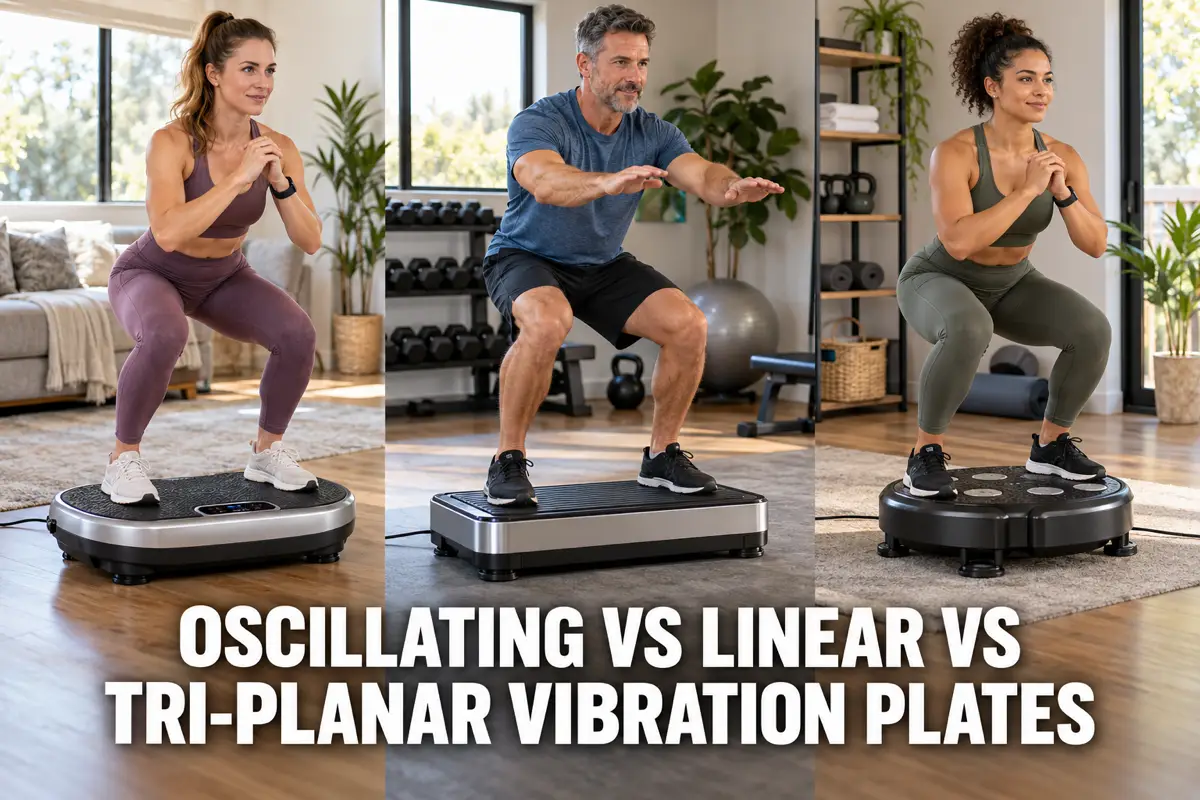
Oscillating, linear, and tri-planar vibration plates create genuinely different mechanical stimuli, but there is no scientifically proven universal winner. Oscillating plates use an alternating seesaw movement, linear plates move the deck synchronously along a straight axis, and tri-planar systems add smaller side-to-side and front-to-back movements to a predominantly vertical vibration.

About the author: Hello! I’m Vladimir Stanar, professor of physical education, kinesiotherapist, marathon runner, cyclist, and cycling coach, and long-time advocate of health, fitness, and active living.
My journey with vibration plates runs parallel to my professional career in education, sports medicine, and athletic development. I’ve developed a unique process for testing vibration plates as they are some of the most versatile tools for enhancing health, recovery, and performance.
✅ Expert-Reviewed by: Vanja Vukas, MPhEd
📚 Expert Contributor: Milutin Tucakov, MPhEd
For many home users, I think a well-designed oscillating plate is the easiest starting point because the movement is intuitive, intensity can often be changed substantially through foot position, and side-alternating vibration has a solid research base. Linear and tri-planar systems can make more sense for someone specifically looking for higher-frequency synchronous vibration, but the name of the vibration type tells you far less than frequency, amplitude, acceleration, stance, exercise selection, and the quality of the machine itself.
The terminology also needs cleaning up before comparing them. Consumer brands use words such as linear, vertical, 3D, 4D, pivotal, and tri-planar inconsistently, while scientific research normally uses more precise descriptions such as side-alternating and synchronous vibration.
First, the Terminology Is More Complicated Than It Looks
An oscillating vibration plate is normally the same basic concept researchers call side-alternating vibration. The platform pivots around a central point, so when the left side rises, the right side falls. A familiar home-fitness example is the LifePro Waver, which LifePro describes as using oscillating vibration.
You may also see the words pivotal or seesaw vibration used for the same type of movement. These terms describe the mechanism more accurately than treating oscillation as a general synonym for any vibrating platform.
A linear vibration plate usually means a platform where both sides move together rather than alternating. In consumer fitness equipment, the word linear is most commonly used for vertical up-and-down movement, which scientific papers normally describe as synchronous vibration. The Vibration Therapeutic VT007 is a clear example of this type, with the manufacturer specifically describing it as a linear vibration plate operating from 10 to 40 Hz.
Technically, however, linear only means movement along a straight line. Some consumer products use front-to-back translational movement and also describe it as linear, so I would always check what the platform physically does instead of relying on the word alone.
Tri-planar vibration refers to simultaneous movement through three axes: vertical, side-to-side, and front-to-back. A good real-world example is the Power Plate MOVE. Power Plate states that its whole-body vibration machines use its tri-planar harmonic vibration technology, including the MOVE.
Finally, 3D and 4D are marketing categories rather than standardized scientific vibration types. A 3D or 4D home machine may combine several separate motors and movement modes rather than creating the same simultaneous tri-planar stimulus used by a dedicated commercial platform.
Oscillating vs Linear vs Tri-Planar at a Glance
| Feature | Oscillating / Pivotal | Linear / Vertical | Tri-Planar |
|---|---|---|---|
| Research term | Side-alternating | Synchronous | Often synchronous / multi-axis |
| Example | LifePro Waver | Vibration Therapeutic VT007 | Power Plate MOVE |
| Main movement | Seesaw | Entire deck rises and falls together | Vertical plus smaller lateral and front/back movement |
| Left/right feet | Alternate | Move together | Move together within a multi-axis stimulus |
| Typical feel | Rocking from side to side | Rapid vertical vibration | Rapid multidirectional vibration |
| Amplitude across deck | Changes with foot position | More uniform across deck | More uniform by design |
| Typical consumer configuration | Lower frequency, larger displacement | Higher frequency, smaller displacement | Higher frequency, small multidirectional displacement |
| Upward vibration transmission | Often more attenuated | Can travel more strongly upward | Depends on platform, settings, and posture |
| Research base | Extensive | Extensive | More limited as a completely separate category |
| Universal winner? | No | No | No |
These are general mechanical patterns, not rules every manufacturer follows. Two products from the same category can still deliver very different accelerations and feel completely different underfoot.
How Oscillating Vibration Plates Work
An oscillating plate pivots around the center of the platform. When one foot moves upward, the other moves downward, producing an alternating motion through the legs and pelvis. The LifePro Waver is a practical example of this familiar home-use oscillating design.
One of the most useful things to understand is that foot position changes the effective amplitude. Standing close to the center pivot produces relatively little vertical displacement, while moving the feet toward the outside of the deck increases how far each side travels.
That makes oscillating machines unusually easy to adjust mechanically without touching the control panel. A beginner can use a narrow stance near the center and later move wider as the movement becomes more familiar.
This also explains why research on side-alternating machines needs to report foot placement. Saying that a plate has a particular amplitude is incomplete if the user can create a much smaller or larger displacement simply by changing stance width.
How Linear Vibration Plates Work
A typical linear or vertical platform moves the entire deck upward and downward at the same time. Both legs therefore receive the mechanical stimulus simultaneously rather than alternating from one side to the other. The Vibration Therapeutic VT007 is one example, using a linear vibration pattern with adjustable frequency from 10 to 40 Hz.
These machines commonly operate at higher frequencies and smaller displacements than home oscillating plates. The sensation can feel faster and more direct, especially when the knees are relatively straight.
Because the entire platform moves synchronously, moving the feet farther apart does not change amplitude in the same seesaw fashion. Foot position can still change muscular demand and body mechanics, but it does not function as the same simple amplitude adjustment found on a pivotal deck.
I would not automatically call linear vibration stronger. A low-magnitude vertical machine can deliver a much gentler stimulus than a large-amplitude oscillating plate, even if its frequency number is higher.
How Tri-Planar Vibration Plates Work
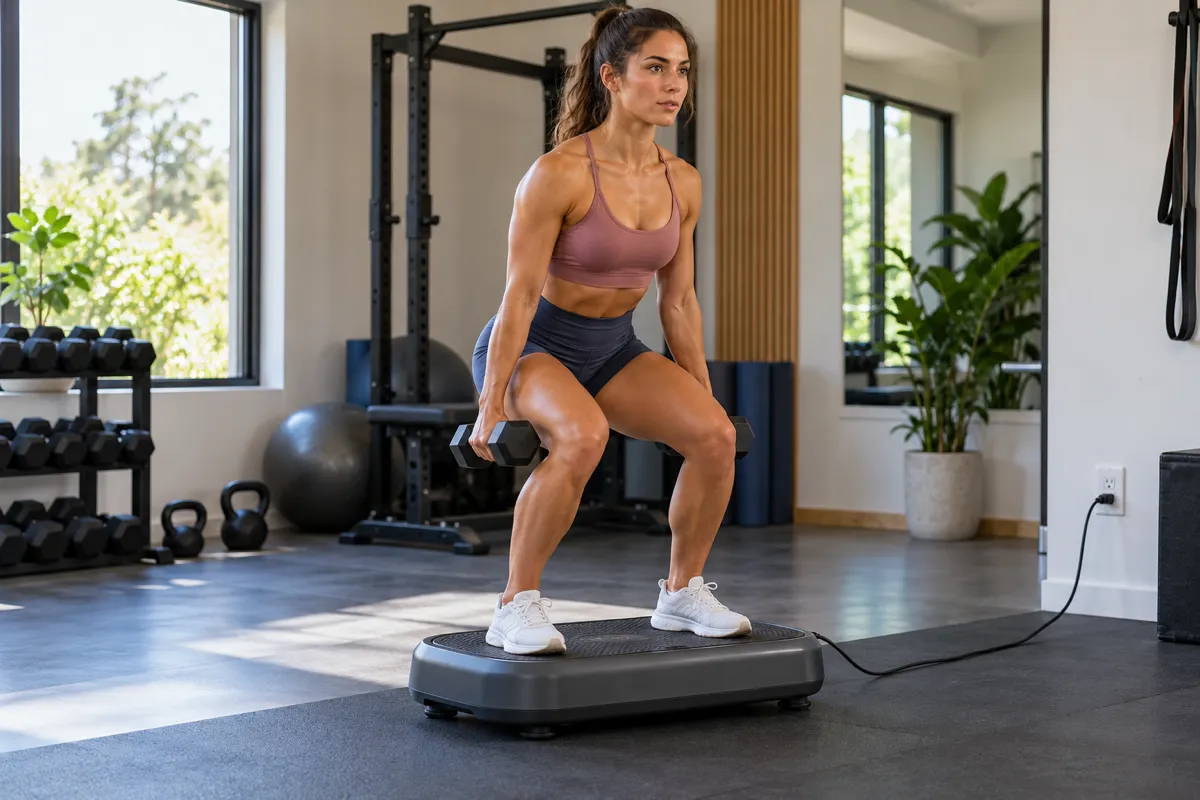
Tri-planar systems add movement in three directions: vertical, lateral, and front-to-back. The Power Plate MOVE is a good example of a commercial tri-planar vibration plate using Power Plate's multi-axis harmonic vibration technology.
The key point is that this does not necessarily mean the platform travels equally far in all three directions. Research measuring Power Plate equipment has shown a stimulus that is largely vertical, with smaller secondary movements through the other planes.
In practical terms, tri-planar vibration feels more like a rapid multidirectional variation of synchronous vibration than three dramatic independent movements of the deck.
This is important because marketing descriptions can create the impression that the machine is throwing the body significantly forward, backward, sideways, and upward on every cycle. That is not what a well-controlled tri-planar stimulus necessarily looks like.
Premium tri-planar machines often also have excellent frames, motors, frequency control, deck stability, and commercial build quality. Those characteristics can make the overall product better without proving that three-axis movement itself is universally superior.
Tri-Planar Is Not the Same as 3D or 4D
This is one of the most important distinctions when shopping for a vibration plate.
A dedicated tri-planar system creates its multidirectional displacement as part of one coordinated vibration pattern. Consumer 3D and 4D machines frequently achieve multidirectional capability through multiple independent motors.
For example, a 3D plate might contain one motor producing pivotal oscillation and another producing a separate vertical or translational movement. The controls may allow either motor to run alone or both to operate together.
A 4D machine may add another motor or mode such as pulsation. The exact meaning changes between manufacturers because there is no scientific standard defining what a consumer “4D vibration plate” must do.
I therefore would not rank products by dimensional labels. 4D does not automatically beat 3D, and 3D does not automatically mean true tri-planar vibration.
The right question is: What movements does the machine actually produce, and can those movements be controlled independently?
How the Different Types Transmit Vibration Through the Body
Vibration does not remain at the feet. Some of the mechanical energy travels through the ankles, knees, hips, trunk, and potentially farther upward, while muscles and joints absorb part of the stimulus along the way.
Direct platform comparisons show meaningful differences between side-alternating and vertical systems. Under comparable conditions, side-alternating vibration has produced higher acceleration through parts of the lower limbs but greater attenuation before the vibration reaches the upper body, while vertical-type equipment has transmitted relatively more acceleration toward the trunk in some tests.
That does not make one category automatically safer or more effective. Frequency, amplitude, body position, footwear, stance, and the specific machine can dramatically change transmission.
A powerful oscillating platform used with a wide stance can create a very substantial lower-body stimulus. A low-magnitude vertical machine may create much less overall acceleration despite using a much higher frequency.
Why Knee Bend and Body Position Change Everything
One of the biggest mistakes in vibration-plate comparisons is discussing the machine while ignoring the person standing on it.
The knees, hips, ankles, and muscles act as part of the vibration-transmission system. Slightly flexing the knees generally allows the lower body to absorb more of the mechanical stimulus rather than creating a rigid path upward.
This is one reason I regularly prefer soft knees rather than locking the legs during standing vibration. It is also why two people using exactly the same machine and setting can experience the vibration very differently.
Body position changes muscle activation too. Squat depth, forefoot loading, external resistance, and whether the user is standing statically or performing an exercise can materially change the neuromuscular response.
Plate type matters, but how you use the plate matters just as much.
For a broader look at the science behind whole body vibration, including how the body responds to different mechanical stimuli, my guide covers the mechanisms that apply across all three plate types.
Which Type Produces More Muscle Activation?
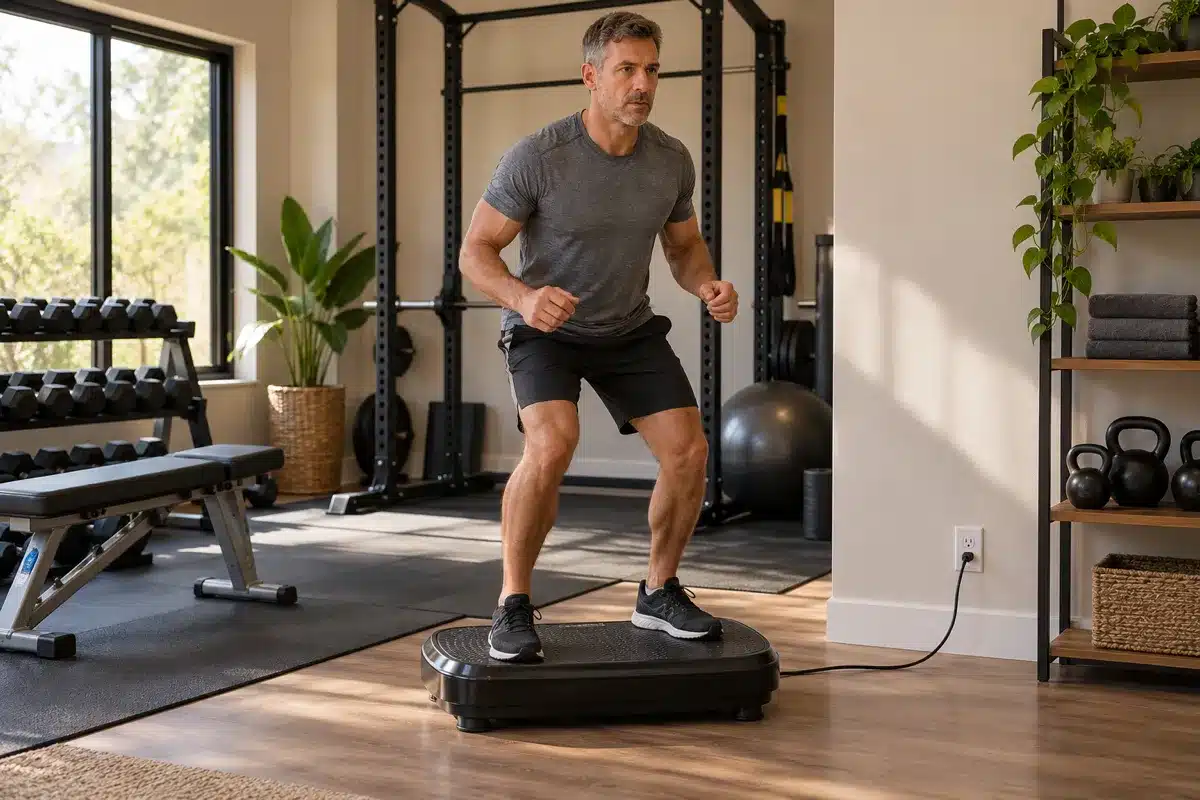
There is no universal winner, although direct research provides an interesting result.
One crossover study compared side-alternating and synchronous vibration while also changing frequency, knee angle, stance, and external load. Under the conditions tested, side-alternating vibration produced greater overall lower-limb neuromuscular activity than synchronous vibration.
The same study also showed how dangerous it is to attribute everything to vibration type. Increasing frequency, changing knee flexion, shifting stance, and adding external load also changed muscle activation substantially.
Research involving multidirectional systems tells a similar story. Combined vibration modes can create high muscle activity, but the actual platform acceleration, particularly the vertical component, appears to matter greatly.
I would therefore reject the common claim that tri-planar vibration automatically activates more muscle simply because the deck moves in more directions. More directions do not automatically equal more useful stimulation.
Which Type Is Better for Blood Flow?
Side-alternating vibration has some particularly interesting evidence here.
A meta-analysis of whole-body vibration and peripheral blood flow found an overall increase in blood flow after vibration. When researchers examined vibration type, side-alternating protocols showed a significant effect, while pooled vertical-vibration results were less convincing.
Lower frequencies also appeared important in some analyses, which may partly explain why pivotal systems often perform well in circulation-oriented studies.
A direct metabolic comparison found a higher heart-rate response during side-alternating vibration than during synchronous vibration even when researchers attempted to match peak acceleration between conditions.
That is enough for me to say that oscillating vibration has a good evidence base for acute peripheral circulation responses. It is not enough to say that every oscillating plate is better for circulation than every vertical or tri-planar machine.
Which Type Is Better for Strength?
Both side-alternating and synchronous vibration have been used successfully in strength research.
Muscle activation may differ between the systems, but long-term strength outcomes also depend heavily on whether the person is squatting, holding a static position, adding resistance, progressing the program, and training frequently enough to adapt.
This is why I would not buy a linear plate purely because someone says linear vibration is “for strength.” An active squat on a capable oscillating machine can create a meaningful muscular stimulus, while standing passively on an expensive tri-planar platform is still passive standing.
For serious strength development, conventional progressive resistance training remains the foundation. The vibration plate is an additional training stimulus rather than a replacement for loaded exercise.
For a broader overview of what vibration plates can and cannot do, my vibration plate benefits guide covers the strength, circulation, and bone-density evidence across the research base.
Which Type Is Better for Balance?
Oscillating vibration has an intuitive appeal for balance because the two sides of the body respond alternately. Studies using side-alternating platforms have reported improvements in postural stability, ankle strength, and selected balance outcomes.
That does not establish a side-alternating monopoly on balance benefits. Synchronous platforms also appear throughout successful balance and gait research, and systematic reviews include positive studies using both mechanical systems.
For balance training, I would pay at least as much attention to the exercises being performed. Supported weight shifts, shallow squats, calf raises, stance changes, and progressive reduction of hand support create a much more meaningful balance program than merely choosing a machine because its product page says “balance.”
Which Type Is Better for Bone Density?
This is another area where simple online comparisons usually go too far.
An earlier stimulus-focused meta-analysis found stronger bone-density effects from side-alternating vibration in postmenopausal women. That created some support for the idea that pivotal systems might provide a better osteogenic stimulus.
A larger updated meta-analysis, however, found significant bone-mineral-density outcomes with both side-alternating and synchronous vibration, depending on skeletal site, frequency, magnitude, total exposure, and body position.
That changes the practical conclusion substantially. I would not describe either oscillating or linear vibration as the scientifically proven bone-density winner.
The mechanical dose matters more than the category label alone.
My best vibration plate for osteoporosis guide identifies the models with the most relevant frequency and amplitude settings for bone-loading protocols.
Which Type Feels Gentler?
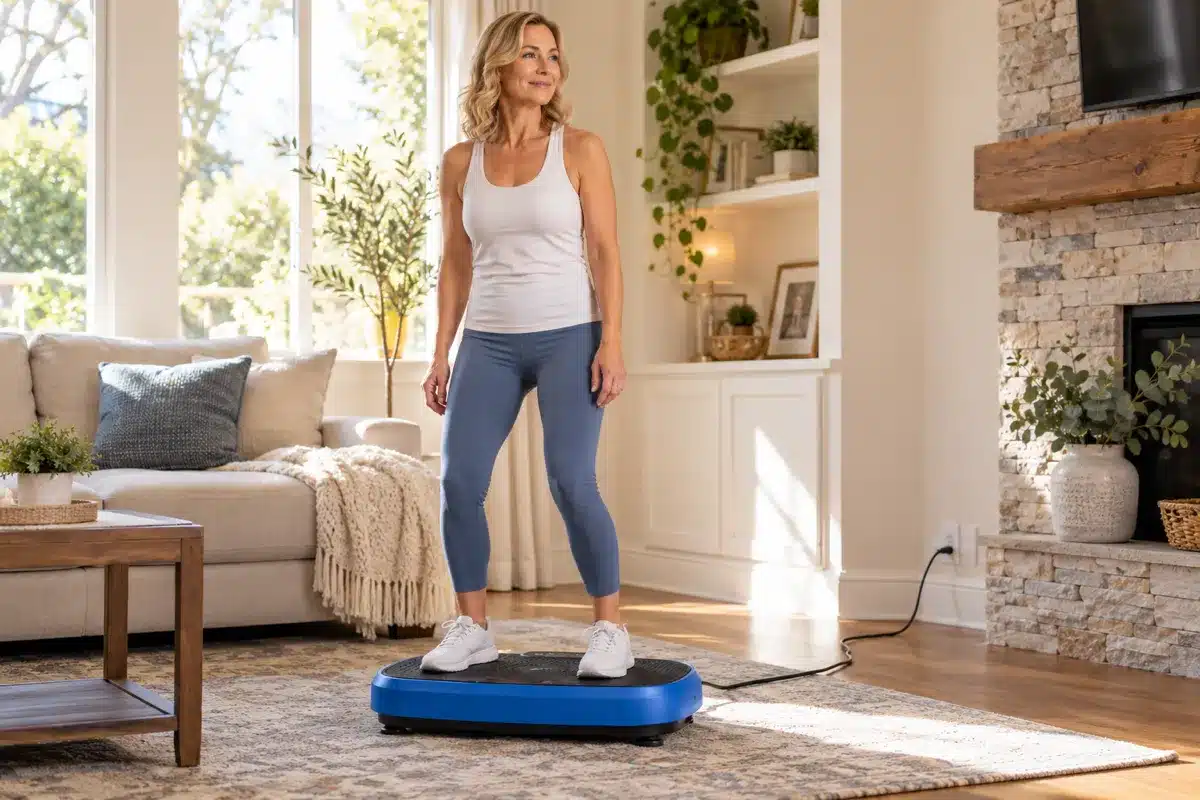
Many people find the alternating movement of an oscillating plate more comfortable because the body rocks from side to side rather than being driven vertically as one unit. Side-alternating vibration can also attenuate more of the mechanical energy before it reaches the trunk under some conditions.
That makes oscillating plates a sensible general starting point for many home users. However, the recommendation should not be turned into a rule.
A wide stance on a high-amplitude pivotal machine can feel extremely strong. A carefully controlled low-magnitude vertical system can feel comparatively mild.
Comfort therefore depends on movement type plus actual mechanical intensity.
Which Type Sends More Vibration Toward the Spine and Head?
Research comparing vibration platforms has found greater upward attenuation with side-alternating vibration and relatively greater transmission toward the thoracic spine with a vertical Power Plate system under certain test conditions.
That gives some support to the idea that oscillating vibration often concentrates more of the stimulus in the lower body. It does not mean vertical or tri-planar vibration is inherently harmful to the spine or head.
Posture can make an enormous difference. Slightly bent knees allow the legs to absorb more vibration, while locked knees can create a more direct mechanical path through the body.
If I felt excessive vibration in my jaw, vision, or head, I would adjust posture or reduce the setting rather than treating stronger transmission as evidence that the machine is working better.
Is Tri-Planar More Effective Because It Moves in Three Directions?
That has not been established.
Three-direction movement sounds intuitively more complete, and a well-engineered tri-planar machine can provide a sophisticated and highly repeatable stimulus. What research has not shown is that adding those extra movement components automatically produces superior outcomes for every user or every goal.
Muscle-activation research involving multi-axis platforms suggests that the magnitude of the actual mechanical acceleration may explain a large part of the response. In other words, the muscles do not simply count movement directions.
This is why I would not pay a premium for tri-planar technology solely because three dimensions sound more advanced. I would pay more when the entire product, including build quality, controls, verified output, deck design, and training options, justifies the difference.
Frequency, Amplitude, Acceleration, and Vibration Type All Matter
Frequency tells you how many vibration cycles occur each second. A machine operating at 30 Hz completes 30 cycles per second.
Amplitude or displacement tells you how far the platform moves. Acceleration describes how rapidly velocity changes during that motion and can be expressed in multiples of gravity, or g.
These variables interact.
A 10 Hz oscillating machine using large displacement can provide a substantial mechanical stimulus. A 35 Hz vertical machine using very small displacement may feel completely different even though the frequency number is much higher.
This is why comparing two machines only by Hz is almost meaningless. Research measuring commercial vibration platforms has found very different real accelerations and transmission patterns even when machines were nominally operated at similar settings.
Speed levels are even less useful for comparing brands. “Level 80” on one plate does not correspond to level 80, 80 Hz, or any standardized physical output on another.
For a deeper look at how frequency interacts with amplitude and acceleration across different plate types, my guide to frequencies in vibration plates covers what the numbers mean and how to use them for actual sessions.
Even Matching G-Force Does Not Make Two Plates Equivalent
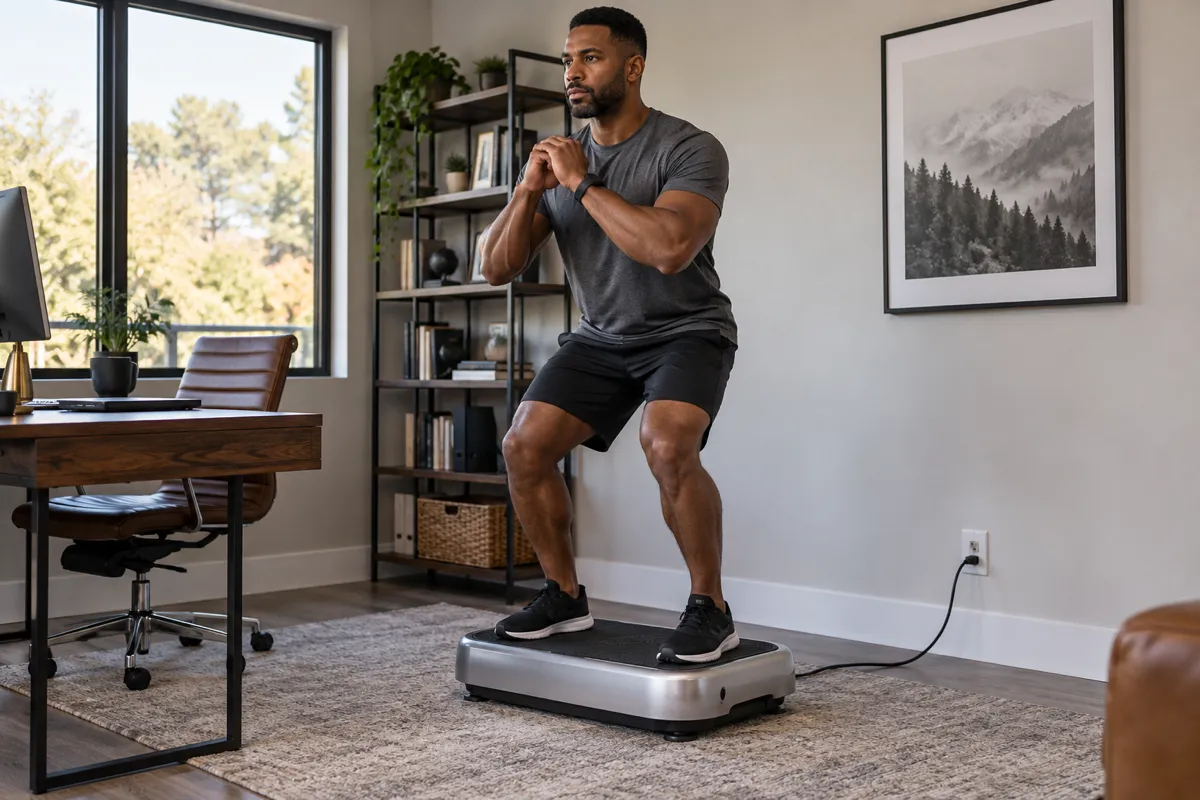
Acceleration is more informative than a proprietary speed level, but even g-force does not capture everything.
Researchers have compared side-alternating and synchronous vibration while attempting to match peak acceleration and still observed different physiological responses. The reason is that the body is receiving mechanically different movement patterns.
A side-alternating stimulus loads the legs in alternation, while synchronous vibration moves both sides together. Matching one physical number therefore does not make the experience or biological response identical.
This is another reason I prefer looking at the complete system rather than searching for one magic specification.
Why Foot Position Matters on an Oscillating Plate
Foot position is particularly important with pivotal machines.
Imagine standing almost directly over the center of a seesaw. The vertical movement under each foot is relatively small because you are close to the pivot.
Move your feet toward the outside edges and each foot travels farther up and down during every cycle. The frequency may remain exactly the same, but the displacement and resulting mechanical stimulus increase.
That gives oscillating plates a built-in method of progression. I would start closer to the center when learning the movement and widen the stance only when greater displacement serves a reason.
Which Type Is Best for Beginners?
For a typical healthy beginner choosing a home machine, I generally lean toward oscillating vibration.
The movement is easy to understand, stance width provides another way to regulate intensity, and side-alternating platforms are widely available at home-fitness prices. They also have a substantial research base rather than being merely a budget alternative to premium vibration systems.
The LifePro Waver is a recognizable example of this category and illustrates the type of straightforward oscillating platform commonly sold for home use.
My full LifePro Waver review covers how it performs on amplitude range, motor consistency, and suitability for people using it for the first time.
That does not mean every beginner needs oscillation. A good vertical machine with a wide intensity range may be equally appropriate if the user prefers synchronous movement.
I would prioritize controllability over the label. A beginner needs a plate that can start gently and allow progression.
Which Type Is Best for Older Adults?
I would not select a vibration type for an older adult without considering the machine around it.
An oscillating platform may feel comfortable and can reduce upward transmission under some conditions, which makes it an attractive option. But a handled vertical machine with excellent stability and a very gentle minimum setting could be the better choice for someone who needs rigid support.
For an older user with balance limitations, I would prioritize a stable deck, predictable controls, low starting intensity, easy mounting and dismounting, and access to a fixed support. Those factors can matter more than whether the platform is technically side-alternating or synchronous.
My best vibration plate for seniors guide focuses on stability, low starting intensity, and ease of use across the leading oscillating and vertical options.
Which Type Is Best for Strength and Athletic Training?
Synchronous and tri-planar systems are common in professional performance environments, and these platforms work well for squats, lunges, push-up positions, loaded exercises, and other active training. The Power Plate MOVE is an example of a tri-planar system designed for this more active style of whole-body vibration training.
My Power Plate MOVE review covers how it performs in practice, including frequency precision, deck stability, and what training goals it actually suits.
That does not mean oscillating platforms cannot be used dynamically. Side-alternating vibration research includes squats, wide squats, lunges, loaded positions, and other active exercises.
My vibration plate exercises guide covers the key positions, progressions, and timing for building an effective session on any plate type.
Our broader athletic-performance research also gives an important warning against choosing a machine based on sporting hype. Whole-body vibration can influence strength and muscle activation without consistently improving sprint speed, jumping, agility, or aerobic performance.
For athletes, I would choose the machine that best fits the training plan rather than assuming tri-planar or linear vibration automatically produces better sports performance.
Which Type Is Best for Circulation?
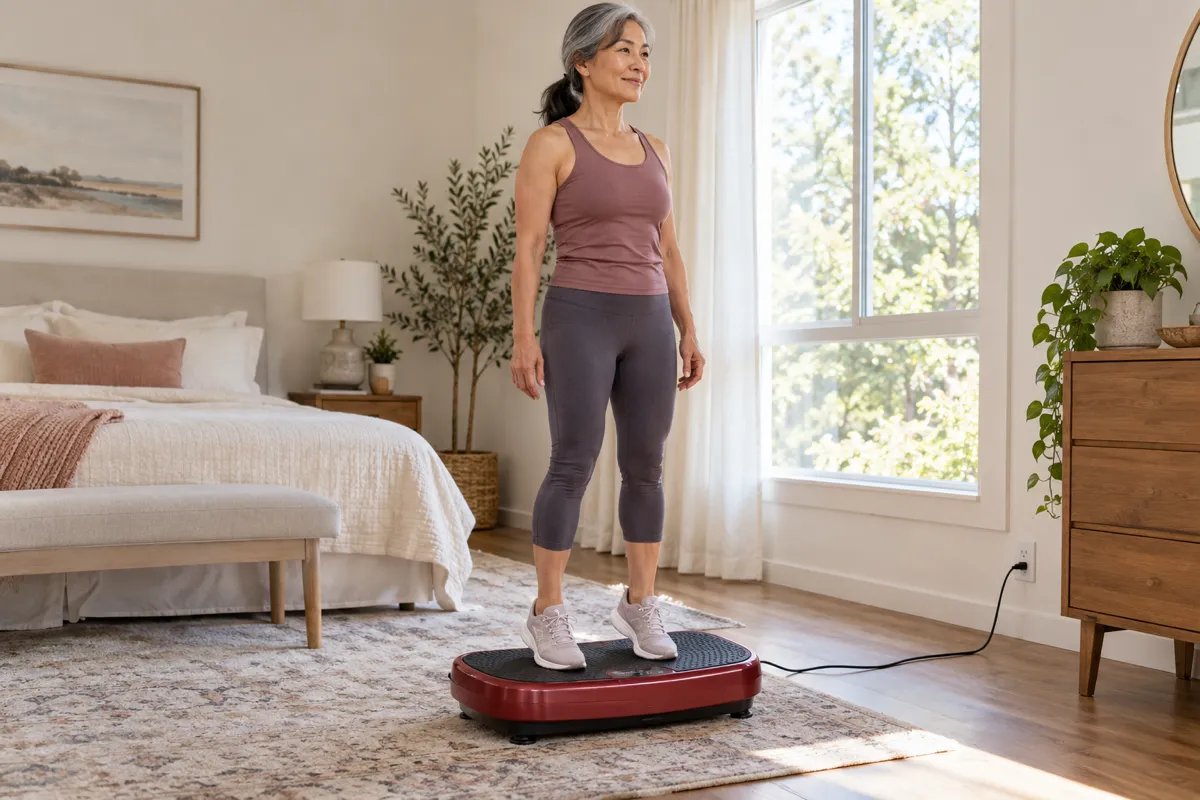
If circulation is the specific comparison, side-alternating vibration currently has some of the more interesting direct evidence.
That gives oscillating platforms a reasonable edge in the discussion, but I would still avoid presenting the result as settled. Blood-flow research uses different frequencies, amplitudes, participants, session lengths, and measurement methods.
For a normal home buyer, the difference between two actual machines may be more important than the difference between the category names.
For a breakdown of the top oscillating machines with strong circulation evidence, my vibration plate for circulation picks covers the models I would recommend.
Which Type Is Best for Home Use?
For most people buying their first vibration plate for general home fitness, I think oscillating machines provide the easiest combination of accessibility, versatility, and value.
They are widely available, often relatively compact, and allow the user to change the mechanical feel through both settings and stance width. Many people also find the side-alternating movement intuitive once they understand how it works.
A linear machine such as the Vibration Therapeutic VT007 makes more sense when you specifically want synchronous linear vibration. Tri-planar equipment such as the Power Plate MOVE becomes attractive when you want a premium higher-frequency multi-axis platform with precise control and are willing to pay for the entire engineering package.
For home use, I would still compare deck size, machine weight, stability, noise, minimum and maximum intensity, actual frequency and amplitude information, controls, warranty, and support before allowing the vibration-type label to decide the purchase.
My best vibration plate for home use guide compares the leading oscillating and vertical models on deck size, noise, and intensity range.
What About Dual-Motor 3D and Triple-Motor 4D Plates?
Multi-motor plates deserve their own category because they can provide genuine versatility.
A dual-motor machine may let you choose oscillation for one session, a different linear or translational movement for another, or run both systems together. A more complex model may add a third motor or pulsing mode and market the resulting combinations as 4D.
I like this approach when the modes are genuinely different and individually controllable. It gives one machine a broader range of movement patterns.
What I would not do is assume more motors automatically produce better physiological results. A poorly controlled “4D” machine does not become superior to a well-engineered single-mode platform just because the marketing number is larger.
How I Would Choose Between Oscillating, Linear, and Tri-Planar
I would choose an oscillating plate, such as the LifePro Waver, when I wanted an approachable, versatile home machine with side-alternating movement and an easy way to modify displacement through stance width. For most general home users, this remains my default starting point.
I would choose a linear or vertical plate, such as the Vibration Therapeutic VT007, when I specifically wanted synchronous linear vibration and the machine offered verified settings, good build quality, and enough control to match the exercises I planned to perform.
I would choose a tri-planar machine, such as the Power Plate MOVE, when I wanted a premium synchronous multi-axis system and valued precise commercial-grade engineering enough to justify the price. I would not choose it solely because the phrase tri-planar sounds more advanced.
I would choose a 3D or 4D multi-mode machine when switching between genuinely different movement systems was more useful to me than specializing in one type of vibration. Before buying, I would check what each motor actually does rather than relying on dimensional branding.
Common Claims to Ignore
Claims that tri-planar vibration is always superior, linear vibration is only for athletes, or oscillating vibration is only for beginners oversimplify a research field with substantial overlap between systems. Studies using both synchronous and side-alternating platforms have produced useful strength, balance, gait, circulation, and bone-related outcomes.
Higher Hz also does not automatically mean a stronger or better vibration plate, and 4D is not inherently better than 3D. Likewise, adding movement directions does not multiply muscle activation in proportion to the number printed on the product page.
Oscillating platforms can absolutely be used for squats, lunges, and other active exercises when the machine and user are suitable. The idea that one vibration geometry is best for every exercise, age group, and goal is not supported by the evidence.
My Take on Oscillating vs Linear vs Tri-Planar Vibration Plates
I would choose based on the complete mechanical stimulus rather than the label printed on the box. Oscillating, linear, and tri-planar machines genuinely move differently, and those differences affect muscle activation, vibration transmission, comfort, and how the body responds.
What the research does not support is one universal hierarchy where tri-planar beats linear and linear beats oscillating. Frequency, displacement, acceleration, posture, foot position, exercise selection, machine quality, and the individual user can change the stimulus enough that vibration type alone cannot predict the result.
For most general home users, I still think a good oscillating plate is the easiest place to start. I would consider linear or tri-planar systems when I specifically wanted synchronous higher-frequency WBV, while a multi-mode 3D or 4D machine makes sense when switching between genuinely different vibration patterns is more valuable than specializing in one.
The most important buying lesson is simple: understand how the platform actually moves before deciding whether the marketing name matters.
For a comparison built around real test data rather than category labels, my best vibration plate guide ranks the top oscillating, linear, and tri-planar models across all price ranges.
FAQs
What is the difference between oscillating and linear vibration plates?
An oscillating plate pivots around a central point, so one foot rises while the other falls. A typical linear or vertical plate moves the entire platform up and down synchronously, so both feet move together.
The different mechanics change vibration transmission, muscle activation, and how the platform feels.
Is oscillating the same as pivotal vibration?
Usually, yes. Oscillating, pivotal, seesaw, and side-alternating are commonly used to describe the same basic mechanism where the platform rotates around a central pivot.
Is linear vibration the same as vertical vibration?
In consumer vibration-plate terminology, linear usually means vertical synchronous vibration. Technically, linear simply means movement along a straight path, so checking the actual product movement is still important.
What is tri-planar vibration?
Tri-planar vibration produces motion in three axes: vertical, side-to-side, and front-to-back. On some commercial systems, the movement is predominantly vertical with smaller displacement in the other two directions.
The Power Plate MOVE is one example of a tri-planar whole-body vibration machine.
Is tri-planar the same as 3D vibration?
Not necessarily. Tri-planar is a specific multidirectional vibration pattern, while 3D is often a consumer marketing term for a machine containing multiple motors or movement modes.
Two products labeled 3D can therefore work very differently.
What is a 4D vibration plate?
There is no standardized scientific definition of a 4D vibration plate. Manufacturers typically use the term for machines combining multiple vibration motors or modes such as oscillation, linear movement, pulsation, or simultaneous combinations.
Which vibration plate type is best?
There is no universal best type. Oscillating plates are an excellent general home option, while linear and tri-planar systems may suit users specifically seeking synchronous vibration.
Machine quality, settings, amplitude, acceleration, deck design, and the way you exercise matter as much as the category.
Is oscillating or linear vibration better for muscle activation?
Direct comparative research has found greater lower-limb muscle activation with side-alternating vibration under some conditions. However, frequency, stance, knee angle, load, and exercise also substantially affect muscle activity.
Which vibration type is best for circulation?
Side-alternating vibration has strong evidence for increasing acute peripheral blood flow in some research. Current evidence is not sufficient to conclude that every oscillating machine is superior to every vertical or tri-planar machine for circulation.
Which vibration type is best for bone density?
Both side-alternating and synchronous vibration have produced positive bone-density results in research. The outcome appears to depend heavily on vibration magnitude, frequency, cumulative exposure, body position, and skeletal site.
Which type is better for balance?
Side-alternating vibration has produced positive balance and postural-control outcomes, but synchronous systems have also been effective in balance research. The exercises performed on the platform remain an important part of the training stimulus.
Are oscillating plates better for beginners?
They can be an excellent beginner option because the side-alternating movement is easy to understand and stance width can alter displacement. A well-controlled vertical machine can also be suitable, so the minimum intensity and overall usability matter more than the label alone.
Are linear vibration plates better for athletes?
Not necessarily. Linear and tri-planar systems are common in performance environments, but research does not show that vibration type alone determines athletic results.
Does tri-planar vibration work better than linear vibration?
There is not enough direct comparative evidence to say that tri-planar vibration is universally more effective than conventional synchronous vertical vibration. Extra movement directions do not automatically guarantee better outcomes.
Does a higher frequency mean a better vibration plate?
No. Frequency is only one part of the mechanical stimulus, along with amplitude, acceleration, motion type, posture, and exercise.
A lower-frequency oscillating machine can deliver a substantial stimulus because it may use much larger displacement.
Why does foot position matter on an oscillating plate?
An oscillating deck pivots around its center. Standing close to the center produces smaller vertical movement, while placing the feet farther toward the edges increases displacement.
That lets you change the mechanical intensity without changing the vibration frequency.
Notable Studies
Ritzmann R, Gollhofer A, Kramer A. The Influence of Vibration Type, Frequency, Body Position and Additional Load on the Neuromuscular Activity During Whole Body Vibration. Side-alternating vibration produced greater neuromuscular activation in several lower-limb muscles than synchronous vibration, with frequency and body position also influencing the response.
Spain L, et al. Transmission of Whole Body Vibration: Comparison of Three Vibration Platforms in Healthy Subjects. Vibration transmission to the lower limbs differed significantly between platform types, with oscillating platforms transmitting greater acceleration to the hip and spine than synchronous platforms.
Pel JJM, et al. Platform Accelerations of Three Different Whole-Body Vibration Devices and the Transmission of Vertical Vibrations to the Lower Limbs. The three device types generated distinct acceleration profiles, and differences in mechanical output affected how vibration was transmitted through the kinetic chain.
Gojanovic B, Henchoz Y. Whole-Body Vibration Training: Metabolic Cost of Synchronous, Side-Alternating or No Vibrations. Side-alternating vibration produced a higher metabolic cost than synchronous vibration at comparable settings, suggesting type-dependent differences in physiological demand.
Reis-Silva A, et al. Immediate Effect of Whole-Body Vibration Exercise Performed in Vertical Versus Side-Alternating Displacement Modes on Physiological Parameters, Perception of Effort, Strength and Functionality in Adults With Obesity. Side-alternating vibration produced greater improvements in functional outcomes and perceived effort than vertical vibration across multiple measures.
Games KE, Sefton JM, Wilson AE. Whole-Body Vibration and Blood Flow and Muscle Oxygenation: A Meta-Analysis. Acute WBV increased peripheral blood flow, while effects on muscle oxygenation were less consistent across vibration settings and platform types.
Power Plate. Tri-Planar vs Linear vs Pivotal Vibration: Which One Will Help You Achieve the Best Results? Power Plate explains the mechanical differences between its tri-planar technology and the linear and pivotal plate types most commonly found in consumer products.
Healthcare and Medical Disclaimer
The information provided on Vibration Plate Zone is for general informational purposes only and is not intended to replace professional medical advice, diagnosis, or treatment. Always seek the guidance of a qualified healthcare provider with any questions you may have regarding a medical condition, and never disregard or delay seeking professional advice.