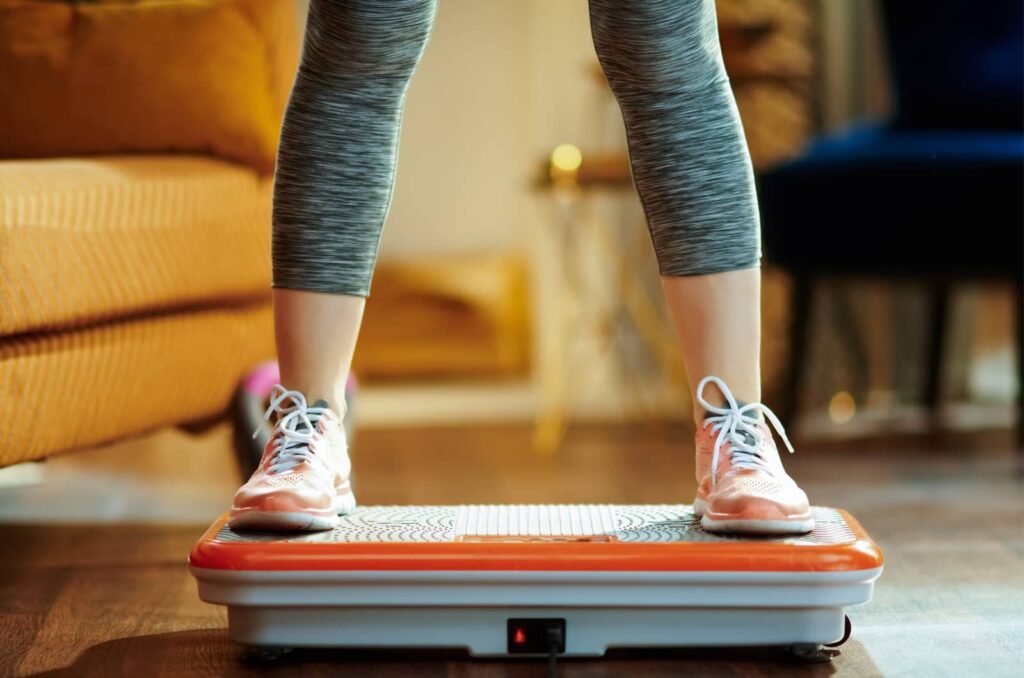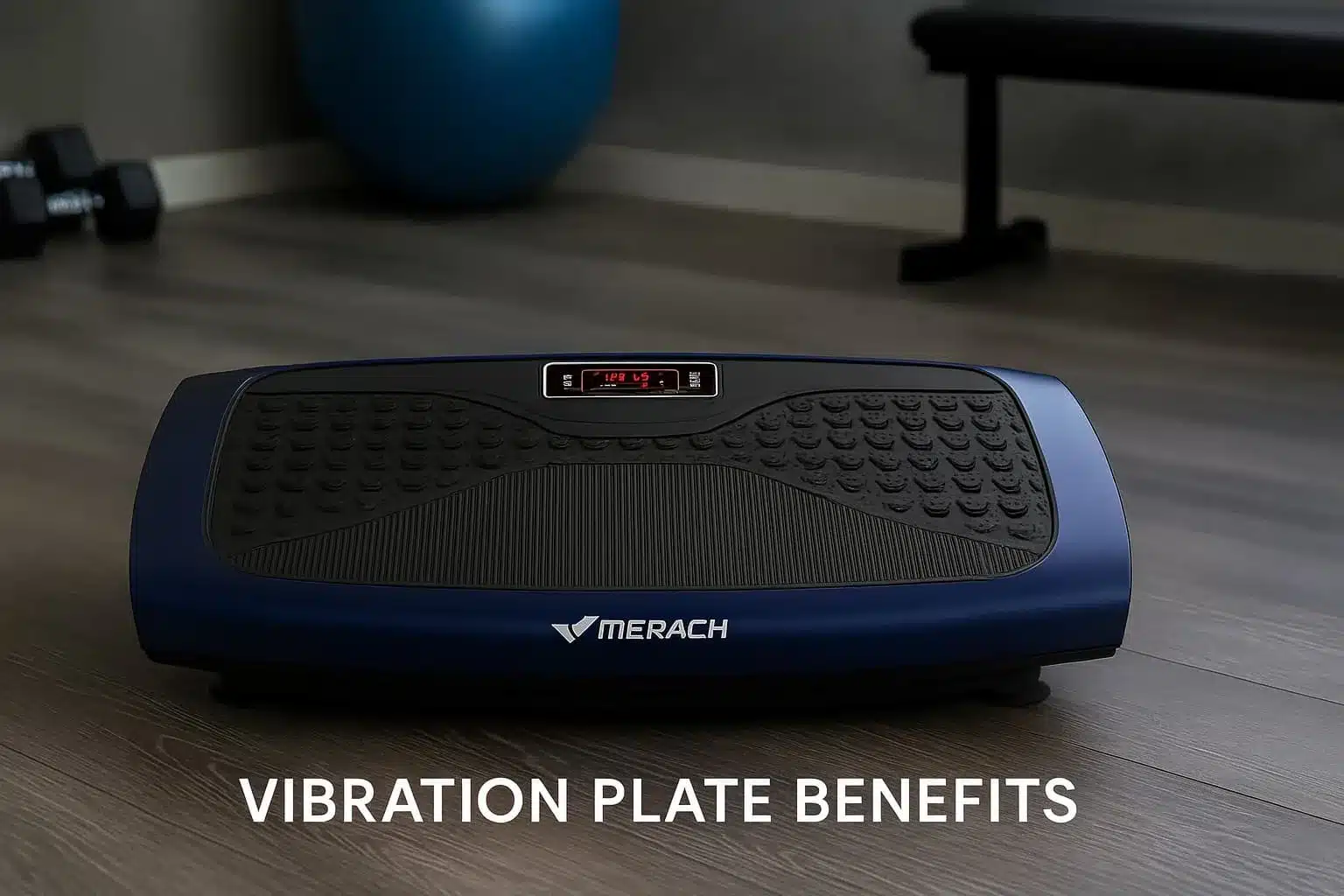
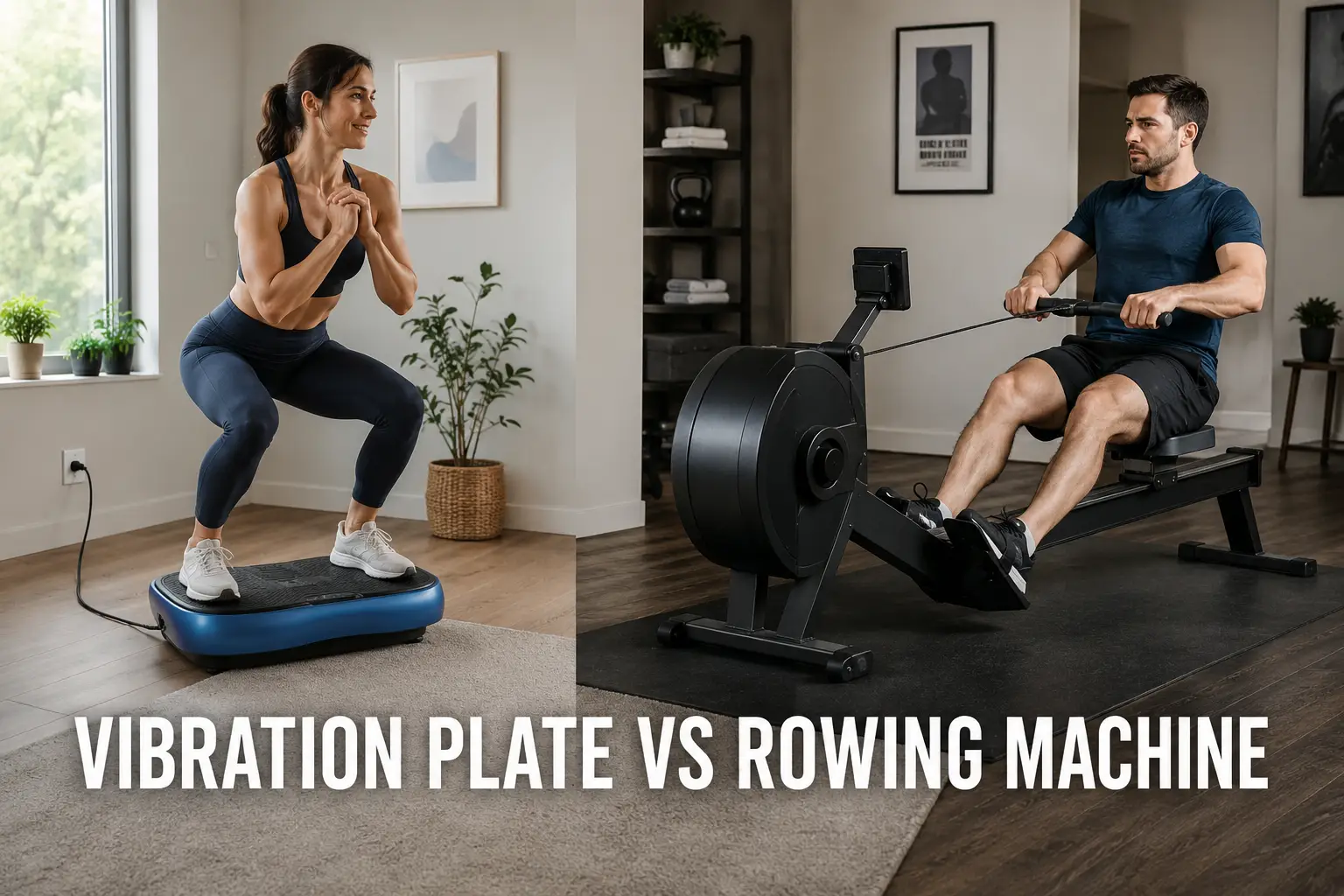
A vibration plate and a rowing machine can both earn a place in a home gym, but they solve very different problems. A rowing machine is primarily a cardiovascular and muscular-endurance machine, while a vibration plate is better suited to short sessions focused on muscle activation, stability, balance, and adding another challenge to bodyweight exercises.

About the author: Hello! I’m Vladimir Stanar, professor of physical education, kinesiotherapist, marathon runner, cyclist, and cycling coach, and long-time advocate of health, fitness, and active living.
My journey with vibration plates runs parallel to my professional career in education, sports medicine, and athletic development. I’ve developed a unique process for testing vibration plates as they are some of the most versatile tools for enhancing health, recovery, and performance.
✅ Expert-Reviewed by: Vanja Vukas, MPhEd
📚 Expert Contributor: Milutin Tucakov, MPhEd
Affiliate Disclosure: Vibration Plate Zone is a proud participant in the Amazon Services LLC Associates Program.
If I had to choose one purely for overall cardiovascular fitness and conditioning, I would pick the rowing machine. Rowing lets you sustain a meaningful aerobic workload, track pace and power, and involve the legs, hips, trunk, back, shoulders, and arms through every stroke.
A vibration plate has different advantages. It takes up much less room, sessions can be very short, and you can use it for standing exercises, squats, calf raises, planks, push-ups, mobility work, and low-intensity recovery sessions.
The best choice therefore depends on what you expect the equipment to do. In this vibration plate vs rowing machine comparison, I will break down how the two machines work, where each performs best, their drawbacks, exercises and workouts I recommend, and which models are worth considering.
Vibration Plate vs Rowing Machine: Key Differences
The biggest difference is where the movement comes from.
A vibration plate uses a motor to move the platform beneath you. Your body reacts to the vibration through repeated muscle contractions and small postural adjustments while you stand or perform an exercise.
A rowing machine works the opposite way. You create the movement yourself by driving through the legs, opening the hips and torso, and finishing the stroke with the arms before reversing the sequence during recovery.
This creates two very different workout experiences. Vibration training can be relatively static, particularly if you are standing, holding a squat, or supporting your hands on the plate. Rowing is continuous, rhythmic exercise that can challenge the cardiovascular system for 10, 20, 30 minutes, or longer.
The equipment also differs considerably in size. Most vibration plates fit into a relatively small square or rectangular floor area, while a full-size rower can extend seven or eight feet across the room during use.
What Is a Vibration Plate?
A vibration plate is a motorized exercise platform that moves rapidly while you stand, sit, or perform exercises on its surface. Depending on the model, the platform may use oscillating, vertical, lateral, pulsating, or multidirectional vibration.
Frequency describes how often the platform completes a vibration cycle each second, while amplitude describes how far the platform moves. Both influence the sensation, although stance width, knee angle, exercise choice, body weight, and vibration type also affect how intense a session feels.
Many home vibration plates also include preset programs, remote controls, resistance bands, Bluetooth speakers, and multiple intensity settings. More advanced 3D and 4D machines may combine several motors to produce different movement patterns.
I tend to view the vibration plate as a versatile accessory rather than a complete replacement for conventional exercise. It becomes much more useful when you perform active movements on it instead of simply standing passively every time.
What Is a Rowing Machine?
A rowing machine, or indoor rower, simulates the movement pattern of rowing a boat. Most models use a sliding seat, footplates, a handle, and a resistance system based on air, magnets, water, hydraulics, or a combination of these technologies.
The rowing stroke consists of four basic positions or phases: the catch, drive, finish, and recovery. The drive begins through the legs, continues as the torso opens, and finishes as the arms pull the handle toward the body.
During recovery, the sequence reverses. The arms extend, the torso pivots forward from the hips, and the knees bend as the seat slides toward the front of the machine.
This coordinated sequence is what makes rowing such an effective full-body conditioning exercise. It also explains why rowing requires more technique than simply stepping onto a vibration plate.
Most modern rowing machines track metrics such as distance, workout time, stroke rate, pace per 500 meters, watts, and estimated calories. I find that objective feedback particularly useful because it gives you obvious ways to measure progress.
Benefits of Vibration Plates
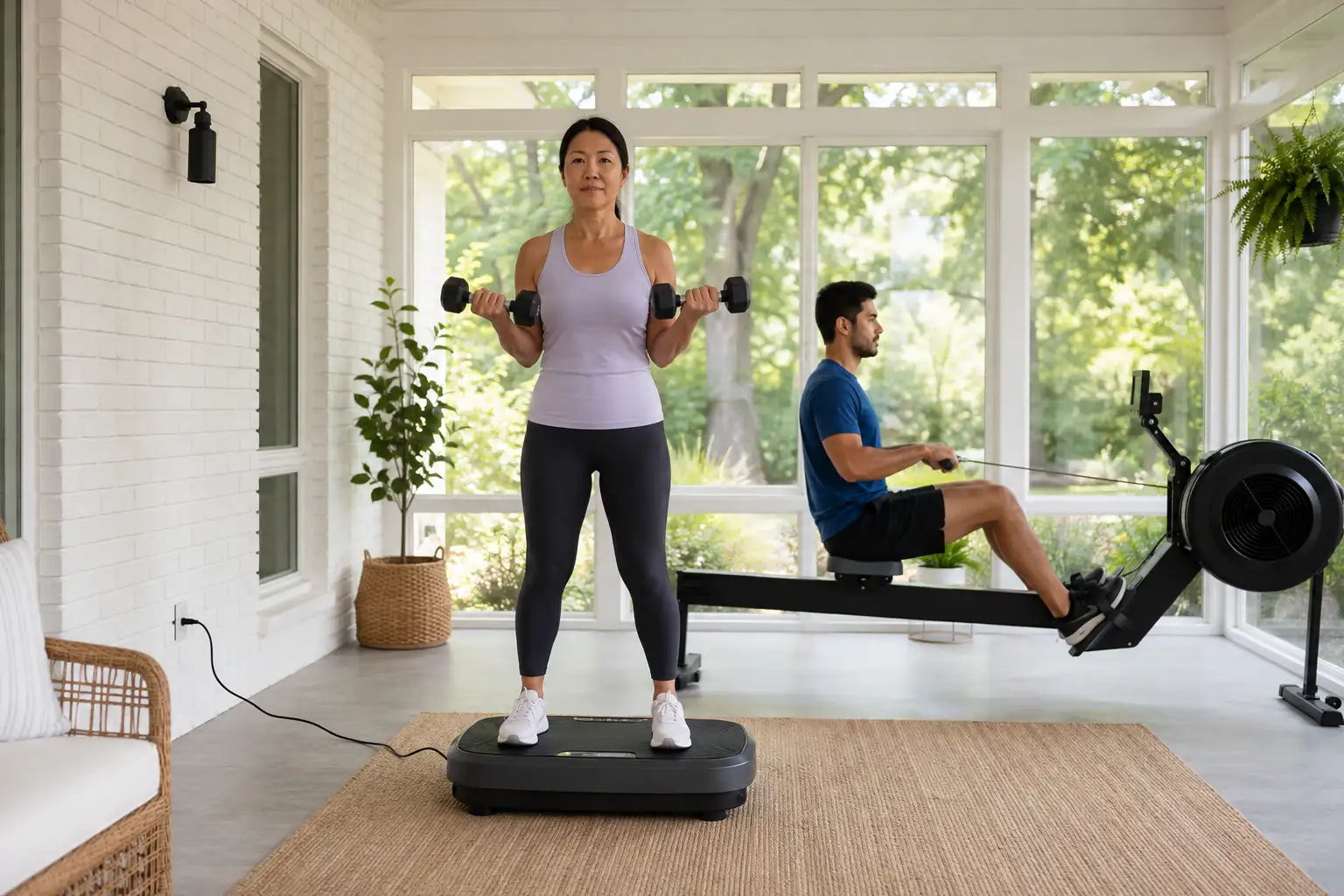
Vibration plates offer a different set of benefits from rowing machines. Their biggest strengths are muscle activation, balance, compactness, and the ability to add vibration to exercises that you already perform.
Muscle Activation and Strength
The rapid movement of a vibration platform requires your muscles to respond repeatedly as the body attempts to remain stable. Even a static position can therefore involve more muscular activity than simply holding the same position on the floor.
I notice this most clearly during squats, calf raises, and planks. The exercise itself is familiar, but the moving platform adds another stability demand that makes the muscles work continuously to control position.
Whole-body vibration training has produced improvements in lower-body strength and physical function in multiple studies, particularly in older adults and less active populations. It should still be viewed as a supplement to progressive resistance training rather than the best way to maximize strength or muscle size.
Improved Circulation and Flexibility
A vibration session repeatedly activates the muscles in the legs and other areas in contact with the platform. This may temporarily increase local blood flow and can leave the muscles feeling warmer and less stiff.
That is one reason I like a lower setting before mobility work or after a long period of sitting. The plate provides movement without requiring an intense workout when I mainly want to loosen up.
For people who use a plate primarily for that purpose, my picks for the best vibration plate for circulation focus on machines suited to gentle, consistent daily use.
Flexibility improvements reported in vibration research are likely influenced by several mechanisms, including muscle activation, warming of tissues, and the stretching positions performed during training. I would not treat the plate as a replacement for regular mobility work, but it can complement it well.
Bone Density and Balance Support
Whole-body vibration has also been studied for bone health, balance, and functional performance. The evidence varies according to the population, vibration frequency, program duration, and type of platform used.
Balance is one of the areas where the mechanism makes intuitive sense. When the surface moves beneath your feet, the ankles, knees, hips, and trunk must make continuous corrections to keep you stable.
I think this is one of the more useful aspects of a vibration plate for older adults or beginners, provided they can use the machine safely. A fixed rail, handle, or stable support should be available if balance is uncertain.
For older adults focused specifically on bone density and balance, my picks for the best vibration plate for osteoporosis cover machines validated for lower-speed, controlled use in that context.
Calorie Burn and Weight Management
Vibration training does use energy, particularly when combined with active exercises. Squats, lunges, push-ups, planks, and resistance-band movements performed on the plate can turn a passive session into a legitimate workout.
However, I would not choose a vibration plate primarily for maximum calorie expenditure. Standing on a plate for 10 minutes is not equivalent to 10 minutes of hard rowing, running, cycling, or another sustained cardiovascular activity.
For weight management, I see the plate as a supporting tool. It can help you move more, strengthen muscles, and make short exercise sessions easier to fit into the day, but it should sit inside a broader activity and nutrition plan.
Recovery and Mental Focus
One reason I continue to find vibration plates useful is that every session does not have to be hard. A low setting can provide a gentle way to move after another workout or after spending several hours at a desk.
I sometimes prefer this to forcing another conventional training session when my legs already feel tired. The rhythmic movement can also encourage you to pay attention to stance, breathing, and muscle tension.
That does not mean vibration has a magical recovery effect. I use it because it feels comfortable and helps me transition from complete rest into light movement.
Rehabilitation and Special Populations
Whole-body vibration has been studied in older adults, people with reduced physical function, and rehabilitation settings. It can provide a controlled exercise stimulus without requiring running, jumping, or complicated movement patterns.
That does not make every vibration plate appropriate for every health condition. Someone with significant cardiovascular, neurological, orthopedic, or balance concerns should get individual guidance before beginning.
For people dealing with nerve-related conditions specifically, my picks for the best vibration plate for neuropathy address the frequency, amplitude, and session length considerations that matter most in that context.
I would also distinguish between professionally supervised vibration training and buying a consumer machine and selecting the maximum setting at home. The equipment may look simple, but frequency, amplitude, posture, and session duration all matter.
For older adults looking for a machine with appropriate defaults and a manageable starting point, my picks for the best vibration plate for seniors cover the settings and features that matter most at that stage.
Drawbacks of Vibration Plates
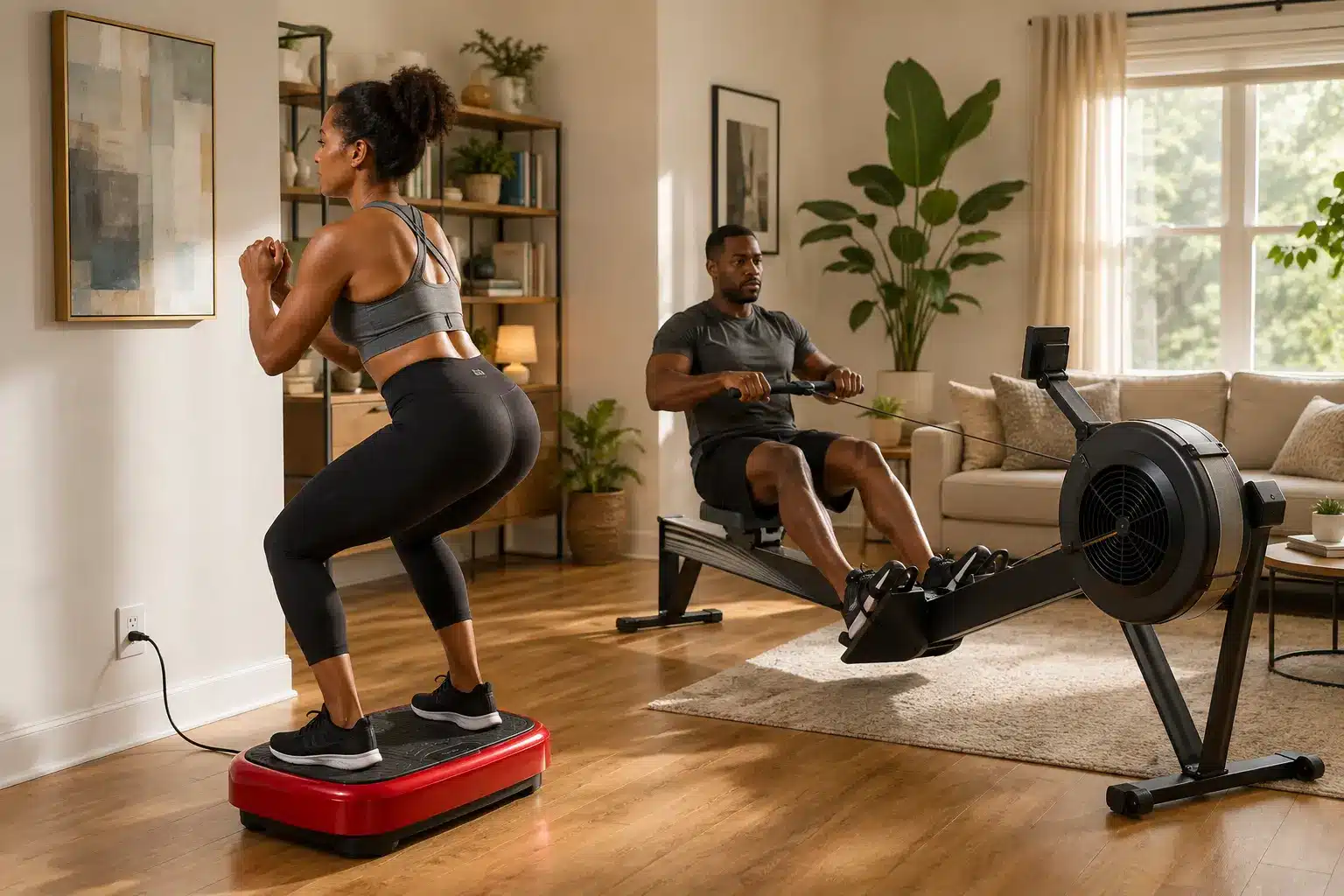
Vibration plates are versatile, but they have clear limitations. The biggest becomes obvious when you compare them directly with a rowing machine.
Limited Cardiovascular Challenge
A vibration plate is not primarily an aerobic machine. Standing on one can activate muscles and increase physiological demand slightly, but the cardiovascular challenge is usually modest compared with continuous rowing.
Active plate exercises can increase heart rate more significantly. Even then, it is difficult to create the same sustained aerobic workload that you can produce on a rower.
If improving cardiovascular fitness is my main goal, I would not choose a vibration plate as my only piece of exercise equipment.
Learning Curve and Posture
A vibration plate looks easier to use than a rower because there is no complex stroke sequence. That does not mean technique can be ignored.
Standing with completely locked knees can transmit more vibration toward the hips, spine, neck, and head. A slight knee bend generally allows the lower body to absorb more of the movement.
Foot position matters too. On an oscillating plate, moving the feet farther from the central pivot can produce considerably more movement.
I recommend starting low, learning the machine, and changing one variable at a time instead of immediately combining maximum speed, a wide stance, and difficult exercises.
Contraindications and Safety Considerations
Whole-body vibration is not suitable for everyone in every situation. Pregnancy, recent surgery, severe cardiovascular disease, significant balance problems, certain implanted medical devices, acute injuries, and other medical concerns may require professional guidance.
Symptoms such as dizziness, sharp pain, numbness, unusual shortness of breath, or excessive shaking through the head are reasons to stop rather than push through the session.
The short duration of many vibration workouts can make the machine seem harmless. It is still exercise equipment producing mechanical forces through the body.
Equipment Quality and Cost
Budget vibration plates can look very similar to more expensive machines while using very different motors, platform mechanisms, electronics, and housings.
The cheapest models also tend to publish fewer meaningful specifications. A listing may advertise 120 speeds without telling you the operating frequency or amplitude.
I would rather buy a simpler oscillating platform from a manufacturer with clear specifications and warranty support than a mysterious "4D" machine that barely explains how it works.
If you want to see how a well-specified 4D plate actually performs, my LifePro Rumblex review covers build quality, vibration settings, and what real-world training sessions feel like on it.
Recommended Vibration Plate Exercises
A vibration plate becomes more useful when you move beyond passive standing. I would start with simple positions, then increase exercise difficulty as balance and confidence improve.
Basic Stance: Stand with your feet at a comfortable width and keep a slight bend in your knees. Use a low setting initially and concentrate on keeping the upper body relaxed rather than resisting every movement.
Squats and Lunges: Lower slowly into a squat while keeping your feet planted securely. For a lunge variation, one or both feet can be positioned on the platform depending on your experience and the available deck space.
Push-Ups and Planks: Place your hands or forearms on the platform and maintain a straight body position. The moving surface makes the shoulders, arms, chest, and core work harder to stabilize.
Bridges and Hip Raises: Lie on your back with your feet supported on the plate and lift your hips. This emphasizes the glutes and hamstrings while the vibration adds another stability challenge.
Calf Raises: Stand securely and rise onto the balls of your feet before lowering with control. I prefer slow repetitions rather than bouncing through the movement.
A beginner does not need a long session. Five to ten minutes of total vibration exposure can provide plenty of time to learn several positions before increasing duration or intensity.
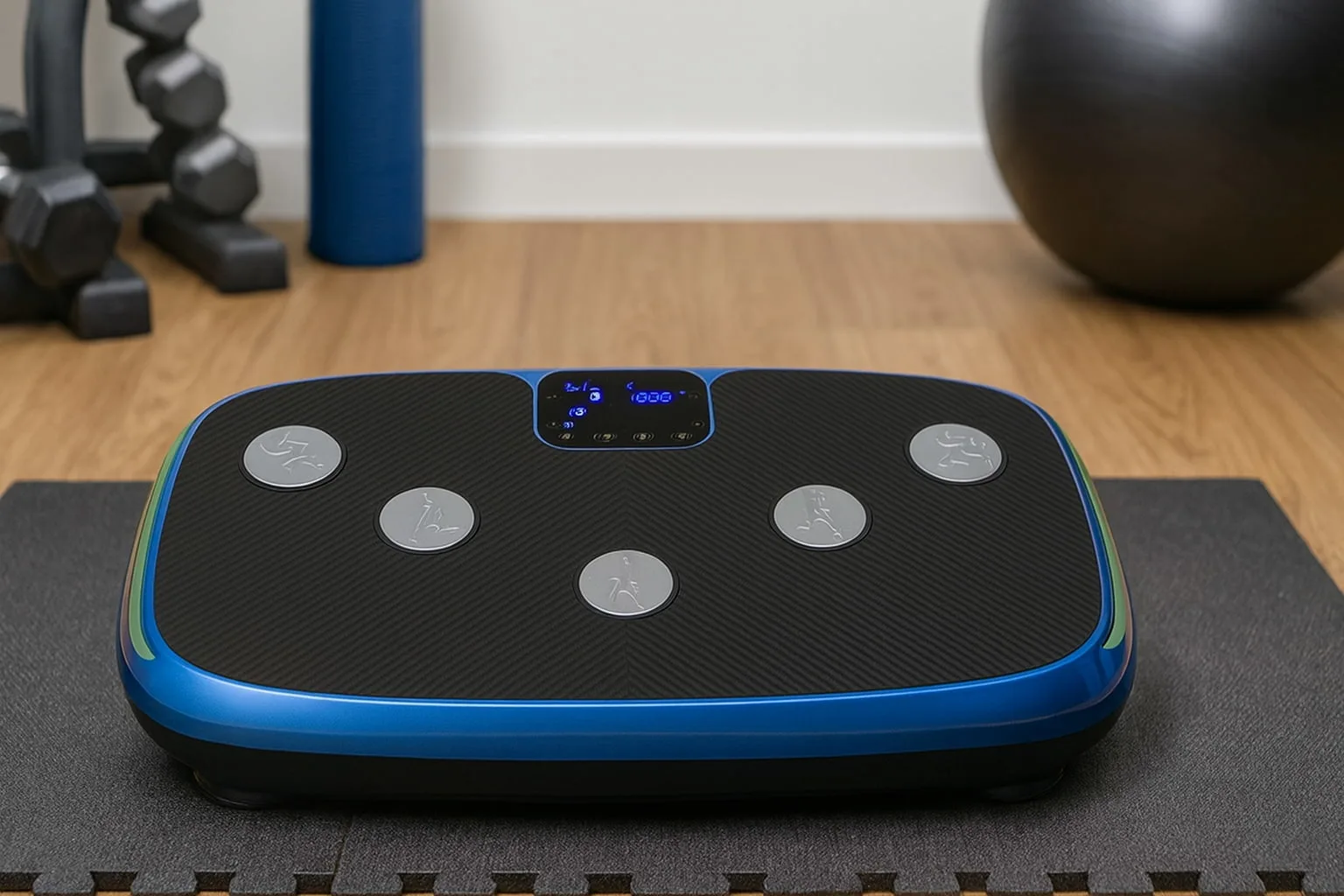
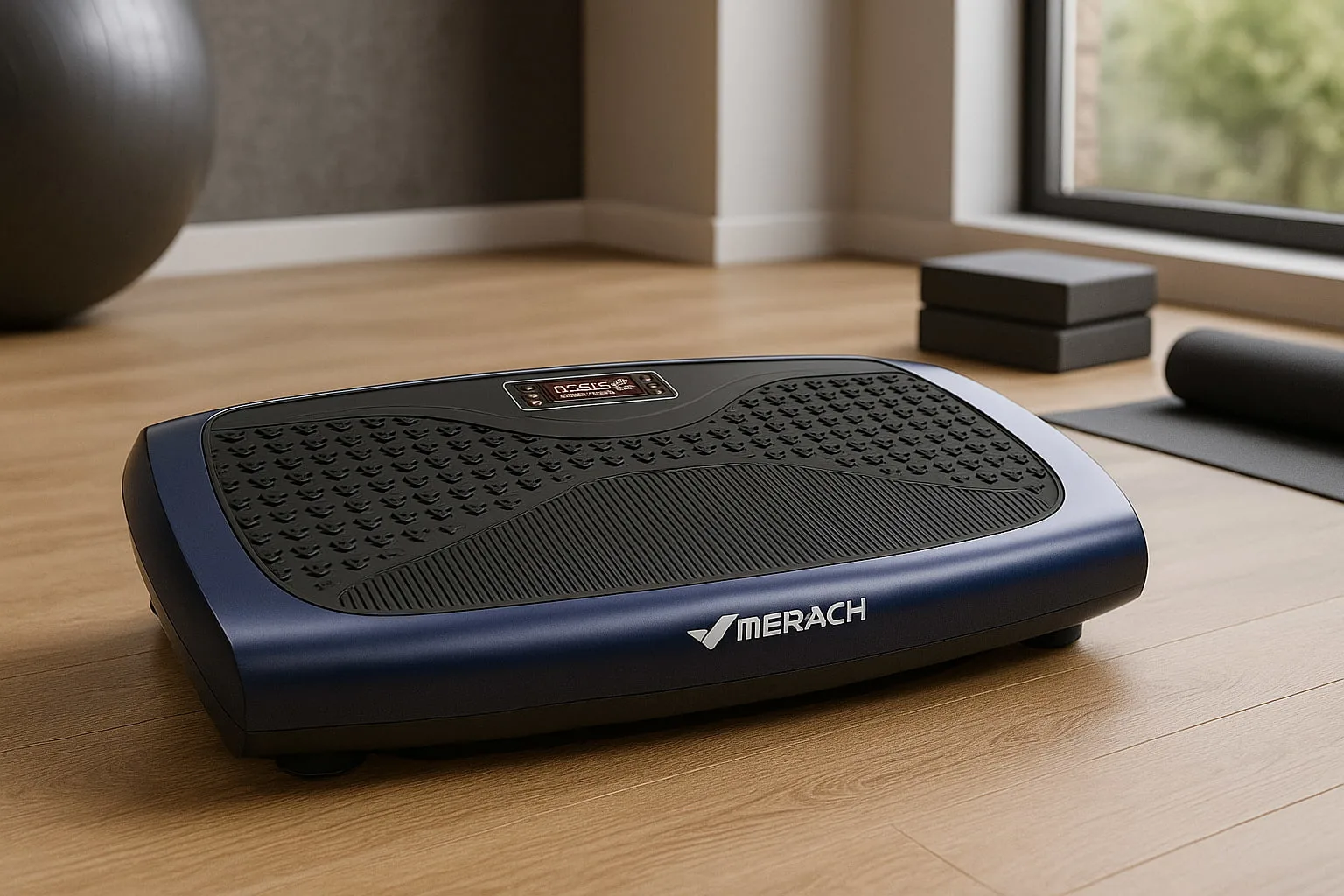
My Recommended Top 3 Vibration Plates: Reviewed & Rated

Benefits of Rowing Machines
Rowing machines shift the emphasis from externally generated vibration to continuous whole-body exercise. They are much stronger for cardiovascular training, muscular endurance, and measurable workout progression.
Cardiovascular Conditioning and Endurance
Cardiovascular conditioning is where the rowing machine clearly separates itself from the vibration plate.
Rowing requires continuous work from large muscle groups while heart rate and oxygen consumption rise with intensity. Moderate rowing can provide steady aerobic training, while hard intervals can become extremely demanding.
Research using indoor rowing programs has shown improvements in aerobic capacity and cardiovascular responses after regular training. In one 10-week program, participants rowed three times per week and improved several measures of cardiorespiratory performance.
The intensity range is also enormous. Stationary rowing can move from moderate exercise into very vigorous work depending on power output.
If improving endurance is one of my main goals, I choose the rowing machine without hesitation.
Full-Body Muscle Engagement
People sometimes describe rowing as an upper-body exercise because the handle is so visible. In reality, good rowing begins with the legs.
At the catch, the knees are bent and the body is prepared to drive. The legs initiate the stroke, the hips and torso contribute next, and the arms finish the movement.
During recovery, the arms move away first, the torso pivots forward, and the knees then bend as the seat travels toward the front.
This sequence engages the quadriceps, glutes, hamstrings, calves, abdominal and spinal muscles, upper back, shoulders, and arms. Muscle-activation research confirms that the exercise recruits muscles across both the lower and upper body.
I think that coordinated whole-body involvement is one of rowing's biggest advantages. You are not isolating one area, but repeatedly transferring force through the entire kinetic chain.
Low-Impact Full-Body Training
Rowing does not involve the repeated landing impact associated with running or jumping. Your feet remain strapped to the footplates, and the seat moves horizontally along the rail.
That makes rowing an attractive cardiovascular option for people who dislike running or want to reduce impact. Low impact does not mean zero joint or spinal loading, however.
The knees and hips repeatedly flex and extend, and the torso moves through each stroke. Poor technique or excessive training volume can create problems, especially around the lower back.
I consider rowing joint-friendly when technique and resistance are appropriate, not universally safe regardless of how it is performed.
Calorie Burn and Weight Management
For calorie expenditure, the rowing machine has a major advantage over passive vibration training.
Moderate stationary rowing can already reach a meaningful aerobic intensity, while hard rowing can become extremely demanding. The energy cost rises sharply as power output increases.
That makes rowing useful for people who want to increase weekly activity and cardiovascular workload while also using multiple muscle groups.
I still would not reduce weight loss to a "calories burned on this machine" contest. Nutrition, total daily movement, sleep, recovery, and consistency matter far more over months than the estimate shown after one workout.
Between these two machines, though, rowing is the obvious choice when sustained energy expenditure is a priority.
Measurable Progress and Mental Focus
One of my favorite things about rowing is how easy progress is to quantify.
A good monitor can show distance, elapsed time, stroke rate, watts, pace per 500 meters, and other metrics. You can repeat the same workout several weeks later and see whether you cover more distance, hold a faster pace, or produce the same power at a lower perceived effort.
This makes rowing particularly satisfying for people who enjoy numbers and structured training. A vibration plate gives you speed levels and workout duration, but those values do not provide the same performance feedback.
Rowing is also rhythmic enough to become mentally absorbing. Once technique feels natural, the repeated drive and recovery can create the same focused feeling that I get during running or cycling.
Drawbacks of Rowing Machines
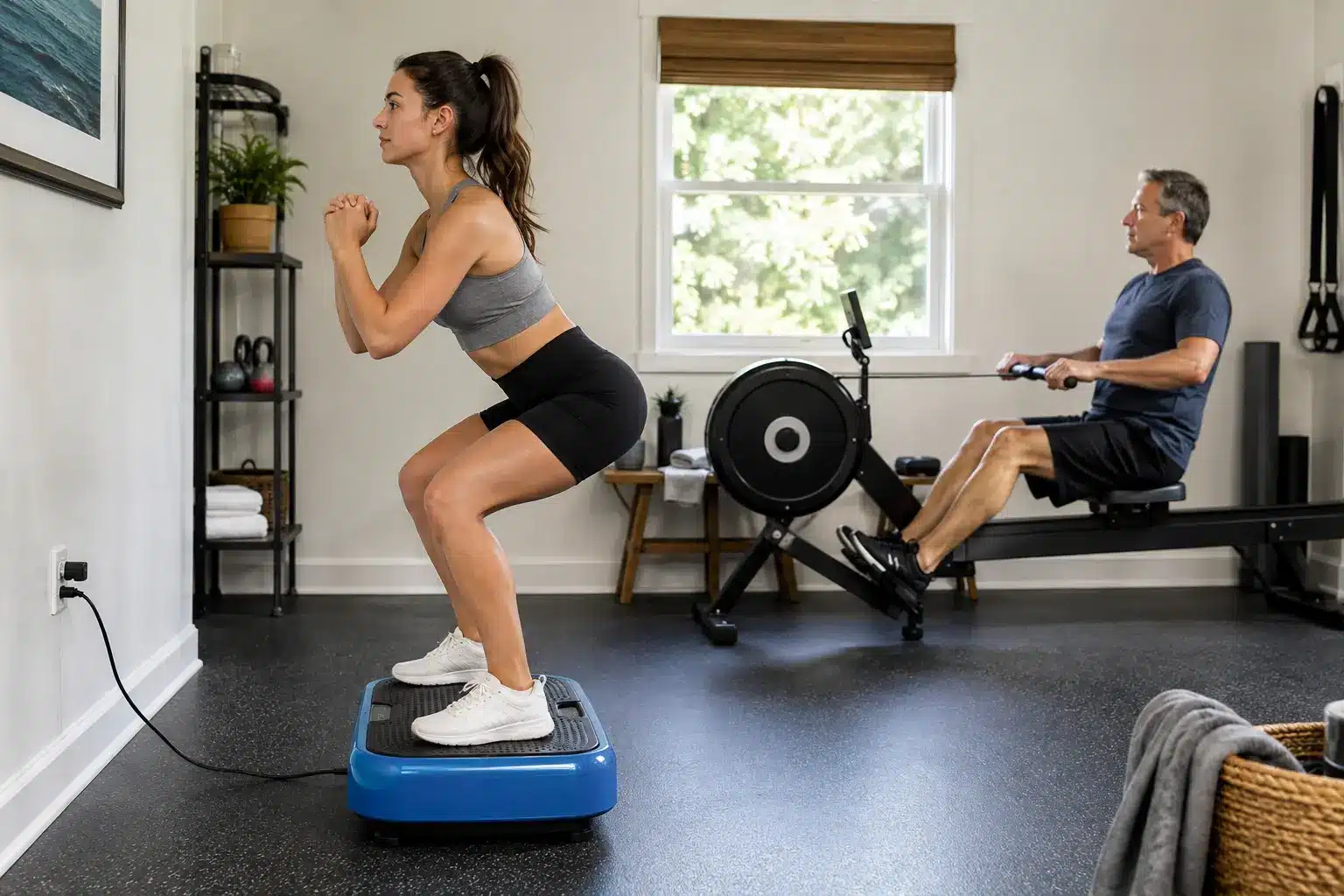
A rowing machine provides a more complete conditioning workout, but it asks more from the user and requires considerably more space.
Technique and Coordination Requirements
Rowing has a real technique component.
The drive should begin with the legs before the torso opens and the arms finish the stroke. During recovery, the arms move away first, followed by the body pivot and then the sliding seat.
Beginners often pull with the arms too early, bend the knees before the hands have passed them, rush toward the catch, or use excessive back movement.
These errors do not mean rowing is unusually difficult. Most people can learn a functional stroke fairly quickly, but I would spend the first several workouts practicing the sequence instead of chasing maximum speed.
Good technique makes the exercise smoother, more efficient, and easier to sustain.
Lower-Back Stress With Poor Technique
Low-back discomfort is a legitimate issue in rowing, particularly when training volume increases or technique deteriorates with fatigue.
The torso should pivot primarily around the hips rather than repeatedly collapsing into excessive lumbar flexion. Beginners sometimes reach too far forward at the catch or use the back too aggressively during the drive.
I would rather shorten the stroke slightly and maintain control than chase extra length by rounding the lower back.
Someone with an existing back problem should be particularly cautious. Rowing can be an excellent training tool, but it should not be treated as automatically therapeutic for every spinal condition.
Space and Storage
This is one category where the vibration plate wins easily.
A full-size rowing machine can be more than seven feet long while you are using it. A Concept2 RowErg, for example, is approximately 96 inches long and 24 inches wide.
Many rowers can fold, stand upright, or separate into sections for storage. That helps after the workout but does not solve the space requirement while you are actually rowing.
A vibration plate can often fit in the same floor area as a small coffee table. For apartments and crowded home gyms, that difference may determine the purchase before performance even enters the discussion.
Repetitive Movement and Workout Variety
Rowing offers plenty of ways to change intensity, but every rowing workout still revolves around the same basic stroke.
You can row steadily, perform sprints, change stroke rate, use intervals, race against previous times, or vary duration. The underlying movement remains essentially the same.
A vibration plate offers more variety in exercise position. You can squat, lunge, plank, perform push-ups, sit, stretch, use resistance bands, or train calves and glutes in different ways.
I enjoy rowing precisely because of the repetitive rhythm, but someone who needs constant exercise variety may become bored more quickly.
Resistance System, Noise, and Equipment Quality
Rowing machines can use air, magnetic, water, or hydraulic resistance, and each system changes the experience.
Air rowers respond naturally to how hard you pull and are popular for serious training, but the fan generates noticeable noise. Magnetic rowers are usually much quieter and work well in apartments or shared homes.
Water rowers provide a smooth stroke and distinctive sound but add a tank that requires maintenance. Hydraulic machines can be compact and inexpensive but often feel less similar to conventional rowing.
Build quality also matters. Seat rollers, rail alignment, footrests, handles, belts or chains, resistance mechanisms, and monitors all affect how the machine feels during repeated use.
I would not choose a rower based only on the number of resistance levels. Smoothness, stability, ergonomics, monitor quality, and parts availability matter just as much.
Recommended Rowing Machine Workouts
Rowing workouts can be extremely simple. You do not need to begin with exhausting two-kilometer time trials.
Technique Row: Row for three to five minutes at an easy effort and focus entirely on the sequence of legs, body, and arms. Take a short break, then repeat several times if you feel comfortable.
Steady-State Row: Choose a pace you can sustain while breathing harder but remaining in control. Start with 10 to 15 minutes and gradually build the duration as your fitness improves.
Stroke-Rate Progression: Row several short blocks at different stroke rates, such as 20, 22, and 24 strokes per minute. Try to increase power without simply rushing the recovery.
Interval Row: Alternate harder rowing with easy recovery. A beginner might row one minute harder followed by one or two minutes easy, repeating the pattern several times.
Pyramid Workout: Increase the length or intensity of each interval gradually and then work back down. For example, row one, two, three, two, and one minute harder with easy recovery between each effort.
I prefer short, structured sessions for beginners because technique usually deteriorates when fatigue arrives before the movement pattern has been learned. Once the stroke feels natural, longer steady rows and harder intervals become much more productive.
My Recommended Top 3 Rowing Machines: Reviewed & Rated
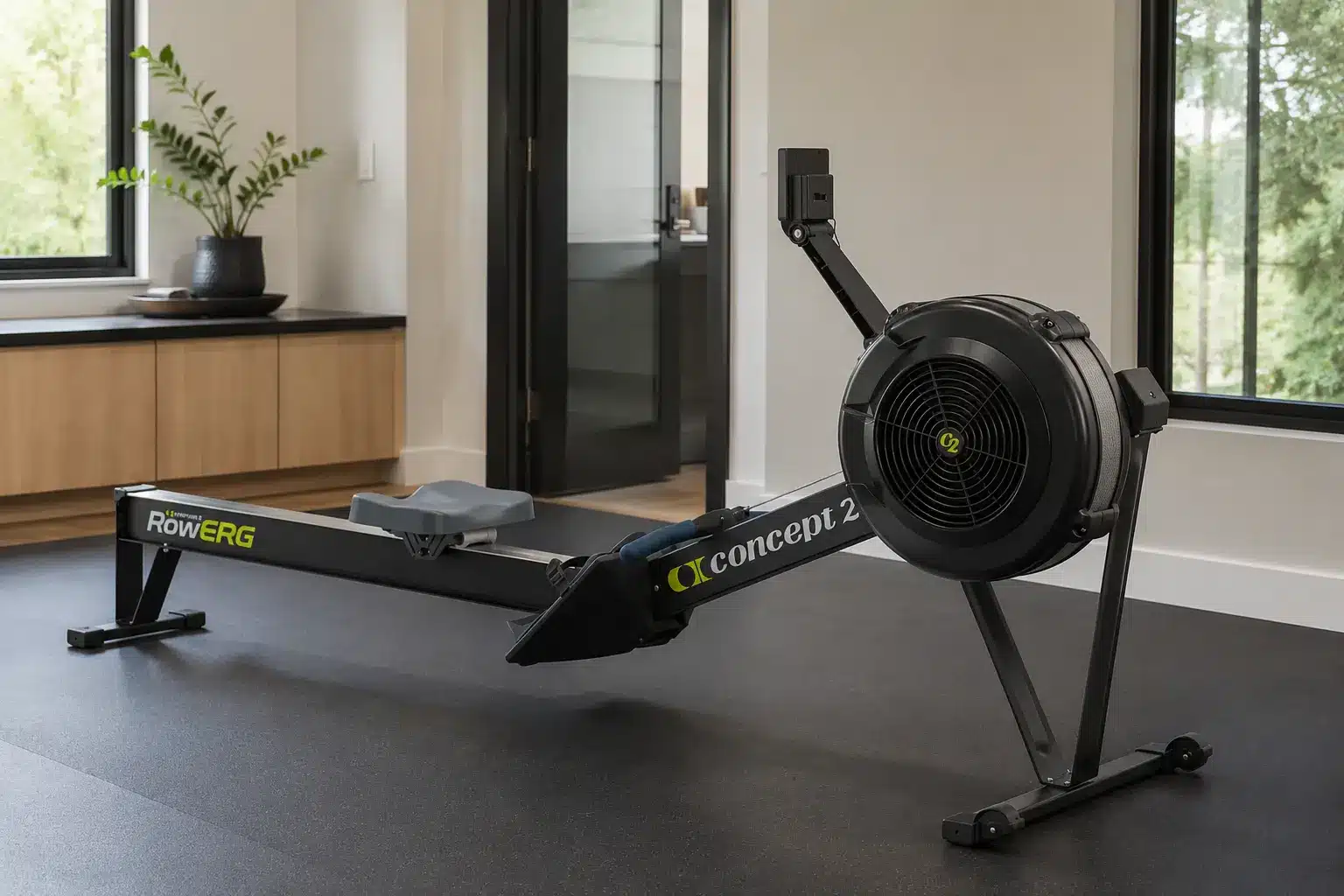
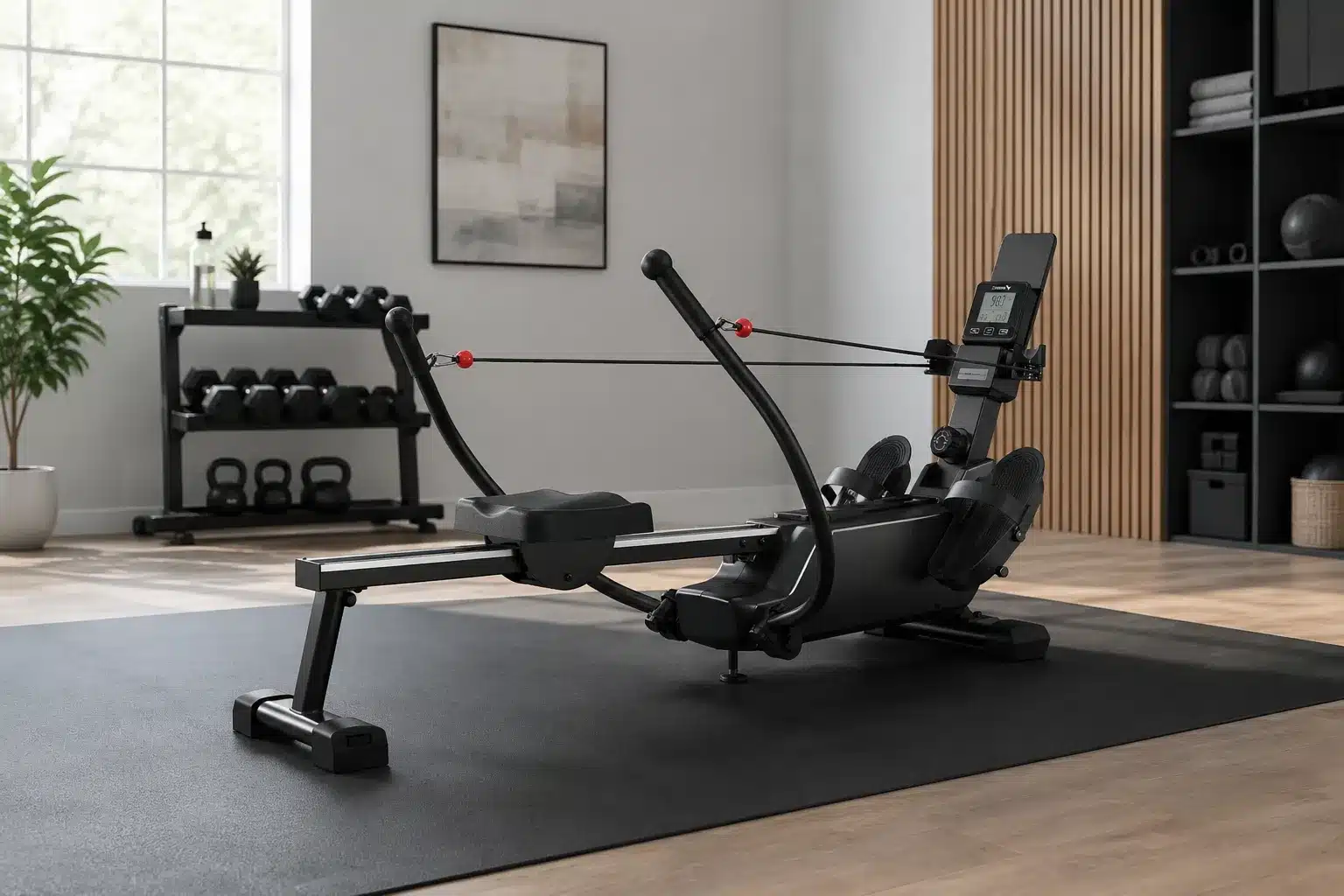
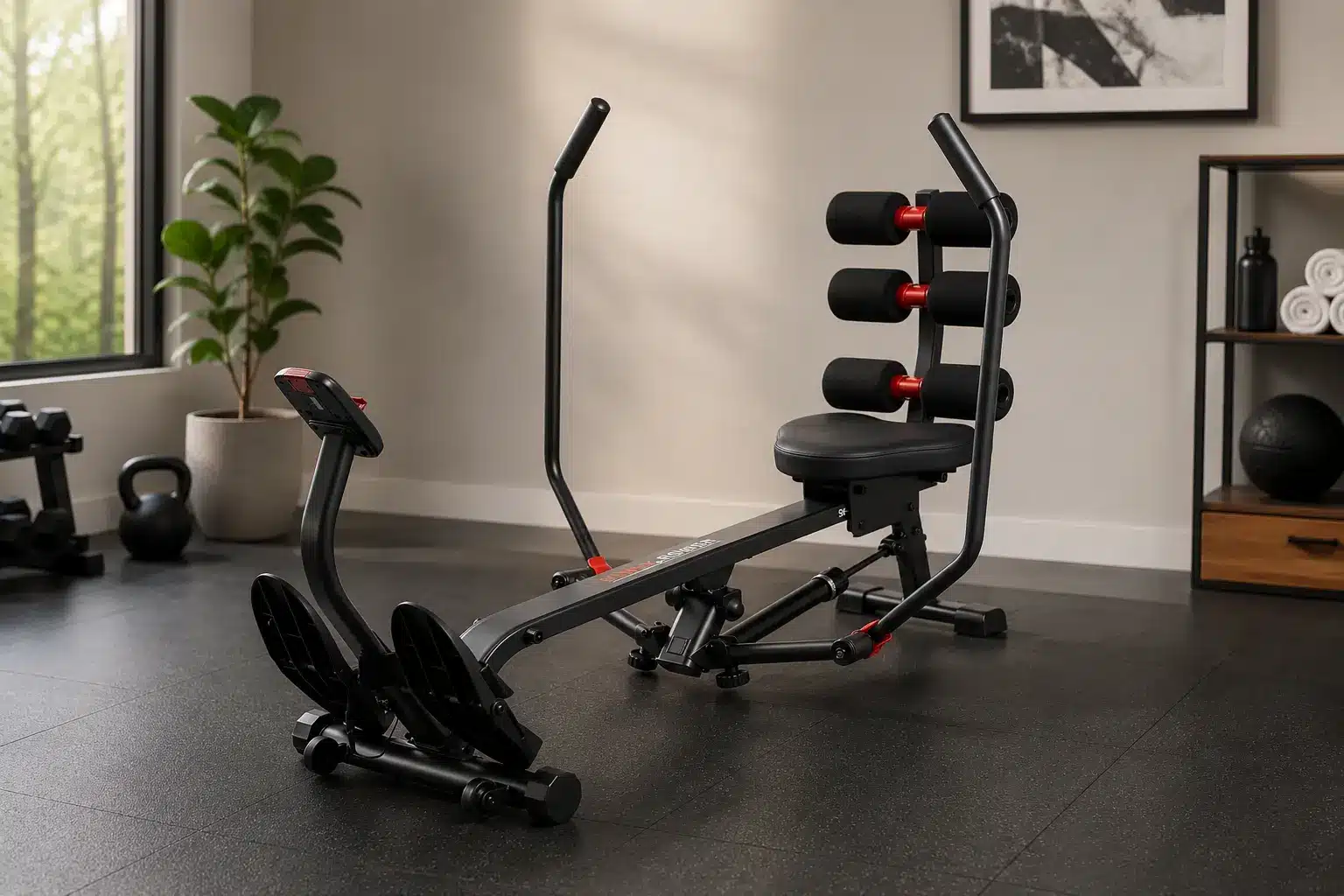
Comparing Vibration Plates and Rowing Machines for Fitness Goals
Now that we have looked at both machines separately, the differences become much easier to evaluate.
Neither machine wins every category. The rowing machine dominates cardiovascular conditioning and sustained energy expenditure, while the vibration plate wins on compactness and supports a broader range of short strength, stability, and accessory exercises.
Weight Loss and Metabolic Health
If weight loss is the main goal, I would choose the rowing machine.
Rowing allows you to perform continuous moderate or vigorous exercise for an extended period. It raises cardiovascular demand considerably more than simply standing on a vibration platform and can generate substantial weekly exercise volume.
A vibration plate still has a role. Performing squats, lunges, planks, and resistance-band movements on it increases muscle involvement and may help someone become more active.
I would not use the two machines interchangeably for weight loss. Rowing is the primary calorie-burning workout, while vibration training is better treated as additional strength and movement work.
If a vibration plate is part of a broader weight management routine, my picks for the best vibration plate for weight loss focus on machines that support active exercise rather than passive standing.
Using both can work particularly well. Row on dedicated cardio days and use the vibration plate for shorter strength, mobility, or recovery sessions.
If a treadmill is also on your shortlist, my vibration plate vs treadmill comparison covers how the two machines differ across calorie burn, joint impact, space, and training variety.
Strength and Muscle Development
This category is closer than the cardio comparison because the machines challenge muscles in completely different ways.
A vibration plate is well suited to targeted muscle activation. You can perform squats, calf raises, bridges, planks, push-ups, and resistance-band exercises while the vibration increases the stabilization demand.
A rowing machine provides repeated full-body muscular work. The legs generate force on every stroke, while the hips, trunk, back, shoulders, and arms coordinate the transfer of that force.
For muscular endurance, rowing has the edge. For localized stability work and making bodyweight positions more demanding, the vibration plate has advantages.
If maximizing muscle size or absolute strength is the real goal, I would still prioritize conventional progressive resistance training over either machine.
Joint Health and Low-Impact Training
Both machines can provide low-impact exercise, but "low impact" should not be confused with "no physical stress."
A vibration plate does not require running or jumping. You can stand in one position or perform slow controlled exercises while the platform moves beneath you.
A rowing machine also avoids landing impact, but every stroke repeatedly moves the knees, hips, and trunk through a significant range of motion.
For someone who has difficulty performing repeated knee and hip flexion, a vibration plate may be easier to tolerate. For someone who can row comfortably and wants low-impact cardio, the rower is much more useful.
Neither machine should automatically be recommended for an existing orthopedic condition without considering the individual problem.
A rebounder is another piece of low-impact equipment some people consider alongside a vibration plate; my vibration plate vs rebounder comparison covers how the two differ in joint loading, balance demands, and training application.
Space, Budget, and Convenience
The vibration plate wins for space by a very large margin.
Most plates can remain in a corner, slide beneath suitable furniture, or be moved between rooms relatively easily. Even larger premium plates occupy far less length than a rowing machine.
A rower needs substantial open floor space while you exercise. Folding or vertical storage reduces its footprint afterward but does not change the space required during the workout.
Price is less straightforward because both categories range from inexpensive consumer products to premium equipment.
You can buy an entry-level vibration plate for under $100, while more advanced machines can cost several hundred or much more. Rowers follow a similar pattern, although high-quality performance machines often require a larger initial investment.
For someone with very limited room, I would choose the vibration plate even before considering the workout differences.
For anyone in that situation, my picks for the best vibration plate for home use focus on compact, quiet machines that work well in shared or limited spaces.
Enjoyment, Motivation, and Variety
Enjoyment is subjective, but it matters because the best machine is the one you continue using.
Rowing gives you a structured athletic experience. You can chase distances, splits, watts, intervals, personal records, and stroke-rate targets.
A vibration plate offers more movement variety. One session might involve squats and bands, another planks and push-ups, while another could be little more than gentle standing and mobility work.
Personally, I enjoy the measurable progression of rowing more when I want a proper workout. I prefer the vibration plate when I want something short, convenient, or different from my usual cardio.
That distinction is one reason I do not see these machines as direct substitutes.
Selecting the Right Equipment for Your Needs
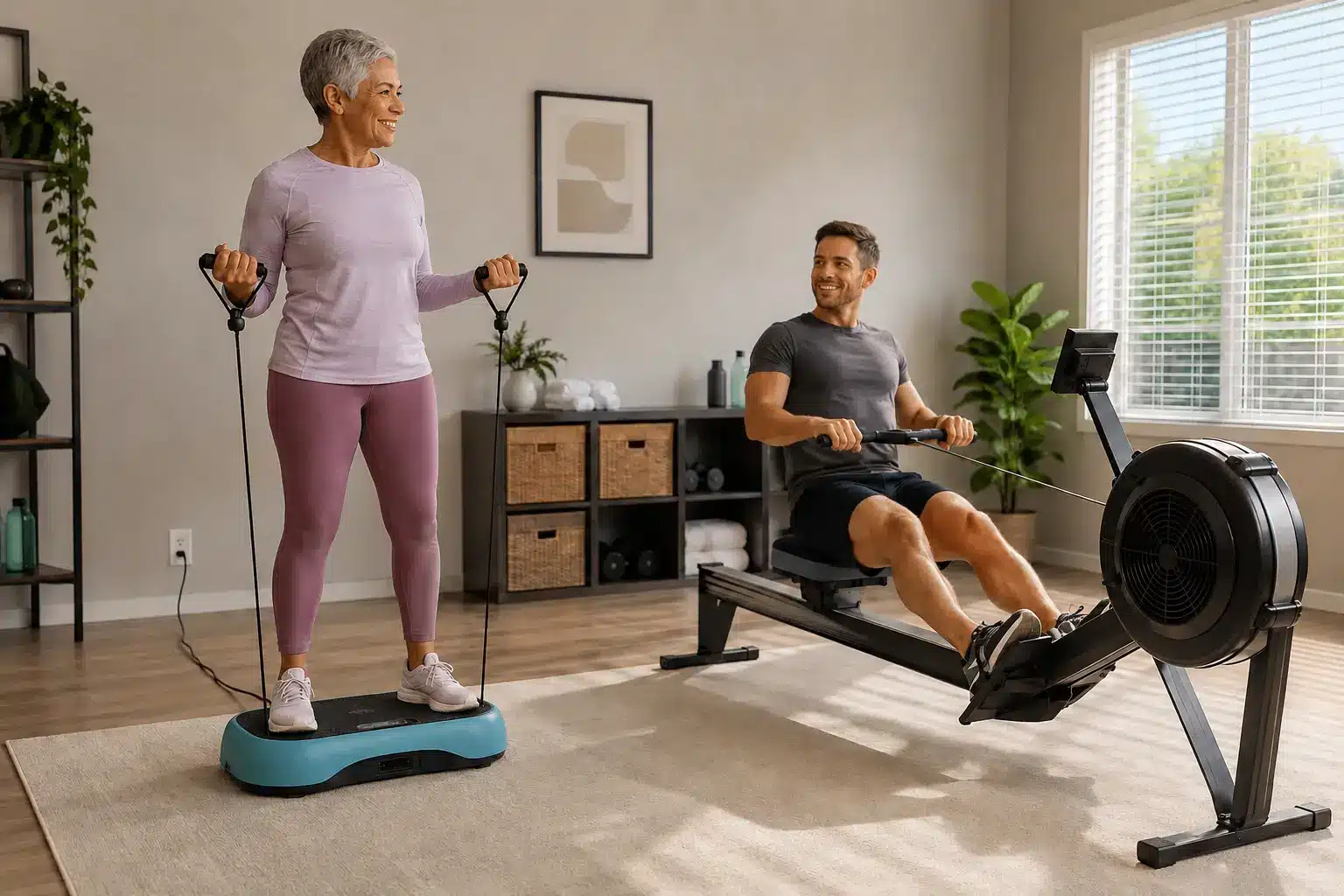
The best choice depends less on which machine has more benefits and more on which benefits actually matter to you.
Assess Your Fitness Goals
Start by identifying the primary job you want the machine to perform.
If you want cardiovascular fitness, endurance, sustained calorie expenditure, and measurable performance progression, choose the rowing machine.
If you want muscle activation, balance work, short sessions, bodyweight exercise variations, or a compact supplement to another training routine, choose the vibration plate.
If you are also deciding between a vibration plate and an elliptical, my vibration plate vs elliptical comparison covers calorie burn, joint stress, space, and which training goals each machine supports better.
If your goals include both, there is little overlap in owning both machines. They can fill different roles within the same program.
If an exercise bike is also under consideration, my vibration plate vs exercise bike comparison covers how the two machines differ across cardiovascular output, lower-body training, space, and long-term use.
Consider Your Health and Physical Condition
Your current mobility and exercise tolerance should influence the decision.
A rower requires repeated knee and hip flexion, coordinated pulling, and enough trunk control to maintain technique as fatigue develops.
A vibration plate can require less gross movement, but balance and vibration tolerance still matter. People who feel unsteady should use a fixed support rather than assuming the machine is automatically easy.
Anyone managing a significant health condition, recent surgery, severe balance problem, unexplained pain, or another exercise-related concern should seek appropriate professional guidance.
Evaluate Space and Storage
Measure your available exercise area before buying either machine.
A vibration plate needs relatively little room and is much easier to integrate into a bedroom, living room, or office. You mainly need enough surrounding space to step on safely and perform the exercises you intend to use.
A rowing machine requires length. Even if the frame separates or folds afterward, you still need sufficient space to complete the stroke without hitting furniture or walls.
I would also measure the actual storage location rather than assuming a product advertised as "compact" will fit.
Budget and Quality
Both equipment categories contain very cheap products and substantially more expensive models.
With vibration plates, I look at movement type, platform size, weight capacity, frequency and amplitude when available, controls, machine weight, and warranty support.
With rowers, I look closely at the resistance system, rail length, seat movement, footrests, handle, monitor, user capacity, storage system, and parts availability.
I would rather buy a high-quality simple machine than a poorly built product overloaded with features.
The Merach MR-2489 is a plate that delivers on its specifications without unnecessary complexity; my Merach vibration plate review covers how it performs across different session types and use cases.
A single reliable vibration mode or a good magnetic rowing mechanism is more valuable than a long specification list that does not translate into a better workout.
If you are ready to buy a vibration plate, my breakdown of the best vibration plates covers the top options across motion types, price ranges, and intended uses.
Variety and Long-Term Use
Think beyond the first month.
A vibration plate offers more exercise-position variety because the platform can be incorporated into many bodyweight movements. It can also remain useful alongside dumbbells, resistance bands, walking, running, cycling, or strength training.
A rowing machine offers less movement variety but much more workout variety than it initially appears. Steady aerobic rows, short intervals, long intervals, power strokes, pyramids, time trials, and technique work can feel very different.
The right choice depends on what keeps you consistent.
If I owned both, I would not try to make them perform the same job. I would use the rower for cardio and conditioning, then use the vibration plate for shorter strength, activation, balance, or recovery-oriented sessions.
Final Thoughts on Vibration Plates and Rowing Machines
Choosing between a vibration plate and rowing machine becomes fairly straightforward once you identify your main goal.
Choose a rowing machine if cardiovascular fitness, muscular endurance, calorie expenditure, full-body conditioning, and measurable progression are most important. It demands more technique and much more floor space, but it provides a far more complete aerobic workout.
Choose a vibration plate if you value compactness, short workouts, muscle activation, balance, stability, and the ability to add vibration to several bodyweight exercises. It is also easier to fit into an existing exercise routine without committing to another long workout.
I would not describe either as objectively better for every person. They are fundamentally different pieces of equipment.
Before buying, I would ask myself five questions. Do I primarily need cardio or supplemental strength and stability work? How much room do I have? Am I comfortable learning rowing technique? Will I actually perform 20 to 30-minute cardio sessions, or am I more likely to use a machine for 5 to 10 minutes? And finally, do I already have another form of cardio or resistance training?
For someone with enough space and budget, I actually like the combination. A rowing machine can handle the longer cardiovascular sessions, while a vibration plate gives you a compact tool for shorter accessory work on other days.
FAQs
What are the differences between a vibration plate and a rowing machine?
A vibration plate creates mechanical vibration beneath your body while you stand or perform exercises. A rowing machine requires you to generate continuous movement through a coordinated leg, hip, trunk, and arm stroke.
The vibration plate is better suited to muscle activation, stability work, balance, and short workouts. The rowing machine is stronger for cardiovascular conditioning, muscular endurance, and sustained calorie expenditure.
How long should a beginner use a vibration plate or rowing machine?
A vibration plate beginner can start with approximately five to ten minutes at a low setting while learning stance and posture.
For rowing, I prefer several short three to five-minute intervals initially. This allows you to practice the stroke before fatigue causes technique to deteriorate, after which workouts can gradually become longer.
Can I use both a vibration plate and rowing machine in my routine?
Yes. In fact, the two machines complement each other better than many direct equipment comparisons.
You could use the rowing machine two or three times per week for cardiovascular conditioning and use the vibration plate on other days for squats, calf raises, planks, resistance work, balance exercises, or lighter movement sessions.
Which device is better for weight loss, a vibration plate or rowing machine?
The rowing machine is the better choice when weight loss is the main goal because it allows sustained cardiovascular exercise and substantially higher energy expenditure.
A vibration plate can still contribute by making bodyweight exercises more challenging and helping increase overall activity. I would treat it as a supplement rather than the primary calorie-burning machine.
What are some safety tips for using a vibration plate and rowing machine?
For a vibration plate, begin at a low setting, keep a slight bend in the knees, maintain a stable stance, and avoid increasing several variables at once.
For rowing, learn the stroke sequence before increasing intensity. Drive with the legs first, maintain controlled trunk movement, avoid excessive reaching at the catch, and stop when fatigue causes technique to deteriorate.
Healthcare and Medical Disclaimer
The information provided on Vibration Plate Zone is for general informational purposes only and is not intended to replace professional medical advice, diagnosis, or treatment. Always seek the guidance of a qualified healthcare provider with any questions you may have regarding a medical condition, and never disregard or delay seeking professional advice.