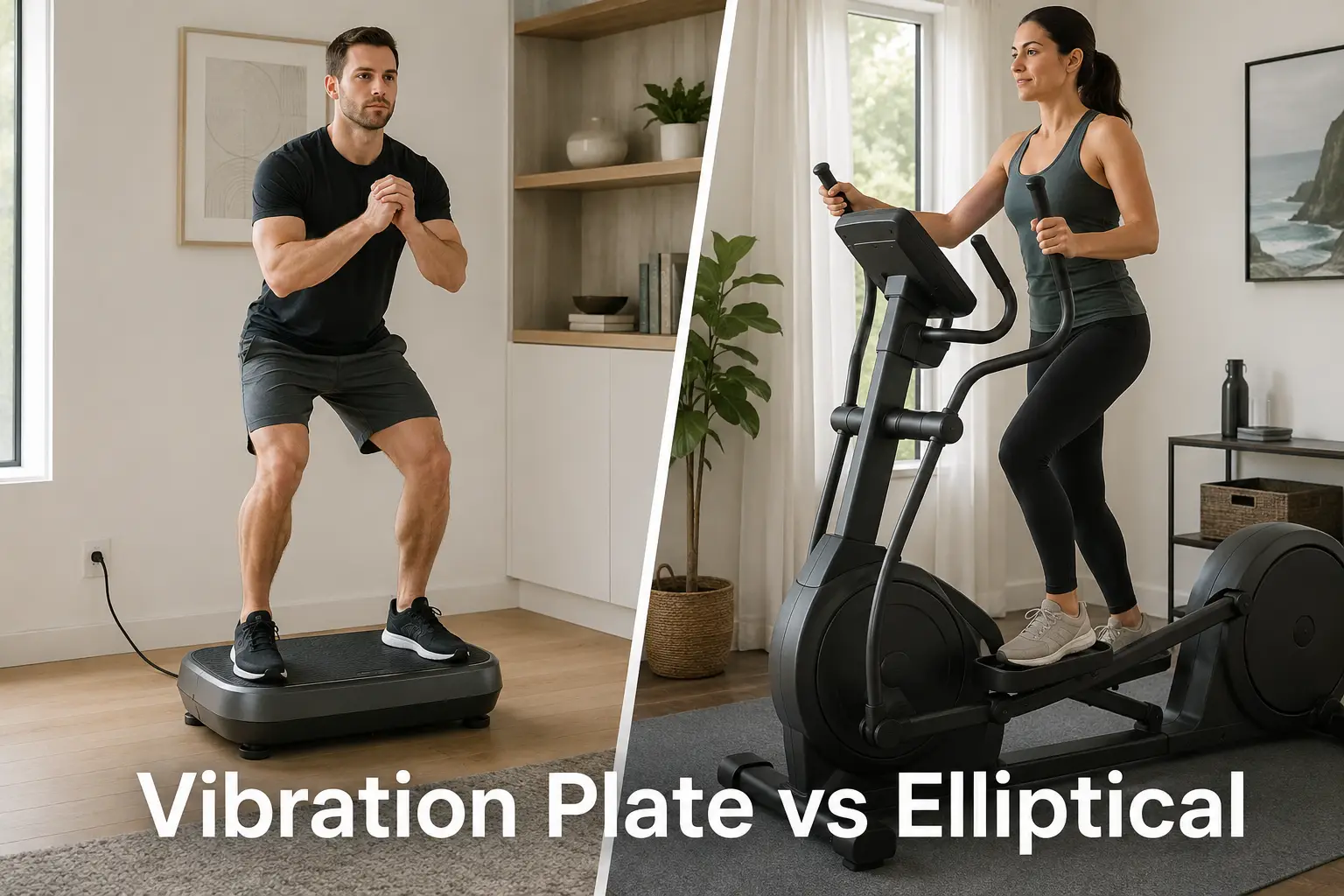
A vibration plate and an elliptical can both provide low-impact home exercise, but they accomplish that in very different ways. An elliptical is primarily a cardiovascular machine built for sustained movement, while a vibration plate is better suited to shorter sessions involving muscle activation, balance, stability, and bodyweight exercises.

About the author: Hello! I’m Vladimir Stanar, professor of physical education, kinesiotherapist, marathon runner, cyclist, and cycling coach, and long-time advocate of health, fitness, and active living.
My journey with vibration plates runs parallel to my professional career in education, sports medicine, and athletic development. I’ve developed a unique process for testing vibration plates as they are some of the most versatile tools for enhancing health, recovery, and performance.
✅ Expert-Reviewed by: Vanja Vukas, MPhEd
📚 Expert Contributor: Milutin Tucakov, MPhEd
Affiliate Disclosure: Vibration Plate Zone is a proud participant in the Amazon Services LLC Associates Program.
A vibration plate has several advantages of its own. It occupies a fraction of the floor space, sessions can be much shorter, and you can use it for everything from squats and calf raises to planks, push-ups, bridges, resistance-band exercises, and mobility work.
If improving cardiovascular fitness and endurance were my main priorities, I would choose the elliptical. It allows continuous moderate or vigorous exercise, gives you measurable resistance progression, and can involve both the lower and upper body when the moving handles are used.
The best choice therefore depends on the job you want the equipment to perform. In this vibration plate vs elliptical comparison, I will break down how each machine works, its benefits and limitations, recommended exercises and workouts, and which option makes more sense for different fitness goals.
Vibration Plate vs Elliptical: Key Differences
The biggest difference is where the movement comes from.
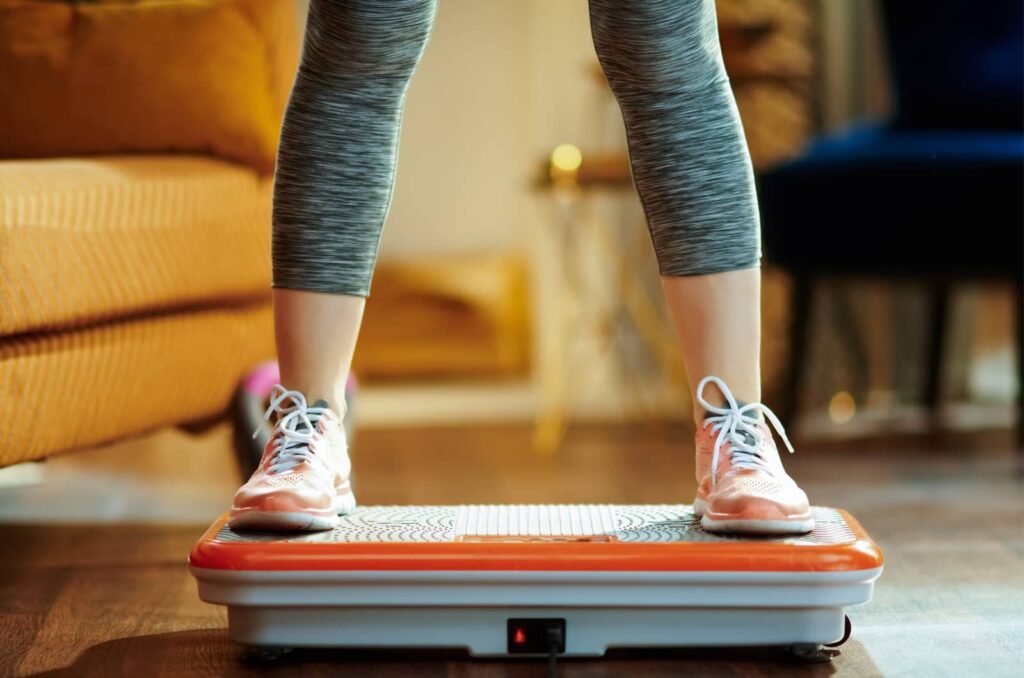
A vibration plate uses a motor to move the platform beneath you. Your muscles react to that movement through repeated contractions and small postural corrections while you stand or perform exercises.
An elliptical requires you to generate the movement yourself. You push the pedals through a fixed elliptical path while working against resistance, and moving handlebars can involve the upper body at the same time.
This creates a major difference in cardiovascular demand. Most vibration sessions are relatively short, while an elliptical can be used continuously for 20, 30, 45 minutes, or longer.
The two machines also provide different types of exercise variety. An elliptical offers one main movement pattern but allows you to change resistance, pace, incline, direction, and workout structure. A vibration plate provides more body-position variety because you can stand, squat, plank, push, pull, stretch, or perform floor exercises around the platform.
Space may be an equally important difference for home users. A vibration plate can be only a couple of feet wide and several inches high, while a full-size elliptical can be six feet long and weigh well over 100 pounds.
What Is a Vibration Plate?
A vibration plate is a motorized platform that moves rapidly beneath your feet, hands, or another part of the body in contact with the deck.
Different machines use different types of vibration. Oscillating platforms rock from side to side around a central pivot, while vertical machines move predominantly upward and downward. More advanced 3D and 4D models may combine oscillating, lateral, and pulsating movement through several motors.
Frequency tells you how many vibration cycles occur each second and is measured in hertz. Amplitude describes how far the platform moves.
Most consumer models also advertise speed or intensity settings, but these numbers are manufacturer-defined. A plate with 120 speed levels does not operate at 120 Hz, and level 20 on one machine cannot be compared directly with level 20 on another.
Your body position also affects how strong the vibration feels. On an oscillating platform, standing farther from the center usually increases movement, while slightly bending the knees helps the lower body absorb more vibration.
I think a vibration plate becomes much more useful once you move beyond passive standing. Squats, calf raises, push-ups, planks, bridges, resistance-band exercises, and other movements turn it into a considerably more versatile training tool.
What Is an Elliptical?
An elliptical trainer is a stationary cardio machine that guides your feet through a continuous oval-shaped path.
Your feet remain on the pedals instead of repeatedly striking the floor, which removes the landing phase associated with running. Most machines also include moving handlebars that allow the arms and upper body to contribute.
Ellipticals can use front-drive, rear-drive, or center-drive systems. The location of the flywheel and mechanical design influence the feel of the stride, but a smooth and comfortable movement matters more to me than the drive label alone.
Resistance is usually magnetic or electronically controlled. Better machines allow resistance to be adjusted during the workout without interrupting the stride.
Some ellipticals also include power incline. Increasing incline can change the movement pattern and place more emphasis on different lower-body muscles.
Stride length is particularly important. A longer stride generally feels more natural for taller users, while a very short stride can create more of a stepping sensation.
Most machines track time, distance, speed, resistance, estimated calories, and heart rate. More advanced models may also provide cadence, app connectivity, workout programs, incline metrics, and other performance data.
Benefits of Vibration Plates
Vibration plates are useful because they can add muscular and balance demands without requiring a large cardio machine or a long workout.
Muscle Activation and Strength
The rapid movement beneath your body forces muscles to make repeated adjustments to keep you stable.
A shallow squat is a good example. Your quadriceps, glutes, and calves already work to maintain the position, while the vibration creates an additional stabilization demand.
I find the same principle useful for planks. Putting the forearms or hands on the platform adds movement underneath the upper body, forcing the shoulders, arms, and trunk to work continuously to maintain position.
Whole-body vibration training has produced improvements in lower-body strength and physical performance in research, particularly among older adults.
I would still treat it as a supplement to conventional resistance training rather than a complete replacement. If maximizing muscle size or absolute strength is my goal, progressive weight training remains more effective.
Improved Circulation and Flexibility
Repeated muscle contractions during vibration can temporarily increase blood flow through the areas being exercised.
This is one reason I like a brief low-intensity vibration session before mobility work. The muscles feel more active and warmer than they do after sitting still.
For people who use a plate specifically for that purpose, my picks for the best vibration plates for circulation cover machines suited to gentle, consistent use before or between other activities.
A few minutes of gentle standing followed by calf raises, shallow squats, or stretches can also be an easy transition from inactivity into exercise.
Flexibility improvements reported with vibration training may involve several factors, including muscle warming, relaxation, and the stretching positions used during the sessions.
I would not use the plate as a replacement for mobility training, but it can complement it nicely.
Bone Density and Balance Support
Whole-body vibration has also been studied for bone health, balance, mobility, and physical function.
Balance is particularly relevant because the platform continually changes beneath the feet. The ankles, knees, hips, and trunk have to make small corrections to maintain stability.
This is something an elliptical does not emphasize to the same degree because the feet follow a guided path.
For older adults or people new to exercise, I think vibration-based balance work can be useful when performed appropriately. Someone who feels unsteady should use a rigid handle, railing, countertop, or other fixed support.
For people focused specifically on bone density and balance, my picks for the best vibration plate for bone density cover the frequency ranges and session parameters most relevant for that population.
A resistance band is not a balance handle because it moves when you pull against it.
Calorie Burn and Weight Management
A vibration plate can contribute to energy expenditure, particularly when you perform active exercises rather than simply standing.
Squats, lunges, resistance-band movements, planks, and other exercises require muscular work and can increase the overall intensity of a session.
However, I would not choose a vibration plate over an elliptical specifically for calorie expenditure.
An elliptical allows continuous exercise at a moderate or vigorous intensity for much longer periods. That gives it a clear advantage when increasing weekly cardiovascular activity is part of a weight-management plan.
I consider vibration training a supporting tool for weight management rather than the primary calorie-burning exercise.
Recovery and Mental Focus
Not every workout needs to leave you exhausted.
A low-intensity vibration session can provide a convenient way to move on a day when I do not want another demanding cardio session.
I might stand on the plate briefly, perform gentle calf raises or weight shifts, and then use it for mobility positions. That feels more useful to me than doing nothing simply because I do not feel ready for another hard workout.
The repetitive movement can also increase awareness of posture. You quickly notice when one leg is carrying more weight or when your knees become rigid.
I would describe this as a practical low-intensity movement option rather than claiming that vibration automatically accelerates recovery.
Rehabilitation and Special Populations
Whole-body vibration has been studied in older adults and several clinical and rehabilitation populations.
It can provide a muscular stimulus without running or jumping, and many exercises can be performed with a relatively small range of movement.
That does not make every home vibration plate appropriate for every medical condition.
Someone with significant balance impairment, recent surgery, severe cardiovascular disease, certain neurological conditions, implanted medical devices, or another major health concern should get appropriate individual guidance before beginning.
For older adults looking for a safe starting point, my picks for the top vibration plates for seniors cover models with stable platforms, appropriate defaults, and manageable controls.
Drawbacks of Vibration Plates
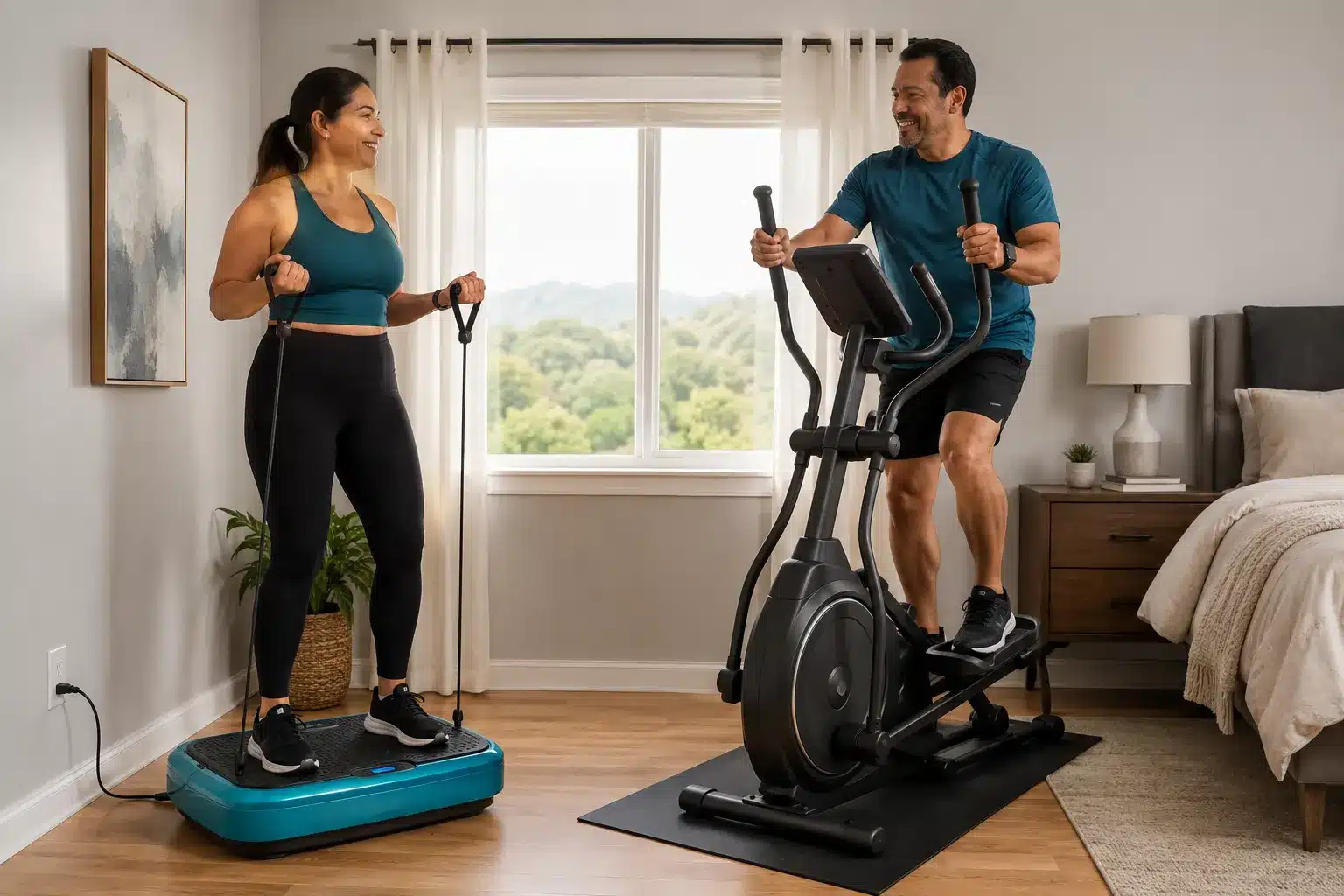
Vibration plates offer convenience and versatility, but their limitations become particularly clear when compared with dedicated cardio machines.
Limited Cardiovascular Challenge
A vibration plate is not primarily a cardiovascular machine.
Standing on the deck can increase muscle activity, but it rarely creates the sustained aerobic workload you can achieve on an elliptical.
Active plate exercises can raise heart rate more significantly. You can perform squats, lunges, resistance-band exercises, and short circuits, but the experience still differs from 30 minutes of continuous elliptical training.
If improving aerobic fitness were my main goal, I would not depend on a vibration plate alone.
Learning Curve and Posture
Vibration plates look simple, but body position affects how vibration travels through you.
Standing with completely locked knees can allow more movement to reach the hips, spine, neck, and head. I prefer maintaining a gentle knee bend and relaxed upper body.
Foot position matters as well. On an oscillating platform, a wider stance typically produces more movement.
I would begin with a low setting and simple stance before introducing more difficult exercises.
Increasing intensity, stance width, duration, and exercise difficulty simultaneously makes it much harder to determine what caused discomfort.
Contraindications and Safety Considerations
Whole-body vibration is not automatically suitable for every person.
Recent surgery, pregnancy, significant balance disorders, certain cardiovascular conditions, acute injuries, and some implanted medical devices may require professional guidance.
The session should also stop if you develop sharp pain, unusual numbness, significant dizziness, severe headache, or another concerning symptom.
The fact that vibration sessions are often short does not mean they should be treated casually.
Equipment Quality and Cost
Vibration plate quality varies dramatically.
Some inexpensive machines disclose little more than an impressive-looking speed number. Others provide motor information, frequency, amplitude, capacity, platform dimensions, and warranty coverage.
I would rather buy a well-documented oscillating machine than a platform marketed as "4D" without any meaningful explanation of its movement.
My LifePro Rumblex 4D review shows what a well-documented plate actually delivers in practice, covering build quality, vibration feel, and how it holds up across different session types.
Complexity also creates more potential points of failure. With multi-motor machines, I pay more attention to warranty coverage and manufacturer support.
Recommended Vibration Plate Exercises
A vibration plate becomes much more versatile when you perform exercises on it instead of standing passively during every session.
Basic Stance: Stand at a comfortable width with slightly bent knees. Start at a low setting and keep the shoulders and upper body relaxed.
Squats and Lunges: Lower slowly into a shallow squat and maintain control. Lunges can be performed with one foot on the platform or in other supported variations depending on experience and deck size.
Push-Ups and Planks: Place your hands or forearms on the plate while keeping the trunk stable. The moving surface increases the stabilization demand through the shoulders, arms, chest, and core.
Bridges and Hip Raises: Lie on your back with the feet placed on the platform and lift the hips. This targets the glutes and hamstrings while the legs respond to the vibration.
Calf Raises: Rise slowly onto the balls of your feet before lowering with control. I prefer slow repetitions rather than bouncing rapidly through the movement.
Beginners do not need long vibration sessions. Five to ten minutes of total exposure can provide plenty of time to learn the machine before increasing duration or difficulty.
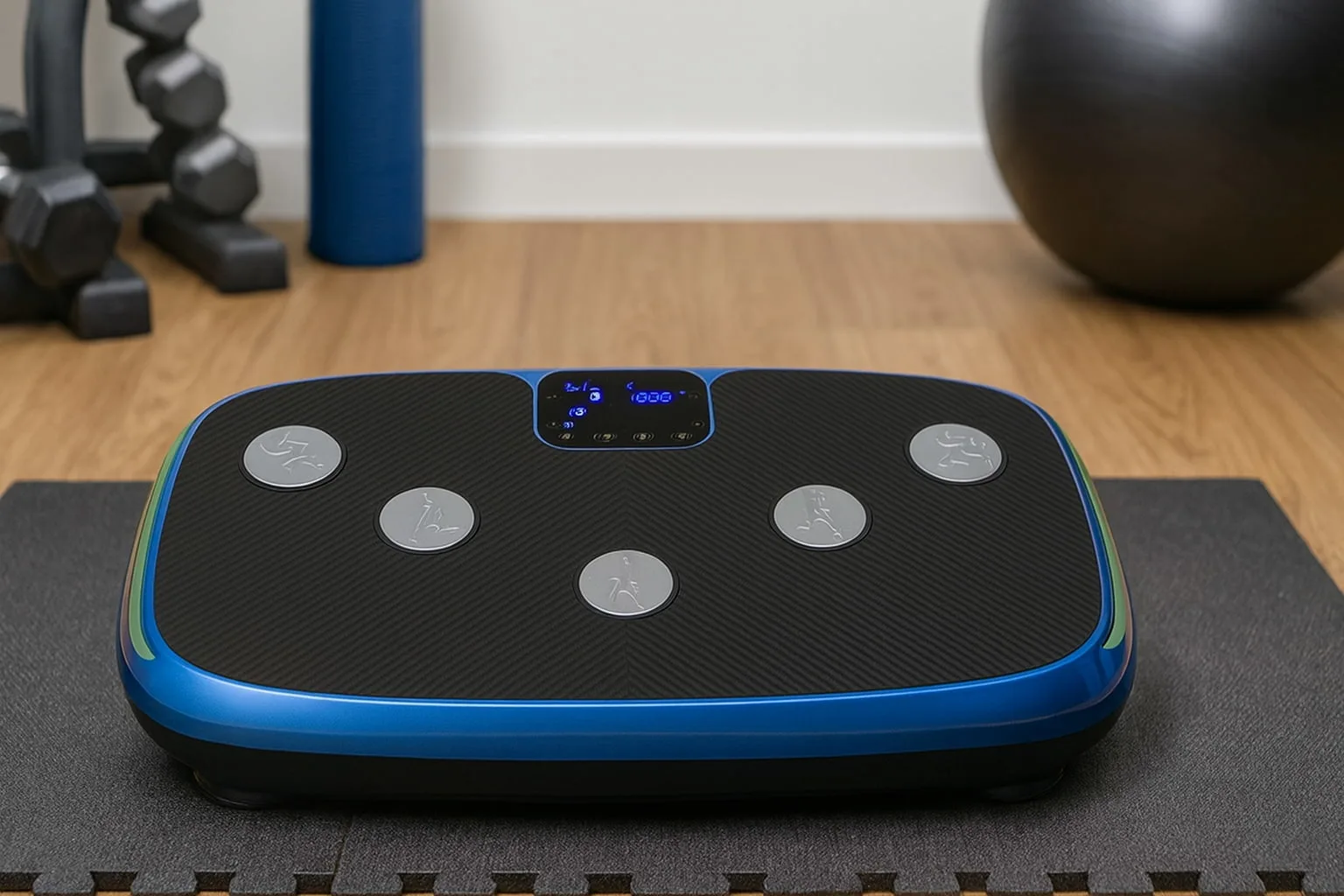
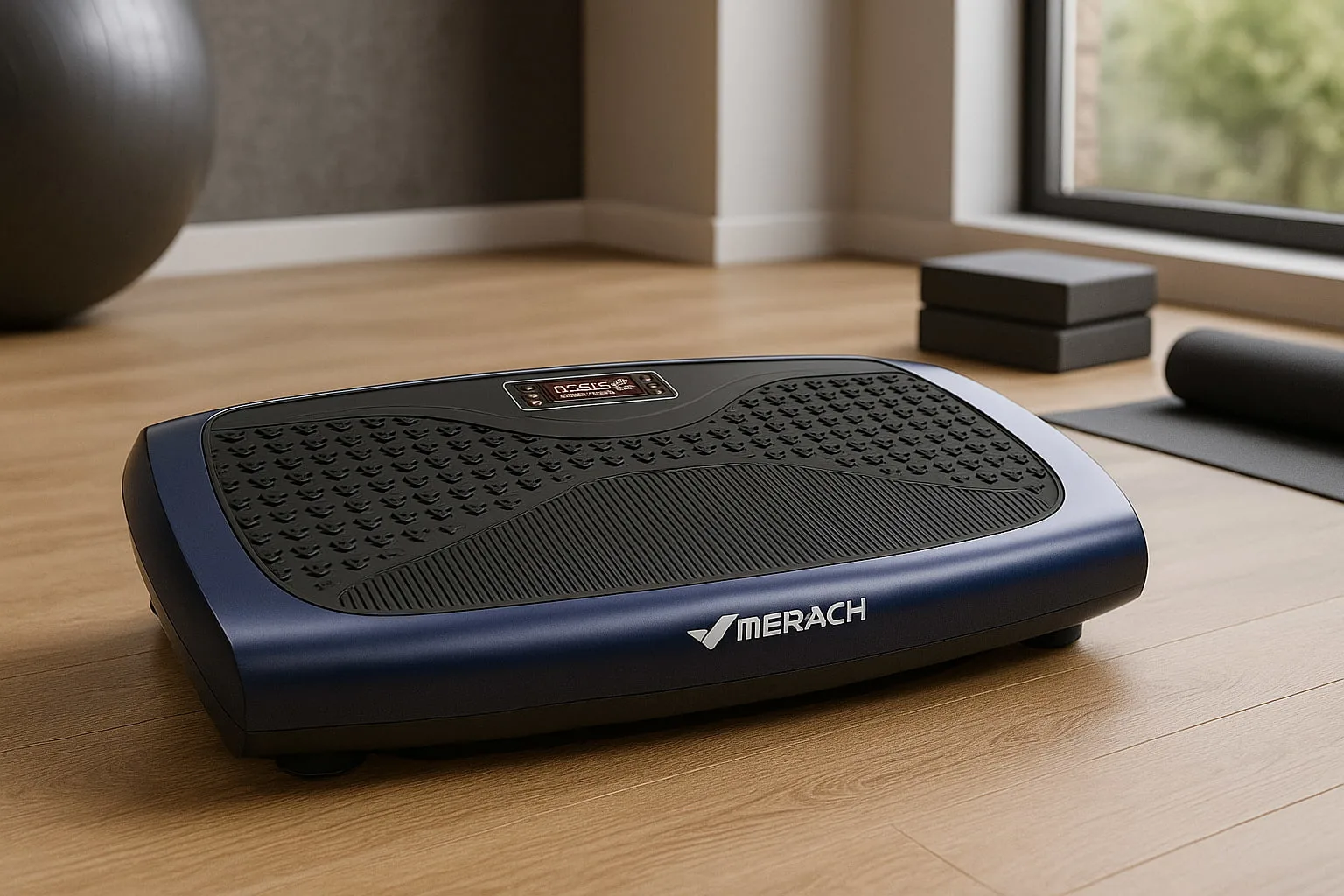
My Recommended Top 3 Vibration Plates: Reviewed & Rated

Benefits of Elliptical Trainers
An elliptical is much closer to a complete standalone cardio machine than a vibration plate.
It provides continuous weight-bearing exercise without the repeated foot strikes associated with running and can involve both the lower and upper body.
Cardiovascular Conditioning and Endurance
Cardio is the biggest reason I would choose an elliptical.
You can maintain continuous movement for 20, 30, 45 minutes, or longer while adjusting the resistance to match your current fitness level.
Moderate elliptical exercise can provide a substantial aerobic stimulus, while vigorous sessions can become very demanding.
Training research has shown improvements in aerobic capacity after regular elliptical exercise. Studies comparing elliptical training with treadmill exercise have also found similar cardiovascular responses when relative intensity is matched.
I like this flexibility because the same machine can support easy aerobic work, moderate steady-state training, and harder intervals.
For someone whose routine currently lacks cardio, the elliptical fills a much larger gap than a vibration plate.
Low-Impact Weight-Bearing Exercise
Ellipticals are frequently described as low-impact because the feet remain in continuous contact with the pedals.
There is no repeated heel strike like there is during walking or running. This reduces the rapid loading associated with landing.
The important point is that low impact does not mean no joint demand.
Your knees and hips repeatedly move through the stride, and the muscles around those joints still produce force. Research comparing elliptical movement with walking has found lower loading rates but also greater knee extensor and hip flexor moments during elliptical exercise.
I therefore consider the elliptical a low-impact cardiovascular option, not a zero-load exercise.
Another distinction from an exercise bike is that the elliptical keeps you upright and weight-bearing. Some people prefer that because it feels more like standing or walking, while others may find seated cycling more comfortable.
Lower- and Upper-Body Muscle Engagement
The elliptical primarily challenges the lower body.
The quadriceps, glutes, hamstrings, and calves all contribute as you push and pull the pedals through the stride.
Muscle-activation research has shown particularly substantial quadriceps involvement during elliptical exercise.
Moving handlebars can add upper-body involvement. You can push and pull with the arms while coordinating the stride, increasing the contribution of the back, shoulders, chest, and arms.
I would still call this cardio-oriented upper-body involvement rather than strength training. The handles do not provide the same progressive resistance that you would get from dumbbell rows, presses, or other dedicated exercises.
Compared with a vibration plate, the elliptical gives you more continuous whole-body movement but less freedom to target individual areas through different positions.
Calorie Burn and Weight Management
The elliptical has a clear advantage when the goal is sustained energy expenditure.
Moderate elliptical exercise is already a genuine cardiovascular activity, while vigorous sessions can reach a high metabolic demand.
The biggest practical advantage is duration. It is completely realistic to remain on an elliptical continuously for 30 or 45 minutes.
That makes accumulating weekly aerobic exercise relatively straightforward.
I would not take the estimated calorie number on the console too literally. Machine calculations can differ, and actual energy expenditure depends on body size, workload, fitness, and how much effort you contribute with the upper body.
For weight management, what matters is that the elliptical allows meaningful amounts of continuous exercise.
Between these two machines, it is the clear winner for calorie-burning workouts.
Measurable Progress and Workout Variety
Ellipticals provide much more objective performance feedback than most vibration plates.
Even a basic machine may track:
- Time
- Distance
- Speed
- Resistance
- Estimated calories
- Heart rate
More advanced models can add:
- Incline
- Workout programs
- Bluetooth
- App integration
- Heart-rate programs
- Interval profiles
This makes progression easy to structure.
I might increase resistance while maintaining the same pace, cover more distance in 30 minutes, increase incline, or complete harder intervals.
Forward and reverse movement also provides some variation in the movement pattern.
A vibration plate gives me more exercise-position variety, but an elliptical gives me much better cardio-training variety and measurable progression.
Drawbacks of Ellipticals
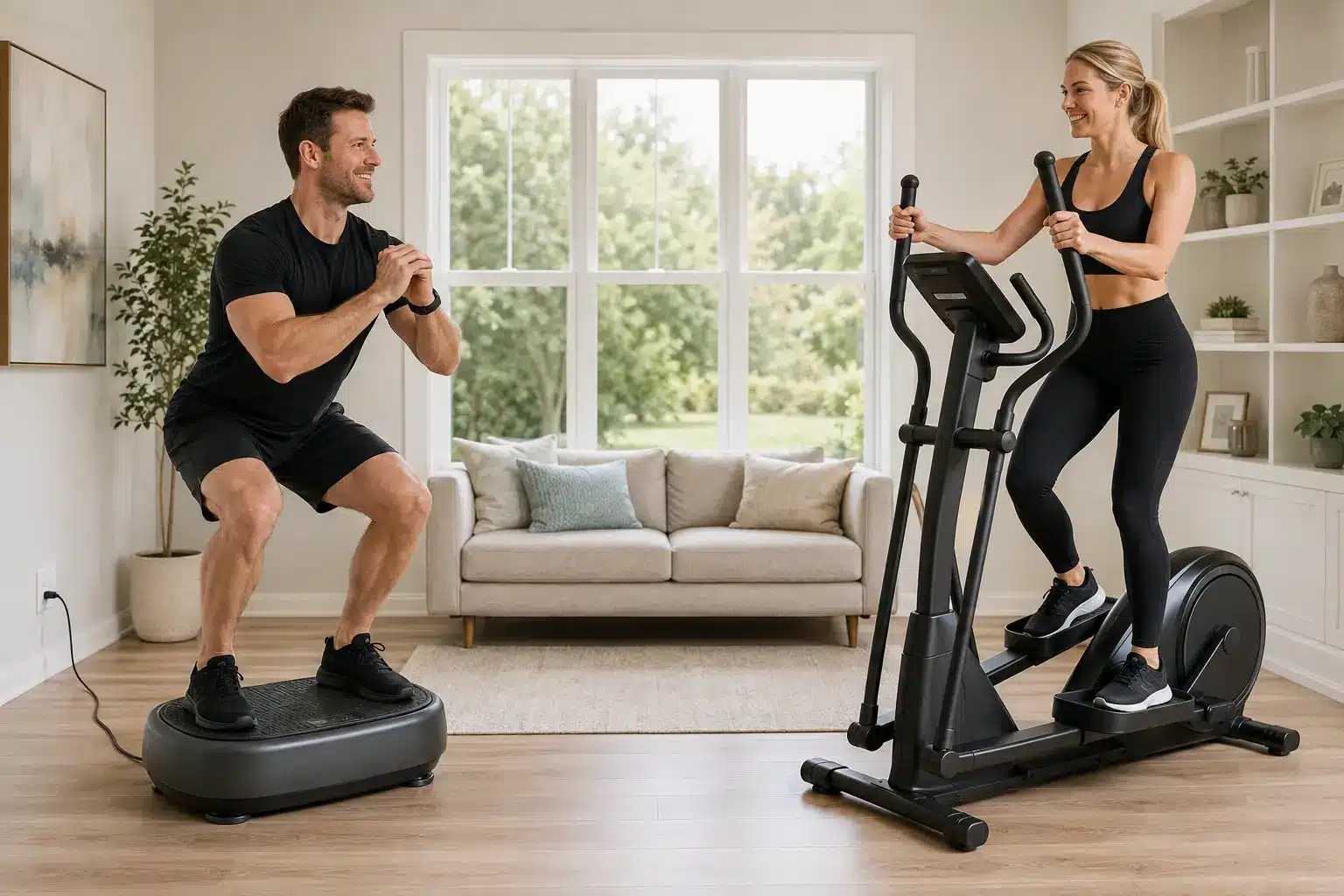
The elliptical is much stronger for cardio, but it comes with several practical disadvantages that matter in a home gym.
Large Footprint and Machine Weight
Space is the biggest weakness compared with a vibration plate.
A full-size elliptical can be roughly six feet long, two feet wide, and more than five feet tall.
The SOLE E25, for example, measures around 70 × 24 × 70 inches and weighs approximately 209 pounds.
The Horizon EX-59 is around 73 to 74 inches long and weighs approximately 145 pounds.
Those machines are movable with transport wheels, but I would not describe them as portable in the same sense as a 20-pound vibration plate.
Once assembled, I would want an elliptical to stay in one location.
You also need space around the machine to step on and off safely.
For an apartment, bedroom, or multipurpose living area, a vibration plate is much easier to accommodate.
Fixed Stride Length and Machine Fit
Stride length is one of the most important elliptical specifications.
A short stride can feel cramped or overly step-like for a taller person, while a longer stride may feel more natural.
The SOLE E25 uses a 20-inch stride, which suits a broad range of users.
The Horizon EX-59 uses an 18-inch stride. That may work perfectly well for many users, but taller people may prefer the additional room provided by a 20-inch design.
Compact machines can be much shorter. The Sunny SF-E905, for example, uses an 11-inch stride, which contributes to its small footprint but produces a distinctly shorter movement.
I would never choose an elliptical based solely on price without considering stride length.
A machine can have excellent resistance and electronics but still be uncomfortable if its geometry does not suit your body.
Repetitive Knee and Hip Movement
The elliptical eliminates foot strike, but it does not eliminate repetitive movement.
Your knees, hips, and ankles go through thousands of repeated cycles during a longer session.
The fixed path can be helpful because the pedals guide the movement. At the same time, that fixed path needs to suit your body reasonably well.
Biomechanical research has found that elliptical exercise produces lower loading rates than walking while also creating greater knee extensor and hip flexor moments.
That is why I avoid saying the elliptical is automatically "better for bad knees."
Some people find it extremely comfortable. Others may prefer cycling, walking, swimming, or another movement depending on their individual condition.
Balance and Coordination Requirements
An elliptical provides a guided movement path, but you are still standing on elevated moving pedals.
Getting on and off requires more balance than sitting on an exercise bike.
During the workout, you also coordinate the legs and moving handles while maintaining an upright posture.
A beginner can hold the stationary handles until confidence improves. I would recommend that over immediately using the moving arms if balance feels uncertain.
This is another interesting difference from the vibration plate.
Both machines can challenge balance, but they do so in different ways. The vibration plate creates rapid movement beneath a relatively small stance, while the elliptical moves the entire body through a repeated stride.
Someone with substantial balance impairment may need professional guidance before using either unsupported.
Equipment Complexity, Noise, and Maintenance
An elliptical contains considerably more moving hardware than a typical vibration plate.
Depending on the model, you may have:
- Flywheel
- Drive belt
- Resistance system
- Pedal arms
- Rollers
- Tracks
- Pivot joints
- Moving handlebars
- Incline mechanism
- Console electronics
These components can develop squeaks, looseness, or wear over time.
A quality magnetic resistance system can be extremely quiet, but the pedals, rollers, and joints still move through every stride.
Assembly is another consideration. A large elliptical may arrive in a heavy box with several major components that need to be connected accurately.
I would pay close attention to warranty coverage and replacement-part availability when buying one for long-term use.
Recommended Elliptical Workouts
You do not need complex programming to get useful workouts from an elliptical.
Easy Recovery Glide: Use light resistance and a comfortable pace for 10 to 20 minutes. Keep the effort easy enough that breathing remains controlled.
Steady-State Elliptical: Maintain a moderate, sustainable pace for 20 to 40 minutes. This is the workout format I would use most often for building aerobic endurance.
Resistance Progression: Begin at an easy resistance level and increase it gradually every few minutes while trying to keep your cadence controlled. Work back down after reaching the hardest sustainable level.
Interval Workout: Alternate harder blocks with easy recovery. A beginner might use one minute of higher resistance followed by two minutes of easier movement.
Hill or Incline Pyramid: On a machine with incline, gradually increase incline or resistance across several intervals before decreasing it in the same stages. This creates a structured workout without requiring all-out sprinting.
You can also experiment with brief reverse-stride periods when your machine allows it and the movement feels comfortable.
I would begin with shorter workouts rather than immediately attempting a hard 45-minute session. Progressing duration gradually makes consistency much easier.
My Recommended Top 3 Ellipticals: Reviewed & Rated
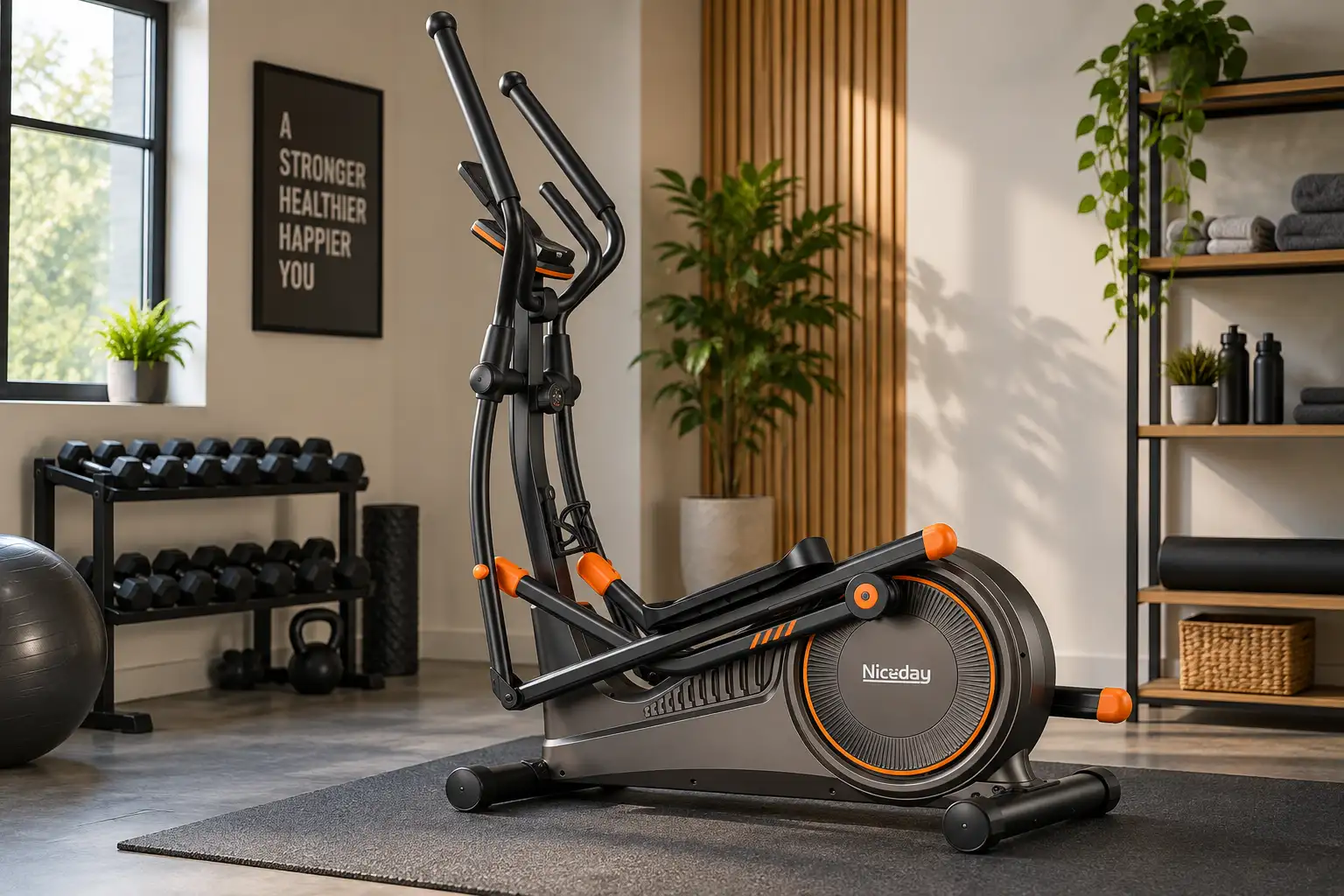
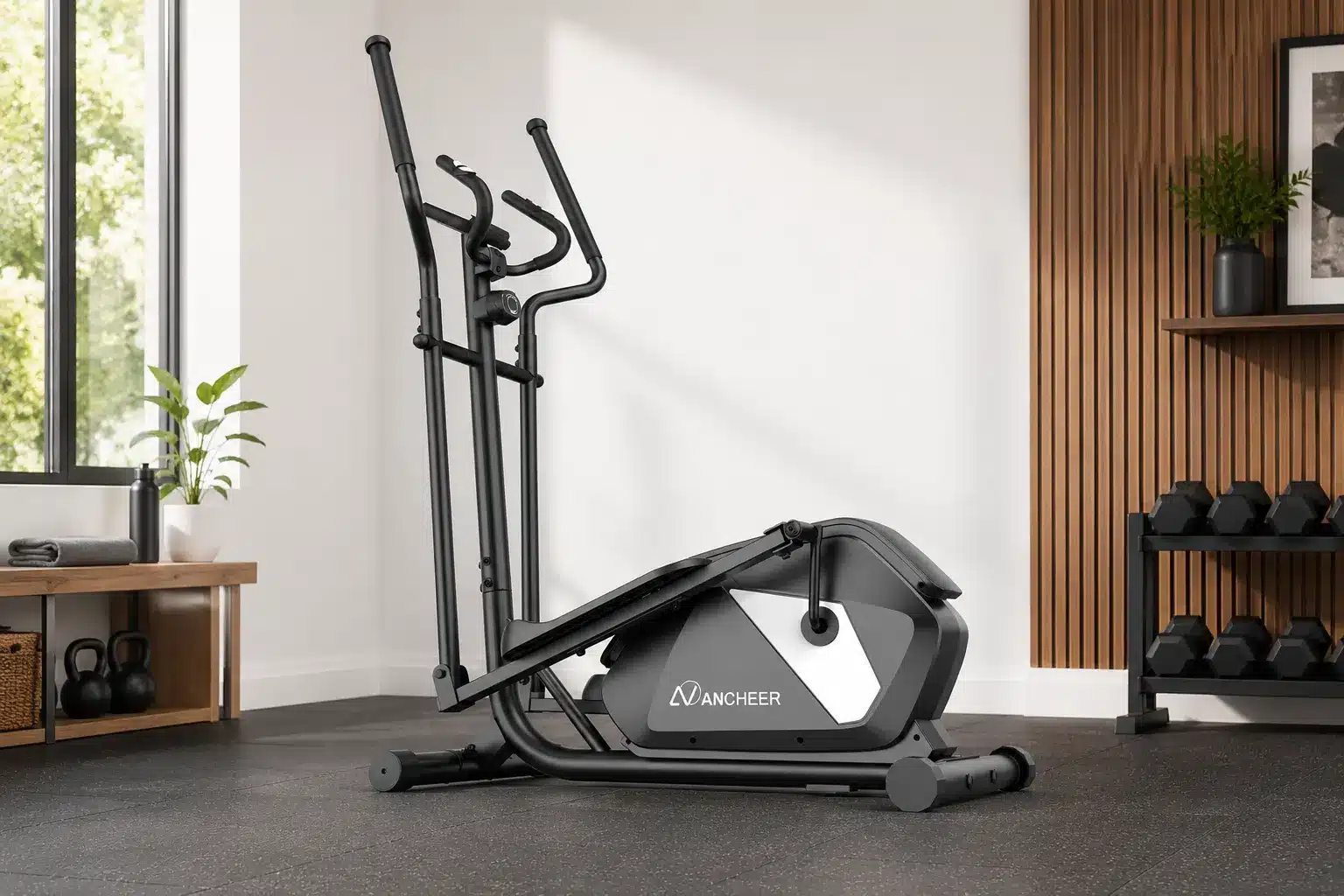
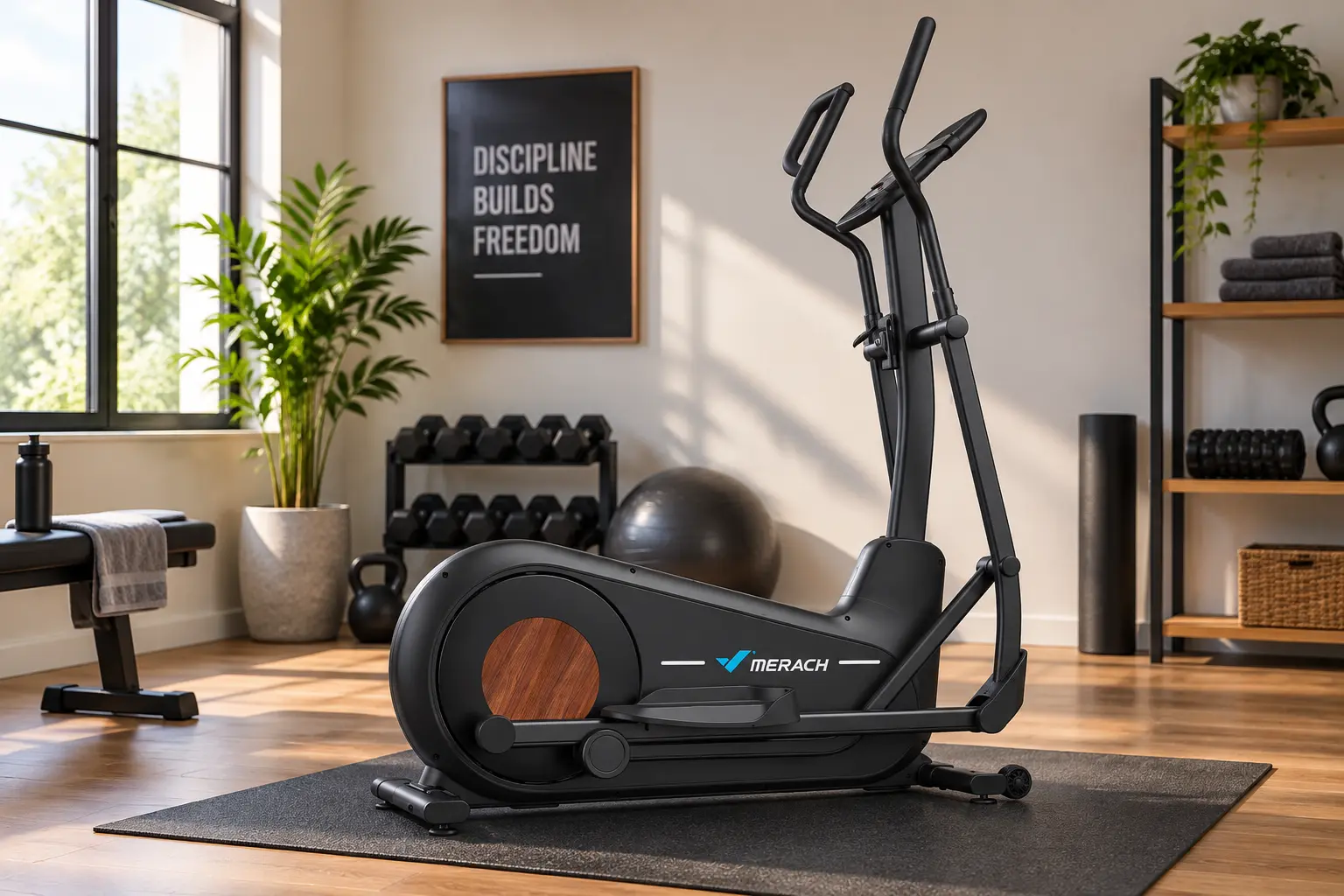
Comparing Vibration Plates and Ellipticals for Fitness Goals
Now that we have looked at both machines separately, the differences become much easier to apply to specific fitness goals.
Neither machine is universally better. The elliptical dominates cardiovascular conditioning, while the vibration plate wins on compactness and exercise-position variety.
Weight Loss and Metabolic Health
If weight loss is the main goal, I would choose the elliptical.
The reason is straightforward: it allows sustained moderate or vigorous exercise for much longer periods.
Moderate elliptical training already represents genuine cardiovascular activity. At vigorous intensity, the metabolic demand increases substantially.
A vibration plate can still contribute to weight management when you perform active exercises such as squats, lunges, planks, and resistance-band movements.
If a plate is part of your weight management plan, my picks for the best vibration plates for weight loss focus on machines that support active exercise rather than passive standing.
What I would not do is compare ten minutes of passive vibration with 30 minutes of active elliptical training and expect equivalent energy expenditure.
Research on vibration training alone has not shown consistent reductions in body weight or fat mass.
For a broader routine, the two machines can complement each other. Use the elliptical for dedicated cardio and the vibration plate for shorter strength, balance, or mobility sessions.
If a treadmill is also in the mix, my treadmill vs vibration plate comparison covers how running differs from whole-body vibration across calorie burn, joint impact, space, and training variety.
Strength and Muscle Development
This comparison depends on the type of muscular development you want.
The elliptical is better for sustained lower-body muscular endurance. Your quadriceps, glutes, hamstrings, and calves work repeatedly throughout the session, particularly as resistance increases.
Using the moving handles also gives the upper body some involvement.
The vibration plate provides much greater exercise-position variety.
You can perform squats for the thighs and glutes, calf raises for the lower legs, bridges for the posterior chain, planks for the trunk, push-ups for the upper body, and resistance-band movements for the arms and shoulders.
That makes the plate better for targeting different areas within one compact setup.
For maximum strength or muscle growth, though, I would choose neither machine as the only solution. Progressive resistance training with weights or suitable resistance equipment remains more effective.
Joint Health and Low-Impact Training
Both machines can provide low-impact exercise, but that term means something different in each case.
The elliptical keeps your feet on the pedals and eliminates repeated heel strikes. Research has found lower loading rates than walking, which is one reason the machine is popular for low-impact cardio.
However, elliptical movement still creates meaningful forces around the knees and hips. The joints repeatedly flex and extend through every stride.
A vibration plate can be used with much less joint movement, particularly during a static stance.
It still produces mechanical forces through the body, and those forces depend on vibration type, frequency, amplitude, stance width, and posture.
A rebounder produces a very different mechanical profile; my rebounder vs vibration plate comparison covers how the two machines differ in joint loading, training application, and who each one suits.
I would therefore call this category a draw.
The better option depends on the individual. Someone comfortable with repeated knee and hip movement may get far more fitness value from an elliptical. Someone who needs very limited movement may prefer carefully controlled vibration exercise.
For people managing arthritis specifically, my picks for the best vibration plate for arthritis cover machines that allow gentle, controlled movement with minimal stress on the affected joints.
Space, Budget, and Convenience
The vibration plate wins easily for space and portability.
A compact plate can measure only around 20 to 30 inches across and weigh approximately 20 to 40 pounds.
A substantial elliptical can be around six feet long and weigh 150 to more than 200 pounds.
Even the compact Sunny SF-E905 weighs about 61 pounds and stands almost five feet tall.
This difference matters in a small home.
A vibration plate can often be stored against a wall or beneath suitable furniture. An elliptical normally becomes a permanent part of the room.
The price of entry is also lower for vibration plates. Usable budget models are available below $100, while a good full-size elliptical generally requires a considerably larger investment.
If floor space is one of my main constraints, I would choose the vibration plate without hesitation.
For anyone prioritizing space, my picks for the best vibration plates for home use focus on compact, quiet models that fit easily into small rooms or multipurpose spaces.
Enjoyment, Motivation, and Variety
This category depends almost entirely on personality. An elliptical provides a structured cardio experience.
You can change resistance, incline, direction, pace, and workout duration. Better machines add interval programs, heart-rate workouts, apps, entertainment options, and performance tracking.
A vibration plate gives you more movement-position variety. One session can involve squats and bands, another planks and push-ups, while a lighter day might include gentle standing, calf raises, and mobility work.
I think of the difference this way:
The elliptical offers more ways to vary one cardiovascular movement.
The vibration plate offers more completely different exercise positions.
For me, the elliptical is more satisfying when I want a dedicated workout with measurable progress. The vibration plate is more appealing when I want something short or want to complement another form of training.
The best machine is ultimately the one you continue using.
Selecting the Right Equipment for Your Needs
Instead of asking which machine has the longer list of benefits, consider which one fills the bigger gap in your current routine.
Assess Your Fitness Goals
If cardiovascular conditioning, endurance, sustained calorie expenditure, and measurable aerobic progression matter most, choose the elliptical.
If you want short workouts, balance work, stability, muscle activation, or a compact way to make bodyweight exercises more challenging, choose the vibration plate.
Your existing exercise matters too.
If you already run, cycle, swim, hike, or perform another form of cardio several times each week, adding an elliptical may simply duplicate something you already have.
If a rowing machine is also under consideration, my vibration plate vs rowing machine comparison covers how rowing differs from whole-body vibration across cardiovascular output, muscle engagement, space, and training variety.
A vibration plate could add a different type of training.
If you currently lift weights but rarely perform sustained aerobic exercise, the elliptical would probably fill the larger gap.
Consider Your Health and Physical Condition
An elliptical requires enough mobility and balance to step onto the pedals, maintain an upright position, and repeatedly flex and extend the knees and hips.
The vibration plate can require far less gross movement, but you still need sufficient balance and vibration tolerance.
Neither machine should automatically be labeled safe for every joint or medical condition.
Someone with significant orthopedic, cardiovascular, neurological, or balance concerns should base the decision on individual guidance rather than generic claims about low-impact exercise.
Stationary cycling or a recumbent bike may also be worth considering if standing on an elliptical is uncomfortable.
Evaluate Space and Storage
Measure your exercise space before choosing.
A vibration plate is vastly easier to accommodate. You mainly need enough room around it to step on and perform the exercises you intend to use.
An elliptical needs a permanent floor footprint plus clearance for getting on and off.
Check ceiling height as well. Your feet are elevated on the pedals, so your head will sit several inches higher than normal standing height.
This can matter in basements or rooms with low ceilings.
I would also measure doorways if the machine will need to move after assembly.
Budget and Quality
Both categories cover a wide price range.
For vibration plates, I look closely at:
- Vibration type
- Frequency
- Amplitude
- Platform dimensions
- Maximum user weight
- Machine weight
- Controls
- Warranty
For ellipticals, I prioritize:
- Stride length
- Resistance system
- Flywheel and overall smoothness
- Frame stability
- Maximum user weight
- Machine dimensions
- Incline
- Handle design
- Console
- Warranty
I would rather buy a simpler high-quality machine than a low-quality product packed with questionable features.
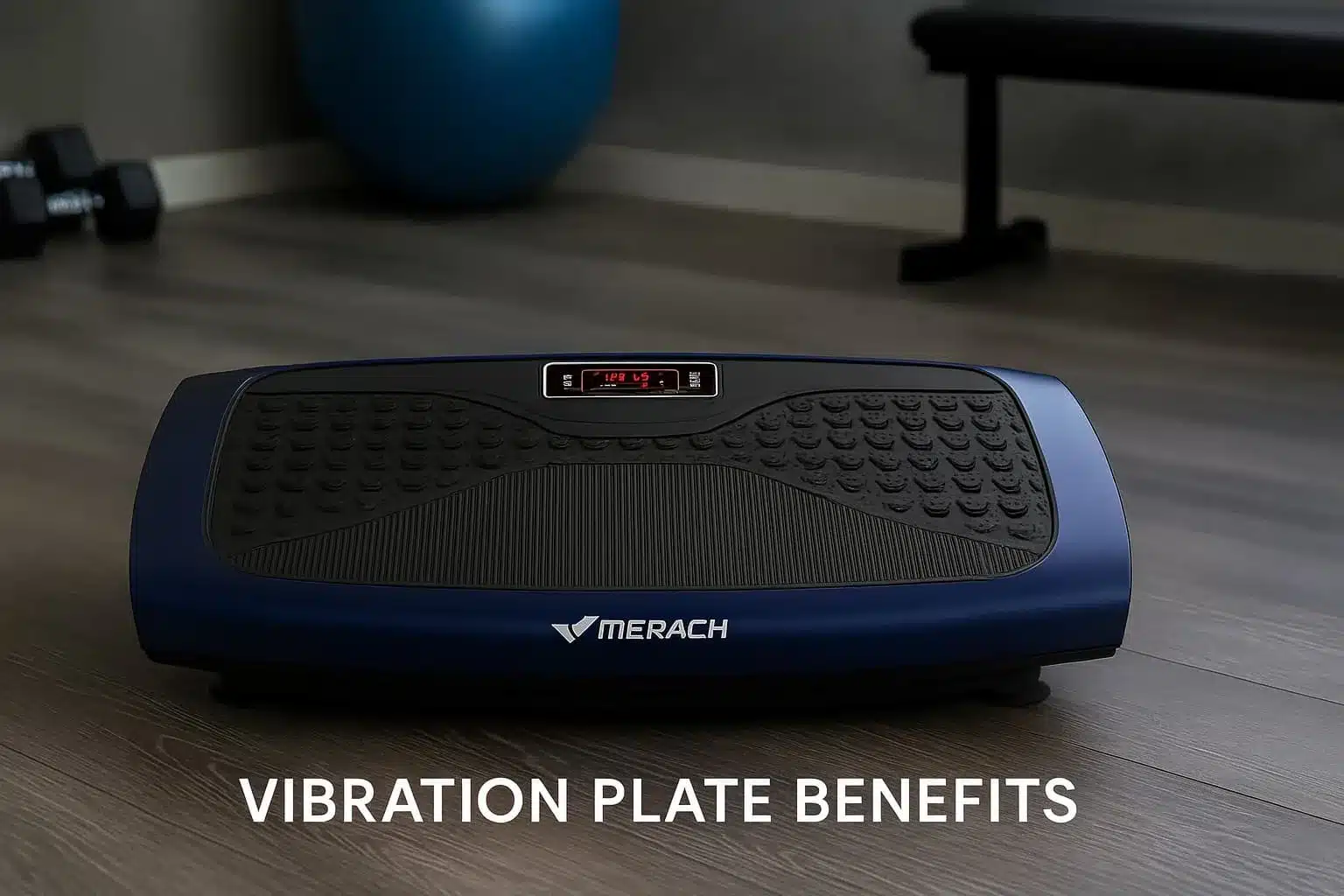
The Merach MR-2489 earns its specifications without unnecessary extras; my full Merach vibration plate review covers how it performs across different session types and use cases.
A smooth elliptical with ten resistance levels can be a better purchase than one advertising 50 settings if the frame and stride feel poor.
The same principle applies to vibration plates.
My breakdown of the top vibration plates applies those same criteria, comparing motion type, specification clarity, platform size, and build quality across the machines I have tested.
Variety and Long-Term Use
Think about how you are likely to use the machine a year from now.
A vibration plate supports many exercises, which can help prevent boredom. It can also remain useful alongside dumbbells, resistance bands, walking, running, cycling, or another training program.
An elliptical uses one basic movement pattern, but the training possibilities are still broad.
You can perform recovery sessions, long aerobic workouts, resistance intervals, incline sessions, heart-rate training, and harder high-intensity workouts.
If I owned both machines, I would give them completely different jobs.
The elliptical would handle two to four weekly cardio sessions.
The vibration plate would be used for shorter sessions involving squats, calf raises, planks, mobility, balance work, and resistance bands.
That creates a much more complete home program than asking either machine to cover every aspect of fitness.
If an exercise bike is also a candidate, my vibration plate vs exercise bike comparison covers how the two differ across cardiovascular output, lower-body training, space, and long-term variety.
Final Thoughts on Vibration Plates and Ellipticals
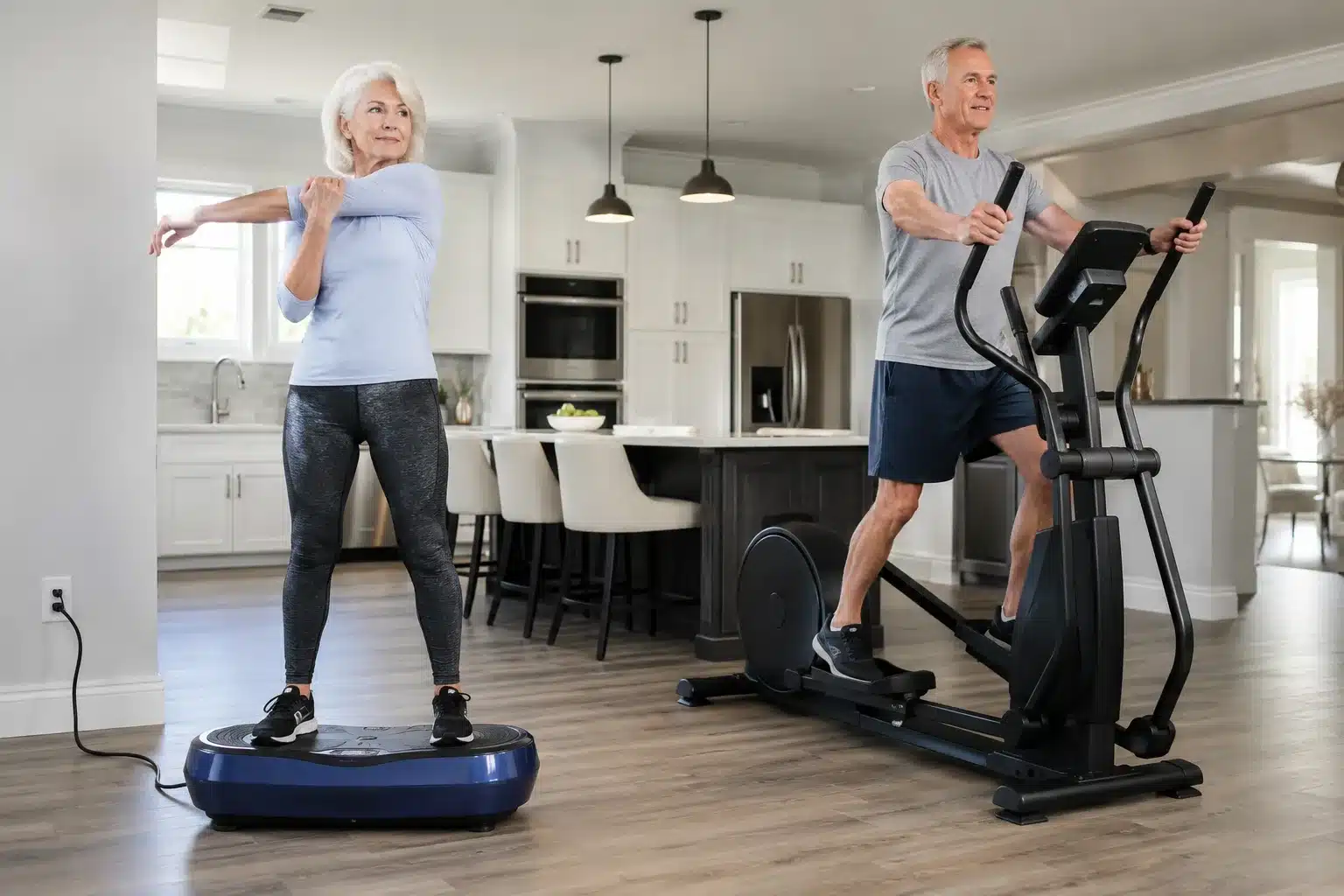
Choosing between a vibration plate and elliptical becomes easier once you decide whether you primarily need cardio equipment or a compact supplemental training tool.
Choose the elliptical if cardiovascular fitness, endurance, sustained calorie expenditure, and measurable progression matter most. It can provide genuine moderate-to-vigorous aerobic exercise while also involving large lower-body muscle groups and the upper body through moving handles.
Choose the vibration plate if space is limited, you prefer shorter sessions, or you want a machine that can support balance, stability, muscle activation, mobility, and several bodyweight exercises.
The vibration plate is also the more logical choice if your existing routine already provides plenty of cardiovascular exercise.
I would choose the elliptical if cardio were missing from my weekly training.
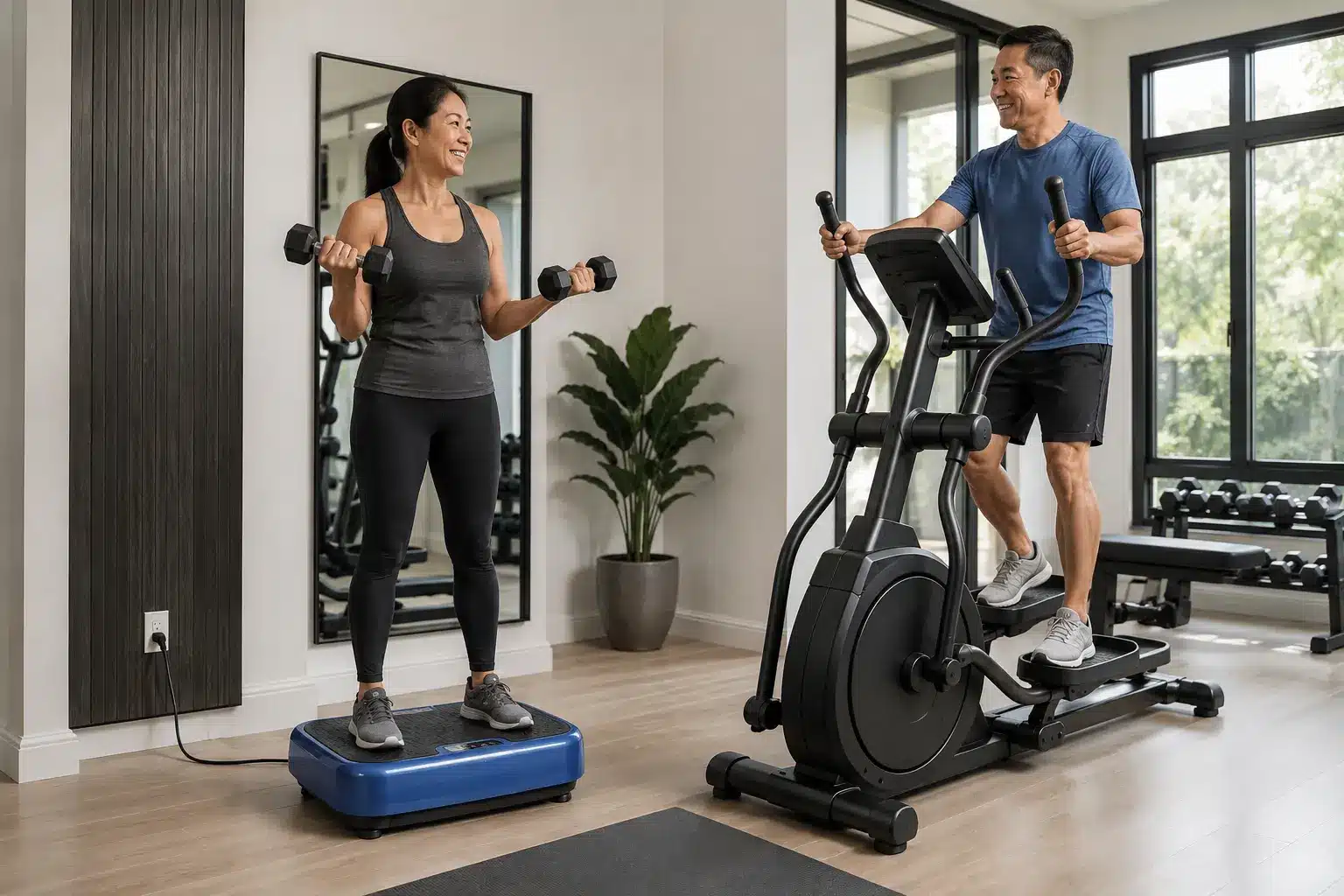
For people with enough room and budget, I like the combination. Use the elliptical as your dedicated cardiovascular machine and keep the vibration plate for shorter strength, balance, mobility, and lighter training sessions.
They overlap much less than their shared "low-impact fitness equipment" label might suggest.
FAQs
What are the differences between a vibration plate and an elliptical?
A vibration plate creates rapid mechanical movement beneath your body, causing repeated muscle contractions and stabilization demands while you stand or perform exercises.
An elliptical requires you to move continuously through a fixed stride while pushing the pedals against resistance. It provides much more cardiovascular exercise, while the vibration plate offers more exercise-position variety and takes considerably less space.
How long should a beginner use a vibration plate or elliptical?
A beginner can start with approximately five to ten minutes on a vibration plate at a low setting while learning posture and balance.
For an elliptical, 10 to 15 minutes at an easy resistance is a reasonable starting session. Duration can gradually increase to 20, 30 minutes, or longer as aerobic fitness improves.
Can I use both a vibration plate and elliptical in my routine?
Yes. The two machines complement each other well because they emphasize different fitness qualities.
You could use the elliptical several times per week for cardiovascular conditioning and use the vibration plate on other days for squats, calf raises, planks, resistance-band exercises, balance, or mobility work.
Which device is better for weight loss, a vibration plate or elliptical?
The elliptical is the better choice when weight loss is the main goal because it supports sustained cardiovascular exercise and greater total energy expenditure.
A vibration plate can still contribute to an active weight-management routine, particularly when you perform active exercises rather than standing passively.
What are some safety tips for using a vibration plate and elliptical?
For a vibration plate, begin at a low setting, keep a small bend in the knees, maintain stable posture, and increase intensity gradually.
For an elliptical, use stationary handles initially if balance is uncertain, maintain an upright posture, select manageable resistance, and make sure the machine's stride feels comfortable for your body.
Healthcare and Medical Disclaimer
The information provided on Vibration Plate Zone is for general informational purposes only and is not intended to replace professional medical advice, diagnosis, or treatment. Always seek the guidance of a qualified healthcare provider with any questions you may have regarding a medical condition, and never disregard or delay seeking professional advice.