Affiliate Disclosure: Vibration Plate Zone is a proud participant in the Amazon Services LLC Associates Program.
The VT007 Therapeutic vibration plate looks very different from most vibration plates I reviewed. There are no Bluetooth speakers, resistance bands, LED light strips, or 120 vague speed levels. Instead, the entire design focuses on adjustable high-frequency linear vibration.

About the author: Hello! I’m Vladimir Stanar, professor of physical education, kinesiotherapist, marathon runner, cyclist, and cycling coach, and long-time advocate of health, fitness, and active living.
My journey with vibration plates runs parallel to my professional career in education, sports medicine, and athletic development. I’ve developed a unique process for testing vibration plates as they are some of the most versatile tools for enhancing health, recovery, and performance.
✅ Expert-Reviewed by: Vanja Vukas, MPhEd
📚 Expert Contributor: Milutin Tucakov, MPhEd
In this VT007 Therapeutic Vibration Plate review, I am looking at a vibration plate with a 10 to 40 Hz vibration range, two amplitude settings, and direct 1 Hz frequency adjustment. Instead of choosing speed 37 and wondering what that actually means, I can select a specific vibration frequency.
That immediately makes the VT007 more interesting to me from a kinesiotherapy and exercise science perspective. Its platform moves vertically in a linear pattern, so both sides of my body move up and down together instead of alternating from left to right like they do on an oscillating plate.
The result is a faster, tighter vibration sensation. At lower frequencies and low amplitude, the VT007 can feel controlled and surprisingly comfortable. Raise the frequency and switch to high amplitude, and this little 23 pound plate becomes much more serious.
I do not see it as a trendy wellness plate for casually standing on while scrolling through my phone. The VT007 is better suited to people who want to understand frequency, posture, amplitude, and how their body responds to linear vibration.
After comparing its specifications, control system, construction, and intended use with the many oscillating vibration plates I have tested, I think the VT007 occupies a very specific place in the home vibration plate market. It is simple on the outside, but technically much more focused than it first appears.
VT007 Therapeutic Vibration Plate Review: Hands-On Overview
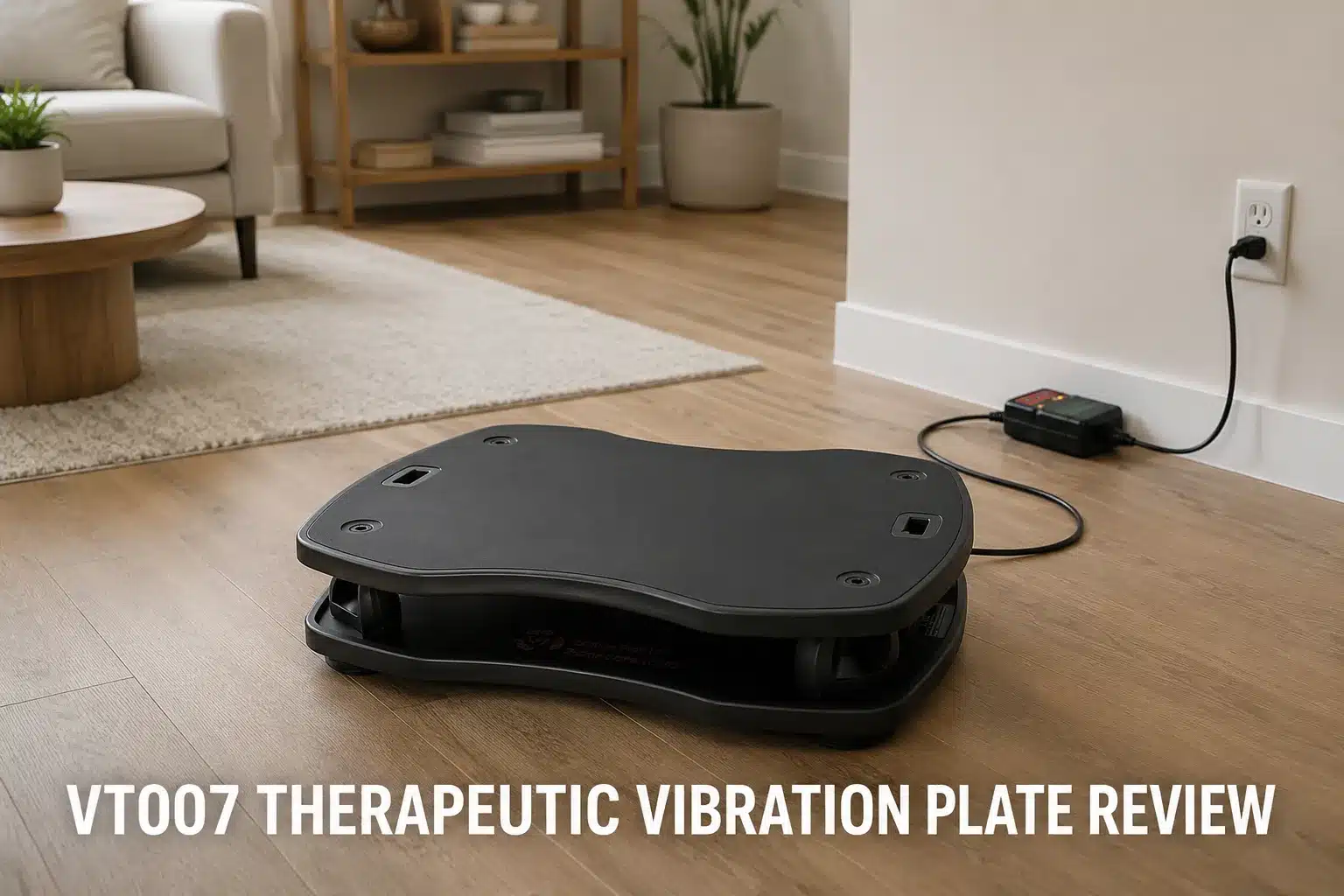
The first thing I notice about the VT007 is its industrial simplicity. The plate measures 22 inches long, 16.5 inches wide, and 5.7 inches high, while its total weight is 23 pounds.
The platform supports users up to 250 pounds. Its rectangular surface is more compact than the deck on many large fitness-focused vibration plates, but I still have enough room for a normal standing position, shallow squats, calf raises, and several static exercises.
The VT007 uses an 80 watt permanent magnet DC motor that operates between 900 and 2,400 RPM. More importantly, the motor produces linear vibration rather than side alternating oscillation.
This difference matters more than the motor wattage alone. On an oscillating vibration plate, one side rises while the other falls, creating a seesaw-like movement through the hips and legs.
The VT007 platform moves vertically, so my feet rise and fall together. I feel the vibration travel through my calves and thighs very quickly, and poor posture can allow more of that vibration to move toward my upper body.
For that reason, knee position matters much more on this plate than it does on some gentle oscillating models. I keep my knees slightly bent, which allows my leg muscles to absorb and respond to the vibration instead of sending as much of it directly upward.
The control system is another major difference. I can select a frequency within the plate's 10 to 40 Hz operating range, while manual mode allows direct adjustment from 15 to 40 Hz in 1 Hz increments.
There are also low and high amplitude settings. Low amplitude ranges from approximately 0.7 to 1.2 mm without load, while high amplitude ranges from around 1.5 to 2.6 mm without load.
Those numbers sound small when written down, but they do not feel small at higher frequencies. The combination of frequency and amplitude changes the session much more than a generic speed number.
A 20 Hz session at low amplitude feels completely different from 35 Hz at high amplitude. This is the main reason I consider the VT007 a specialist vibration plate rather than another general home fitness platform.
Unique Features
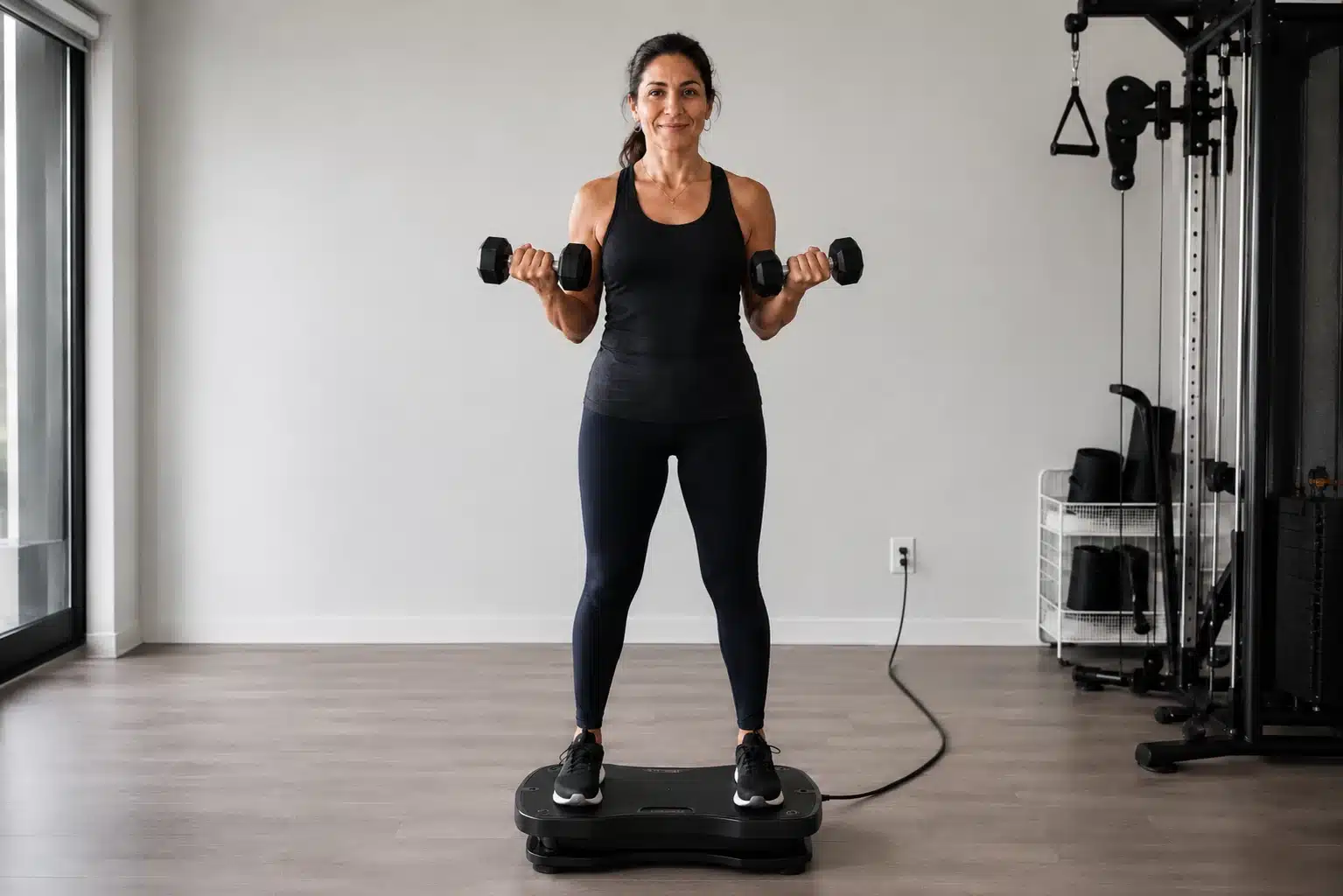
The VT007 stands out because it focuses on the core mechanics of vibration instead of packing the machine with entertainment and fitness accessories. Its most important features are directly connected to vibration quality and control.
- True linear vibration: The entire platform moves vertically in the same direction. This produces a very different stimulus from side alternating oscillation and gives the VT007 its fast, direct vibration feel.
- 10 to 40 Hz frequency range: The machine is designed around an adjustable 10 to 40 Hz vibration range. Manual mode allows direct control from 15 to 40 Hz.
- 1 Hz frequency adjustment: The VT007 allows small changes between frequencies. I can move from 20 Hz to 21 Hz instead of making a large jump between broad intensity levels.
- Two amplitude settings: Low and high amplitude give me another way to change intensity without relying on frequency alone.
- Manual control: I can choose session time, frequency, and amplitude according to the goal of my session.
- Three automatic programs: P1, P2, and P3 change frequency automatically every five seconds during a ten minute session.
- P3 mixed amplitude program: The third program changes both frequency and amplitude, creating a more varied vibration pattern.
- Simple control console and remote: The buttons on the control panel and remote perform the same basic functions.
- Universal 100 to 240V power supply: The power design makes the plate more flexible for different electrical systems.
- Modular construction: The control console and internal components are designed around a relatively simple, serviceable structure.
- 10 year warranty: The long warranty is unusual in the home vibration plate category.
What I appreciate most is that the VT007 does not hide its vibration output behind marketing terms. Frequency is measured in hertz, amplitude is given in millimeters, and the manufacturer also provides G-force data under different loads.
That level of technical information is rare. Many affordable vibration plates advertise 99, 120, or even 200 speed levels without telling me the actual frequency range.
The VT007 takes the opposite approach. I know what frequency I am selecting, and I can adjust it one hertz at a time.
For someone who wants a simple wellness plate, that may sound unnecessarily technical. For me, it makes the machine easier to use with a purpose.
Specs Table
| Parameter | Details |
|---|---|
| Brand/Model | Vibration Therapeutic VT007 |
| Vibration Type | Linear vertical vibration |
| Frequency Range | 10 to 40 Hz |
| Manual Frequency Range | 15 to 40 Hz |
| Frequency Adjustment | 1 Hz increments |
| Low Amplitude | 0.7 to 1.2 mm without load |
| High Amplitude | 1.5 to 2.6 mm without load |
| Nominal G-Force Without Load | 0.2 to 3.3 G |
| Nominal G-Force at 180 lb | 0.1 to 2.7 G |
| Motor | 80W PMDC motor |
| Motor Speed | 900 to 2,400 RPM |
| Machine Dimensions | 22 x 16.5 x 5.7 inches |
| Machine Weight | 23 lb |
| Weight Capacity | 250 lb |
| Manual Session Time | 1 to 20 minutes |
| Default Session Time | 10 minutes |
| Preset Programs | P1, P2, and P3 |
| Power Supply | Universal 100V to 240V |
| Control | Console and remote control |
| US Return Period | 90 days |
| US Warranty | 10 years |
The 10 to 40 Hz range is the specification I pay the most attention to. The overall vibration system is designed around this range, while manual control allows me to select frequencies from 15 to 40 Hz in 1 Hz increments.
I also think the dual amplitude system is more useful than having dozens of tiny speed changes. Frequency tells me how quickly the platform vibrates, while amplitude tells me how far it moves.
Changing either one affects the experience, and changing both can make the plate feel like a different machine. This gives me more meaningful control than a long list of unexplained speed numbers.
The 250 pound capacity is lower than the 330 pound capacity I see on several larger home vibration plates. I would respect that limit, especially because body weight affects the vibration output and measured G-force.
The 23 pound weight is a positive for moving the plate, but it creates one of the VT007's main weaknesses too. A high frequency linear vibration plate generates substantial mechanical force, so floor placement becomes very important.
Performance and Daily Comfort
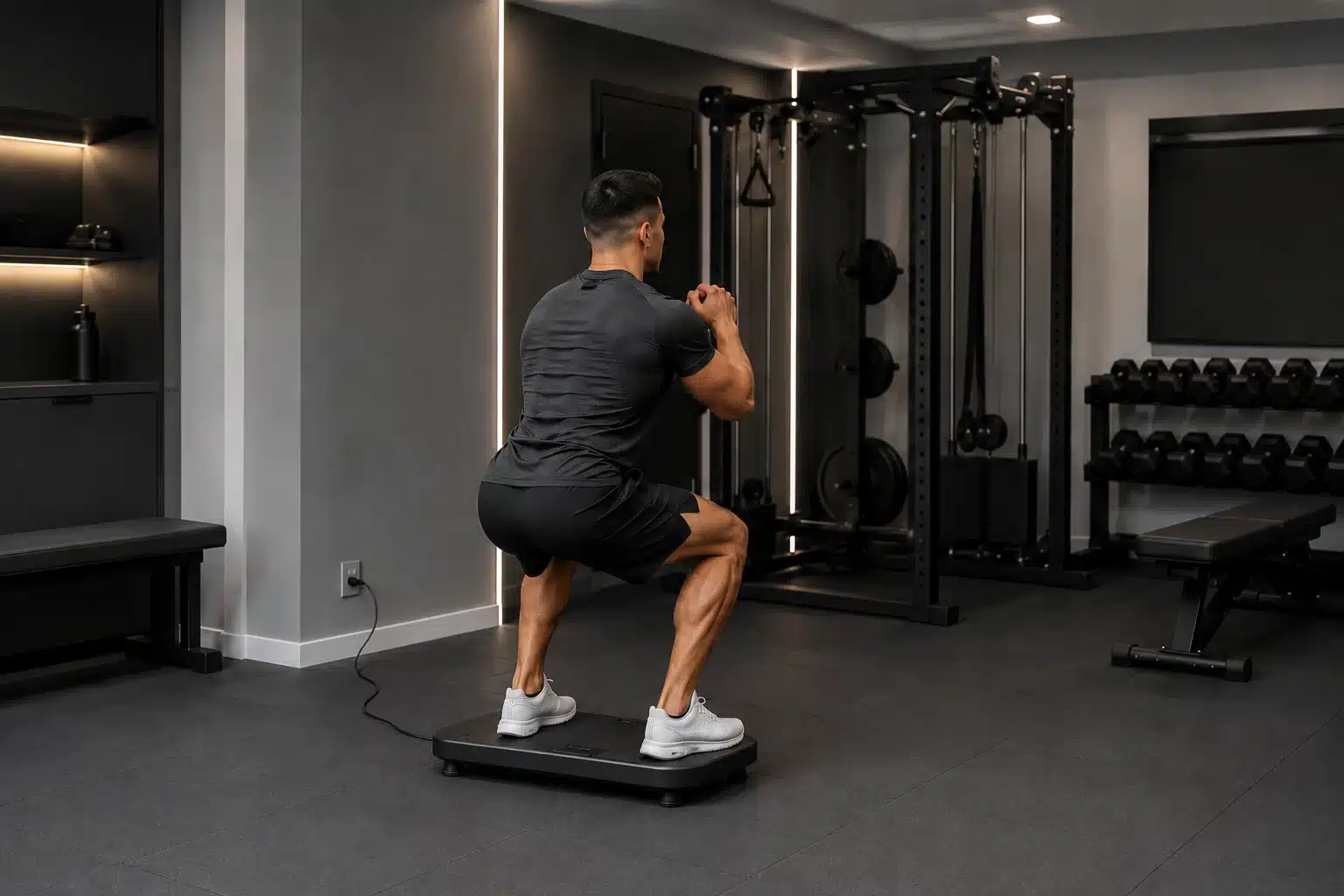
The VT007 does not give me the rolling, wave-like sensation of an oscillating vibration plate. Its vibration feels faster and more direct, particularly once I move into the middle and upper part of the frequency range.
At lower frequencies and low amplitude, I feel a controlled buzzing sensation through my feet and lower legs. My calf muscles respond quickly, especially when I keep a soft bend in my knees.
As I raise the frequency, the individual movements become harder to distinguish. The platform feels smoother in one sense because the vibration cycles happen so quickly, but the muscle stimulation becomes more noticeable.
The high amplitude setting changes the experience again. At the same frequency, high amplitude feels much more forceful because the platform is physically moving farther with every vibration cycle.
This is why I do not jump straight to 40 Hz and high amplitude. I prefer to learn how my body responds to one variable at a time and gradually increase the mechanical demand.
For a gentle session, I might start around the lower end of the manual frequency range and use low amplitude. If I want stronger muscle activation, I can raise the frequency gradually before testing high amplitude.
This approach gives me a much clearer idea of what is creating the stronger sensation. It also makes it easier to find settings I can repeat consistently instead of turning every session into an intensity test.
The VT007 feels different according to my posture too. Standing upright with locked knees is uncomfortable for me because too much vibration travels upward.
A slight bend in the knees changes that immediately. My calves, thighs, and hips absorb more of the mechanical vibration, so I feel more muscular activity and less vibration around my head.
A shallow squat increases the demand again. I do not need to squat deeply because holding a small knee bend while the platform moves at a moderate frequency is enough to make my quadriceps work.
Calf raises are another exercise I like on this plate. The direct vertical vibration and repeated calf contractions create a very active lower leg session without requiring a complicated routine.
The VT007 is not silent. High frequency vibration creates audible sound, especially as the frequency rises above approximately 20 Hz, and there is also mechanical noise from the moving components.
I would describe the sound as functional rather than refined. This is not a vibration plate designed to disappear quietly into a luxury bedroom.
The machine also makes a noticeable clunk when it starts or changes amplitude. The first time I heard it, I would have assumed something inside the machine had shifted.
That sound is part of the VT007's amplitude switching mechanism. The motor reverses direction to engage a different number of eccentric wheels, and the wheels strike the position block during the change.
P3 can produce the clunk several times because the program changes amplitude automatically. Once I understand why it happens, it does not concern me, but I think new users should know about it before their first session.
What’s Included
The VT007 package is much simpler than the accessory-heavy boxes I get with fitness-focused vibration plates. You receive the VT007 linear vibration plate, remote control, power components, and user documentation.
The control console is part of the machine's modular design. Both the console and remote provide the same basic controls for session time, frequency, amplitude, and program selection.
The current VT007 does not include hand straps. Older versions came with non-elastic straps intended to provide some balance assistance, but Vibration Therapeutic later removed them because flexible straps were not considered reliable balance support.
I agree with that decision. If I lose my balance on a vibration plate, pulling against a flexible strap can create another unstable force instead of giving me firm support.
A wall-mounted rail, stable handrail, or genuinely heavy piece of furniture provides more predictable support. This is particularly important with the VT007 because linear vibration can feel more direct through the body.
There are no resistance bands, Bluetooth speakers, or app controls. The standard setup is focused almost entirely on the vibration plate itself.
I would budget for a dense exercise mat or anti-vibration mat if I planned to use the VT007 on a hard floor. A large EVA exercise mat around half an inch thick can add friction and help reduce some vibration transfer into the floor.
The VT007 is a good example of why I separate accessories from actual vibration performance. A large box of bands can make a product look generous, but accessories do not tell me how well the vibration system is designed.
The VT007 gives me fewer extras. In return, its adjustable frequency and amplitude system is far more technically specific than the control system on many accessory-heavy plates.
Linear vibration delivers vertical displacement only, matching the mechanism used in clinical WBV trials on bone density, neuropathy, and circulatory outcomes rather than the rotational motion of consumer oscillation plates.
Frequency increments of 1 Hz across the 15-40 Hz range allow the session to be dialed precisely into the 20-30 Hz window for lymphatic and nerve stimulation or the 30-40 Hz range for bone density therapy.
Two amplitude modes — high (1.5-3.0 mm) and low (0.7-1.2 mm) — provide the dose differentiation that clinical protocols use for distinguishing between muscle activation and more sensitive nerve stimulation targets.
Linear vibration delivers vertical displacement only, matching the mechanism used in clinical WBV trials on bone density, neuropathy, and circulatory outcomes rather than the rotational motion of consumer oscillation plates.
Frequency increments of 1 Hz across the 15-40 Hz range allow the session to be dialed precisely into the 20-30 Hz window for lymphatic and nerve stimulation or the 30-40 Hz range for bone density therapy.
Two amplitude modes — high (1.5-3.0 mm) and low (0.7-1.2 mm) — provide the dose differentiation that clinical protocols use for distinguishing between muscle activation and more sensitive nerve stimulation targets.
Pros and Cons
| Pros | Cons |
|---|---|
| True linear vibration with direct vertical movement | Linear vibration can feel harsh if posture is poor |
| Adjustable 10 to 40 Hz frequency range | 250 pound capacity is lower than some competing plates |
| Manual frequency control in 1 Hz increments | Can transfer noticeable vibration into the floor |
| Low and high amplitude settings | Not recommended for weak wood frame floors or mobile homes |
| Three automatic programs | Makes a clunk when starting or changing amplitude |
| P3 changes both frequency and amplitude | No resistance bands or fitness accessories |
| Compact 22 x 16.5 inch footprint | No Bluetooth or app features |
| 23 pound weight is manageable for moving | No built-in handrail |
| Technical vibration data is clearly provided | Current model does not include hand straps |
| Universal 100 to 240V power supply | Learning frequency and amplitude takes more thought than using generic speed levels |
| 90 day US return policy | |
| 10 year US warranty |
The biggest advantage is precise vibration control. I know the frequency I am using, I can change it by 1 Hz, and I can choose low or high amplitude.
That is much more useful to me than choosing speed 73 on a vibration plate that provides no technical explanation of what speed 73 means. The settings on the VT007 tell me something about the actual movement of the platform.
The main disadvantage is floor vibration, and this is not a small issue I would hide in the fine print. The VT007 produces high frequency linear vibration, and some of that mechanical energy can transfer through the vibration plate and into the floor.
The problem becomes more important in wood frame homes. I would not place this vibration plate upstairs on a flexible wood floor and assume an exercise mat will solve everything.
A basement or solid ground floor is a much better location. The manufacturer also specifically advises against using the VT007 in a mobile home.
That restriction tells me something important about the machine. The VT007 is compact, but the vibration it produces is not mild.
Design and Build Quality

The VT007 has an industrial design that I find refreshingly honest. It does not try to look like a smart home device, and the simple rectangular shape keeps the focus on the vibration system.
The platform has a broad black training surface and a separate control area. The overall construction feels focused on the motor, vibration mechanism, springs, and control system rather than decorative features.
The machine weighs 23 pounds, which is light compared with premium commercial linear vibration platforms. It does not feel flimsy, though, and the current design uses reinforced construction based on the earlier VT003F platform.
The VT007 also uses a simplified mechanical structure intended to improve reliability and make servicing easier. I like this modular approach because vibration equipment experiences repeated mechanical stress during every session.
Bolts, springs, rubber, connectors, and electronic controls all deal with constant movement. A sealed vibration plate can become electronic waste when one small component fails.
The VT007 is designed to be serviced. Its control console uses a plug-and-play design, and the vibration plate can be disassembled with a screwdriver and basic wrenches.
Vibration Therapeutic states that replacement parts and modules are available for at least ten years after purchase. The US warranty also runs for ten years.
I consider that a major advantage for a vibration plate with a specialized motor and mechanical system. Long-term parts support matters more to me than an extra speaker or another set of resistance bands.
VT007 vibration plate reviews from verified buyers consistently echo this priority, with long-term users citing the ten-year warranty and available replacement parts as the reasons they chose it over cheaper alternatives.
The manufacturer's published first-year failure data is unusually detailed. It lists control console failure at 1.2 percent, remote control failure at 1 percent, and motor failure at 0.2 percent.
I rarely see a vibration plate company openly publish component failure percentages. That does not mean the VT007 is indestructible, but the transparency is useful.
The VT 007 vibration plate is the same machine regardless of how the name is spaced or spelled, and as a vt007 vibration plate exercise machine it supports standing protocols, squats, calf raises, and low-amplitude seated foot placement without requiring any accessories.
The rubber and upper plate connection can loosen over time, and mechanical noise may increase. Tightening the four corner bolts may help if gaps develop between the upper plate and supporting components.
This is not a zero-maintenance vibration plate. I would rather know that before buying it than discover it after the machine becomes noisier.
How to Use the VT007 for Best Results
I would not use the VT007 by randomly selecting a high frequency. My first goal is to learn how the plate feels at different frequencies and amplitudes while keeping my posture consistent.
- Place the plate on a solid floor. I prefer concrete or a solid ground floor and use a dense exercise mat to add friction and reduce vibration transfer.
- Step onto the plate before starting it. The VT007 is relatively light, and centrifugal force can cause the machine to drift when it runs without body weight.
- Start with low amplitude. I want to learn how a frequency feels before increasing the platform's movement.
- Keep the knees slightly bent. This helps the leg muscles absorb the vibration.
- Begin at a moderate frequency. I do not start at 40 Hz simply because it is available.
- Change one variable at a time. I adjust frequency or amplitude instead of changing both together.
- Use short sessions at first. Manual mode allows sessions from one to 20 minutes, with ten minutes as the default.
- Stop if the vibration feels uncomfortable around the head. I first check my posture, knee position, frequency, and amplitude.
For a simple circulation-focused routine, I stand with my feet comfortably apart and use low amplitude. I add slow calf raises after my body settles into the vibration.
For targeting the lymphatic system specifically, where lower-frequency and gentler vibration approaches are often more effective, I cover those options in my guide to the best vibration plate for lymphatic drainage.
For targeting the lymphatic system specifically, where lower-frequency and gentler vibration approaches are often more effective, I cover those options in my guide to the best vibration plate for lymphatic drainage.
Readers managing lower limb nerve sensitivity will find targeted model recommendations in my guide to the best vibration plate for neuropathy, which focuses on lower-frequency settings and gentler oscillating options.
For muscle activation, I use a shallow squat and keep the position controlled. I do not chase depth because the vibration already increases the amount of muscular adjustment required.
For readers focused on bone density specifically, I cover the most effective frequency ranges and session approaches in my guide to the best vibration plate for osteoporosis.
For readers focused on bone density specifically, I cover the most effective frequency ranges and session approaches in my guide to the best vibration plate for osteoporosis.
Readers who want to pair muscle activation work with a fat loss goal will find specific protocols and plate recommendations in my guide to the best vibration plate for weight loss.
For a hands-supported position, I can place my hands on the platform for a plank variation. I am more careful with upper body exposure because vibration entering through the arms feels different from standing on the plate.
The preset programs are useful when I do not want to adjust frequency manually. Each program changes frequency every five seconds during a ten minute session.
P1 uses low amplitude and changing frequencies, so I see it as the gentlest automatic option. P2 uses high amplitude and changes the frequency throughout the session.
P3 mixes both frequency and amplitude. This is the program I would leave until I understand how I respond to the vibration plate.
The repeated amplitude changes in P3 also produce the characteristic clunk sound during the program. I expect to hear it each time the amplitude mechanism switches.
Safety and Who Should Avoid It
The VT007 is sold as exercise equipment, not a medical device. I think that distinction is particularly important because the product name and therapeutic focus can create medical expectations.
Linear vibration can produce rapid repeated muscle contractions. That mechanical stimulation may be useful in exercise, muscle activation, and general movement routines, but it does not mean the VT007 has been proven to treat a specific disease.
I would speak with a qualified healthcare professional before using the vibration plate for a diagnosed musculoskeletal, neurological, or circulatory condition. The same applies after surgery or during rehabilitation.
For a condition like lymphedema, where vibration intensity requires careful calibration to avoid aggravating the affected limb, I cover dedicated low-impact options in my guide to the best vibration plate for lymphedema.
For a condition like lymphedema, where vibration intensity requires careful calibration to avoid aggravating the affected limb, I cover dedicated low-impact options in my guide to the best vibration plate for lymphedema.
People with significant balance problems should use rigid support. The current VT007 does not include balance straps, and I would not improvise with elastic resistance bands.
Older users or anyone who prioritises stability over vibration intensity will find gentler oscillating options in my guide to the best vibration plate for seniors, which covers machines with lower G-force output and wider platform surfaces.
I also respect the 250 pound user limit. The vibration specifications change under load, and the manufacturer publishes lower G-force measurements at a 180 pound load than under no load.
This is normal because body weight affects how the platform and vibration system behave. It is also a reminder that published no-load specifications do not perfectly describe what every person will experience.
Floor safety deserves equal attention. I would avoid flexible wood floors and would not use the VT007 in a mobile home.
I would also never leave the machine running without body weight on the platform. The vibration plate can drift because centrifugal force can overcome the friction created by its relatively light 23 pound body.
How the VT007 Compares to Other Vibration Plates
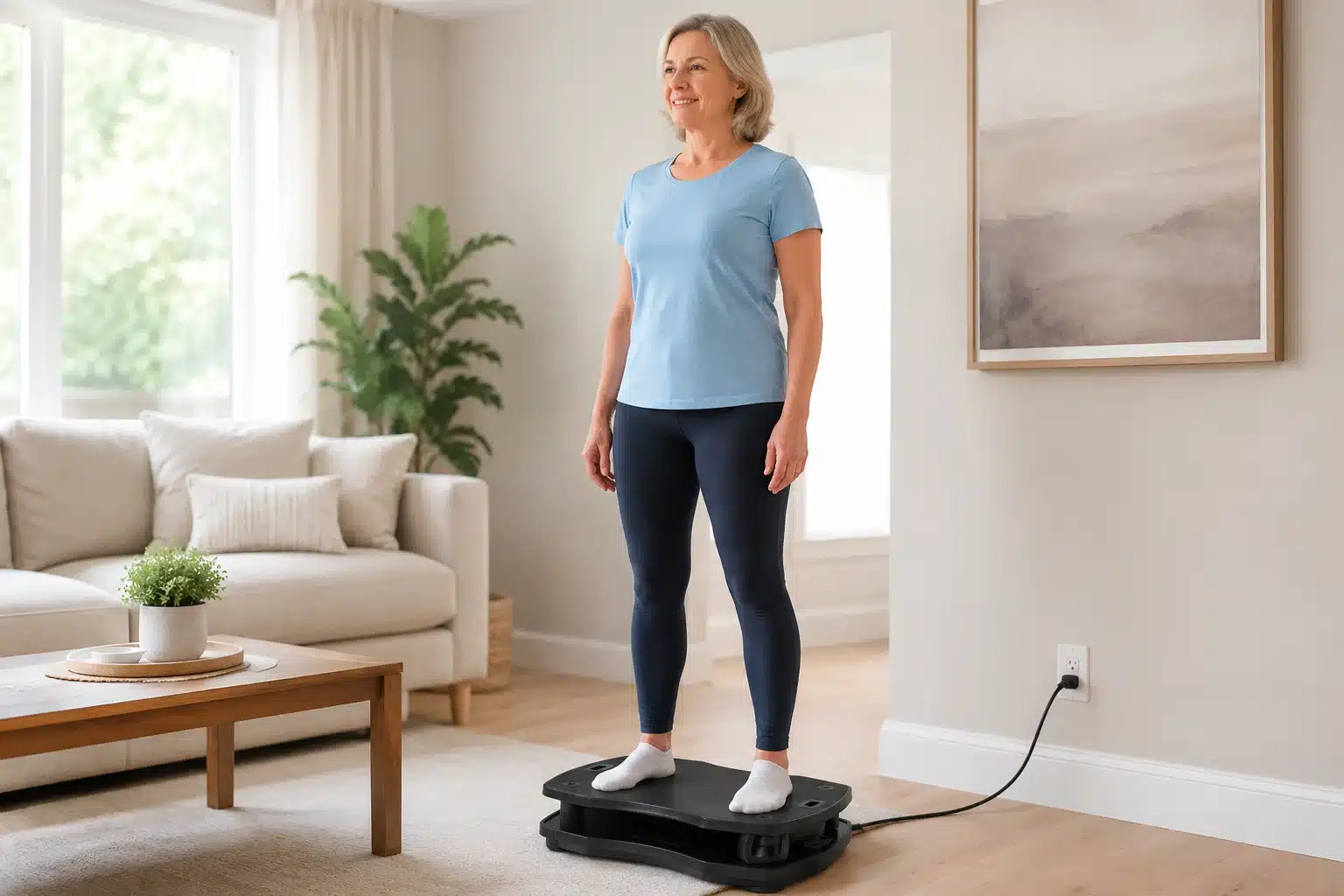
The VT007 is almost the opposite of the Lifepro Rumblex Pro 4D. The Rumblex Pro uses three motors to produce oscillation, lateral movement, and pulsation, while the VT007 uses one focused linear vibration system.
The Rumblex Pro gives me seven modes, 60 speed levels, Bluetooth speakers, a wearable remote, and a large resistance accessory kit. The VT007 gives me direct frequency and amplitude control.
If I want exercise variety and several movement patterns, I prefer the Lifepro Rumblex Pro 4D. If I want a technically specific linear vibration plate with adjustable hertz and two amplitude levels, the VT007 is much more focused.
Readers drawn to the Lifepro range who want to compare its models head to head will find my picks and testing notes in the best Lifepro vibration plate guide.
The difference is even greater when I compare the VT007 with a basic oscillating vibration plate. An oscillating plate creates side alternating movement, which I often find comfortable for gentle circulation sessions and beginners.
For goals like skin smoothing and cellulite reduction where oscillating or multidirectional motion is often preferred, I cover the top options in my guide to the best vibration plate for cellulite.
For goals like skin smoothing and cellulite reduction where oscillating or multidirectional motion is often preferred, I cover the top options in my guide to the best vibration plate for cellulite.
The VT007 moves both feet vertically at the same time. Its vibration feels faster and more direct, especially as I raise the frequency and amplitude.
This is why I would not tell a beginner that all vibration plates feel basically the same. The vibration type changes how the platform moves and how the mechanical stimulus reaches the body.
My guide to the best vibration plate covers both linear and oscillating options across several price points, so readers can see exactly where the VT007 sits relative to the broader category.
I also think the VT007 makes more sense for technically curious users. If you do not care about hertz, amplitude, or linear vibration, you may find its main advantages unimportant.
A cheaper oscillating vibration plate can still support simple home movement and exercise. If I want precise frequency selection, however, the VT007 gives me something most low-cost plates do not.
For buyers researching the best linear vibration plate for home use, the VT007 is consistently one of the top options in its price range, with the Infinity Pro models sitting above it and the VT003F below it in the same manufacturer lineup.
If you are drawn to the multidirectional approach rather than the linear focus of the VT007, my Fitboard 3D review covers the Sunny Health & Fitness three-mode home plate in detail.
Readers still weighing options across different budgets and vibration types will find my full comparison in the best vibration plate for home use guide useful before committing to a machine.
My Final Thoughts and Recommendation
After looking closely at the VT007, I think its biggest strength is focus. This vibration plate is built around linear vibration and gives me meaningful control over how that vibration is delivered.
The 10 to 40 Hz operating range, 1 Hz manual frequency changes, and two amplitude settings let me adjust the actual vibration stimulus. I do not need 200 speed levels, flashing lights, or a speaker built into every piece of fitness equipment in my home.
I want to know what the platform is doing beneath my feet. The VT007 gives me that information in a way many home vibration plates do not.
Its 22 by 16.5 inch platform is compact but usable, while the 23 pound weight makes occasional moving manageable. The 80W PMDC motor creates a much more serious vibration experience than the machine's simple appearance suggests.
The three programs are useful, but I prefer manual mode. Being able to choose a specific frequency and switch between low and high amplitude is the main reason I would buy this vibration plate.
There are drawbacks. The 250 pound capacity is lower than many home vibration plates, and floor vibration can be a real problem in wood frame homes.
The clunk during amplitude changes can also surprise new users. There are no resistance bands, speakers, app controls, or fixed handrails.
For me, none of those issues changes what the VT007 does well. This is not the vibration plate I recommend to everyone, but it is a strong option for people who specifically want linear vibration and value frequency control more than accessories.
Readers managing plantar fasciitis who want a gentle, low-impact approach to heel and arch stimulation will find specific plate options in my guide to the best vibration plate for plantar fasciitis.
Readers managing plantar fasciitis who want a gentle, low-impact approach to heel and arch stimulation will find specific plate options in my guide to the best vibration plate for plantar fasciitis.
Readers whose main focus is lower body circulation support will find targeted picks and frequency guidance in my guide to the best vibration plate for circulation.
For circulation-focused use, controlled muscle activation, and technically structured vibration sessions, the VT007 is one of the more interesting consumer linear plates I have reviewed. I rate the VT007 Therapeutic Vibration Plate 4.7 out of 5.
FAQs
What type of vibration does the VT007 use?
The VT007 uses linear vertical vibration. The entire platform moves up and down in the same direction, so both feet receive the vibration at the same time. This creates a faster and more direct sensation than the side alternating motion of an oscillating vibration plate.
What frequency does the VT007 vibration plate use?
The VT007 vibration plate operates across a 10 to 40 Hz vibration range, with manual frequency adjustment from 15 to 40 Hz in 1 Hz increments. This allows me to select a specific vibration frequency instead of relying on generic speed levels.
What is the difference between low and high amplitude on the VT007?
The difference between low and high amplitude on the VT007 is how far the platform moves during each vibration cycle. Low amplitude is approximately 0.7 to 1.2 mm without load, while high amplitude is around 1.5 to 2.6 mm. High amplitude creates a stronger vibration sensation at the same frequency.
Is the VT007 good for circulation?
Yes, the VT007 can support circulation by creating rapid repeated muscle contractions during vibration. I find low amplitude standing sessions and controlled calf raises useful for lower body muscle activity, but the VT007 is exercise equipment and should not replace medical treatment for a circulatory condition.
Is the VT007 Therapeutic Vibration Plate worth it?
Yes, the VT007 Therapeutic Vibration Plate is worth it for people who specifically want linear vibration, direct frequency control, and dual amplitude settings. Its 10 year warranty and serviceable construction add value, but I would choose a different plate if I needed built-in handrails, a higher weight capacity, or gentler oscillating motion.