
About the author: Hello! I’m Vladimir Stanar, professor of physical education, kinesiotherapist, marathon runner, cyclist, and cycling coach, and long-time advocate of health, fitness, and active living.
My journey with vibration plates runs parallel to my professional career in education, sports medicine, and athletic development. I’ve developed a unique process for testing vibration plates as they are some of the most versatile tools for enhancing health, recovery, and performance.
✅ Expert-Reviewed by: Vanja Vukas, MPhEd
📚 Expert Contributor: Milutin Tucakov, MPhEd
Getting older often feels like a slow trade-off. We trade our flexibility for stiffness. We trade our confidence in walking for a fear of falling. I see this happen with my own family members, and I hear it from our community every day. You want to stay active, but your joints just don’t agree with the pavement anymore.
This is where Whole Body Vibration (WBV) enters the picture. Vovration plates aren't just a fitness trend for young athletes. They are actually one of the most effective, low-impact tools for older adults. I have spent years testing these machines, and I can tell you that the vibration plate benefits for elderly users are profound.
You don’t need to jump or run. You don’t even need to lift heavy weights. The plate does the hard work for you. It stimulates your muscles, bones, and nerves while you simply stand or sit. It sounds too good to be true, but the science behind it is solid.
In this guide, I am going to walk you through exactly how these machines help. I will cover the specific benefits for your bones and balance. I will also explain the technical settings you need to know to stay safe. Let’s get moving.
Major Vibration Plate Benefits for Elderly Users
When we talk about exercise for seniors, we usually think of walking or water aerobics. Those are great, but they miss a crucial element. They don't always provide enough stimulus to strengthen bone density or improve fast-twitch muscle response.
Vibration plates fill that gap. The vibration sends energy waves through your body. Your body has to react to these waves. It does this by contracting muscles dozens of times per second.
Here is a deep look at the primary ways this technology changes the game for older adults.
Fighting Osteoporosis and Building Bone Density
One of the biggest fears as we age is breaking a bone, especially the hip. Osteoporosis makes bones brittle. A simple fall can turn into a life-altering event.
Our bones are living tissue. They react to stress. When you walk or lift things, you put stress on the bone. The bone responds by adding more calcium and getting denser. This is known as Wolff's Law.
But here is the problem. As we get older, we stop lifting heavy things. We walk less. Our bones stop getting that signal to stay strong.
A vibration plate mimics that stress. When you stand on the plate, the vibrations create a mild G-force. It might feel gentle to you, but your skeleton perceives it as a load.
The vibration stimulates osteoblasts. These are the cells responsible for building new bone. Research suggests that frequencies between 25Hz and 30Hz are best for this.
Using a plate regularly can help slow down bone loss. It can even help rebuild density in the spine and hips. It does all of this without you having to lift a heavy barbell.
Improving Balance and Reducing Fall Risks
Falls are the leading cause of injury for seniors. Balance isn't just about having strong legs. It is about communication. Your brain needs to talk to your feet.
Your feet have thousands of sensors. These sensors tell your brain where you are in space. This is called proprioception. As we age, these sensors get dull. The signal gets weak.
When you stand on a vibrating platform, you wake up those sensors. The vibrations are fast. Your body has to make tiny, micro-adjustments to stay steady. You might not even feel your muscles working, but they are.
Your core muscles fire rapidly to stabilize your spine. The small stabilizer muscles around your ankles and knees light up.
This creates a stronger neural pathway between your feet and your brain. After a few weeks of use, many users report feeling more "grounded." They trust their feet more. If you do trip in daily life, your body is ready to react faster to catch you.
If you are looking for a machine specifically designed to help with stability, you should check our guide on the best vibration plates for seniors. These models often come with handlebars, which are essential for balance training.
Boosting Circulation and Lymphatic Drainage
Have you ever noticed your ankles getting puffy after a long day? Or maybe your feet always feel cold? Poor circulation is a common struggle for older adults.
Your heart pumps blood out to your body. But getting that blood back up from your legs against gravity is hard work. Your body relies on muscle movement to pump that blood back to the heart.
If you aren't moving much, that fluid pools in your legs. This causes swelling, known as edema.
A vibration plate acts like a second heart for your legs. The rapid muscle contractions pump blood and lymph fluid efficiently. It flushes out toxins and reduces swelling.
I often recommend using the plate just for massage. You can sit in a chair and place your feet on the machine. The vibration moves the fluid without raising your heart rate. It provides immediate relief for tired, heavy legs.
Vibration Plate Benefits for Seniors Dealing with Pain
Pain is the main reason people stop moving. It is a vicious cycle. You hurt, so you sit. You sit, so you get stiff. You get stiff, so you hurt more.
Breaking that cycle is hard. High-impact exercise is often out of the question. You can’t just go for a jog if you have bad knees.
This is why the vibration plate benefits for seniors focused on pain relief are so valuable. It allows you to move without the impact.
Alleviating Joint Pain and Arthritis
Motion is lotion. That is a saying we use a lot. Your joints have fluid inside them called synovial fluid. This fluid nourishes the cartilage and keeps things moving smoothly.
But the fluid only moves when you move. If you are sedentary, your joints dry out and stiffen up.
Vibration therapy gently mobilizes the joints. It circulates that synovial fluid. It warms up the area and reduces the friction that causes arthritis pain.
The key here is the low impact. When you walk, your knees take a hit with every step. On a vibration plate, your feet never leave the ground. There is zero impact shock.
You get the benefits of movement—increased blood flow and lubrication—without the pounding. Many of our users with knee osteoarthritis find they can stand on the plate comfortably when they can’t walk for long distances.
Easing Back Pain and Sciatica
Back pain can be debilitating. Often, it comes from tight muscles or a weak core.
The vibration plate works in two ways here. First, it strengthens the deep abdominal muscles. These muscles support your spine. A stronger core means less pressure on your lower back.
Second, the vibration acts as a deep tissue massage. It relaxes tight muscles in the lower back and hips.
If you suffer from sciatica, the gentle vibration can help soothe the nerve irritation. It relaxes the piriformis muscle, which often pinches the sciatic nerve.
However, you must be careful with your posture. Never lock your knees. Keeping a soft bend in your knees ensures the vibration goes to your muscles, not your head.
Combating Sarcopenia (Muscle Loss)
Sarcopenia is the medical term for age-related muscle loss. After age 30, we start losing muscle mass. By age 60, the process speeds up.
Losing muscle makes you weak. It makes it harder to get out of a chair or carry groceries.
To keep muscle, you usually need resistance training. But lifting weights can be intimidating or unsafe for some older adults.
Vibration plates induce involuntary muscle contractions. When the plate moves, your muscles reflexively contract to keep you stable.
This happens 30 to 50 times per second. Even if you are just standing there, your leg and glute muscles are working hard. This helps preserve muscle mass. It keeps your legs strong enough to support your daily activities.
For those specifically looking to combat muscle loss while keeping bones strong, taking a look at our roundup of the best vibration plates for osteoporosis can help you find a machine with the right frequency specs.
Understanding the Mechanics: Is It Safe?

I know what you might be thinking. "Is it really safe for me to shake my body at my age?"
That is a valid question. The answer is yes, but only if you understand the mechanics. Not all vibration is the same. The settings you choose matter immensely.
To truly understand the vibration plate benefits for older adults, we have to look at the technical details. We need to talk about the type of movement, the speed, and the intensity.
Oscillating vs. Linear Vibration for Older Adults
There are two main types of vibration movements.
Linear (Vertical) Vibration: This moves straight up and down. It is very intense. It mimics a hard jump landing. While it is great for pro athletes, I generally do not recommend high-intensity linear vibration for seniors. It can be jarring to the spine and neck.
Oscillating (Pivotal) Vibration: This is the type you want. Imagine a teeter-totter. The plate has a center fulcrum. When one side goes up, the other goes down.
This motion mimics the natural movement of walking. Your hips move side to side. It feels much more natural to the body.
Oscillation is far safer for older adults. It reduces the vibration that travels to the head. It protects the spine while still giving you a great workout. Most machines on the market today use this style, but always double-check before you buy.
The Importance of Low Frequency and Amplitude
You will see numbers on the machine display. Usually, these are Frequency (Hz) and Amplitude (mm).
Frequency (Hz): This is how fast the plate vibrates per second.
- 10Hz - 15Hz: This is slow. It is great for balance, mobilization, and relaxation.
- 20Hz - 30Hz: This is the sweet spot for bone density and muscle toning.
For seniors, I recommend starting low. Start at a lower setting to get used to the sensation. You never want to start at the highest speed.
Amplitude (mm): This is how far the plate moves up and down.
- High Amplitude (approx 10mm): This creates a lot of movement. It is physically difficult.
- Low Amplitude (1mm - 2mm): This is gentle.
For elderly users, Low Amplitude is key. You want the vibration to be subtle. High amplitude combined with high speed creates high G-force.
Understanding G-Force: G-force is the load placed on your body.
- Walking creates about 1G to 1.2G of force.
- Running creates 2G to 3G.
On a vibration plate, we want to keep the G-force low, especially when starting. By keeping the amplitude low (your feet closer to the center of the plate) and the frequency moderate, you keep the G-force safe.
If you stand with your feet wide apart on an oscillating plate, the amplitude is high. The movement is big. If you bring your feet closer to the center, the movement is small.
My advice for seniors is always: Start with your feet close together. Use a low speed. See how you feel. You can always increase the intensity later, but you cannot undo a sore back from overdoing it on day one.
If you are looking for a machine that offers precise control over these settings, our review of the best vibration plates for home use highlights several models that are user-friendly and safe for beginners.
How to Use a Vibration Plate as an Older Adult

Buying the machine is the easy part. Using it can feel a little intimidating at first. I remember when my aunt first got hers. She stared at it for a week before she turned it on. She was worried it would shake her too hard or that she might lose her balance.
That fear is normal, but it is unnecessary if you approach it the right way. The goal isn't to train like an Olympian. The goal is consistency and safety. Start with learning about vibration plate dos and don'ts.
Now, here is my step-by-step guide on how to ease into using a vibration plate safely.
Starting Slow: The Seated Approach
This is the absolute best way to start. You do not even need to stand on the machine.
Place the vibration plate in front of a comfortable chair. Sit down in the chair. Place your feet flat on the plate. Now, turn it on to the lowest setting.
This method delivers about 80% of the vibration benefit to your legs without any risk of falling. You are completely stable.
I recommend doing this for the first week. It lets your body get used to the sensation of the vibration. It also does wonders for circulation in your lower legs. If you have swelling in your ankles, this seated method is fantastic. The next step would be to reap the benefits of sitting on a vibration plate.
For those who struggle with standing for long periods, we have a specific guide on the best vibration plates for circulation that highlights machines with lower profiles and gentler motors perfect for this seated technique.
Transitioning to Standing
Once you feel comfortable with the seated method, you can try standing. But there are rules.
1. Hold on to something. If your machine has handlebars, hold them. If it is a flat plate, place it in front of a sturdy counter or a high-back chair. Never stand on the plate without having something stable to grab.
2. Wear the right shoes. I usually tell younger users to go barefoot to stimulate the nerves. For seniors, I recommend wearing supportive sneakers with rubber soles. The rubber absorbs some of the vibration and gives you better grip. It prevents slipping.
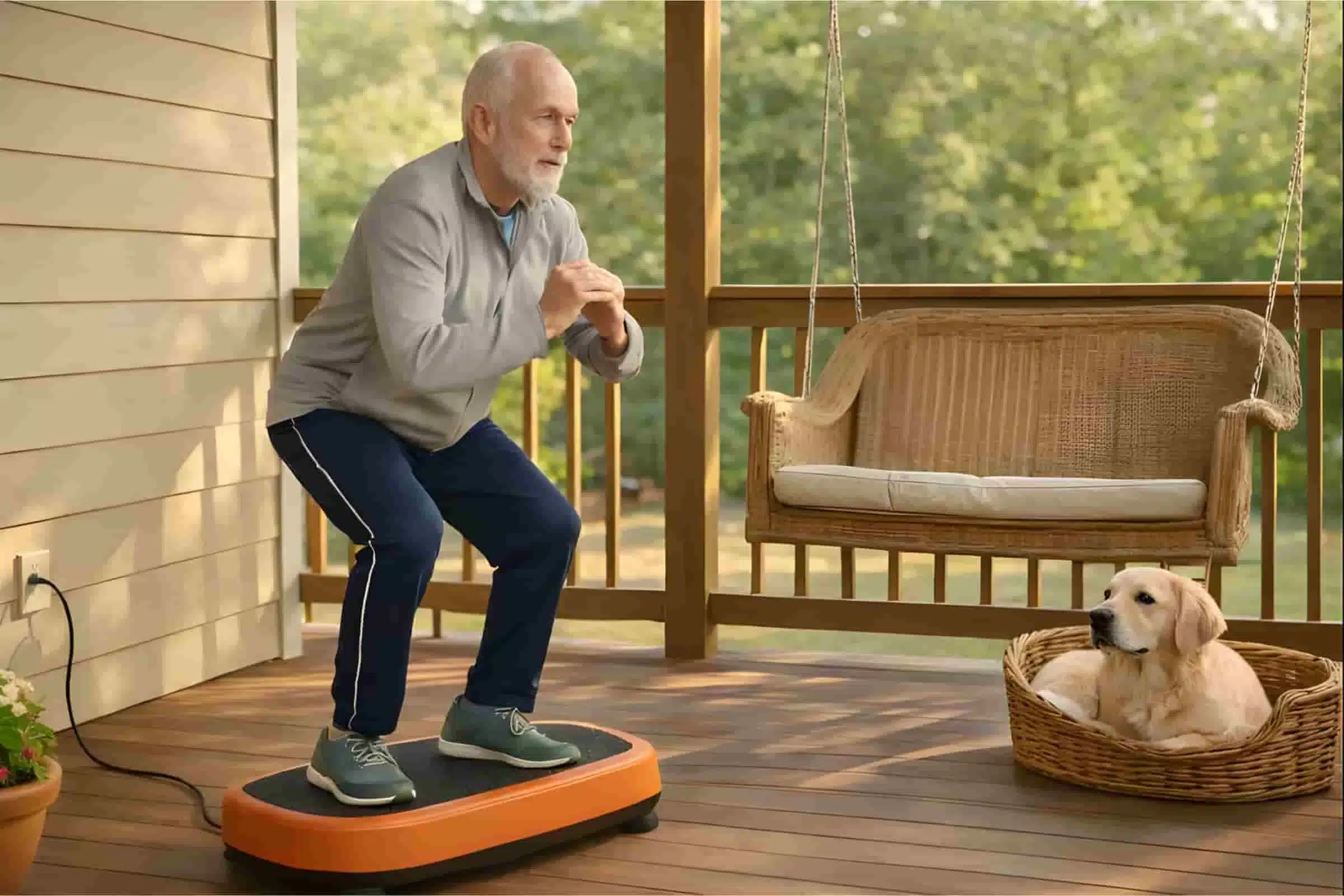
3. The Golden Rule: Never Lock Your Knees. This is the most important rule in the book. When you stand on the plate, you must keep your knees bent.
Think of your legs like shock absorbers on a car. If your legs are straight and locked, the vibration travels straight up through your hips and spine to your head. It feels terrible. It causes headaches and dizziness.
When you bend your knees, your muscles absorb the vibration. The vibration stops at your hips. Your muscles get a workout, and your head stays still.
Duration and Frequency
You do not need to spend an hour on this thing. In fact, you shouldn't.
Whole Body Vibration is efficient. Because your muscles are contracting so fast (30 times a second), you get a lot of work done in a short time.
I recommend starting with just 5 minutes a day. Do this for a week. See how your joints feel. See how your energy levels are.
If you feel good, you can work your way up to 10 or 15 minutes.
Most studies on the vibration plate benefits for seniors show that consistency beats duration. It is better to do 10 minutes every day than 30 minutes once a week.
Make it part of your morning routine. I like to use mine while I watch the morning news. By the time the weather report is over, my workout is done.
Remember, the best vibration plate is the one you actually use. Start slow, listen to your body, and enjoy the movement.
5 Simple Exercises for Vibration Plate Benefits for Older Adults
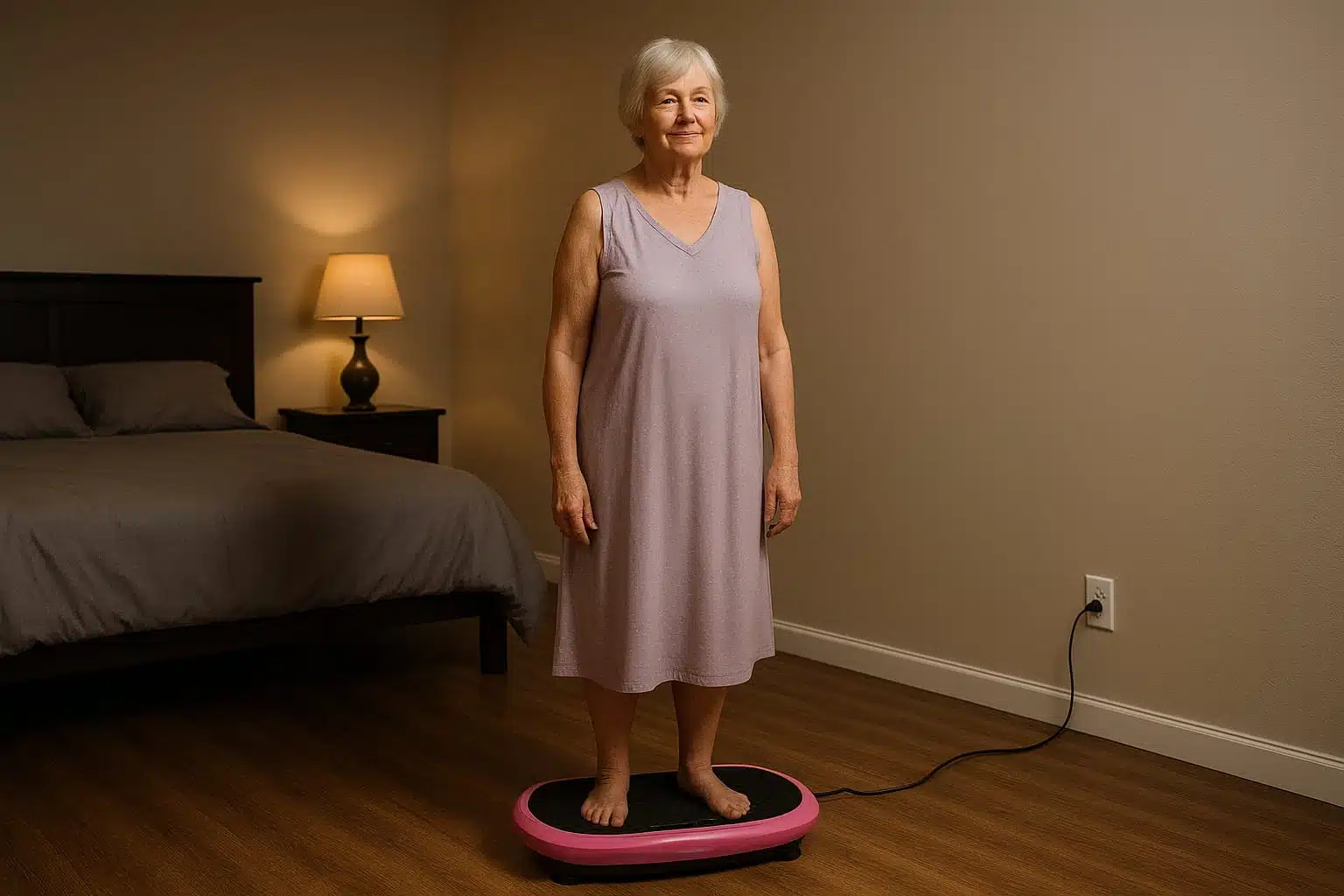
You don't need a complex routine. You don't need to do lunges or push-ups. Simple, static positions are incredibly effective.
Here are five exercises specifically designed to maximize the vibration plate benefits for older adults while keeping safety the top priority.
1. The Seated Calf Massage
We already talked about this, but it is worth repeating as an exercise. This is your warm-up.
- How to do it: Sit in a chair. Place both feet flat on the plate. Set the frequency to low.
- Time: 2 minutes.
- Benefit: This wakes up the blood vessels in your feet and calves. It prepares your nervous system for movement. It is also very soothing if you have restless legs.
If getting down to the floor is difficult for you, or if you need a machine that fits easily under a chair, check out our list of the best vibration plates for lymphatic drainage. These compact units are perfect for this specific movement.
2. The Basic Stance (Holding Rails)
This is your bread-and-butter move for bone density.
- How to do it: Step onto the plate. Hold the rail or counter firmly. Place your feet about shoulder-width apart. Bend your knees slightly. Keep your back straight and look forward.
- Time: 1 to 2 minutes.
- Benefit: This engages your core, glutes, and quads. It sends the vibration signal through your hips and spine to stimulate bone growth.
3. The Pelvic Tilt
Back pain is common as we age. This move helps loosen the lower back.
- How to do it: Stand in your Basic Stance with knees bent. Slowly tilt your pelvis forward and backward. Imagine you are tucking your tailbone between your legs, then sticking it out.
- Time: 1 minute.
- Benefit: The vibration helps relax the tight muscles in the lumbar region. The gentle motion improves mobility in the hips.
4. The Gentle Squat
We need leg strength to get out of chairs and climb stairs. This exercise builds that strength safely.
- How to do it: Start in your Basic Stance. Hold the rail. Slowly lower your hips a few inches, as if you are about to sit in a high stool. Hold that position. You don't need to go deep. Just a few inches is enough to make your quads fire.
- Time: 30 seconds to 1 minute.
- Benefit: This strengthens the quadriceps and glutes. Stronger legs mean less pressure on your knee joints during the day.
5. The Hamstring Stretch
Flexibility is vital for preventing injury.
- How to do it: Turn the machine off for a moment. Stand on the floor in front of the machine. Place one heel on the plate. Keep that leg straight but soft (don't lock the knee). Hinge forward at the hips slightly until you feel a stretch in the back of your thigh.
- Option with Vibration: If you are stable, you can turn the machine on low. The vibration helps the muscle relax into the stretch.
- Time: 30 seconds per leg.
- Benefit: Looser hamstrings reduce lower back pain and improve your walking stride.
Who Should Avoid Vibration Plates?
I love these machines. I think they are wonderful tools. But I also know they are not for everyone.
There are specific medical conditions where vibration therapy is unsafe. We have to be honest about this. You should always talk to your doctor before starting any new exercise, but this is doubly true for vibration plates.
Here are the main contraindications where you should likely avoid using the machine.
Pacemakers and Heart Conditions
If you have a pacemaker or a serious heart condition like arrhythmia, you should avoid vibration plates.
The magnetic field from the motor can potentially interfere with the electronics of a pacemaker. Furthermore, the vibration increases blood flow and heart rate. For someone with severe cardiovascular disease, this unmonitored stress on the heart could be risky.
Recent Implants (Hip or Knee Replacements)
This one is debated, but I prefer to err on the side of caution.
If you have had a joint replacement recently (within the last 6 to 12 months), do not use a vibration plate. The bone needs time to heal and fuse with the implant.
The concern is that vigorous vibration could theoretically loosen the implant before it is fully set. Once you are fully healed and your doctor gives the green light, it can actually be good for strengthening the bone around the implant. But do not rush it.
Acute Thrombosis or Blood Clots
This is a strict no. If you have Deep Vein Thrombosis (DVT) or are at high risk for blood clots, do not use a vibration plate.
The machine is designed to increase circulation. If you have a clot, the vibration could dislodge it. If that clot travels to your lungs or heart, it is a life-threatening emergency.
Recent Surgeries or Wounds
If you are recovering from any surgery—hernia repair, appendix removal, or even eye surgery—stay off the plate.
Vibration vibrates everything. It can disrupt the healing of incisions or sutures. Wait until you are fully recovered.
Other Conditions
There are other conditions to be wary of:
- Severe Migraines: The vibration can trigger headaches in sensitive people.
- Detached Retina: The vibration can worsen eye issues.
- Advanced Osteoporosis: While vibration helps prevent bone loss, if your bones are already extremely brittle (severe osteoporosis), the vibration might be too much stress. You need a doctor's approval first.
Understanding these risks ensures you stay safe. The goal is to improve your quality of life, not risk it. If you fit into the safe category, the benefits usually far outweigh the risks.
It is about finding the right balance. Listen to your body. If something feels wrong, stop. If it feels good, keep going. It is that simple.
Final Thoughts on Active Aging Using Vibration Plates
We have covered a lot of ground here. From building bone density to soothing stiff joints, the vibration plate benefits for elderly users are clear. It is not just about exercise. It is about keeping your independence.
It is about having the confidence to walk to the mailbox without fear of slipping. It is about having the leg strength to get up from the dinner table easily. It is about feeling good in your body again.
You do not need to run marathons to be healthy. You just need to keep moving. A vibration plate offers a way to keep moving that is safe, low-impact, and effective. It fits into your living room, and it fits into your life.
FAQs
Is a vibration plate safe for seniors?
Yes, when used at low intensity and with proper support. Most older adults tolerate vibration plates well when sessions are short and the plate has a stable handle. Sneakers are recommended.
What accessories do I need for a vibration plate workout?
The accessories you need for a vibration plate workout are minimal, but a sturdy chair or stability bar is essential for seniors. While many plates come with resistance bands, your priority should be safety. Placing a high-back chair in front of the plate gives you something to hold onto. This ensures you stay balanced while your feet get used to the vibration.
Can I use my vibration plate in sneakers?
Yes, you can use your vibration plate in sneakers, and I actually recommend it for older adults. While barefoot training is good for younger users to stimulate nerves, sneakers provide grip. The rubber sole acts as a small buffer. It dampens the vibration slightly and prevents your feet from sliding off the vibrating surface.
How often should a 70-year-old use a vibration plate?
A 70-year-old should use a vibration plate about 3 to 4 times a week for 10 to 15 minutes per session. You do not need to use it every single day to see results. Your body needs recovery time to build bone and muscle. Consistency is more important than intensity, so finding a schedule you can stick to is key.
Does a vibration plate help with knee pain?
Yes, a vibration plate helps with knee pain by increasing circulation and lubricating the joint fluid without impact. Because your feet never leave the plate, there is no shock to the knee joint like there is with walking or running. The gentle vibration helps massage the muscles around the knee, which can reduce stiffness and improve your range of motion.