
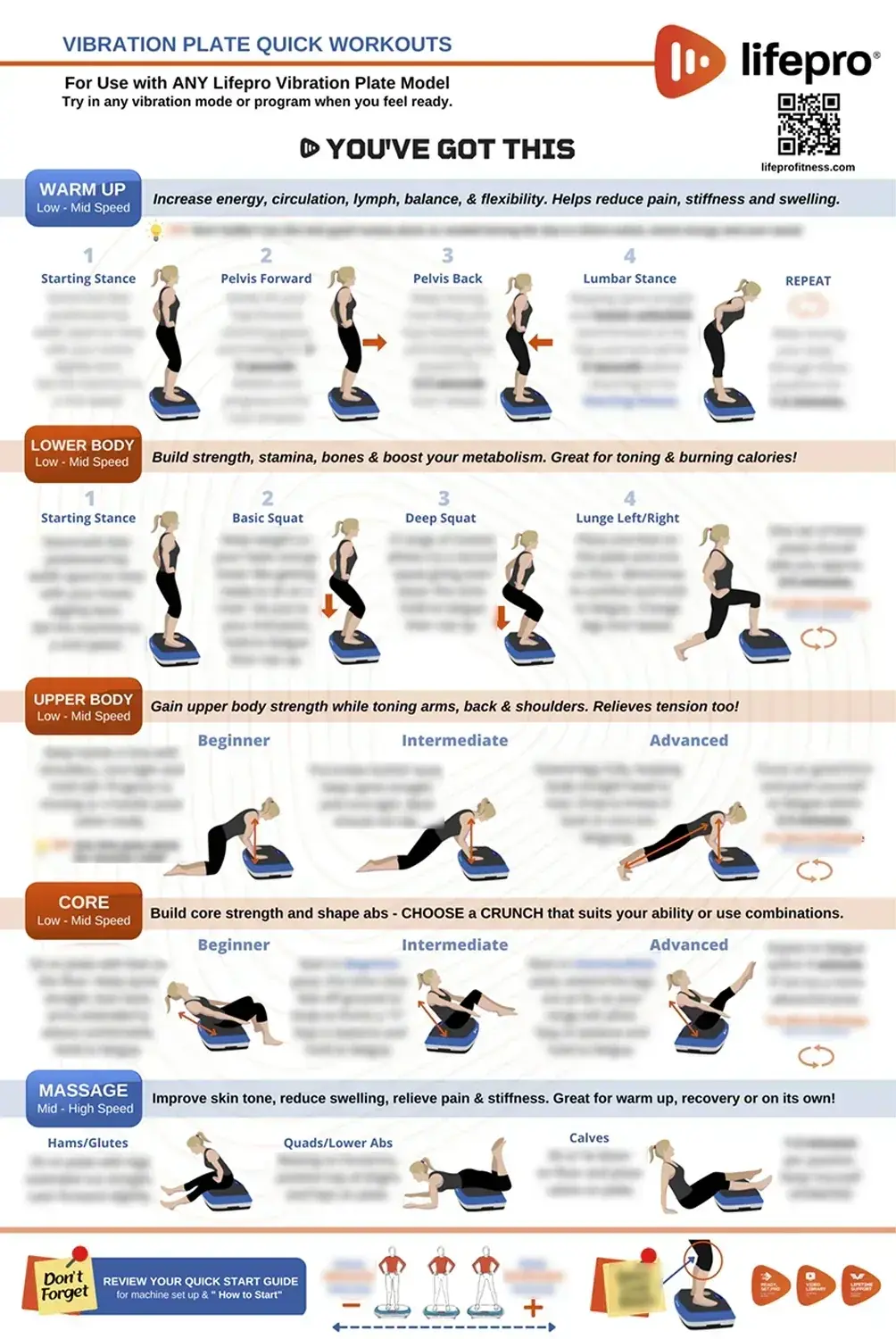
Get a FREE Lifepro Whole Body Vibration Workout Chart with exclusive Vibration Plate Zone Coupon Code!
For a limited time, Vibration Plate Zone readers can get a complimentary Lifepro Whole Body Vibration Workout Chart with the purchase of any vibration plate.
Use coupon code VPZLPFQ2 from April 1, 2026 through May 15, 2026. Only one use per customer.
Save $24.99 on paper chart or $12 on laminated chart.
To claim the offer, add at least 1 vibration plate and the chart to your cart, then apply the coupon code at checkout. You can choose either the paper or laminated version.
Choosing the right vibration plate can dramatically influence the way you exercise, recover and maintain your health. The Lifepro Rumblex 4D line has become a benchmark in the industry because each model offers a distinct combination of motion types, intensity settings and accessories. In this deep dive, I compare the Lifepro Rumblex 4D, Rumblex Plus 4D, Rumblex Max 4D and Rumblex Pro 4D, four machines that share the same triple‑motor concept but target different users.
You’ll learn how their specifications differ, what it feels like to use each one and which situations make one machine a better choice than another.

About the author: Hello! I’m Vladimir Stanar, professor of physical education, kinesiotherapist, marathon runner, cyclist, and cycling coach, and long-time advocate of health, fitness, and active living.
My journey with vibration plates runs parallel to my professional career in education, sports medicine, and athletic development. Over time, I’ve come to see vibration plates as one of the most versatile tools for enhancing health, recovery, and performance.
✅ Expert-Reviewed by: Vanja Vukas, MPhEd
📚 Expert Contributor: Milutin Tucakov, MPhEd
Affiliate Disclosure: Vibration Plate Zone is a proud participant in the Amazon Services LLC Associates Program.
Lifepro earned a reputation for reliability and strong customer support, a point often highlighted in Lifepro Rumblex 4D vibration plate reviews. When you buy a Rumblex, you’re getting a machine backed by a lifetime warranty and a company that offers training videos and responsive service.
I’ve spent years testing vibration plates in personal workouts and with clients seeking improved strength, balance, and recovery. My hands‑on experience allows me to go beyond simple spec sheets to explain how a curved or flat deck changes the workout, why a 6–14 Hz frequency band feels different from a 4–40 Hz range, and how accessories like D‑ring straps enhance a routine.
One reminder: this is NOT the best LifePro vibration plate reviews roundup (I wrote a dedicated listicle which includes additional Lifepro machines like Waver and Trim Lite, for example).
My Recommended 2026 Rumblex 4D Lineup: Reviewed & Rated
Comparison Table: Key Specifications
The table below summarises the most important specifications of the four Rumblex models. It highlights differences in motors, frequency, amplitude, speed settings, platform design, programs, weight capacity and accessories. No long sentences appear here; the goal is to provide an at‑a‑glance reference before diving into detailed analysis.
| Model | Motors & Vibration Modes | Frequency Range (Hz) | Speed Levels | Amplitude (mm) | Platform Shape & Size | Programs | Weight Capacity | Accessories & Remote |
|---|---|---|---|---|---|---|---|---|
| Rumblex 4D | Triple motors: oscillation, lateral & pulsation; 7 modes | 4–40 | 60 | 0–12 / 1.5 / 8 | Curved deck; approx. 31 × 18 in | 3 presets + manual; 7 modes | 330 lb (149 kg) | Loop bands, resistance bands; handheld remote |
| Rumblex Plus 4D | Triple motors; same 7 modes | 4–40 | 60 | 0–12 / 1.5 / 8 | Flat deck; approx. 29 × 17.5 in | 3 presets + manual; 7 modes | 330 lb | Loop bands, resistance bands, exercise mat; watch‑style remote |
| Rumblex Max 4D | Triple motors; 7 modes & 16 presets | 6–14 | 99 | 0–10 | Flat, cushioned deck; approx. 30.7 × 15.7 in | 16 presets + manual; 7 modes | 500 lb (227 kg) | Resistance bands, mat; handheld remote |
| Rumblex Pro 4D | Triple motors; 7 modes | 4–40 | 60 | 0–12 / 1.5 / 8 | Large flat deck; approx. 30.9 × 18.2 in | 3 presets + manual; 7 modes | 330 lb | Deluxe kit: D‑ring straps, ankle & hand straps, multiple bands, mat; hands‑free remote |
Now that you have a quick snapshot, let’s explore the technology behind these specifications and how each model performs in real‑world use, based on Lifepro Rumblex Pro 4D vibration plate reviews.
Understanding Lifepro’s 4D Vibration Technology
Over the last decade, vibration platforms have moved from therapy clinics into gyms and living rooms. Athletes use them to prime muscles and aid recovery, therapists recommend them to improve balance and circulation, and home users appreciate the extra challenge they bring to body‑weight exercises.
If you’re new to vibration plates, the idea is simple: the machine moves and your muscles reflexively contract to keep you stable. This rapid contraction increases blood flow, engages more muscle fibres and may support bone density. Each Rumblex model applies this principle differently through its frequency range, amplitude and motion patterns. In the following sections, I combine technical data with personal experience to explain why these differences matter and to help you choose the machine that best fits your goals.
All four models in the Lifepro Rumblex family feature 4D vibration, meaning they use three motors to generate different motion patterns. Traditional vibration plates usually offer oscillation only (side‑to‑side seesaw motion) or vertical vibration (up‑and‑down). Lifepro adds a third motor for pulsation—rapid micro‑pulses that produce a tingling sensation—and allows users to mix these motions. Here’s how each motion contributes to the workout:
- Oscillation tilts the platform from left to right, causing your body to shift weight continuously. This engages the legs, core and lower back and is particularly effective for improving balance and stimulating lymphatic flow.
- Lateral (horizontal) movement moves the platform side to side without tilting. It challenges stabilising muscles but with less up‑and‑down displacement, which some users find gentler on joints.
- Pulsation produces high‑frequency micro‑vibrations that feel like tiny pulses underfoot. These vibrations can enhance circulation and muscle activation during static holds.
By combining motors individually or simultaneously, you can create seven distinct vibration modes, ranging from a single motion to full 4D oscillation, lateral and pulsation at once. The ability to adjust frequency (measured in hertz) and amplitude (the displacement of the platform) further customises the experience. For instance, a low frequency with low amplitude produces a gentle sway, ideal for warming up or soothing sore muscles, while high frequency with higher amplitude delivers an intense stimulus that can make static exercises like squats or planks much more challenging.
Amplitude matters just as much as frequency. The Rumblex models feature multiple amplitude settings (0–12 mm for the 4D, Plus and Pro; 0–10 mm for the Max). A small amplitude means the platform moves only slightly up and down or side to side; this tiny displacement is comfortable for sensitive joints and older users. Larger amplitude values create deeper movements, forcing muscles to work harder to stabilise.
When comparing Lifepro rumblex pro 4d vibration plate reviews with Lifepro rumblex Max 4d vibration plate reviews, you will often see comments about how “deep” or “gentle” the vibration feels; that sensation stems from amplitude differences. High amplitude at a moderate frequency can be exhilarating during dynamic exercises like jump squats, while low amplitude at a low frequency may feel like a massage during cool‑down sessions.
Another factor to consider is how vibration affects different parts of the body. Standing on the plate transmits vibrations from your feet up through your legs and into the core. Performing planks transmits vibrations through the arms and shoulders. Sitting on the platform can stimulate the glutes and lower back.
Because the Rumblex machines allow you to choose between oscillation, lateral and pulsation motions, you can tailor the vibration pathway: oscillation tends to travel along the skeletal system, lateral motion challenges balance and engages core muscles more, and pulsation delivers quick stimulations that can reduce muscular tension.
By mixing these motions, you essentially give yourself multiple exercise tools in one device. This versatility is why 4D technology stands out from single‑motor plates and why we spend time comparing each model’s implementation in this review.
When reading Lifepro Rumblex 4D vibration plate reviews, pay close attention to how people describe the feel of these combined motions. Some enjoy the full 4D experience; others prefer to focus on one motor at a time, depending on whether they’re stretching, balancing or strength training. In the sections below, I’ll describe my impressions of each model’s motion quality and how well the motors integrate.
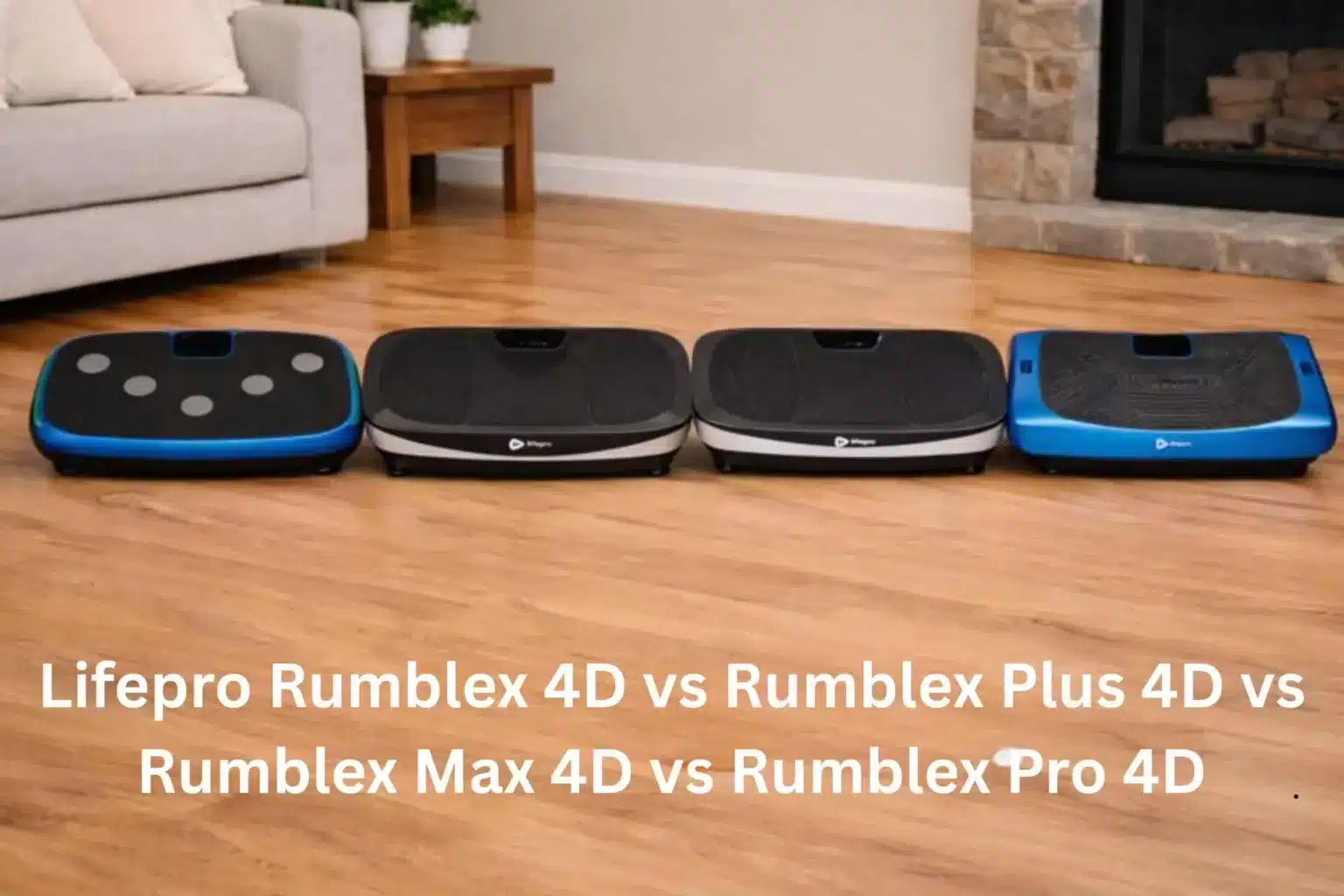
Lifepro Rumblex 4D vs Rumblex Plus 4D vs Rumblex Max 4D vs Rumblex Pro 4D 2026 Reviews
1. Lifepro Rumblex 4D Review
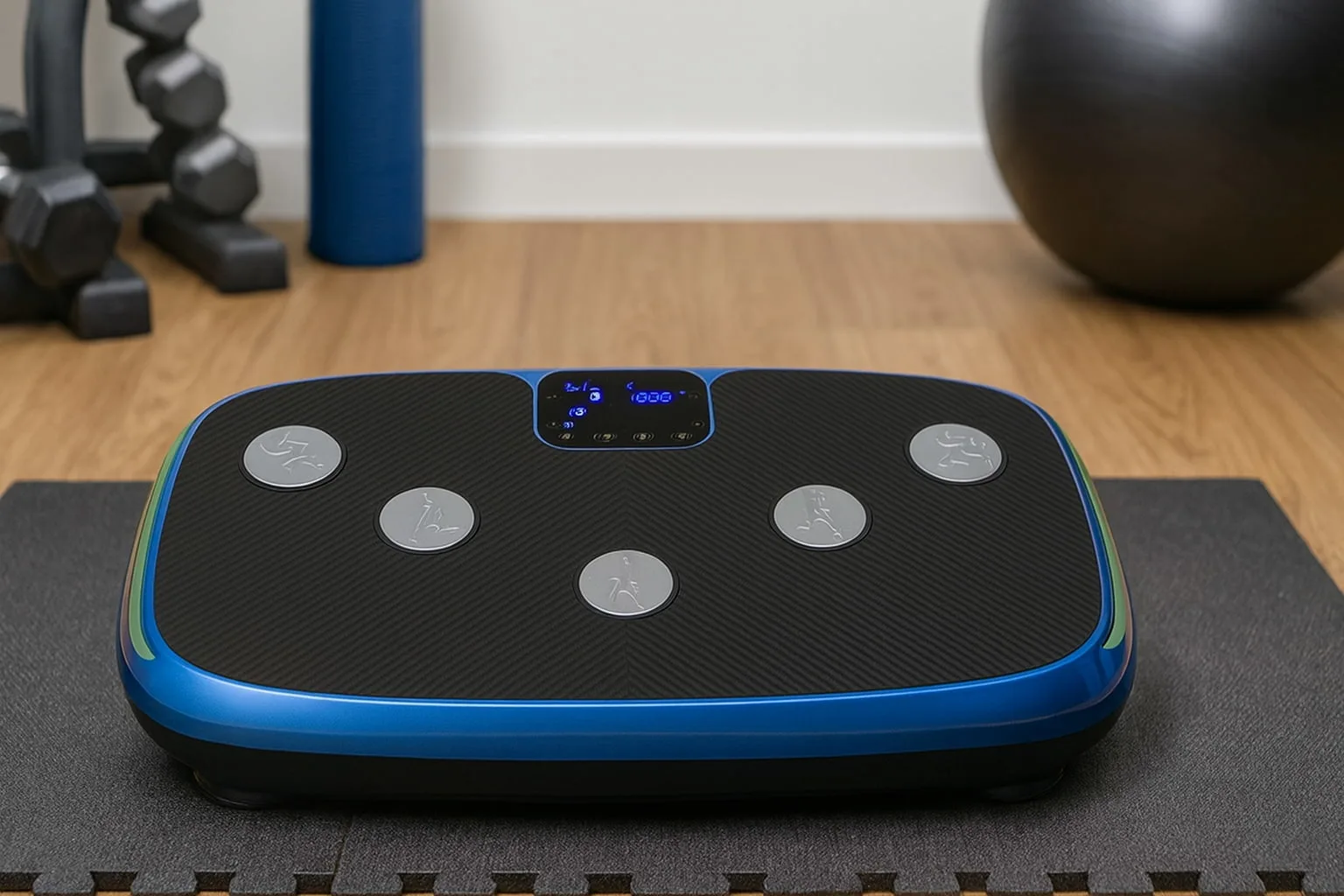
Design and Build Quality
The original Lifepro Rumblex 4D set the foundation for Lifepro’s 4D range. Its curved deck is its most distinctive feature, designed to promote reflexive stabilisation. When you stand on this platform, your feet naturally position themselves along the arch of the curve, which subtly engages the ankles and calves.
The deck measures roughly 31 by 18 inches which is wide enough for shoulder‑width stances but compact enough to fit under a sofa or bed. A rubberised surface prevents slipping, and two side handles make it easier to move the 42‑pound unit.
Underneath the deck, triple motors provide oscillation, lateral movement, and pulsation. You can select any combination using either the control panel or the included handheld remote. Sixty speed levels span the entire 4–40 Hz frequency range, so you can micro‑adjust intensity. I’ve found that the increments between levels are small enough to feel a smooth progression rather than abrupt jumps.
Performance and User Experience
My first sessions on the Rumblex 4D were part of my exploration into 4D technology. I began with single‑motor oscillation at a low speed to get used to the curved surface. The gentle seesaw motion warmed up my hips and knees without making me tense. As I progressed, I added pulsation and lateral motion, eventually using the full 4D mode. The combination of movements created a dynamic challenge: holding a squat at speed level 40 made my quads burn in half the time it would take on the floor. When doing planks with my hands on the plate, the vibrations traveled through my arms and into my core, forcing deep stabilising muscles to engage.
In this Lifepro Rumblex 4D vibration plate review, I also tested how the machine supports accessories. The unit includes loop bands and resistance bands that attach to anchor points on the front edge. While performing curls or lateral raises, the vibration forces your core to stabilise against the band tension. This not only works the targeted muscle group but also engages the ankles and knees to maintain balance.
The remote control is functional but could be improved; the small buttons can be hard to press during a workout. Nevertheless, being able to change speed without bending down is a convenience I now take for granted.
Pros and Cons
| Pros | Cons |
|---|---|
| Wide 4–40 Hz frequency range with sixty speeds allows fine adjustments | Curved surface may feel awkward for users with knee or ankle issues |
| Curved deck encourages stabilisation and balance training | |
| Provides 7 vibration modes and supports both manual and preset workouts | |
| Includes loop bands and resistance bands for upper-body training | |
| Often the most affordable 4D model; good value for beginners seeking versatility |
Pricing and Value
The Lifepro Rumblex 4D vibration plate price typically falls in the mid‑range of the 4D family compared to cheaper Lifepro plates like the Waver. Though I avoid quoting specific numbers due to frequent sales and deals, the Rumblex 4D is generally less expensive than the Plus, Pro, and Max models.
For the price, you get a full complement of vibration modes, a broad frequency range, and enough accessories to start varied workouts. If you plan to upgrade later, you won’t feel like you’re missing essential features on this unit; however, if you specifically require a flat deck or a larger surface, you might consider the Plus or Pro.
2. Lifepro Rumblex Plus 4D Review
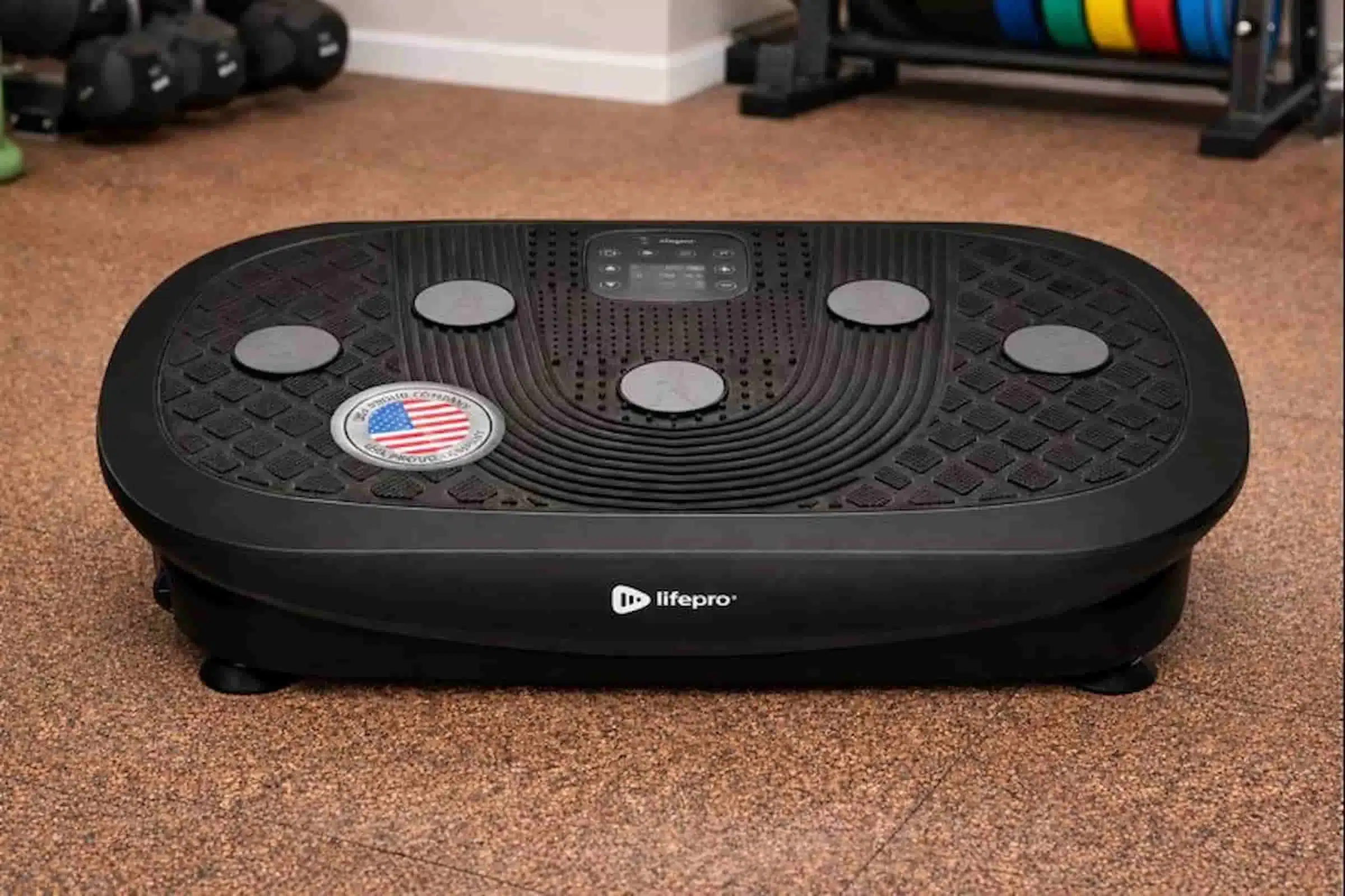
Flat Deck for Comfort
The Rumblex Plus 4D addresses one of the most common issue that some users may have with the original model: the curved surface. By moving to a flat deck, Lifepro creates a stable platform that feels more like standing on solid ground. I first tried the Plus when recovering from a knee injury; the even surface allowed me to maintain a neutral foot position without the extra ankle engagement required on the Rumblex 4D.
Measuring about 29 by 17.5 inches, the deck is slightly smaller yet still roomy enough for shoulder‑width stances and lunges. The machine’s height is roughly 5.7 inches, making it easier to step onto, especially if you have mobility concerns.
Motors, Modes and Controls
Under the deck, the triple motors are rated at 300 W + 40 W + 300 W, providing the same 4–40 Hz frequency range as the base model. Sixty speeds are divided into three intensity zones printed on the control panel: gentle (levels 1–20), moderate (21–40), and intense (41–60). This design helps you quickly select an appropriate setting. You can run the motors individually or combine them, creating the familiar seven vibration modes. The machine offers three preset programs plus manual mode, just like the Rumblex 4D.
The most noticeable improvement is the watch‑style remote. Instead of a handheld device, this remote straps onto your wrist like a smartwatch. During long planks or when lying on the floor, I appreciate being able to tap a button without reaching for a separate controller. The watch remote is easier to use than the original remote, though it requires CR2032 batteries.
Like the other models, the Plus includes loop bands, resistance bands and an exercise mat, giving you immediate ways to integrate upper‑body movements.
Comfort and User Feedback
In this Lifepro Rumblex Plus 4D vibration plate review, the flat deck stands out as the main reason to choose the Plus. My patients and clients who read Lifepro Rumblex Plus 4D vibration plate reviews often cite joint comfort as a deciding factor.
As for me personally, when I performed lunges and one‑leg balances, my ankles and knees felt aligned and secure. The moderate and intense zones provide enough challenge for strength and balance training, and the gentle zone is perfect for stretching or rehab. The machine weighs slightly less than the Rumblex 4D, making it easier to move, though it still feels stable during high‑intensity sessions.
Pros and Cons
| Pros | Cons |
|---|---|
| Flat platform reduces strain on ankles and knees and feels intuitive to stand on | Slightly smaller surface may feel cramped for users with broad stances |
| Wrist-watch remote enables hands-free control and speeds up adjustments | |
| Same broad frequency range and 60 speeds as the base model | |
| Includes a larger variety of accessories, such as an exercise mat |
Pricing Considerations
When comparing the Lifepro Rumblex Plus 4D vibration plate price with the base model, Rumblex 4D expect a small premium for the flat deck and watch remote. If joint comfort is crucial or if you find it difficult to bend to change settings, that extra cost may be justified.
Keep an eye on sales; sometimes the Plus is discounted enough that the price gap shrinks. If you’re sensitive to joint stress or plan to use the plate for rehab, I recommend the Plus over the original Rumblex 4D model.
3. Lifepro Rumblex Max 4D Review
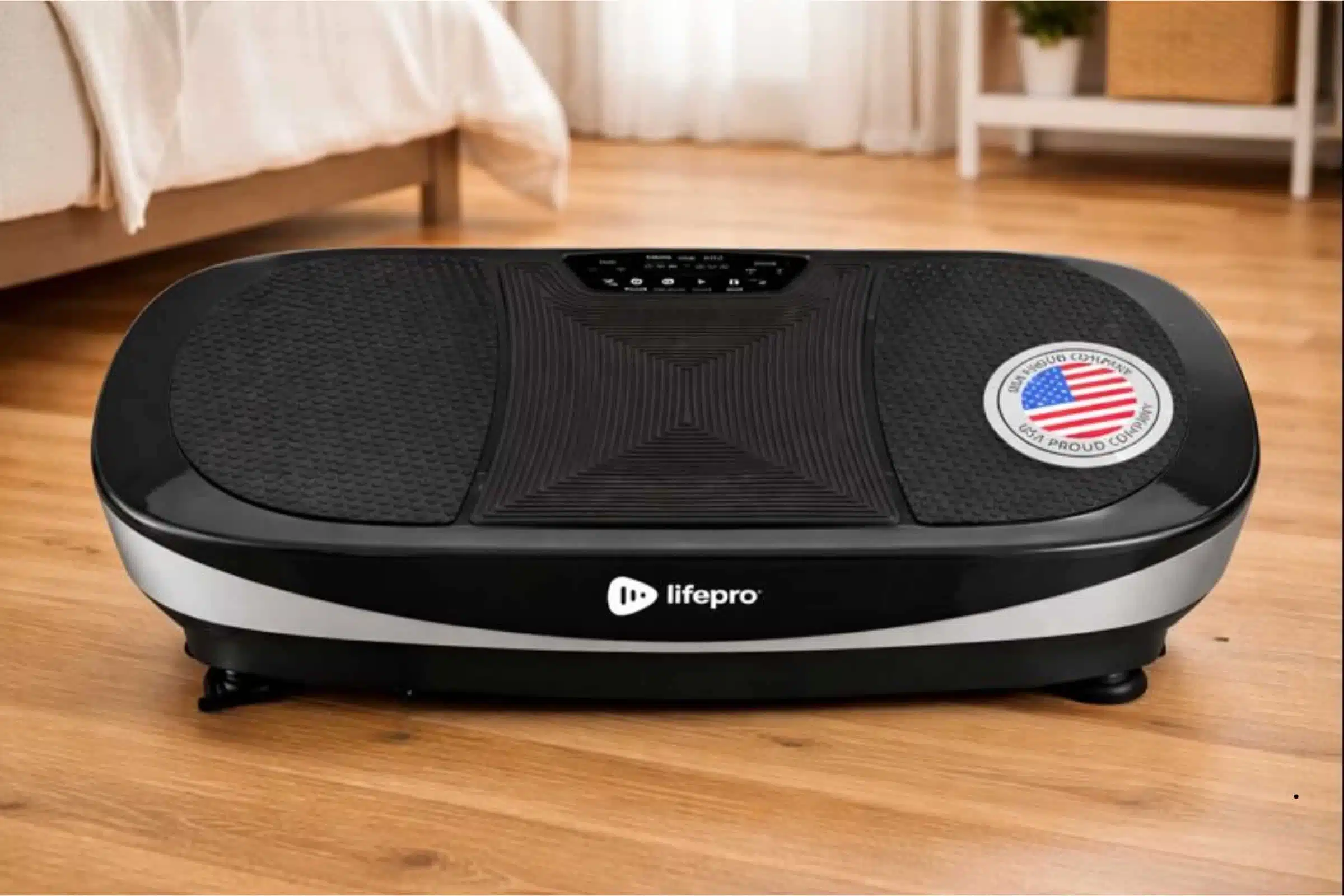
Designed for Heavy Users and Rehab
The Rumblex Max 4D was built with therapeutic and heavy‑duty use in mind. Its 500‑pound weight capacity exceeds that of the other models by far. This makes it suitable for larger users or for those who want to perform weighted exercises. The deck measures about 30.7 by 15.7 inches and is covered with a soft, cushioned surface.
Though narrower than the other units, the cushioned top reduces stress on the feet during long sessions. At 46 pounds, the Max is the heaviest model, yet it sits lower to the ground (only 5.5 inches tall), which makes stepping on and off safe and easy.
Unique Frequency Range and Programs
One of the most distinctive characteristics of the Max is its 6–14 Hz frequency range. This narrower range produces gentler vibrations; think of a soothing sway rather than a vigorous shake. In practice, low frequencies are ideal for rehabilitation, circulation and gentle muscle activation.
People with neurological or joint issues often find high frequencies uncomfortable; the Max caters to them by limiting the intensity. However, the machine compensates by offering 99 speed levels, allowing fine adjustments within that low‑frequency band. In addition to the usual seven vibration modes, the Max includes 16 preset programs that automatically vary the speed and motion to keep workouts engaging.
User Experience and Versatility
This vibration platform feels great during both rehab and strength sessions. At lower speeds, I used the Max as a recovery tool after long runs. The gentle oscillation helped loosen tight calves and improve circulation without overstimulating my joints.
When I shifted to higher speeds, the vibrations remained smooth but felt more like waves than jolts. The extra programs guided me through mixed rhythms, which prevented boredom during 20‑minute sessions.
The included accessories are similar to those of the base model: loop bands and resistance bands, plus a mat. The remote is handheld and uses AAA batteries. While the remote functions well, I would prefer a wrist option for convenience. Users who require a therapeutic device often care less about remote design and more about joint comfort and capacity; on those metrics, the Max really excels.
Pros and Cons
| Pros | Cons |
|---|---|
| Very high 500-pound weight capacity supports larger individuals and loaded exercises | A narrow frequency range may not satisfy users who want more intense vibrations |
| Narrow frequency band (6–14 Hz) creates gentle, therapeutic vibrations ideal for rehab | |
| Offers 99 speed levels and 16 preset programs for customised sessions | |
| Cushioned deck feels comfortable underfoot and sits low to the ground for easy access |
Pricing and Value
The Lifepro Rumblex Max 4d vibration plate price typically sits near the top of the Rumblex range because of its heavy‑duty construction and expanded programs. If you weigh over 330 pounds, plan to use weights on your plate, or need a therapeutic tool with gentle vibrations, the price is justified. For general fitness enthusiasts who desire high‑intensity vibration training, the Max may not offer enough range; in that case, the 4D or Pro models are better suited.
4. Lifepro Rumblex Pro 4D Review
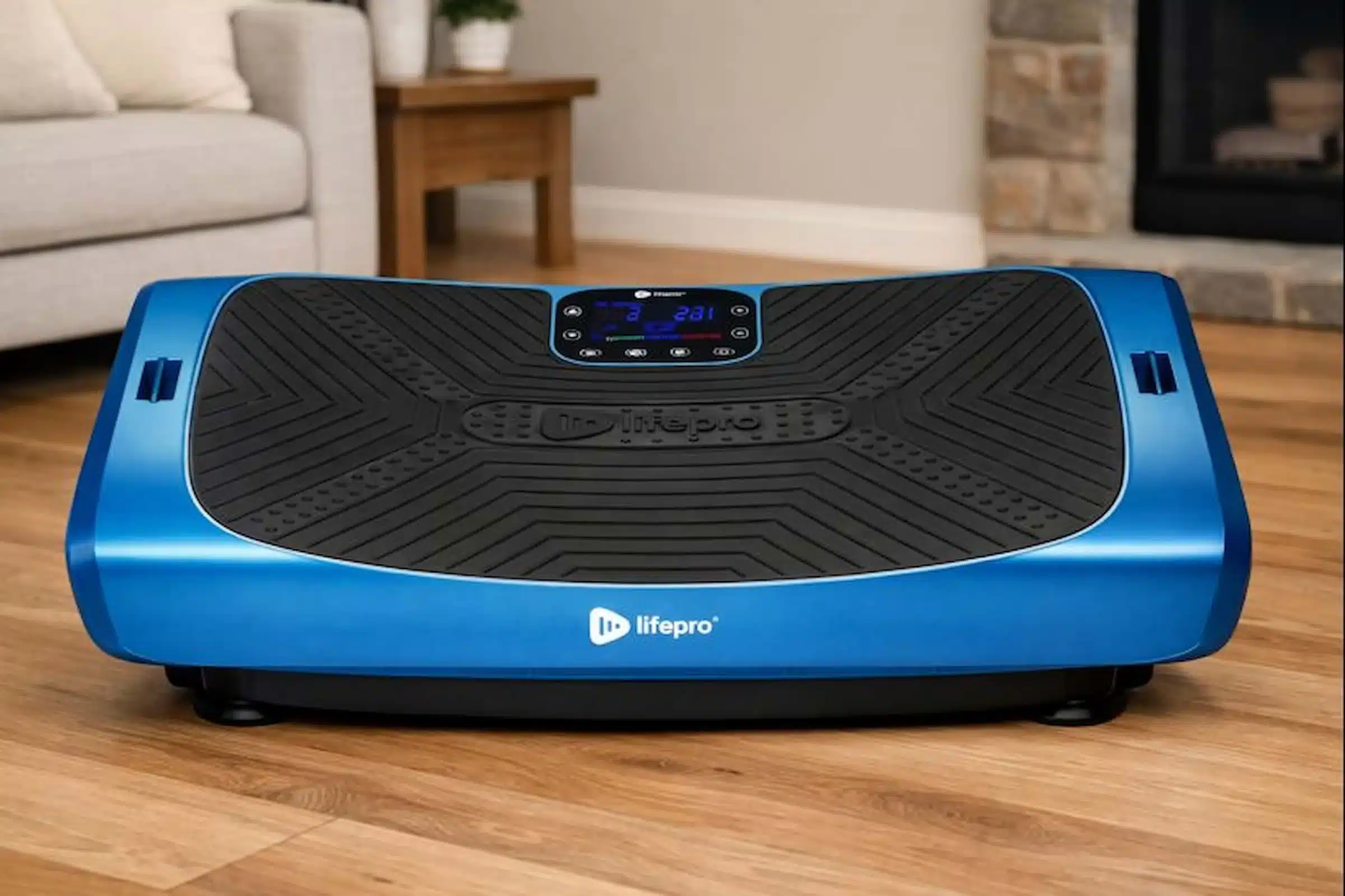
Large Platform and Deluxe Accessories
The Rumblex Pro 4D is Lifepro’s flagship model, designed to feel like a mini home gym. Its platform measures about 30.9 by 18.2 inches, which is nearly as large as the original 4D but completely flat. The surface has a non‑slip texture and four rubber feet for stability. At 7.5 inches tall, the Pro sits higher than the other models, which makes the vibrations travel more distinctly through the body. The machine weighs approximately 42 pounds and includes built‑in wheels and a handle to facilitate rolling it into storage.
What truly sets the Pro apart is the accessory kit. In addition to the standard loop bands and resistance bands, Lifepro packages D‑ring straps, ankle straps, hand straps and a heavy‑duty mat. These accessories allow you to perform rows, presses, lateral raises and leg lifts while standing, sitting or lying on the plate. The machine’s hands‑free remote can be strapped to your wrist or placed near you; it’s larger and more responsive than the remote on the base model.
Performance and Modes
Under the hood, the Pro uses the same triple motors and 4–40 Hz frequency range as the Rumblex 4D and Plus, offering 60 speed levels and seven vibration modes. It also features three preset programs plus manual mode. In my Lifepro Rumblex Pro 4D vibration plate review, I emphasised how the Pro feels more powerful than its siblings even though its frequency and amplitude are identical.
The broader, flatter surface distributes vibrations evenly across both feet, and the machine’s weight and height make the vibrations feel deeper. When I attached the D‑ring straps and performed rows, my back and core muscles worked in tandem to counteract the vibration. Performing step‑overs or lateral shuffles on the large surface also added a cardio component to my sessions.
Pros and Cons
| Pros | Cons |
|---|---|
| Large, flat deck offers plenty of space for dynamic exercises and footwork | Takes up more floor space and may not fit easily under furniture |
| Deluxe accessory kit turns the vibration plate into a versatile resistance-training station | |
| Built-in wheels and handle make moving the 42-pound unit easier | |
| Same broad frequency range and speed settings as the 4D and Plus |
Pricing and Justification
The Lifepro Rumblex Pro 4D vibration plate price reflects its premium construction and extensive accessory kit. If you value a large platform and plan to incorporate resistance training into your vibration sessions, the Pro offers unmatched versatility. It’s also a solid option for households with multiple users who require different exercises; the included accessories cater to varying fitness levels. However, if your primary goal is gentle vibration therapy or simple warm‑up routines, you may find a better value in the 4D or Plus.
Comparative Analysis: Which Lifepro Rumblex 4D Model Suits You?
Frequency and Intensity
The first major differentiator among the Rumblex models is the frequency range. The Rumblex 4D, Plus 4D and Pro 4D share a 4–40 Hz spectrum, giving them the ability to transition from mild to vigorous vibrations. This wide range allows them to serve multiple roles: gentle stretching on level 5, balance training on level 20, and intense squats or planks on level 45.
In contrast, the Rumblex Max 4D operates between 6–14 Hz, creating a softer, wave‑like motion that suits rehabilitation and recovery but may not satisfy users seeking high intensity.
If you plan to use vibration training to supplement strength workouts or desire stronger stimulation for muscle engagement, the 4D, Plus and Pro models will feel more challenging. If you need a gentle and controlled vibration for therapy or if you weigh more than 330 pounds, the Max is your best option.
Platform Design
Platform shape and size strongly affect comfort and exercise options. The Rumblex 4D is the only model with a curved deck, which actively promotes balance training by forcing your feet to adapt to the arch. This design can enhance proprioception but might feel unstable to users with knee or ankle problems.
The Rumblex Plus and Max have flat decks with slight cushioning; the Plus uses a textured rubber top while the Max features a padded surface for extra comfort. These flat designs make it easier to perform lunges, step‑overs and single‑leg stands without worrying about foot placement.
The Rumblex Pro combines the size of the base model with a flat platform, giving you a generous workout area for dynamic moves or using the included straps. Choose the deck shape that aligns with your mobility: curved for balance challenges, flat for stability and comfort.
Weight Capacity and User Profiles
Weight capacity correlates with who each machine is designed for.
The Rumblex 4D, Plus and Pro all support up to 330 pounds, which covers the majority of users.
The Rumblex Max 4D raises this limit to 500 pounds, making it the only model suitable for heavier individuals or for performing exercises with added weights such as kettlebells or dumbbells. If you’re near or above the 330‑pound threshold or plan to use the plate as a base for weighted squats, the Max is the safe choice. For others, the standard capacity of 330 pounds is sufficient.
Speed Levels and Programming
Another important aspect is how the machine structures its speed settings.
The Rumblex 4D, Plus 4D and Pro 4D provide 60 speed levels across the full frequency range. This number of levels offers fine control, letting you find a comfortable speed for each exercise without feeling sudden jumps.
The Rumblex Max 4D goes further with 99 speeds, though all within its narrower frequency band. This high granularity is useful for rehabilitation where small differences can significantly affect comfort. In terms of programming, the 4D, Plus and Pro models offer three preset programs plus manual mode, while the Max offers 16 presets.
If you enjoy a machine guiding you through varied sessions, the Max stands out; if you prefer to control speed and mode yourself, any of the other three will suffice.
Accessories and Extras
Accessories can make or break your experience because they determine how many different exercises you can do.
The Rumblex 4D includes basic resistance bands and loop bands, which are enough for adding light upper‑body movements.
The Rumblex Plus adds an exercise mat and a more convenient watch‑style remote. The Rumblex Max keeps accessories simple but focuses on weight capacity and comfort.
The Rumblex Pro goes all out with D‑ring straps, ankle straps, hand straps and multiple resistance bands, transforming the vibration plate into a complete functional training station.
Consider how you intend to use your machine: if you want to integrate rows, presses and leg lifts into your sessions, the Pro’s kit is a major advantage. If you plan to use free weights separately or need the plate solely for standing exercises, the simpler kits on the 4D and Plus may suffice.
Portability and Storage
All four models weigh between 40 and 46 pounds, so they’re manageable but not lightweight.
The Pro has built‑in wheels and a handle, making it easier to roll away after use.
The 4D has handles on each side for lifting, but no wheels.
The Plus is slightly lighter than the 4D and has a slimmer profile, which helps when sliding it under furniture.
The Max is heavier and has no wheels; because it sits low, you may need to tilt it to move it, which can be challenging. If you anticipate moving the plate frequently, prioritise models with wheels or lighter weight.
Price and Value
Price varies among the models, reflecting their features and target users.
The Rumblex 4D typically offers the best balance between cost and versatility, making it ideal for users wanting a comprehensive 4D experience without paying for extras they may not use.
The Rumblex Plus commands a slight premium for its flat deck and watch remote, appealing to those who prioritise joint comfort and ease of use.
The Rumblex Max sits near the top in pricing because of its high weight capacity and therapeutic focus.
Lastly, the Rumblex Pro is the most expensive due to its large platform and deluxe accessory kit.
Weigh your needs against your budget: paying extra for the Pro makes sense if you will use the accessories often; otherwise, the 4D or Plus may offer better value.
Remote Controls and Durability
Remote design affects how conveniently you can change settings.
The Rumblex 4D and Max 4D use handheld remotes, while the Rumblex Plus provides a watch‑style remote and the Rumblex Pro offers a larger, quick‑response remote that can be worn or placed nearby. R
egardless of remote type, all models share the same sturdy construction and are backed by Lifepro’s warranty. They run quietly and remain stable across many years of use.
Buying Considerations and Recommendations
Define Your Goals
Start by clarifying why you want a vibration plate.
If you’re seeking a general fitness tool to warm up, improve balance and add variety to body‑weight exercises, the Rumblex 4D or Rumblex Plus 4D may be sufficient. Their broad frequency range and 60 speeds allow them to adapt to different intensity levels, and they come with basic accessories. If your primary objective is rehabilitation, joint relief or gentle circulation improvement, especially if you weigh more than 330 pounds, the Rumblex Max 4D is designed for you. For added red light therapy with slightly lower weight capacity, read my Lifepro VibraRed review.
For those who envision using the plate as a base for resistance‑band training, the Rumblex Pro 4D is unmatched. Its large surface and deluxe kit create opportunities for upper‑body exercises and dynamic movements that smaller models can’t accommodate.
If you’re still uncertain which machine fits your needs at home, our best vibration plates guide explores most popular models that balance price and performance.
Assess Your Space
Measure the area where you plan to use the plate and consider storage. The Rumblex Plus and Max are lower in height, making them easier to slide under a bed or sofa. The Rumblex Pro is taller and wider, so you may need a dedicated space. If you live in a small apartment or plan to use the plate in an office, the space requirements may steer you away from the Pro. For a quick look at plates that fit tight spaces, visit our best vibration plates for home use page, which highlights machines with smaller footprints and joint‑friendly designs.
Consider Long‑Term Use and Budget
Finally, weigh the cost against long‑term value. Cheaper single‑motor vibration plates exist, but they lack the versatility of 4D machines. Investing a bit more upfront can save you the hassle of upgrading later if you outgrow the features of a basic unit. On the other hand, if you know you will only use the machine for gentle therapy or occasional stretching, you may not need the full range of features. For users focused on specific therapeutic outcomes, our best vibration plates for neuropathy article discusses machines designed for nerve stimulation and circulation.
Beyond hardware considerations, evaluate brand support and warranty. Lifepro backs the Rumblex line with a lifetime warranty and has built a reputation for quick, helpful customer service. Should a motor fail or a remote stop working, the company often sends replacements promptly, which reduces downtime in your training. You’ll also receive access to online training videos that walk you through setup, workout ideas and maintenance tips. When comparing prices, factor in this level of post‑purchase support—it adds intangible value that doesn’t appear on spec sheets.
Another cost‑related factor is the ongoing expense of accessories or batteries. The Rumblex 4D and Max use standard AAA batteries for their remotes; keep a few extras on hand to avoid interruptions. The Rumblex Plus uses CR2032 button cells for its watch remote, which last several months with average use. The Pro remote is rechargeable via USB, eliminating battery replacement altogether. These small operational details can influence your experience over years of use and should be considered alongside the upfront price.
Conclusion
The Lifepro Rumblex family demonstrates how variations within a single line can cater to different needs. From the original Rumblex 4D with its balance‑enhancing curved deck, to the flat, comfort‑oriented Rumblex Plus 4D, to the therapeutic heavyweight Rumblex Max 4D and the fully equipped Rumblex Pro 4D, there is a model for almost every situation. What unites them is Lifepro’s commitment to quality, versatility and user support. The brand’s lifetime warranty, comprehensive online resources and responsive customer service give you peace of mind that the investment will last.
When deciding which machine fits you best, start by evaluating your priorities. If you’re on a budget and want to experience 4D technology without extras, the Rumblex 4D offers the core features at the lowest price point. If you need a flat surface for joint comfort and appreciate the convenience of a wrist‑watch remote, the Rumblex Plus 4D is a sensible upgrade. Those seeking gentle therapy, high weight capacity or rehab functionality should gravitate toward the Rumblex Max 4D.
Finally, if you envision your vibration plate as a central piece of your home gym, one that supports strength, balance and cardio training with a variety of attachments, the Rumblex Pro 4D delivers unmatched versatility. Whatever you choose, remember that consistency is key: schedule regular sessions, explore different modes and integrate vibration training with other forms of exercise.
Notable Studies Into Vibration Plate Benefits (Health & Fitness)
Marín & Rhea (2010) – Effects of Vibration Training on Muscle Strength: A Meta-Analysis concluded that chronic vibration training produces muscle-strength gains comparable to traditional resistance workouts.
Games et al. (2015) – Whole-Body Vibration Training Increases Muscle Strength and Performance in Young Adults reported that WBV improved lower-body power, vertical jump height, and strength in physically active adults versus traditional warm-ups.
Alavinia & Omidvar et al. (2019) – The Effects of Whole Body Vibration Therapy on Reducing Fat Mass in the Adult General Population found modest but statistically significant decreases in total fat mass in short-term vibration programs.
Wong et al. (2012) – Whole-body vibration training reduces arterial stiffness, blood pressure and sympathovagal balance in young overweight/obese women showed that six weeks of vibration exercise lowered arterial stiffness and blood pressure, indicating cardiovascular benefits similar to aerobic workouts.
Nakagami et al. (2007) – Effect of Vibration on Skin Blood Flow in a Microcirculatory Model found that vibration rapidly increased blood flow by dilating microvessels, supporting enhanced circulation and lymphatic drainage.
Recap: Which LifePro Model Is Best for You (Based on Use, Not Specs)
Looking at specs alone won’t tell you which model to choose. The real difference between these LifePro plates comes down to how they feel in daily use and what type of routine you plan to follow.
If your main goal is recovery, circulation, or light daily use, simpler models like the Rumblex 4D or Plus are usually the better choice. They are easier to control, quicker to start, and don’t require much setup. This makes them more practical for short, consistent sessions. If you just want to step on the plate for 10 minutes a day, you don’t need the extra complexity.
The Max and Pro models are better suited for structured workouts and higher intensity use. These machines give you more control over vibration combinations and allow for more demanding exercises. If you plan to use the plate for squats, push-ups, or resistance training, the added stability and power become noticeable.
Another key difference is how the vibration modes are actually used. Many people assume more modes are always better, but in practice, most users stick to a few consistent settings. What matters more is how smoothly the machine transitions between levels and how easy it is to adjust during a session.
Platform design also affects real-world use. Some models have a more curved or textured surface, which changes foot positioning and grip. This can make a difference during longer sessions or when performing exercises that require balance. A stable, predictable surface is usually more important than design variations.
Accessories can influence your decision more than expected. The Pro model, for example, includes a more complete setup for full-body training with resistance bands. If you plan to use those regularly, it adds real value. If not, those extras often go unused.
Noise and vibration feel are also worth considering. More advanced models tend to have smoother motor output, especially at higher levels. This makes sessions more comfortable and less disruptive in a home setting.
The best way to choose is to match the model to your routine. If you want something simple and consistent, go with a more straightforward option. If you plan to train on it like a workout platform, the higher-end models make more sense.
Choosing based on use will always give better results than choosing based on specs alone.
FAQs
What is the difference between Lifepro Rumblex 4D and Rumblex Plus 4D?
The Rumblex 4D features a curved deck that promotes balance training, while the Rumblex Plus 4D has a flat deck that feels more stable for users with sensitive joints. Both offer the same 4–40 Hz frequency range, 60 speeds, 7 vibration modes and three preset programs. The Plus includes a watch‑style remote and a more extensive accessory kit, whereas the 4D uses a handheld remote and basic bands. Because of these upgrades, the Plus costs slightly more.
Which Lifepro Rumblex model is best for rehabilitation?
The Rumblex Max 4D is best suited for rehabilitation. Its 6–14 Hz frequency range produces gentle, therapeutic vibrations that are easier on joints and tissues. The cushioned deck, low profile and 500‑pound weight capacity make it safe for individuals with limited mobility or higher body weight. The 16 preset programs also provide structured sessions that can aid recovery.
Is the Rumblex Pro 4D worth the investment?
If you intend to combine vibration training with a variety of resistance exercises, the Rumblex Pro 4D offers the best value. Its large platform accommodates dynamic moves, and the deluxe accessory kit enables rows, presses, squats, leg lifts and more. However, if you only need vibration for light exercise or therapy, the lower‑priced models may suffice. Consider your long‑term workout plans before investing in the Pro.
Can Rumblex 4D vibration plates aid in weight loss?
Rumblex 4D vibration plates can support weight loss as part of a comprehensive fitness program. Standing or exercising on a vibrating surface increases muscle engagement and calorie expenditure compared to the same movements on the floor. However, they are not a standalone solution. For significant weight loss results, pair vibration training with a balanced diet and other forms of exercise.
Are Lifepro Rumblex machines safe for seniors?
Yes, Lifepro Rumblex machines are safe for seniors when used appropriately. Seniors should start at low speeds and gradually increase intensity as they become comfortable. The Rumblex Plus and Max, with their flat decks and gentler vibrations, are often preferred by older adults. As with any exercise equipment, it’s wise to consult a healthcare provider before starting a new regimen, especially if you have underlying health conditions.
Healthcare and Medical Disclaimer
The information provided on Vibration Plate Zone is for general informational purposes only and is not intended to replace professional medical advice, diagnosis, or treatment. Always seek the guidance of a qualified healthcare provider with any questions you may have regarding a medical condition, and never disregard or delay seeking professional advice.